 Add to Chrome
 Add to Firefox
 Add to Edge
Fantastic Copyrighted Beasts and How (Not) to Generate Them
Jun 20, 2024
Recent studies show that image and video generation models can be prompted to reproduce copyrighted content from their training data, raising serious legal concerns around copyright infringement. Copyrighted characters, in particular, pose a difficult challenge for image generation services, with at least one lawsuit already awarding damages based on the generation of these characters. Yet, little research has empirically examined this issue. We conduct a systematic evaluation to fill this gap. First, we build CopyCat, an evaluation suite consisting of diverse copyrighted characters and a novel evaluation pipeline. Our evaluation considers both the detection of similarity to copyrighted characters and generated image's consistency with user input. Our evaluation systematically shows that both image and video generation models can still generate characters even if characters' names are not explicitly mentioned in the prompt, sometimes with only two generic keywords (e.g., prompting with "videogame, plumber" consistently generates Nintendo's Mario character). We then introduce techniques to semi-automatically identify such keywords or descriptions that trigger character generation. Using our evaluation suite, we study runtime mitigation strategies, including both existing methods and new strategies we propose. Our findings reveal that commonly employed strategies, such as prompt rewriting in the DALL-E system, are not sufficient as standalone guardrails. These strategies must be coupled with other approaches, like negative prompting, to effectively reduce the unintended generation of copyrighted characters. Our work provides empirical grounding to the discussion of copyright mitigation strategies and offers actionable insights for model deployers actively implementing them.

DataComp-LM: In search of the next generation of training sets for language models
Jun 18, 2024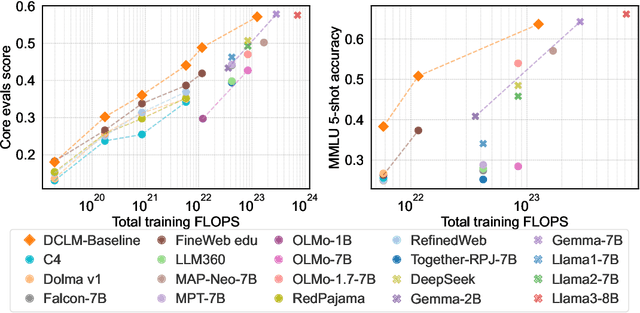

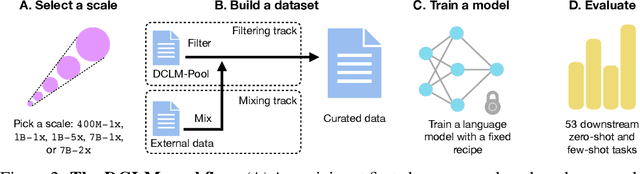
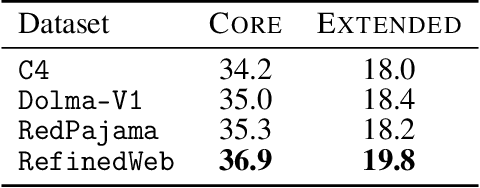
We introduce DataComp for Language Models (DCLM), a testbed for controlled dataset experiments with the goal of improving language models. As part of DCLM, we provide a standardized corpus of 240T tokens extracted from Common Crawl, effective pretraining recipes based on the OpenLM framework, and a broad suite of 53 downstream evaluations. Participants in the DCLM benchmark can experiment with data curation strategies such as deduplication, filtering, and data mixing at model scales ranging from 412M to 7B parameters. As a baseline for DCLM, we conduct extensive experiments and find that model-based filtering is key to assembling a high-quality training set. The resulting dataset, DCLM-Baseline enables training a 7B parameter language model from scratch to 64% 5-shot accuracy on MMLU with 2.6T training tokens. Compared to MAP-Neo, the previous state-of-the-art in open-data language models, DCLM-Baseline represents a 6.6 percentage point improvement on MMLU while being trained with 40% less compute. Our baseline model is also comparable to Mistral-7B-v0.3 and Llama 3 8B on MMLU (63% & 66%), and performs similarly on an average of 53 natural language understanding tasks while being trained with 6.6x less compute than Llama 3 8B. Our results highlight the importance of dataset design for training language models and offer a starting point for further research on data curation.
Visual Sketchpad: Sketching as a Visual Chain of Thought for Multimodal Language Models
Jun 13, 2024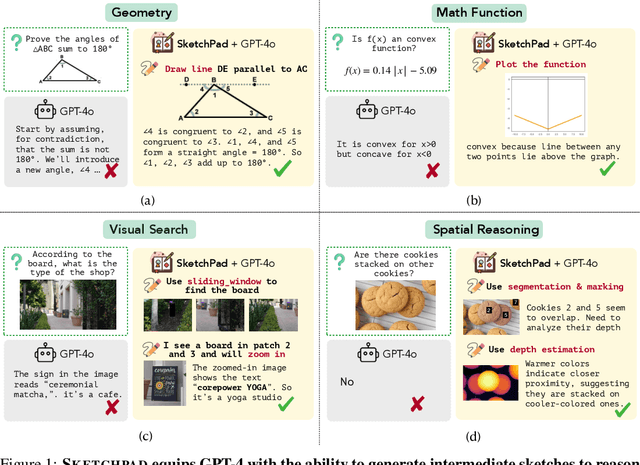
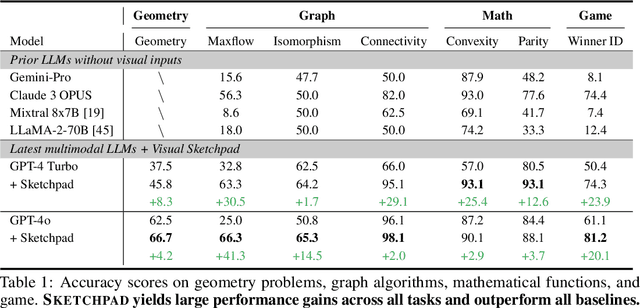

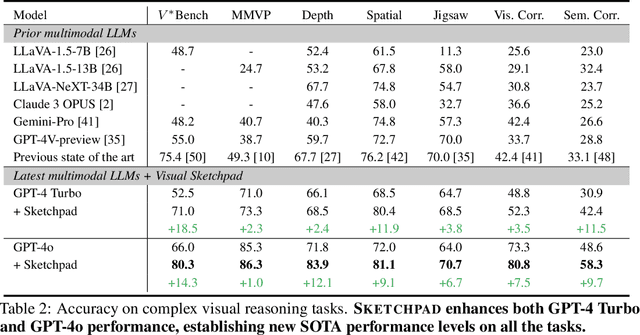
Humans draw to facilitate reasoning: we draw auxiliary lines when solving geometry problems; we mark and circle when reasoning on maps; we use sketches to amplify our ideas and relieve our limited-capacity working memory. However, such actions are missing in current multimodal language models (LMs). Current chain-of-thought and tool-use paradigms only use text as intermediate reasoning steps. In this work, we introduce Sketchpad, a framework that gives multimodal LMs a visual sketchpad and tools to draw on the sketchpad. The LM conducts planning and reasoning according to the visual artifacts it has drawn. Different from prior work, which uses text-to-image models to enable LMs to draw, Sketchpad enables LMs to draw with lines, boxes, marks, etc., which is closer to human sketching and better facilitates reasoning. Sketchpad can also use specialist vision models during the sketching process (e.g., draw bounding boxes with object detection models, draw masks with segmentation models), to further enhance visual perception and reasoning. We experiment with a wide range of math tasks (including geometry, functions, graphs, and chess) and complex visual reasoning tasks. Sketchpad substantially improves performance on all tasks over strong base models with no sketching, yielding an average gain of 12.7% on math tasks, and 8.6% on vision tasks. GPT-4o with Sketchpad sets a new state of the art on all tasks, including V*Bench (80.3%), BLINK spatial reasoning (83.9%), and visual correspondence (80.8%). All codes and data are in https://visualsketchpad.github.io/.
Computational Tradeoffs in Image Synthesis: Diffusion, Masked-Token, and Next-Token Prediction
May 21, 2024Nearly every recent image synthesis approach, including diffusion, masked-token prediction, and next-token prediction, uses a Transformer network architecture. Despite this common backbone, there has been no direct, compute controlled comparison of how these approaches affect performance and efficiency. We analyze the scalability of each approach through the lens of compute budget measured in FLOPs. We find that token prediction methods, led by next-token prediction, significantly outperform diffusion on prompt following. On image quality, while next-token prediction initially performs better, scaling trends suggest it is eventually matched by diffusion. We compare the inference compute efficiency of each approach and find that next token prediction is by far the most efficient. Based on our findings we recommend diffusion for applications targeting image quality and low latency; and next-token prediction when prompt following or throughput is more important.
MoDE: CLIP Data Experts via Clustering
Apr 24, 2024


The success of contrastive language-image pretraining (CLIP) relies on the supervision from the pairing between images and captions, which tends to be noisy in web-crawled data. We present Mixture of Data Experts (MoDE) and learn a system of CLIP data experts via clustering. Each data expert is trained on one data cluster, being less sensitive to false negative noises in other clusters. At inference time, we ensemble their outputs by applying weights determined through the correlation between task metadata and cluster conditions. To estimate the correlation precisely, the samples in one cluster should be semantically similar, but the number of data experts should still be reasonable for training and inference. As such, we consider the ontology in human language and propose to use fine-grained cluster centers to represent each data expert at a coarse-grained level. Experimental studies show that four CLIP data experts on ViT-B/16 outperform the ViT-L/14 by OpenAI CLIP and OpenCLIP on zero-shot image classification but with less ($<$35\%) training cost. Meanwhile, MoDE can train all data expert asynchronously and can flexibly include new data experts. The code is available at https://github.com/facebookresearch/MetaCLIP/tree/main/mode.
Megalodon: Efficient LLM Pretraining and Inference with Unlimited Context Length
Apr 12, 2024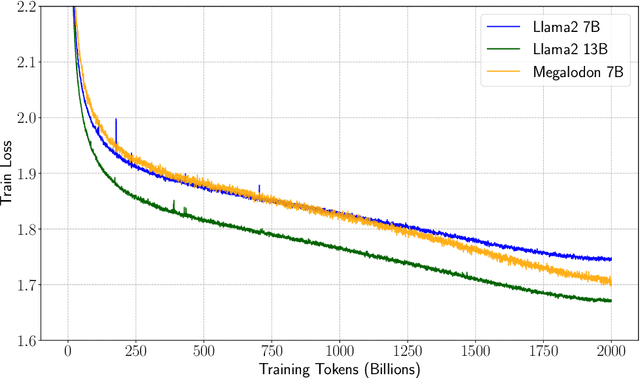
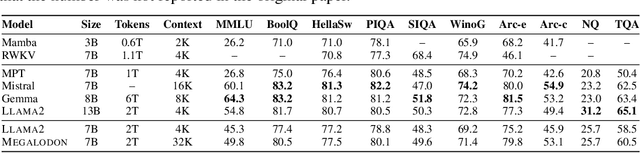
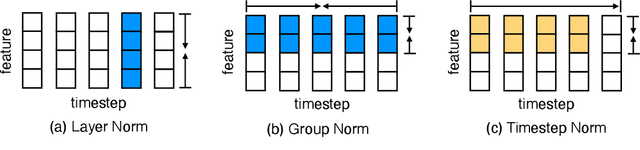
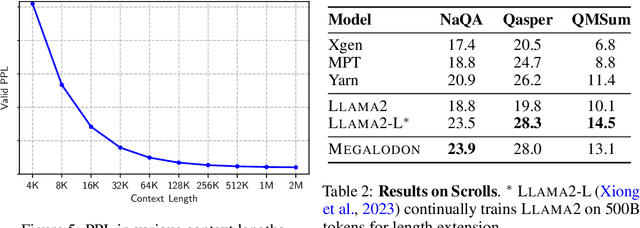
The quadratic complexity and weak length extrapolation of Transformers limits their ability to scale to long sequences, and while sub-quadratic solutions like linear attention and state space models exist, they empirically underperform Transformers in pretraining efficiency and downstream task accuracy. We introduce Megalodon, a neural architecture for efficient sequence modeling with unlimited context length. Megalodon inherits the architecture of Mega (exponential moving average with gated attention), and further introduces multiple technical components to improve its capability and stability, including complex exponential moving average (CEMA), timestep normalization layer, normalized attention mechanism and pre-norm with two-hop residual configuration. In a controlled head-to-head comparison with Llama2, Megalodon achieves better efficiency than Transformer in the scale of 7 billion parameters and 2 trillion training tokens. Megalodon reaches a training loss of 1.70, landing mid-way between Llama2-7B (1.75) and 13B (1.67). Code: https://github.com/XuezheMax/megalodon
MYTE: Morphology-Driven Byte Encoding for Better and Fairer Multilingual Language Modeling
Mar 15, 2024A major consideration in multilingual language modeling is how to best represent languages with diverse vocabularies and scripts. Although contemporary text encoding methods cover most of the world's writing systems, they exhibit bias towards the high-resource languages of the Global West. As a result, texts of underrepresented languages tend to be segmented into long sequences of linguistically meaningless units. To address the disparities, we introduce a new paradigm that encodes the same information with segments of consistent size across diverse languages. Our encoding convention (MYTE) is based on morphemes, as their inventories are more balanced across languages than characters, which are used in previous methods. We show that MYTE produces shorter encodings for all 99 analyzed languages, with the most notable improvements for non-European languages and non-Latin scripts. This, in turn, improves multilingual LM performance and diminishes the perplexity gap throughout diverse languages.
Reliable, Adaptable, and Attributable Language Models with Retrieval
Mar 05, 2024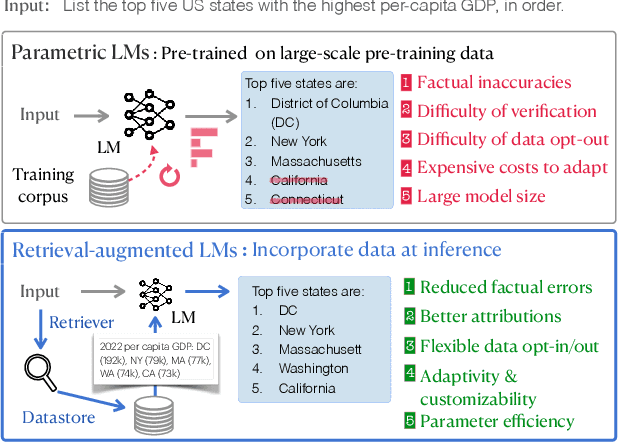
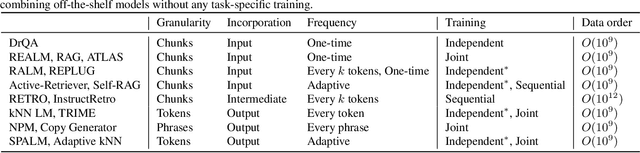
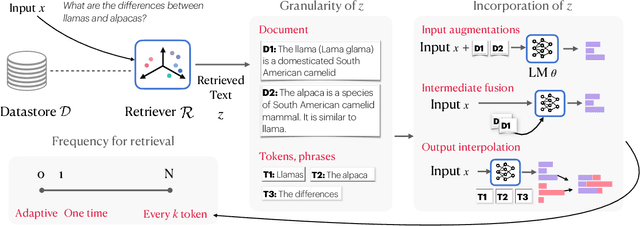
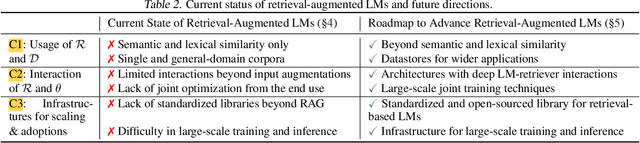
Parametric language models (LMs), which are trained on vast amounts of web data, exhibit remarkable flexibility and capability. However, they still face practical challenges such as hallucinations, difficulty in adapting to new data distributions, and a lack of verifiability. In this position paper, we advocate for retrieval-augmented LMs to replace parametric LMs as the next generation of LMs. By incorporating large-scale datastores during inference, retrieval-augmented LMs can be more reliable, adaptable, and attributable. Despite their potential, retrieval-augmented LMs have yet to be widely adopted due to several obstacles: specifically, current retrieval-augmented LMs struggle to leverage helpful text beyond knowledge-intensive tasks such as question answering, have limited interaction between retrieval and LM components, and lack the infrastructure for scaling. To address these, we propose a roadmap for developing general-purpose retrieval-augmented LMs. This involves a reconsideration of datastores and retrievers, the exploration of pipelines with improved retriever-LM interaction, and significant investment in infrastructure for efficient training and inference.
Comparing Hallucination Detection Metrics for Multilingual Generation
Feb 16, 2024While many automatic hallucination detection techniques have been proposed for English texts, their effectiveness in multilingual contexts remains unexplored. This paper aims to bridge the gap in understanding how these hallucination detection metrics perform on non-English languages. We evaluate the efficacy of various detection metrics, including lexical metrics like ROUGE and Named Entity Overlap and Natural Language Inference (NLI)-based metrics, at detecting hallucinations in biographical summaries in many languages; we also evaluate how correlated these different metrics are to gauge whether they measure the same phenomena. Our empirical analysis reveals that while lexical metrics show limited effectiveness, NLI-based metrics perform well in high-resource languages at the sentence level. In contrast, NLI-based metrics often fail to detect atomic fact hallucinations. Our findings highlight existing gaps in multilingual hallucination detection and motivate future research to develop more robust detection methods for LLM hallucination in other languages.
Do Membership Inference Attacks Work on Large Language Models?
Feb 12, 2024Membership inference attacks (MIAs) attempt to predict whether a particular datapoint is a member of a target model's training data. Despite extensive research on traditional machine learning models, there has been limited work studying MIA on the pre-training data of large language models (LLMs). We perform a large-scale evaluation of MIAs over a suite of language models (LMs) trained on the Pile, ranging from 160M to 12B parameters. We find that MIAs barely outperform random guessing for most settings across varying LLM sizes and domains. Our further analyses reveal that this poor performance can be attributed to (1) the combination of a large dataset and few training iterations, and (2) an inherently fuzzy boundary between members and non-members. We identify specific settings where LLMs have been shown to be vulnerable to membership inference and show that the apparent success in such settings can be attributed to a distribution shift, such as when members and non-members are drawn from the seemingly identical domain but with different temporal ranges. We release our code and data as a unified benchmark package that includes all existing MIAs, supporting future work.