 Add to Chrome
 Add to Firefox
 Add to Edge
Which Models Are Our Models Built On? Auditing Invisible Dependencies in Modern LLMs
Jun 10, 2026
Modern LLM training pipelines increasingly rely on other models to generate data, filter corpora, judge outputs, and guide development decisions. These dependencies are recursive: a model may depend on an upstream artifact whose own dependencies are documented only in separate releases and artifacts. As a result, the full dependency structure is fragmented across heterogeneous public artifacts, with complexity and recursive depth far outpacing humans' ability to trace. We introduce ModSleuth, an agentic system that recursively reconstructs LLM dependency graphs from public artifacts with source-grounded evidence. We find that the primary challenge is no longer information extraction, but defining what constitutes a dependency and reconciling artifact references across inconsistent documentation. We address these challenges through a formalization that distinguishes direct and indirect dependencies, represents heterogeneous pipeline roles through operation-centered relationships, and resolves artifact identities across names, versions, and repositories. Applying ModSleuth to four public-artifact-rich LLM releases, we recover 1,060 source-verified dependencies and construct large-scale dependency graphs of modern LLM development. These graphs reveal multi-hop license obligations, train-evaluation coupling, discrepancies between released and training-time artifacts, and documentation inconsistencies that would otherwise be difficult to uncover. We release ModSleuth and the resulting dependency graphs to support transparent analysis of the increasingly complex ecosystems underlying modern LLMs.

EMO: Pretraining Mixture of Experts for Emergent Modularity
May 07, 2026Large language models are typically deployed as monolithic systems, requiring the full model even when applications need only a narrow subset of capabilities, e.g., code, math, or domain-specific knowledge. Mixture-of-Experts (MoEs) seemingly offer a potential alternative by activating only a subset of experts per input, but in practice, restricting inference to a subset of experts for a given domain leads to severe performance degradation. This limits their practicality in memory-constrained settings, especially as models grow larger and sparser. We introduce EMO, an MoE designed for modularity-the independent use and composition of expert subsets-without requiring human-defined priors. Our key idea is to encourage tokens from similar domains to rely on similar experts. Since tokens within a document often share a domain, EMO restricts them to select experts from a shared pool, while allowing different documents to use different pools. This simple constraint enables coherent expert groupings to emerge during pretraining using document boundaries alone. We pretrain a 1B-active, 14B-total EMO on 1T tokens. As a full model, it matches standard MoE performance. Crucially, it enables selective expert use: retaining only 25% (12.5%) of experts incurs just a 1% (3%) absolute drop, whereas standard MoEs break under the same setting. We further find that expert subsets in EMO specialize at semantic levels (e.g., domains such as math or code), in contrast to the low-level syntactic specialization observed in standard MoEs. Altogether, our results demonstrate a path toward modular, memory-efficient deployment of large, sparse models and open new opportunities for composable architectures.
RAG over Thinking Traces Can Improve Reasoning Tasks
May 05, 2026Retrieval-augmented generation (RAG) has proven effective for knowledge-intensive tasks, but is widely believed to offer limited benefit for reasoning-intensive problems such as math and code generation. We challenge this assumption by showing that the limitation lies not in RAG itself, but in the choice of corpus. Instead of retrieving documents, we propose retrieving thinking traces, i.e., intermediate thinking trajectories generated during problem solving attempts. We show that thinking traces are already a strong retrieval source, and further introduce T3, an offline method that transforms them into structured, retrieval-friendly representations, to improve usability. Using these traces as a corpus, a simple retrieve-then-generate pipeline consistently improves reasoning performance across strong models and benchmarks such as AIME 2025--2026, LiveCodeBench, and GPQA-Diamond, outperforming both non-RAG baselines and retrieval over standard web corpora. For instance, on AIME, RAG with traces generated by Gemini-2-thinking achieves relative gains of +56.3%, +8.6%, and +7.6% for Gemini-2.5-Flash, GPT-OSS-120B, and GPT-5, respectively, even though these are more recent models. Interestingly, RAG on T3 also incurs little or no extra inference cost, and can even reduce inference cost by up to $15%$. Overall, our results suggest that thinking traces are an effective retrieval corpus for reasoning tasks, and transforming them into structured, compact, or diagnostic representations unlocks even stronger gains. Code available at https://github.com/Narabzad/t3.
Train Separately, Merge Together: Modular Post-Training with Mixture-of-Experts
Apr 20, 2026Extending a fully post-trained language model with new domain capabilities is fundamentally limited by monolithic training paradigms: retraining from scratch is expensive and scales poorly, while continued training often degrades existing capabilities. We present BAR (Branch-Adapt-Route), which trains independent domain experts, each through its own mid-training, supervised finetuning, and reinforcement learning pipeline, and composes them via a Mixture-of-Experts architecture with lightweight router training. Unlike retraining approaches that mix all domains and require full reprocessing for any update (with cost scaling quadratically), BAR enables updating individual experts independently with linear cost scaling and no degradation to existing domains. At the 7B scale, with experts for math, code, tool use, and safety, BAR achieves an overall score of 49.1 (averaged across 7 evaluation categories), matching or exceeding re-training baselines (47.8 without mid-training, 50.5 with). We further show that modular training provides a structural advantage: by isolating each domain, it avoids the catastrophic forgetting that occurs when late-stage RL degrades capabilities from earlier training stages, while significantly reducing the cost and complexity of updating or adding a domain. Together, these results suggest that decoupled, expert-based training is a scalable alternative to monolithic retraining for extending language models.
Learning to Detect Language Model Training Data via Active Reconstruction
Feb 22, 2026Detecting LLM training data is generally framed as a membership inference attack (MIA) problem. However, conventional MIAs operate passively on fixed model weights, using log-likelihoods or text generations. In this work, we introduce \textbf{Active Data Reconstruction Attack} (ADRA), a family of MIA that actively induces a model to reconstruct a given text through training. We hypothesize that training data are \textit{more reconstructible} than non-members, and the difference in their reconstructibility can be exploited for membership inference. Motivated by findings that reinforcement learning (RL) sharpens behaviors already encoded in weights, we leverage on-policy RL to actively elicit data reconstruction by finetuning a policy initialized from the target model. To effectively use RL for MIA, we design reconstruction metrics and contrastive rewards. The resulting algorithms, \textsc{ADRA} and its adaptive variant \textsc{ADRA+}, improve both reconstruction and detection given a pool of candidate data. Experiments show that our methods consistently outperform existing MIAs in detecting pre-training, post-training, and distillation data, with an average improvement of 10.7\% over the previous runner-up. In particular, \MethodPlus~improves over Min-K\%++ by 18.8\% on BookMIA for pre-training detection and by 7.6\% on AIME for post-training detection.
Residual Context Diffusion Language Models
Jan 30, 2026Diffusion Large Language Models (dLLMs) have emerged as a promising alternative to purely autoregressive language models because they can decode multiple tokens in parallel. However, state-of-the-art block-wise dLLMs rely on a "remasking" mechanism that decodes only the most confident tokens and discards the rest, effectively wasting computation. We demonstrate that recycling computation from the discarded tokens is beneficial, as these tokens retain contextual information useful for subsequent decoding iterations. In light of this, we propose Residual Context Diffusion (RCD), a module that converts these discarded token representations into contextual residuals and injects them back for the next denoising step. RCD uses a decoupled two-stage training pipeline to bypass the memory bottlenecks associated with backpropagation. We validate our method on both long CoT reasoning (SDAR) and short CoT instruction following (LLaDA) models. We demonstrate that a standard dLLM can be efficiently converted to the RCD paradigm with merely ~1 billion tokens. RCD consistently improves frontier dLLMs by 5-10 points in accuracy with minimal extra computation overhead across a wide range of benchmarks. Notably, on the most challenging AIME tasks, RCD nearly doubles baseline accuracy and attains up to 4-5x fewer denoising steps at equivalent accuracy levels.
VisGym: Diverse, Customizable, Scalable Environments for Multimodal Agents
Jan 23, 2026Modern Vision-Language Models (VLMs) remain poorly characterized in multi-step visual interactions, particularly in how they integrate perception, memory, and action over long horizons. We introduce VisGym, a gymnasium of 17 environments for evaluating and training VLMs. The suite spans symbolic puzzles, real-image understanding, navigation, and manipulation, and provides flexible controls over difficulty, input representation, planning horizon, and feedback. We also provide multi-step solvers that generate structured demonstrations, enabling supervised finetuning. Our evaluations show that all frontier models struggle in interactive settings, achieving low success rates in both the easy (46.6%) and hard (26.0%) configurations. Our experiments reveal notable limitations: models struggle to effectively leverage long context, performing worse with an unbounded history than with truncated windows. Furthermore, we find that several text-based symbolic tasks become substantially harder once rendered visually. However, explicit goal observations, textual feedback, and exploratory demonstrations in partially observable or unknown-dynamics settings for supervised finetuning yield consistent gains, highlighting concrete failure modes and pathways for improving multi-step visual decision-making. Code, data, and models can be found at: https://visgym.github.io/.
FrontierCS: Evolving Challenges for Evolving Intelligence
Dec 17, 2025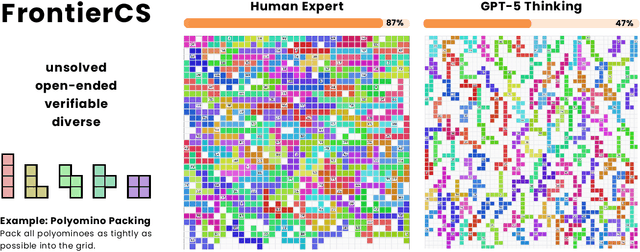

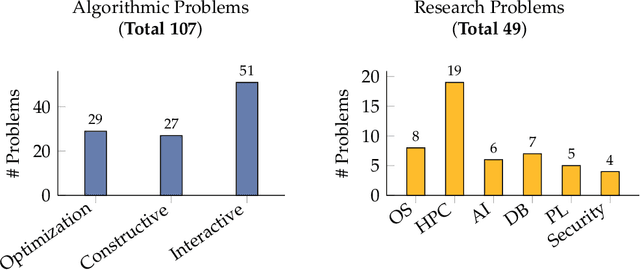

We introduce FrontierCS, a benchmark of 156 open-ended problems across diverse areas of computer science, designed and reviewed by experts, including CS PhDs and top-tier competitive programming participants and problem setters. Unlike existing benchmarks that focus on tasks with known optimal solutions, FrontierCS targets problems where the optimal solution is unknown, but the quality of a solution can be objectively evaluated. Models solve these tasks by implementing executable programs rather than outputting a direct answer. FrontierCS includes algorithmic problems, which are often NP-hard variants of competitive programming problems with objective partial scoring, and research problems with the same property. For each problem we provide an expert reference solution and an automatic evaluator. Combining open-ended design, measurable progress, and expert curation, FrontierCS provides a benchmark at the frontier of computer-science difficulty. Empirically, we find that frontier reasoning models still lag far behind human experts on both the algorithmic and research tracks, that increasing reasoning budgets alone does not close this gap, and that models often over-optimize for generating merely workable code instead of discovering high-quality algorithms and system designs.
What's In My Human Feedback? Learning Interpretable Descriptions of Preference Data
Oct 30, 2025Human feedback can alter language models in unpredictable and undesirable ways, as practitioners lack a clear understanding of what feedback data encodes. While prior work studies preferences over certain attributes (e.g., length or sycophancy), automatically extracting relevant features without pre-specifying hypotheses remains challenging. We introduce What's In My Human Feedback? (WIMHF), a method to explain feedback data using sparse autoencoders. WIMHF characterizes both (1) the preferences a dataset is capable of measuring and (2) the preferences that the annotators actually express. Across 7 datasets, WIMHF identifies a small number of human-interpretable features that account for the majority of the preference prediction signal achieved by black-box models. These features reveal a wide diversity in what humans prefer, and the role of dataset-level context: for example, users on Reddit prefer informality and jokes, while annotators in HH-RLHF and PRISM disprefer them. WIMHF also surfaces potentially unsafe preferences, such as that LMArena users tend to vote against refusals, often in favor of toxic content. The learned features enable effective data curation: re-labeling the harmful examples in Arena yields large safety gains (+37%) with no cost to general performance. They also allow fine-grained personalization: on the Community Alignment dataset, we learn annotator-specific weights over subjective features that improve preference prediction. WIMHF provides a human-centered analysis method for practitioners to better understand and use preference data.
FlexOlmo: Open Language Models for Flexible Data Use
Jul 09, 2025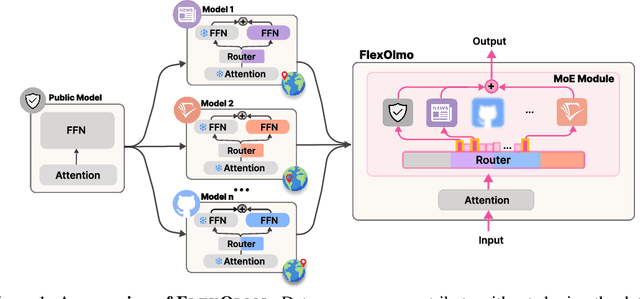
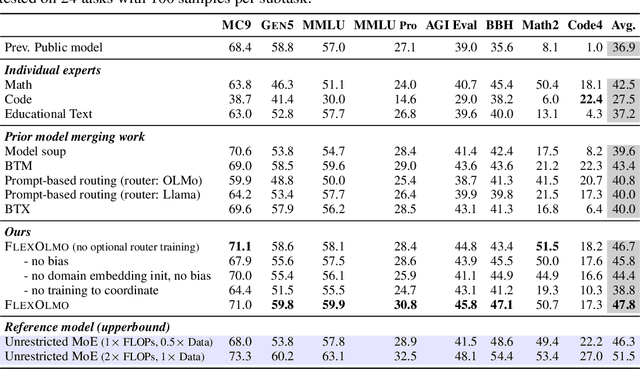
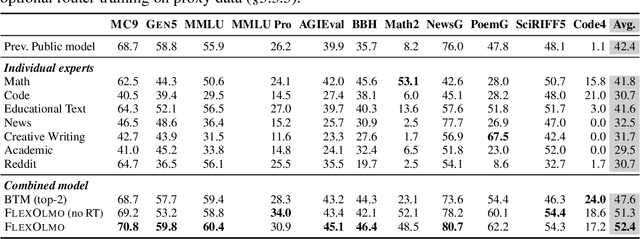
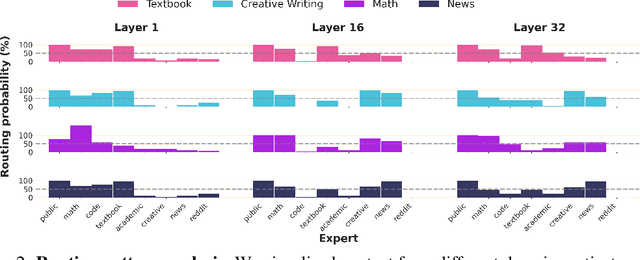
We introduce FlexOlmo, a new class of language models (LMs) that supports (1) distributed training without data sharing, where different model parameters are independently trained on closed datasets, and (2) data-flexible inference, where these parameters along with their associated data can be flexibly included or excluded from model inferences with no further training. FlexOlmo employs a mixture-of-experts (MoE) architecture where each expert is trained independently on closed datasets and later integrated through a new domain-informed routing without any joint training. FlexOlmo is trained on FlexMix, a corpus we curate comprising publicly available datasets alongside seven domain-specific sets, representing realistic approximations of closed sets. We evaluate models with up to 37 billion parameters (20 billion active) on 31 diverse downstream tasks. We show that a general expert trained on public data can be effectively combined with independently trained experts from other data owners, leading to an average 41% relative improvement while allowing users to opt out of certain data based on data licensing or permission requirements. Our approach also outperforms prior model merging methods by 10.1% on average and surpasses the standard MoE trained without data restrictions using the same training FLOPs. Altogether, this research presents a solution for both data owners and researchers in regulated industries with sensitive or protected data. FlexOlmo enables benefiting from closed data while respecting data owners' preferences by keeping their data local and supporting fine-grained control of data access during inference.