 Add to Chrome
 Add to Firefox
 Add to Edge
MemSyco-Bench: Benchmarking Sycophancy in Agent Memory
Jul 01, 2026
Memory has emerged as a cornerstone of modern LLM-based agents, supporting their evolution from single-turn assistants to long-term collaborators. However, memory is not always beneficial: retrieved memories often induce a critical issue of sycophancy, causing agents to over-align with the user at the cost of factual accuracy or objective reasoning. Despite this emerging risk, existing memory benchmarks primarily evaluate whether memories are correctly stored, retrieved, or updated, while overlooking how retrieved memories influence downstream reasoning and decision-making. To bridge this gap, we propose MemSyco-Bench, a comprehensive benchmark for evaluating memory-induced sycophancy in agent systems. MemSyco-Bench measures when memory should influence a decision and how valid memory should be used. Specifically, it covers five tasks that assess whether agents can reject memory as factual evidence, respect its applicable scope, resolve conflicts between memory and objective evidence, track memory updates, and use valid memory for personalization. All related resources are collected for the community at https://github.com/XMUDeepLIT/MemSyco-Bench.

Evolution Fine-Tuning: Learning to Discover Across 371 Optimization Tasks
Jun 27, 2026Would experience designing faster GPU kernels also help close in on a long-standing open mathematical conjecture? Large Language Models (LLMs) integrated into evolutionary search have recently produced state-of-the-art solutions on optimization tasks, including open mathematical conjectures, GPU kernel design, scientific law discovery, and combinatorial puzzles. To achieve this, prior work applied search scaffolds to one target task at a time, so every new problem is approached from scratch and the experience accumulated during search is discarded once the model finishes its attempt. This leaves the capability of iteratively evolving a solution (e.g., knowing which part to mutate and how, deciding when to backtrack) entirely in the scaffold rather than in the model itself. Whether the model itself could acquire this capability and reuse it across different tasks has been largely unexamined. To address this, we introduce Evolution Fine-Tuning (EFT), a mid-training paradigm that teaches LLMs to evolve solutions across tasks by converting evolutionary search trajectories into supervision. We construct Finch Collection, a 156K-trajectory dataset spanning 10 domains and 371 optimization tasks, and fine-tune open-source LLMs from 2B to 9B parameters. Empirically, EFT confers cross-task generalization: across 22 held-out tasks, our models surpass their base counterparts by 10.22% on average. Furthermore, when paired with test-time RL, our model matches state-of-the-art performance on two circle-packing tasks and outperforms its base-model counterpart on the Erdős minimum-overlap problem. EFT thus serves as a "practice phase" for general-purpose discovery agents that do not solve new problems from scratch.
MemGraphRAG: Memory-based Multi-Agent System for Graph Retrieval-Augmented Generation
May 30, 2026Retrieval-Augmented Generation (RAG) has become an essential method for mitigating hallucinations in Large Language Models (LLMs) by leveraging external knowledge. Although effective for simple queries, traditional RAG struggles with large-scale, unstructured corpora where information is highly fragmented. Graph-based RAG (GraphRAG) incorporates knowledge graphs to capture structural relationships, enabling more comprehensive retrieval for complex reasoning. However, existing GraphRAG methods rely on isolated, fragment-level extraction for graph construction, lacking a global perspective on the whole corpus. As a result, these methods frequently lead to thematically inconsistent, logically conflicting, and structurally fragmented graphs that degrade retrieval performance. In this paper, we propose MemGraphRAG, a novel framework that introduces a memory-based multi-agent system to ensure high-quality graph construction. Specifically, MemGraphRAG employs a collaborative society of agents supported by shared memory, which provides a unified global context throughout the extraction process. This mechanism allows agents to dynamically resolve logical conflicts and maintain structural connectivity throughout the corpus. Furthermore, we propose a memory-aware hierarchical retrieval algorithm tailored for the constructed graph. Extensive experiments on multiple benchmarks demonstrate that MemGraphRAG outperforms the state-of-the-art baseline models with comparable efficiency. Our code is available at https://github.com/XMUDeepLIT/MemGraphRAG.
SAAS: Self-Aware Reinforcement Learning for Over-Search Mitigation in Agentic Search
May 28, 2026Agentic search enables LLMs to solve complex multi-hop questions through iterative reasoning and external search. Despite the effectiveness, these systems often suffer from a critical limitation in practice: agents fail to recognize their own knowledge boundaries, blindly triggering searches when internal knowledge suffices and failing to terminate search even when adequate evidence has been collected. The lack of self-awareness leads to severe \textbf{over-search}, incurring substantial inference latency and prohibitive computational cost. To this end, we propose SAAS, a novel RL framework designed to cultivate dynamic self-awareness that precisely regulates search behavior without compromising accuracy. SAAS introduces three key components: (i) a search boundary modeling mechanism, which identifies the search boundary under the evolving policy by contrasting search-disabled and search-enabled rollouts; (ii) a boundary-aware reward module, which translates this boundary awareness into trajectory-level penalties, suppressing unnecessary and redundant searches; and (iii) a stage-wise optimization strategy, which leverages a sequential curriculum to prioritize reasoning over search regularization, thereby avoiding reward hacking. Extensive experiments demonstrate that SAAS substantially reduces over-search, while maintaining accuracy. Our code is anonymously released at https://github.com/XMUDeepLIT/SAAS.
LegalGraphRAG: Multi-Agent Graph Retrieval-Augmented Generation for Reliable Legal Reasoning
May 27, 2026Graph-based Retrieval-Augmented Generation (GraphRAG) advances flat document retrieval by structuring knowledge as relational graphs, enabling more coherent and effective reasoning. However, applying it to specific domains like legal reasoning faces critical challenges. (i) Legal corpora are heterogeneous, containing multi-granular knowledge from cases, articles and interpretations. A flat knowledge graph cannot adequately differentiate between factual details, applied rules, and abstract principles, limiting accurate retrieval. (ii) Reliable legal judgment demands transparent, evidence-based reasoning. Traditional RAG passes retrieved context directly to an LLM without verification, resulting in opaque, error-prone reasoning. To this end, we propose LegalGraphRAG, a framework designed for reliable legal reasoning. Our approach introduces two core components: a hierarchical legal graph that hierarchically organizes legal sources to enable retrieval at appropriate abstraction levels, and a multi-agent system for reliable legal reasoning, where a Researcher retrieves candidate evidence, an Auditor rigorously verifies its validity against source documents, and an Adjudicator synthesizes the set of verified evidence to render a final judgment. Extensive experiments show that LegalGraphRAG achieves the state-of-the-art performance, outperforming existing GraphRAG baselines in accurate and trustworthy legal analysis. Our code, datasets and implementation details are available at https://github.com/XMUDeepLIT/LegalGraphRAG.
HO-Flow: Generalizable Hand-Object Interaction Generation with Latent Flow Matching
Apr 12, 2026Generating realistic 3D hand-object interactions (HOI) is a fundamental challenge in computer vision and robotics, requiring both temporal coherence and high-fidelity physical plausibility. Existing methods remain limited in their ability to learn expressive motion representations for generation and perform temporal reasoning. In this paper, we present HO-Flow, a framework for synthesizing realistic hand-object motion sequences from texts and canoncial 3D objects. HO-Flow first employs an interaction-aware variational autoencoder to encode sequences of hand and object motions into a unified latent manifold by incorporating hand and object kinematics, enabling the representation to capture rich interaction dynamics. It then leverages a masked flow matching model that combines auto-regressive temporal reasoning with continuous latent generation, improving temporal coherence. To further enhance generalization, HO-Flow predicts object motions relative to the initial frame, enabling effective pre-training on large-scale synthetic data. Experiments on the GRAB, OakInk, and DexYCB benchmarks demonstrate that HO-Flow achieves state-of-the-art performance in both physical plausibility and motion diversity for interaction motion synthesis.
Beyond the Flat Sequence: Hierarchical and Preference-Aware Generative Recommendations
Mar 01, 2026Generative Recommenders (GRs), exemplified by the Hierarchical Sequential Transduction Unit (HSTU), have emerged as a powerful paradigm for modeling long user interaction sequences. However, we observe that their "flat-sequence" assumption overlooks the rich, intrinsic structure of user behavior. This leads to two key limitations: a failure to capture the temporal hierarchy of session-based engagement, and computational inefficiency, as dense attention introduces significant noise that obscures true preference signals within semantically sparse histories, which deteriorates the quality of the learned representations. To this end, we propose a novel framework named HPGR (Hierarchical and Preference-aware Generative Recommender), built upon a two-stage paradigm that injects these crucial structural priors into the model to handle the drawback. Specifically, HPGR comprises two synergistic stages. First, a structure-aware pre-training stage employs a session-based Masked Item Modeling (MIM) objective to learn a hierarchically-informed and semantically rich item representation space. Second, a preference-aware fine-tuning stage leverages these powerful representations to implement a Preference-Guided Sparse Attention mechanism, which dynamically constrains computation to only the most relevant historical items, enhancing both efficiency and signal-to-noise ratio. Empirical experiments on a large-scale proprietary industrial dataset from APPGallery and an online A/B test verify that HPGR achieves state-of-the-art performance over multiple strong baselines, including HSTU and MTGR.
* Accepted to the ACM Web Conference 2026 (WWW '26). 9 pages, 9 figures. Zerui Chen and Heng Chang contributed equally to this work
SafeRBench: A Comprehensive Benchmark for Safety Assessment in Large Reasoning Models
Nov 19, 2025Large Reasoning Models (LRMs) improve answer quality through explicit chain-of-thought, yet this very capability introduces new safety risks: harmful content can be subtly injected, surface gradually, or be justified by misleading rationales within the reasoning trace. Existing safety evaluations, however, primarily focus on output-level judgments and rarely capture these dynamic risks along the reasoning process. In this paper, we present SafeRBench, the first benchmark that assesses LRM safety end-to-end -- from inputs and intermediate reasoning to final outputs. (1) Input Characterization: We pioneer the incorporation of risk categories and levels into input design, explicitly accounting for affected groups and severity, and thereby establish a balanced prompt suite reflecting diverse harm gradients. (2) Fine-Grained Output Analysis: We introduce a micro-thought chunking mechanism to segment long reasoning traces into semantically coherent units, enabling fine-grained evaluation across ten safety dimensions. (3) Human Safety Alignment: We validate LLM-based evaluations against human annotations specifically designed to capture safety judgments. Evaluations on 19 LRMs demonstrate that SafeRBench enables detailed, multidimensional safety assessment, offering insights into risks and protective mechanisms from multiple perspectives.
Probing Latent Knowledge Conflict for Faithful Retrieval-Augmented Generation
Oct 14, 2025Retrieval-Augmented Generation (RAG) has emerged as a powerful paradigm to enhance the factuality of Large Language Models (LLMs). However, existing RAG systems often suffer from an unfaithfulness issue, where the model's response contradicts evidence from the retrieved context. Existing approaches to improving contextual faithfulness largely rely on external interventions, such as prompt engineering, decoding constraints, or reward-based fine-tuning. These works treat the LLM as a black box and overlook a crucial question: how does the LLM internally integrate retrieved evidence with its parametric memory, particularly under knowledge conflicts? To address this gap, we conduct a probing-based analysis of hidden-state representations in LLMs and observe three findings: knowledge integration occurs hierarchically, conflicts manifest as latent signals at the sentence level, and irrelevant context is often amplified when aligned with parametric knowledge. Building on these findings, we propose CLEAR (Conflict-Localized and Enhanced Attention for RAG), a framework that (i) decomposes context into fine-grained sentence-level knowledge, (ii) employs hidden-state probing to localize conflicting knowledge, and (iii) introduces conflict-aware fine-tuning to guide the model to accurately integrate retrieved evidence. Extensive experiments across three benchmarks demonstrate that CLEAR substantially improves both accuracy and contextual faithfulness, consistently outperforming strong baselines under diverse conflict conditions. The related resources are available at https://github.com/LinfengGao/CLEAR.
HORT: Monocular Hand-held Objects Reconstruction with Transformers
Mar 27, 2025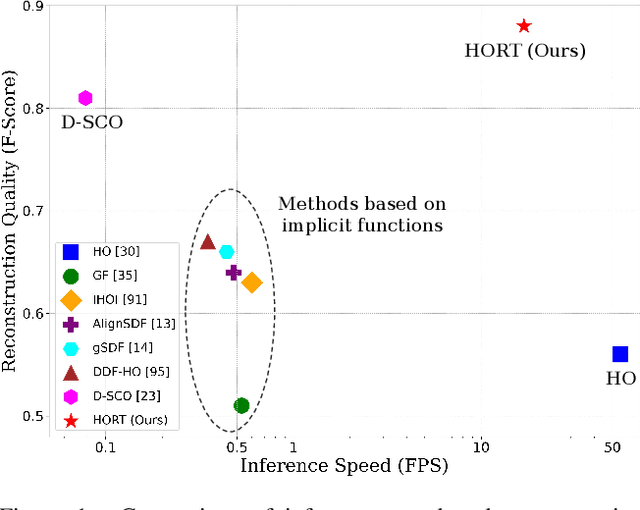
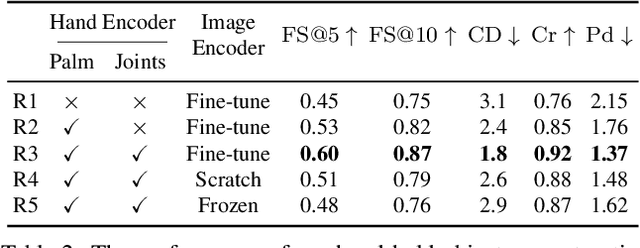
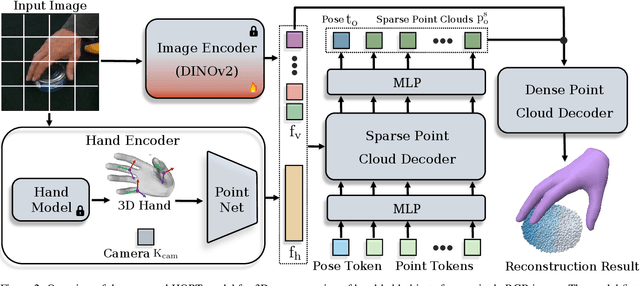
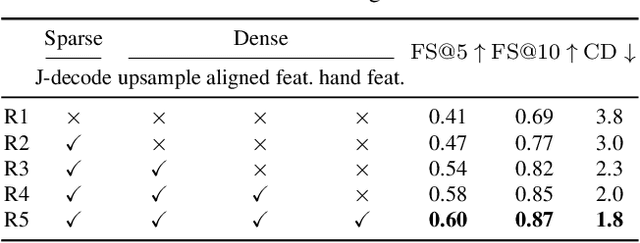
Reconstructing hand-held objects in 3D from monocular images remains a significant challenge in computer vision. Most existing approaches rely on implicit 3D representations, which produce overly smooth reconstructions and are time-consuming to generate explicit 3D shapes. While more recent methods directly reconstruct point clouds with diffusion models, the multi-step denoising makes high-resolution reconstruction inefficient. To address these limitations, we propose a transformer-based model to efficiently reconstruct dense 3D point clouds of hand-held objects. Our method follows a coarse-to-fine strategy, first generating a sparse point cloud from the image and progressively refining it into a dense representation using pixel-aligned image features. To enhance reconstruction accuracy, we integrate image features with 3D hand geometry to jointly predict the object point cloud and its pose relative to the hand. Our model is trained end-to-end for optimal performance. Experimental results on both synthetic and real datasets demonstrate that our method achieves state-of-the-art accuracy with much faster inference speed, while generalizing well to in-the-wild images.