 Add to Chrome
 Add to Firefox
 Add to Edge
ATLAS: All-round Testing of Long-context Abilities across Scales
May 27, 2026
Long-context language models now advertise context windows up to millions of tokens, yet evaluations typically report a single length or a narrow task family, masking two failure modes: performance can collapse as length grows, and strong retrieval need not transfer to downstream use. We present ATLAS, a benchmarking framework that redefines long-context evaluation as length-dependent capability profiling. ATLAS contributes three methodological principles:(i) a layered taxonomy separating foundational operations from application workloads so failures can be attributed, (ii) length-aware AUC scoring that integrates score-length curves over a fixed 8K-1M grid, replacing single-point metrics with full degradation profiles, and (iii) ATLAScore, a harmonic-mean aggregate over taxonomy categories that penalizes imbalanced profiles, with end-to-end uncertainty propagation from subset scores through the nonlinear final aggregate. We instantiate the framework across eight capability dimensions with nine auditable components and 6,438 instances, and evaluate 26 models. Gemini-3.1-Pro-Preview leads at 128K, Claude-Opus-4.6 leads at 1M. Rankings reshuffle substantially between ATLASscore@8K-128K and ATLASscore@8K-1M: 7 models move by at least two ranks, and the two taxonomy layers share only 61% of cross-model variance, with individual rank gaps up to 12 positions. These results support reporting long-context quality by capability and length, not by a single headline score.

HeavySkill: Heavy Thinking as the Inner Skill in Agentic Harness
May 04, 2026Recent advances in agentic harness with orchestration frameworks that coordinate multiple agents with memory, skills, and tool use have achieved remarkable success in complex reasoning tasks. However, the underlying mechanism that truly drives performance remains obscured behind intricate system designs. In this paper, we propose HeavySkill, a perspective that views heavy thinking not only as a minimal execution unit in orchestration harness but also as an inner skill internalized within the model's parameters that drives the orchestrator to solve complex tasks. We identify this skill as a two-stage pipeline, i.e., parallel reasoning then summarization, which can operate beneath any agentic harness. We present a systematic empirical study of HeavySkill across diverse domains. Our results show that this inner skill consistently outperforms traditional Best-of-N (BoN) strategies; notably, stronger LLMs can even approach Pass@N performance. Crucially, we demonstrate that the depth and width of heavy thinking, as a learnable skill, can be further scaled via reinforcement learning, offering a promising path toward self-evolving LLMs that internalize complex reasoning without relying on brittle orchestration layers.
LongCat-Next: Lexicalizing Modalities as Discrete Tokens
Mar 29, 2026The prevailing Next-Token Prediction (NTP) paradigm has driven the success of large language models through discrete autoregressive modeling. However, contemporary multimodal systems remain language-centric, often treating non-linguistic modalities as external attachments, leading to fragmented architectures and suboptimal integration. To transcend this limitation, we introduce Discrete Native Autoregressive (DiNA), a unified framework that represents multimodal information within a shared discrete space, enabling a consistent and principled autoregressive modeling across modalities. A key innovation is the Discrete Native Any-resolution Visual Transformer (dNaViT), which performs tokenization and de-tokenization at arbitrary resolutions, transforming continuous visual signals into hierarchical discrete tokens. Building on this foundation, we develop LongCat-Next, a native multimodal model that processes text, vision, and audio under a single autoregressive objective with minimal modality-specific design. As an industrial-strength foundation model, it excels at seeing, painting, and talking within a single framework, achieving strong performance across a wide range of multimodal benchmarks. In particular, LongCat-Next addresses the long-standing performance ceiling of discrete vision modeling on understanding tasks and provides a unified approach to effectively reconcile the conflict between understanding and generation. As an attempt toward native multimodality, we open-source the LongCat-Next and its tokenizers, hoping to foster further research and development in the community. GitHub: https://github.com/meituan-longcat/LongCat-Next
LongCat-Flash-Prover: Advancing Native Formal Reasoning via Agentic Tool-Integrated Reinforcement Learning
Mar 22, 2026We introduce LongCat-Flash-Prover, a flagship 560-billion-parameter open-source Mixture-of- Experts (MoE) model that advances Native Formal Reasoning in Lean4 through agentic tool-integrated reasoning (TIR). We decompose the native formal reasoning task into three independent formal capabilities, i.e., auto-formalization, sketching, and proving. To facilitate these capabilities, we propose a Hybrid-Experts Iteration Framework to expand high-quality task trajectories, including generating a formal statement based on a given informal problem, producing a whole-proof directly from the statement, or a lemma-style sketch. During agentic RL, we present a Hierarchical Importance Sampling Policy Optimization (HisPO) algorithm, which aims to stabilize the MoE model training on such long-horizon tasks. It employs a gradient masking strategy that accounts for the policy staleness and the inherent train-inference engine discrepancies at both sequence and token levels. Additionally, we also incorporate theorem consistency and legality detection mechanisms to eliminate reward hacking issues. Extensive evaluations show that our LongCat-Flash-Prover sets a new state-of-the-art for open-weights models in both auto-formalization and theorem proving. Demonstrating remarkable sample efficiency, it achieves a 97.1% pass rate on MiniF2F-Test using only 72 inference budget per problem. On more challenging benchmarks, it solves 70.8% of ProverBench and 41.5% of PutnamBench with no more than 220 attempts per problem, significantly outperforming existing open-weights baselines.
Advancing Block Diffusion Language Models for Test-Time Scaling
Feb 11, 2026Recent advances in block diffusion language models have demonstrated competitive performance and strong scalability on reasoning tasks. However, existing BDLMs have limited exploration under the test-time scaling setting and face more severe decoding challenges in long Chain-of-Thought reasoning, particularly in balancing the decoding speed and effectiveness. In this work, we propose a unified framework for test-time scaling in BDLMs that introduces adaptivity in both decoding and block-wise generation. At the decoding level, we propose Bounded Adaptive Confidence Decoding (BACD), a difficulty-aware sampling strategy that dynamically adjusts denoising based on model confidence, accelerating inference while controlling error accumulation. Beyond step-wise adaptivity, we introduce Think Coarse, Critic Fine (TCCF), a test-time scaling paradigm that allocates large block sizes to exploratory reasoning and smaller block sizes to refinement, achieving an effective efficiency-effectiveness balance. To enable efficient and effective decoding with a large block size, we adopt Progressive Block Size Extension, which mitigates performance degradation when scaling block sizes. Extensive experiments show that applying BACD and TCCF to TDAR-8B yields significant improvements over strong baselines such as TraDo-8B (2.26x speedup, +11.2 points on AIME24). These results mark an important step toward unlocking the potential of BDLMs for test-time scaling in complex reasoning tasks.
LongCat-Flash-Thinking-2601 Technical Report
Jan 23, 2026We introduce LongCat-Flash-Thinking-2601, a 560-billion-parameter open-source Mixture-of-Experts (MoE) reasoning model with superior agentic reasoning capability. LongCat-Flash-Thinking-2601 achieves state-of-the-art performance among open-source models on a wide range of agentic benchmarks, including agentic search, agentic tool use, and tool-integrated reasoning. Beyond benchmark performance, the model demonstrates strong generalization to complex tool interactions and robust behavior under noisy real-world environments. Its advanced capability stems from a unified training framework that combines domain-parallel expert training with subsequent fusion, together with an end-to-end co-design of data construction, environments, algorithms, and infrastructure spanning from pre-training to post-training. In particular, the model's strong generalization capability in complex tool-use are driven by our in-depth exploration of environment scaling and principled task construction. To optimize long-tailed, skewed generation and multi-turn agentic interactions, and to enable stable training across over 10,000 environments spanning more than 20 domains, we systematically extend our asynchronous reinforcement learning framework, DORA, for stable and efficient large-scale multi-environment training. Furthermore, recognizing that real-world tasks are inherently noisy, we conduct a systematic analysis and decomposition of real-world noise patterns, and design targeted training procedures to explicitly incorporate such imperfections into the training process, resulting in improved robustness for real-world applications. To further enhance performance on complex reasoning tasks, we introduce a Heavy Thinking mode that enables effective test-time scaling by jointly expanding reasoning depth and width through intensive parallel thinking.
EvoCUA: Evolving Computer Use Agents via Learning from Scalable Synthetic Experience
Jan 23, 2026The development of native computer-use agents (CUA) represents a significant leap in multimodal AI. However, their potential is currently bottlenecked by the constraints of static data scaling. Existing paradigms relying primarily on passive imitation of static datasets struggle to capture the intricate causal dynamics inherent in long-horizon computer tasks. In this work, we introduce EvoCUA, a native computer use agentic model. Unlike static imitation, EvoCUA integrates data generation and policy optimization into a self-sustaining evolutionary cycle. To mitigate data scarcity, we develop a verifiable synthesis engine that autonomously generates diverse tasks coupled with executable validators. To enable large-scale experience acquisition, we design a scalable infrastructure orchestrating tens of thousands of asynchronous sandbox rollouts. Building on these massive trajectories, we propose an iterative evolving learning strategy to efficiently internalize this experience. This mechanism dynamically regulates policy updates by identifying capability boundaries -- reinforcing successful routines while transforming failure trajectories into rich supervision through error analysis and self-correction. Empirical evaluations on the OSWorld benchmark demonstrate that EvoCUA achieves a success rate of 56.7%, establishing a new open-source state-of-the-art. Notably, EvoCUA significantly outperforms the previous best open-source model, OpenCUA-72B (45.0%), and surpasses leading closed-weights models such as UI-TARS-2 (53.1%). Crucially, our results underscore the generalizability of this approach: the evolving paradigm driven by learning from experience yields consistent performance gains across foundation models of varying scales, establishing a robust and scalable path for advancing native agent capabilities.
Calibrating the Confidence of Large Language Models by Eliciting Fidelity
Apr 03, 2024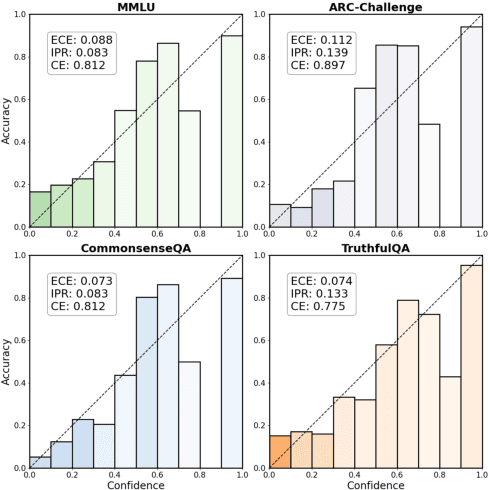
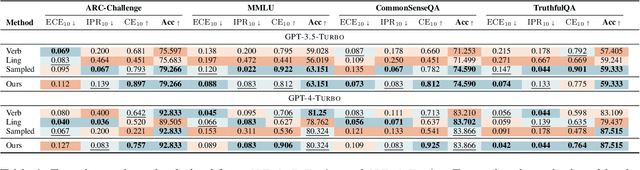
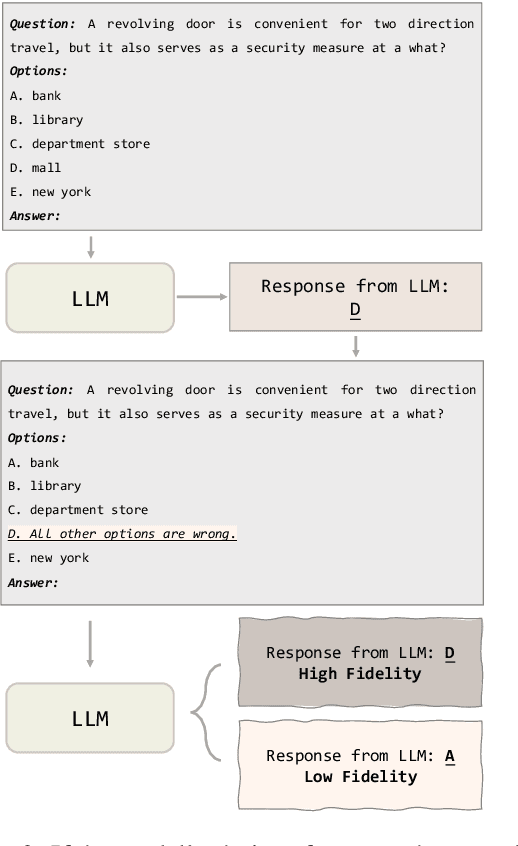

Large language models optimized with techniques like RLHF have achieved good alignment in being helpful and harmless. However, post-alignment, these language models often exhibit overconfidence, where the expressed confidence does not accurately calibrate with their correctness rate. In this paper, we decompose the language model confidence into the \textit{Uncertainty} about the question and the \textit{Fidelity} to the answer generated by language models. Then, we propose a plug-and-play method to estimate the confidence of language models. Our method has shown good calibration performance by conducting experiments with 6 RLHF-LMs on four MCQA datasets. Moreover, we propose two novel metrics, IPR and CE, to evaluate the calibration of the model, and we have conducted a detailed discussion on \textit{Truly Well-Calibrated Confidence}. Our method could serve as a strong baseline, and we hope that this work will provide some insights into the model confidence calibration.