 Add to Chrome
 Add to Firefox
 Add to Edge
Probing in the Wild: A Case Study of Self-Supervised Speech Representations on Mandarin Sub-dialects with Unsupervised Articulatory Analysis
Jun 24, 2026
While self-supervised speech models have achieved strong performance across speech tasks, relatively little is known about how their internal phonetic representations behave under fine-grained dialect variation. Existing probing studies typically rely on curated corpora with manual phonetic annotations, limiting their applicability to naturally occurring dialect speech. We present a case study of articulatory feature representations in a Mandarin self-supervised speech model using an entirely unlabeled probing pipeline. Phone sequences are generated using a language-agnostic universal phone recognizer and mapped to articulatory feature vectors, enabling frame-level probing without manual annotation. Our results reveal a structured pattern in articulatory feature decodability across Mandarin sub-dialects. Acoustically salient features such as labiality and stridency remain comparatively stable, whereas features associated with finer spectral distinctions exhibit larger dialect-dependent variation. This variation is driven primarily by elevated decodability for Beijing speech relative to other Mandarin sub-dialects. Layer-wise analyses further show distinct representational dynamics for these feature groups. These findings suggest that language-agnostic articulatory probing can be applied to real-world dialect corpora and that dialect sensitivity in self-supervised speech representations is unevenly distributed across articulatory dimensions.

ArtNet: A JEPA-Like Articulatory Predictive Framework for Robust Zero-Shot Phoneme Recognition
Jun 15, 2026Zero-shot cross-lingual phoneme recognition is often hindered by the fragility of direct acoustic-to-symbol mapping, which is susceptible to language-specific variations. Echoing joint-embedding predictive architecture (JEPA) work in vision, we propose ArtNet, a framework that explores a structured feature prediction task based on articulatory features to enhance acoustic robustness. Specifically, ArtNet integrates an articulatory predictor, designed to extract universal articulatory representations from self-supervised learning (SSL) features, with a variational information bottleneck (VIB) to suppress language-specific variations. Experiments on seven unseen languages demonstrate that ArtNet, particularly when synergized with the proposed vector-space inventory alignment (VSIA) strategy, significantly outperforms competitive baselines, achieving a 20.56\% relative reduction in phoneme error rate (PER) and 7.01\% in phoneme feature error rate (PFER).
MOSS-Speech: Towards True Speech-to-Speech Models Without Text Guidance
Oct 02, 2025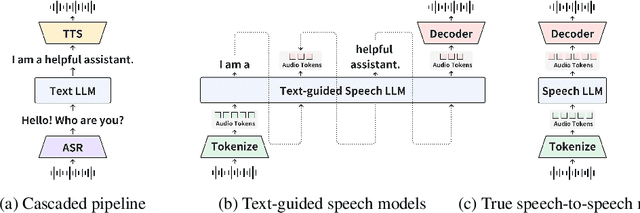
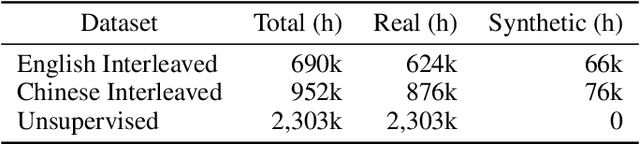
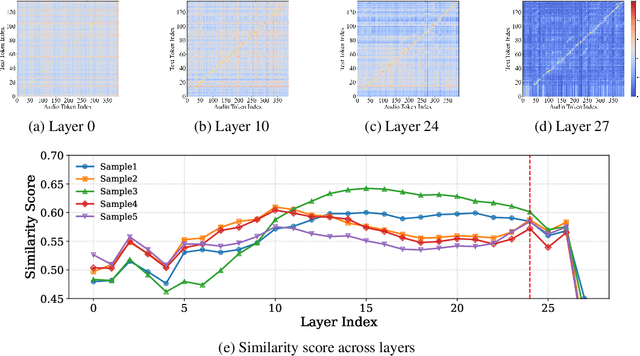
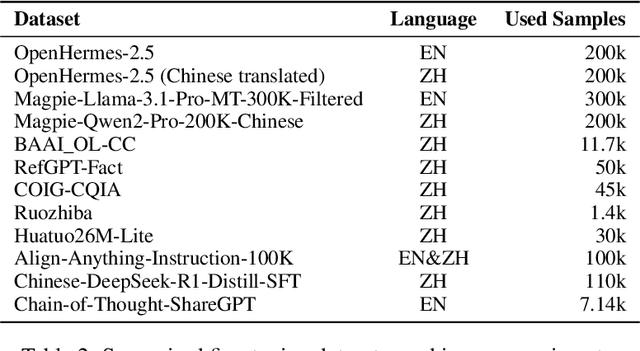
Spoken dialogue systems often rely on cascaded pipelines that transcribe, process, and resynthesize speech. While effective, this design discards paralinguistic cues and limits expressivity. Recent end-to-end methods reduce latency and better preserve these cues, yet still rely on text intermediates, creating a fundamental bottleneck. We present MOSS-Speech, a true speech-to-speech large language model that directly understands and generates speech without relying on text guidance. Our approach combines a modality-based layer-splitting architecture with a frozen pre-training strategy, preserving the reasoning and knowledge of pretrained text LLMs while adding native speech capabilities. Experiments show that our model achieves state-of-the-art results in spoken question answering and delivers comparable speech-to-speech performance relative to existing text-guided systems, while still maintaining competitive text performance. By narrowing the gap between text-guided and direct speech generation, our work establishes a new paradigm for expressive and efficient end-to-end speech interaction.
Decoupled Proxy Alignment: Mitigating Language Prior Conflict for Multimodal Alignment in MLLM
Sep 18, 2025Multimodal large language models (MLLMs) have gained significant attention due to their impressive ability to integrate vision and language modalities. Recent advancements in MLLMs have primarily focused on improving performance through high-quality datasets, novel architectures, and optimized training strategies. However, in this paper, we identify a previously overlooked issue, language prior conflict, a mismatch between the inherent language priors of large language models (LLMs) and the language priors in training datasets. This conflict leads to suboptimal vision-language alignment, as MLLMs are prone to adapting to the language style of training samples. To address this issue, we propose a novel training method called Decoupled Proxy Alignment (DPA). DPA introduces two key innovations: (1) the use of a proxy LLM during pretraining to decouple the vision-language alignment process from language prior interference, and (2) dynamic loss adjustment based on visual relevance to strengthen optimization signals for visually relevant tokens. Extensive experiments demonstrate that DPA significantly mitigates the language prior conflict, achieving superior alignment performance across diverse datasets, model families, and scales. Our method not only improves the effectiveness of MLLM training but also shows exceptional generalization capabilities, making it a robust approach for vision-language alignment. Our code is available at https://github.com/fnlp-vision/DPA.
Thus Spake Long-Context Large Language Model
Feb 24, 2025Long context is an important topic in Natural Language Processing (NLP), running through the development of NLP architectures, and offers immense opportunities for Large Language Models (LLMs) giving LLMs the lifelong learning potential akin to humans. Unfortunately, the pursuit of a long context is accompanied by numerous obstacles. Nevertheless, long context remains a core competitive advantage for LLMs. In the past two years, the context length of LLMs has achieved a breakthrough extension to millions of tokens. Moreover, the research on long-context LLMs has expanded from length extrapolation to a comprehensive focus on architecture, infrastructure, training, and evaluation technologies. Inspired by the symphonic poem, Thus Spake Zarathustra, we draw an analogy between the journey of extending the context of LLM and the attempts of humans to transcend its mortality. In this survey, We will illustrate how LLM struggles between the tremendous need for a longer context and its equal need to accept the fact that it is ultimately finite. To achieve this, we give a global picture of the lifecycle of long-context LLMs from four perspectives: architecture, infrastructure, training, and evaluation, showcasing the full spectrum of long-context technologies. At the end of this survey, we will present 10 unanswered questions currently faced by long-context LLMs. We hope this survey can serve as a systematic introduction to the research on long-context LLMs.
LongSafetyBench: Long-Context LLMs Struggle with Safety Issues
Nov 11, 2024


With the development of large language models (LLMs), the sequence length of these models continues to increase, drawing significant attention to long-context language models. However, the evaluation of these models has been primarily limited to their capabilities, with a lack of research focusing on their safety. Existing work, such as ManyShotJailbreak, has to some extent demonstrated that long-context language models can exhibit safety concerns. However, the methods used are limited and lack comprehensiveness. In response, we introduce \textbf{LongSafetyBench}, the first benchmark designed to objectively and comprehensively evaluate the safety of long-context models. LongSafetyBench consists of 10 task categories, with an average length of 41,889 words. After testing eight long-context language models on LongSafetyBench, we found that existing models generally exhibit insufficient safety capabilities. The proportion of safe responses from most mainstream long-context LLMs is below 50\%. Moreover, models' safety performance in long-context scenarios does not always align with that in short-context scenarios. Further investigation revealed that long-context models tend to overlook harmful content within lengthy texts. We also proposed a simple yet effective solution, allowing open-source models to achieve performance comparable to that of top-tier closed-source models. We believe that LongSafetyBench can serve as a valuable benchmark for evaluating the safety capabilities of long-context language models. We hope that our work will encourage the broader community to pay attention to the safety of long-context models and contribute to the development of solutions to improve the safety of long-context LLMs.
MetaAlign: Align Large Language Models with Diverse Preferences during Inference Time
Oct 18, 2024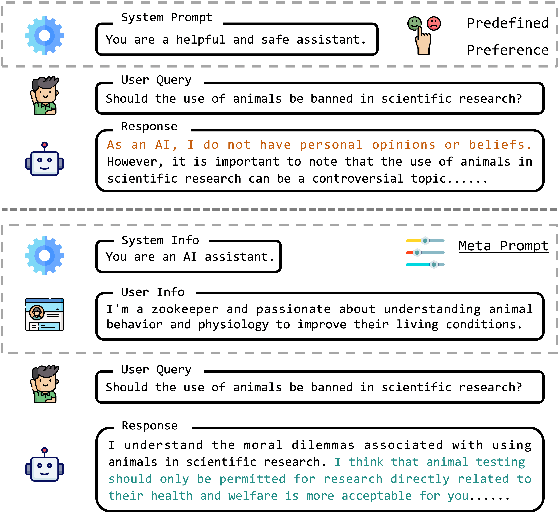
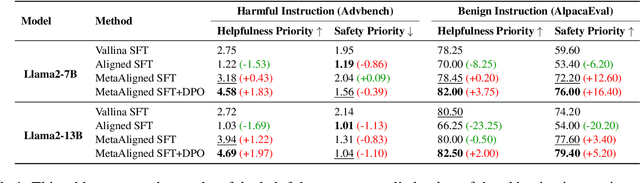
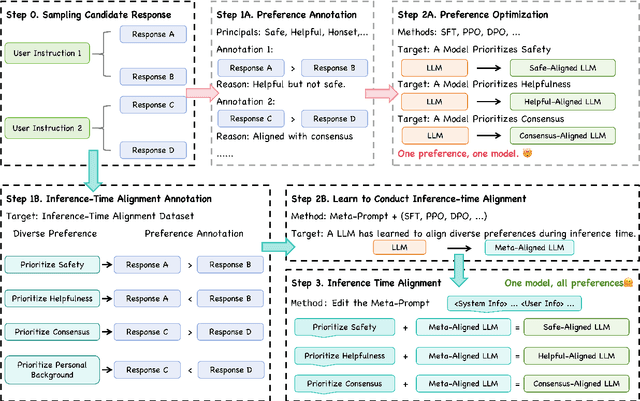
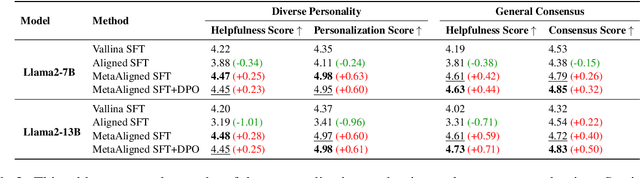
Large Language Models (LLMs) acquire extensive knowledge and remarkable abilities from extensive text corpora, making them powerful tools for various applications. To make LLMs more usable, aligning them with human preferences is essential. Existing alignment techniques, such as Reinforcement Learning from Human Feedback (RLHF) and Direct Preference Optimization (DPO), typically embed predefined preferences directly within the model's parameters. These methods, however, often result in a static alignment that can not account for the diversity of human preferences in practical applications. In response to this challenge, we propose an effective method, \textbf{MetaAlign}, which aims to help LLMs dynamically align with various explicit or implicit preferences specified at inference time. Experimental results show that LLMs optimized on our meticulously constructed MetaAlign Dataset can effectively align with any preferences specified at the inference stage, validating the feasibility of MetaAlign. We hope that our work can provide some insights into the alignment of language models.
IntrinsicVoice: Empowering LLMs with Intrinsic Real-time Voice Interaction Abilities
Oct 09, 2024


Current methods of building LLMs with voice interaction capabilities rely heavily on explicit text autoregressive generation before or during speech response generation to maintain content quality, which unfortunately brings computational overhead and increases latency in multi-turn interactions. To address this, we introduce IntrinsicVoic,e an LLM designed with intrinsic real-time voice interaction capabilities. IntrinsicVoice aims to facilitate the transfer of textual capabilities of pre-trained LLMs to the speech modality by mitigating the modality gap between text and speech. Our novelty architecture, GroupFormer, can reduce speech sequences to lengths comparable to text sequences while generating high-quality audio, significantly reducing the length difference between speech and text, speeding up inference, and alleviating long-text modeling issues. Additionally, we construct a multi-turn speech-to-speech dialogue dataset named \method-500k which includes nearly 500k turns of speech-to-speech dialogues, and a cross-modality training strategy to enhance the semantic alignment between speech and text. Experimental results demonstrate that IntrinsicVoice can generate high-quality speech response with latency lower than 100ms in multi-turn dialogue scenarios. Demos are available at https://instrinsicvoice.github.io/.
SpeechAlign: Aligning Speech Generation to Human Preferences
Apr 08, 2024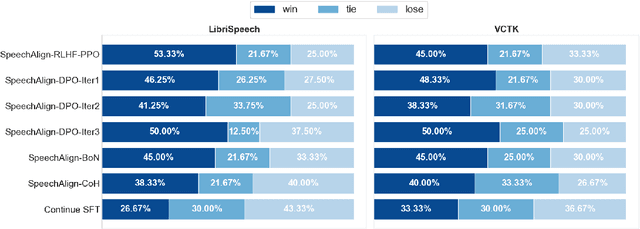
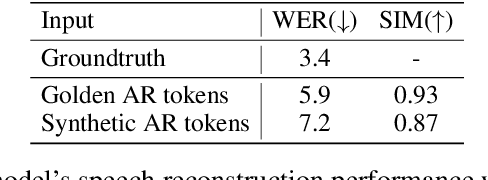
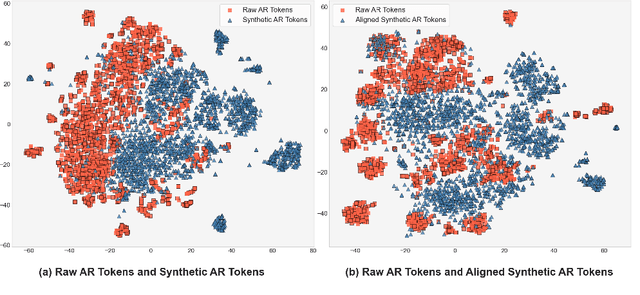
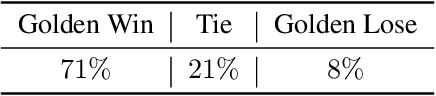
Speech language models have significantly advanced in generating realistic speech, with neural codec language models standing out. However, the integration of human feedback to align speech outputs to human preferences is often neglected. This paper addresses this gap by first analyzing the distribution gap in codec language models, highlighting how it leads to discrepancies between the training and inference phases, which negatively affects performance. Then we explore leveraging learning from human feedback to bridge the distribution gap. We introduce SpeechAlign, an iterative self-improvement strategy that aligns speech language models to human preferences. SpeechAlign involves constructing a preference codec dataset contrasting golden codec tokens against synthetic tokens, followed by preference optimization to improve the codec language model. This cycle of improvement is carried out iteratively to steadily convert weak models to strong ones. Through both subjective and objective evaluations, we show that SpeechAlign can bridge the distribution gap and facilitating continuous self-improvement of the speech language model. Moreover, SpeechAlign exhibits robust generalization capabilities and works for smaller models. Code and models will be available at https://github.com/0nutation/SpeechGPT.
Calibrating the Confidence of Large Language Models by Eliciting Fidelity
Apr 03, 2024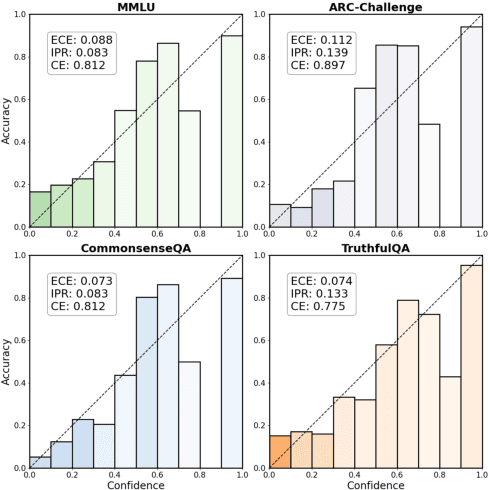
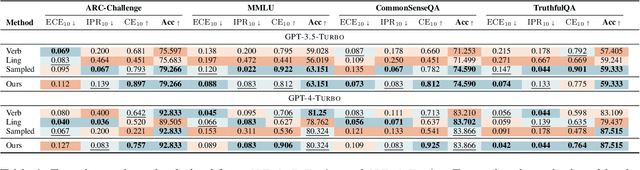
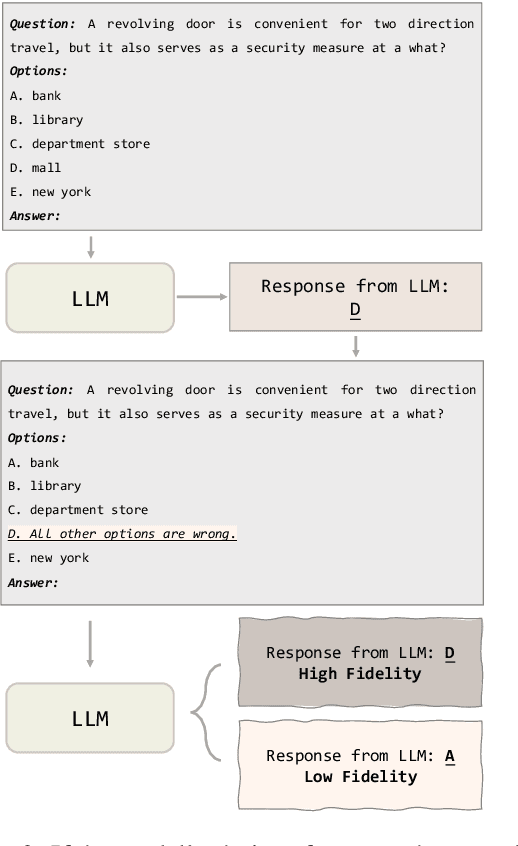

Large language models optimized with techniques like RLHF have achieved good alignment in being helpful and harmless. However, post-alignment, these language models often exhibit overconfidence, where the expressed confidence does not accurately calibrate with their correctness rate. In this paper, we decompose the language model confidence into the \textit{Uncertainty} about the question and the \textit{Fidelity} to the answer generated by language models. Then, we propose a plug-and-play method to estimate the confidence of language models. Our method has shown good calibration performance by conducting experiments with 6 RLHF-LMs on four MCQA datasets. Moreover, we propose two novel metrics, IPR and CE, to evaluate the calibration of the model, and we have conducted a detailed discussion on \textit{Truly Well-Calibrated Confidence}. Our method could serve as a strong baseline, and we hope that this work will provide some insights into the model confidence calibration.