 Add to Chrome
 Add to Firefox
 Add to Edge
Assistron: Bayesian Shared Autonomy with Off-the-shelf Vision-Language-Action Models
Jun 22, 2026
We propose Assistron, a shared autonomy model that leverages Vision-Language-Action (VLA) models to assist the user in daily activities. Our approach is grounded in two core principles: (1)~minimizing human cognitive and physical effort by leveraging VLA-driven autonomy for macro-movements, and (2)~prioritizing human intervention specifically at critical failure points. Driven by the user's verbal language commands, Assistron utilizes the VLA to autonomously execute macro-reaching trajectories, saving users' effort. In contact-rich interactions where VLAs tend to fail, Assistron employs a phase-aware interaction detection mechanism and solicits the user to intervene, in turn adjusting the VLA's action generation via flow matching guidance. Critically, our formulation eliminates the need for VLA fine-tuning, protecting its broad behavioral priors from catastrophic forgetting and ensuring the model does not become a narrow specialist. We validate our approach on a comprehensive multi-task scene recovery benchmark encompassing diverse daily manipulation skills. Empirical results demonstrate that Assistron significantly improves task success rates over pure autonomous baselines while significantly reducing human cognitive and physical workload compared to traditional teleoperation, offering a scalable, smooth, and effortless paradigm for assistive manipulation. The code is available in https://github.com/mousecpn/Assistron.git.

MAPS: Multi-Anchor Projection Similarity for Joint Vision-Language Geo-Localization
Jun 21, 2026Humans localize places by integrating perceptual cues from vision with semantic reasoning from language, forming a scene understanding that is both intuitive and structured. Although existing geo-localization models have made substantial progress in cross-view and cross-modal settings, they are largely built upon point-to-point alignment, which is insufficient for joint vision-language queries. In such queries, visual and textual cues do not simply act as independent references, but jointly define a semantic subspace for locating the target. In this paper, we formulate vision-language geo-localization (VLGL) with joint image-text queries as a multi-anchor geometric alignment problem and propose a unified framework for this setting. To realize this formulation, we propose Multi-Anchor Projection Similarity (MAPS), a new metric which constructs an anchor plane from visual and textual query features in a high-dimensional space and measures similarity by the projection length of the target feature onto this plane. Unlike cosine similarity which evaluates isolated pairwise relations, MAPS captures the geometric consistency between the target feature and the joint query subspace, providing a more discriminative ranking criterion during retrieval. To make the learned representation consistent with this geometry, we further introduce a MAPS-based contrastive loss that drives target features toward the corresponding anchor plane. The proposed framework, similarity metric, and training objective jointly yield state-of-the-art performance in VLGL.
FF-JEPA: Long-Horizon Planning in World Models with Latent Planners
Jun 08, 2026Joint Embedding Predictive Architectures (JEPAs) have shown promising world modeling capabilities, enabling planning in latent space by optimizing action trajectories using methods like the Cross-Entropy Method (CEM). These methods are, however, too computationally expensive and ineffective for long-horizon planning. Furthermore, these methods typically require an explicit image of the goal state, which is not always possible in real-world tasks. In this work, we tackle these limitations by proposing Forward-Forward-JEPA (FF-JEPA), a hierarchical approach leveraging two forward dynamics models. Alongside a standard action-conditioned forward model, we introduce an action-free latent planner that predicts the next subgoal given the current state. This approach removes the need for goal images and enables long-horizon planning by decomposing complex trajectories into a sequence of tractable, short-term optimization problems. Preliminary results on PushT demonstrate that FF-JEPA successfully overcomes flat world models' long-horizon collapse, highlighting this approach as a promising direction for goal-free planning.
ELVIS: Ensemble-Calibrated Latent Imagination for Long-Horizon Visual MPC
May 06, 2026A central challenge of visual control with model-based reinforcement learning (RL) is reliable long-horizon planning: long rollouts with learned latent dynamics exhibit branching futures and multi-modal action-value distributions. In addition, compounding model errors amplified by visual occlusions make deep imagination brittle. We present ELVIS, a latent model predictive controller (MPC) designed to make long-horizon planning practical. ELVIS plans in a Dreamer-style recurrent state space model (RSSM) and replaces standard unimodal model predictive path integral (MPPI) with a Gaussian-mixture MPPI that maintains multiple coherent hypotheses over long horizons, avoiding mode averaging under branching rollouts. In parallel, ELVIS stabilizes deep imagination with a shared uncertainty-aware lambda-return: an ensemble of latent critics defines an upper-confidence-bound (UCB) score that gates a time-varying lambda, adaptively trading off bootstrapping versus look-ahead to limit compounding error during planning. The same return is used both to train an actor-critic prior from imagined rollouts and to score candidate trajectories inside GMM-MPPI, aligning RL objectives with the planner's long-horizon optimization. On fourteen DeepMind Control Suite visual tasks, ELVIS establishes state-of-the-art performance compared with TD-MPC2 and DreamerV3. Finally, ELVIS transfers zero-shot to a real-world sand-spraying task with severe occlusions, improving surface-quality metrics and demonstrating robustness beyond simulation.
AR-VLA: True Autoregressive Action Expert for Vision-Language-Action Models
Mar 10, 2026We propose a standalone autoregressive (AR) Action Expert that generates actions as a continuous causal sequence while conditioning on refreshable vision-language prefixes. In contrast to existing Vision-Language-Action (VLA) models and diffusion policies that reset temporal context with each new observation and predict actions reactively, our Action Expert maintains its own history through a long-lived memory and is inherently context-aware. This structure addresses the frequency mismatch between fast control and slow reasoning, enabling efficient independent pretraining of kinematic syntax and modular integration with heavy perception backbones, naturally ensuring spatio-temporally consistent action generation across frames. To synchronize these asynchronous hybrid V-L-A modalities, we utilize a re-anchoring mechanism that mathematically accounts for perception staleness during both training and inference. Experiments on simulated and real-robot manipulation tasks demonstrate that the proposed method can effectively replace traditional chunk-based action heads for both specialist and generalist policies. AR-VLA exhibits superior history awareness and substantially smoother action trajectories while maintaining or exceeding the task success rates of state-of-the-art reactive VLAs. Overall, our work introduces a scalable, context-aware action generation schema that provides a robust structural foundation for training effective robotic policies.
Global Cross-Modal Geo-Localization: A Million-Scale Dataset and a Physical Consistency Learning Framework
Mar 09, 2026Cross-modal Geo-localization (CMGL) matches ground-level text descriptions with geo-tagged aerial imagery, which is crucial for pedestrian navigation and emergency response. However, existing researches are constrained by narrow geographic coverage and simplistic scene diversity, failing to reflect the immense spatial heterogeneity of global architectural styles and topographic features. To bridge this gap and facilitate universal positioning, we introduce CORE, the first million-scale dataset dedicated to global CMGL. CORE comprises 1,034,786 cross-view images sampled from 225 distinct geographic regions across all continents, offering an unprecedented variety of perspectives in varying environmental conditions and urban layouts. We leverage the zero-shot reasoning of Large Vision-Language Models (LVLMs) to synthesize high-quality scene descriptions rich in discriminative cues. Furthermore, we propose a physical-law-aware network (PLANET) for cross-modal geo-localization. PLANET introduces a novel contrastive learning paradigm to guide textual representations in capturing the intrinsic physical signatures of satellite imagery. Extensive experiments across varied geographic regions demonstrate that PLANet significantly outperforms state-of-the-art methods, establishing a new benchmark for robust, global-scale geo-localization. The dataset and source code will be released at https://github.com/YtH0823/CORE.
Train a Multi-Task Diffusion Policy on RLBench-18 in One Day with One GPU
May 14, 2025We present a method for training multi-task vision-language robotic diffusion policies that reduces training time and memory usage by an order of magnitude. This improvement arises from a previously underexplored distinction between action diffusion and the image diffusion techniques that inspired it: image generation targets are high-dimensional, while robot actions lie in a much lower-dimensional space. Meanwhile, the vision-language conditions for action generation remain high-dimensional. Our approach, Mini-Diffuser, exploits this asymmetry by introducing Level-2 minibatching, which pairs multiple noised action samples with each vision-language condition, instead of the conventional one-to-one sampling strategy. To support this batching scheme, we introduce architectural adaptations to the diffusion transformer that prevent information leakage across samples while maintaining full conditioning access. In RLBench simulations, Mini-Diffuser achieves 95\% of the performance of state-of-the-art multi-task diffusion policies, while using only 5\% of the training time and 7\% of the memory. Real-world experiments further validate that Mini-Diffuser preserves the key strengths of diffusion-based policies, including the ability to model multimodal action distributions and produce behavior conditioned on diverse perceptual inputs. Code available at github.com/utomm/mini-diffuse-actor.
M$^3$PC: Test-time Model Predictive Control for Pretrained Masked Trajectory Model
Dec 07, 2024
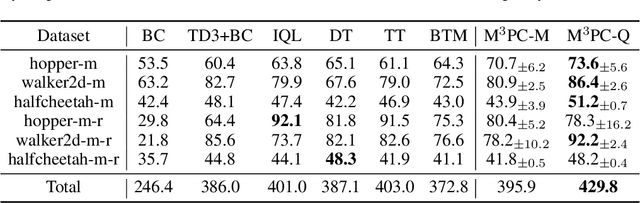

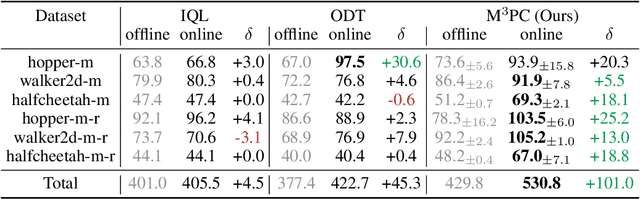
Recent work in Offline Reinforcement Learning (RL) has shown that a unified Transformer trained under a masked auto-encoding objective can effectively capture the relationships between different modalities (e.g., states, actions, rewards) within given trajectory datasets. However, this information has not been fully exploited during the inference phase, where the agent needs to generate an optimal policy instead of just reconstructing masked components from unmasked ones. Given that a pretrained trajectory model can act as both a Policy Model and a World Model with appropriate mask patterns, we propose using Model Predictive Control (MPC) at test time to leverage the model's own predictive capability to guide its action selection. Empirical results on D4RL and RoboMimic show that our inference-phase MPC significantly improves the decision-making performance of a pretrained trajectory model without any additional parameter training. Furthermore, our framework can be adapted to Offline to Online (O2O) RL and Goal Reaching RL, resulting in more substantial performance gains when an additional online interaction budget is provided, and better generalization capabilities when different task targets are specified. Code is available: https://github.com/wkh923/m3pc.
Only One Relation Possible? Modeling the Ambiguity in Event Temporal Relation Extraction
Aug 14, 2024Event Temporal Relation Extraction (ETRE) aims to identify the temporal relationship between two events, which plays an important role in natural language understanding. Most previous works follow a single-label classification style, classifying an event pair into either a specific temporal relation (e.g., \textit{Before}, \textit{After}), or a special label \textit{Vague} when there may be multiple possible temporal relations between the pair. In our work, instead of directly making predictions on \textit{Vague}, we propose a multi-label classification solution for ETRE (METRE) to infer the possibility of each temporal relation independently, where we treat \textit{Vague} as the cases when there is more than one possible relation between two events. We design a speculation mechanism to explore the possible relations hidden behind \textit{Vague}, which enables the latent information to be used efficiently. Experiments on TB-Dense, MATRES and UDS-T show that our method can effectively utilize the \textit{Vague} instances to improve the recognition for specific temporal relations and outperforms most state-of-the-art methods.
ELLA: Empowering LLMs for Interpretable, Accurate and Informative Legal Advice
Aug 13, 2024


Despite remarkable performance in legal consultation exhibited by legal Large Language Models(LLMs) combined with legal article retrieval components, there are still cases when the advice given is incorrect or baseless. To alleviate these problems, we propose {\bf ELLA}, a tool for {\bf E}mpowering {\bf L}LMs for interpretable, accurate, and informative {\bf L}egal {\bf A}dvice. ELLA visually presents the correlation between legal articles and LLM's response by calculating their similarities, providing users with an intuitive legal basis for the responses. Besides, based on the users' queries, ELLA retrieves relevant legal articles and displays them to users. Users can interactively select legal articles for LLM to generate more accurate responses. ELLA also retrieves relevant legal cases for user reference. Our user study shows that presenting the legal basis for the response helps users understand better. The accuracy of LLM's responses also improves when users intervene in selecting legal articles for LLM. Providing relevant legal cases also aids individuals in obtaining comprehensive information.