 Add to Chrome
 Add to Firefox
 Add to Edge
MemoryCPT: An End-to-End Agent Memory Framework for Cost-Performance Trade-off
Aug 05, 2026
Long-horizon LLM agents require memory systems that recover useful evidence from large interaction histories without passing excessive context to downstream models. Existing memory pipelines often rely on hand-crafted heuristics and repeated LLM calls, which can introduce redundant context and high inference cost. We propose MemoryCPT, an end-to-end trainable agent memory pipeline that spans offline memory construction and online query-conditioned context generation. MemoryCPT consists of two stages: Query-agnostic Distillation (QAD), which distills a modular memory-construction pipeline into a compact model using explicit reasoning traces; and Query-aware Retrieval and Summarization (QAR), which combines reciprocal rank fusion (RRF) with a LoRA-based summarizer trained via Group Relative Policy Optimization (GRPO) under a cost-aware reward. We further introduce Quality per Cost (QPC) to quantify answer quality per unit inference cost. Experiments on LoCoMo and LongMemEval show that MemoryCPT improves the cost-performance trade-off over the evaluated baselines, while ablation and sensitivity analyses characterize the contributions of its components and the effects of key design choices.

VideoChat3: Fully Open Video MLLM for Efficient and Generalist Video Understanding
Jul 16, 2026Recent advances in video understanding have spanned motion, long video, and streaming interaction, driving this field toward real-world applications. Despite this progress, current open-source models remain limited in several ways. They often struggle to generalize across diverse video types, making them effective only in specific domains. High computational demands further restrict their efficiency and scalability. Moreover, most models are only partially open, with key components such as training code, strategy, or datasets unavailable, which hinders reproducibility and slows community-driven development. To address these issues, we introduce VideoChat3, a fully open, efficient, and generalist video-centric MLLM. VideoChat3 advances video understanding through two complementary designs. For efficiency, we introduce Inflated 3D Vision Transformer (I3D-ViT) and Adaptive Frame Resolution for Streaming Video Perception, which enables efficient spatiotemporal representation and reduces the cost of processing video inputs during training and inference. For effectiveness, we develop a scalable video data synthesis pipeline that curates three diverse, high-quality training datasets: VideoChat3-Academic2M, VideoChat3-LV116K, and VideoChat3-OL617K, covering general, long-form, and streaming video scenarios, improving the model's generalization across domains. By integrating these designs, VideoChat3 achieves a rare balance of broad generalization and computational efficiency. Experiments across general, long-form, and streaming benchmarks demonstrate that VideoChat3 surpasses prior open-source models with equal or larger parameter counts with only 4B parameters and higher efficiency.
Thinking Without Images: Internalizing Visual Manipulation with On-Policy Self-Distillation
Jun 07, 2026''Thinking with Images'' has emerged as an effective paradigm for fine-grained visual reasoning: by explicitly zooming into relevant regions and reasoning over crops, models can access local evidence that is difficult to recover from a single global image. However, this benefit comes with redundant tool invocations and longer inference traces. Moreover, when such behaviors are learned mainly from outcome reward, the resulting intermediate crops or visual cues can be noisy or fail to faithfully capture task-relevant visual evidence. In this work, we ask whether the reasoning benefits of ''Thinking with Images'' can be internalized through Thinking with Imagination: an internal process that decides where to look and imagines what visual cues closer inspection would reveal without actually invoking tools. We propose Imagine-OPD, an on-policy self-distillation framework in which a teacher plays the role of a ''Thinking with Images'' reasoner during training: it receives privileged zoomed evidence views derived from annotated regions, and supervises the model's own imagination reasoning trajectories. Imagine-OPD does not require an external teacher or high-quality imagination demonstrations. Experiments on vision-centric benchmarks show that Imagine-OPD achieves the best average performance among compared models while significantly reducing inference overhead compared with ''Thinking with Images'' methods.
TimeChat-Captioner: Scripting Multi-Scene Videos with Time-Aware and Structural Audio-Visual Captions
Feb 09, 2026This paper proposes Omni Dense Captioning, a novel task designed to generate continuous, fine-grained, and structured audio-visual narratives with explicit timestamps. To ensure dense semantic coverage, we introduce a six-dimensional structural schema to create "script-like" captions, enabling readers to vividly imagine the video content scene by scene, akin to a cinematographic screenplay. To facilitate research, we construct OmniDCBench, a high-quality, human-annotated benchmark, and propose SodaM, a unified metric that evaluates time-aware detailed descriptions while mitigating scene boundary ambiguity. Furthermore, we construct a training dataset, TimeChatCap-42K, and present TimeChat-Captioner-7B, a strong baseline trained via SFT and GRPO with task-specific rewards. Extensive experiments demonstrate that TimeChat-Captioner-7B achieves state-of-the-art performance, surpassing Gemini-2.5-Pro, while its generated dense descriptions significantly boost downstream capabilities in audio-visual reasoning (DailyOmni and WorldSense) and temporal grounding (Charades-STA). All datasets, models, and code will be made publicly available at https://github.com/yaolinli/TimeChat-Captioner.
Kimi K2.5: Visual Agentic Intelligence
Feb 02, 2026We introduce Kimi K2.5, an open-source multimodal agentic model designed to advance general agentic intelligence. K2.5 emphasizes the joint optimization of text and vision so that two modalities enhance each other. This includes a series of techniques such as joint text-vision pre-training, zero-vision SFT, and joint text-vision reinforcement learning. Building on this multimodal foundation, K2.5 introduces Agent Swarm, a self-directed parallel agent orchestration framework that dynamically decomposes complex tasks into heterogeneous sub-problems and executes them concurrently. Extensive evaluations show that Kimi K2.5 achieves state-of-the-art results across various domains including coding, vision, reasoning, and agentic tasks. Agent Swarm also reduces latency by up to $4.5\times$ over single-agent baselines. We release the post-trained Kimi K2.5 model checkpoint to facilitate future research and real-world applications of agentic intelligence.
Video-o3: Native Interleaved Clue Seeking for Long Video Multi-Hop Reasoning
Jan 30, 2026Existing multimodal large language models for long-video understanding predominantly rely on uniform sampling and single-turn inference, limiting their ability to identify sparse yet critical evidence amid extensive redundancy. We introduce Video-o3, a novel framework that supports iterative discovery of salient visual clues, fine-grained inspection of key segments, and adaptive termination once sufficient evidence is acquired. Technically, we address two core challenges in interleaved tool invocation. First, to mitigate attention dispersion induced by the heterogeneity of reasoning and tool-calling, we propose Task-Decoupled Attention Masking, which isolates per-step concentration while preserving shared global context. Second, to control context length growth in multi-turn interactions, we introduce a Verifiable Trajectory-Guided Reward that balances exploration coverage with reasoning efficiency. To support training at scale, we further develop a data synthesis pipeline and construct Seeker-173K, comprising 173K high-quality tool-interaction trajectories for effective supervised and reinforcement learning. Extensive experiments show that Video-o3 substantially outperforms state-of-the-art methods, achieving 72.1% accuracy on MLVU and 46.5% on Video-Holmes. These results demonstrate Video-o3's strong multi-hop evidence-seeking and reasoning capabilities, and validate the effectiveness of native tool invocation in long-video scenarios.
Conan: Progressive Learning to Reason Like a Detective over Multi-Scale Visual Evidence
Oct 23, 2025Video reasoning, which requires multi-step deduction across frames, remains a major challenge for multimodal large language models (MLLMs). While reinforcement learning (RL)-based methods enhance reasoning capabilities, they often rely on text-only chains that yield ungrounded or hallucinated conclusions. Conversely, frame-retrieval approaches introduce visual grounding but still struggle with inaccurate evidence localization. To address these challenges, we present Conan, a framework for evidence-grounded multi-step video reasoning. Conan identifies contextual and evidence frames, reasons over cross-frame clues, and adaptively decides when to conclude or explore further. To achieve this, we (1) construct Conan-91K, a large-scale dataset of automatically generated reasoning traces that includes frame identification, evidence reasoning, and action decision, and (2) design a multi-stage progressive cold-start strategy combined with an Identification-Reasoning-Action (AIR) RLVR training framework to jointly enhance multi-step visual reasoning. Extensive experiments on six multi-step reasoning benchmarks demonstrate that Conan surpasses the baseline Qwen2.5-VL-7B-Instruct by an average of over 10% in accuracy, achieving state-of-the-art performance. Furthermore, Conan generalizes effectively to long-video understanding tasks, validating its strong scalability and robustness.
VideoReasonBench: Can MLLMs Perform Vision-Centric Complex Video Reasoning?
May 29, 2025Recent studies have shown that long chain-of-thought (CoT) reasoning can significantly enhance the performance of large language models (LLMs) on complex tasks. However, this benefit is yet to be demonstrated in the domain of video understanding, since most existing benchmarks lack the reasoning depth required to demonstrate the advantages of extended CoT chains. While recent efforts have proposed benchmarks aimed at video reasoning, the tasks are often knowledge-driven and do not rely heavily on visual content. To bridge this gap, we introduce VideoReasonBench, a benchmark designed to evaluate vision-centric, complex video reasoning. To ensure visual richness and high reasoning complexity, each video in VideoReasonBench depicts a sequence of fine-grained operations on a latent state that is only visible in part of the video. The questions evaluate three escalating levels of video reasoning skills: recalling observed visual information, inferring the content of latent states, and predicting information beyond the video. Under such task setting, models have to precisely recall multiple operations in the video, and perform step-by-step reasoning to get correct final answers for these questions. Using VideoReasonBench, we comprehensively evaluate 18 state-of-the-art multimodal LLMs (MLLMs), finding that most perform poorly on complex video reasoning, e.g., GPT-4o achieves only 6.9% accuracy, while the thinking-enhanced Gemini-2.5-Pro significantly outperforms others with 56.0% accuracy. Our investigations on "test-time scaling" further reveal that extended thinking budget, while offering none or minimal benefits on existing video benchmarks, is essential for improving the performance on VideoReasonBench.
TimeChat-Online: 80% Visual Tokens are Naturally Redundant in Streaming Videos
Apr 24, 2025The rapid growth of online video platforms, particularly live streaming services, has created an urgent need for real-time video understanding systems. These systems must process continuous video streams and respond to user queries instantaneously, presenting unique challenges for current Video Large Language Models (VideoLLMs). While existing VideoLLMs excel at processing complete videos, they face significant limitations in streaming scenarios due to their inability to handle dense, redundant frames efficiently. We introduce TimeChat-Online, a novel online VideoLLM that revolutionizes real-time video interaction. At its core lies our innovative Differential Token Drop (DTD) module, which addresses the fundamental challenge of visual redundancy in streaming videos. Drawing inspiration from human visual perception's Change Blindness phenomenon, DTD preserves meaningful temporal changes while filtering out static, redundant content between frames. Remarkably, our experiments demonstrate that DTD achieves an 82.8% reduction in video tokens while maintaining 98% performance on StreamingBench, revealing that over 80% of visual content in streaming videos is naturally redundant without requiring language guidance. To enable seamless real-time interaction, we present TimeChat-Online-139K, a comprehensive streaming video dataset featuring diverse interaction patterns including backward-tracing, current-perception, and future-responding scenarios. TimeChat-Online's unique Proactive Response capability, naturally achieved through continuous monitoring of video scene transitions via DTD, sets it apart from conventional approaches. Our extensive evaluation demonstrates TimeChat-Online's superior performance on streaming benchmarks (StreamingBench and OvOBench) and maintaining competitive results on long-form video tasks such as Video-MME and MLVU.
Kimi-VL Technical Report
Apr 10, 2025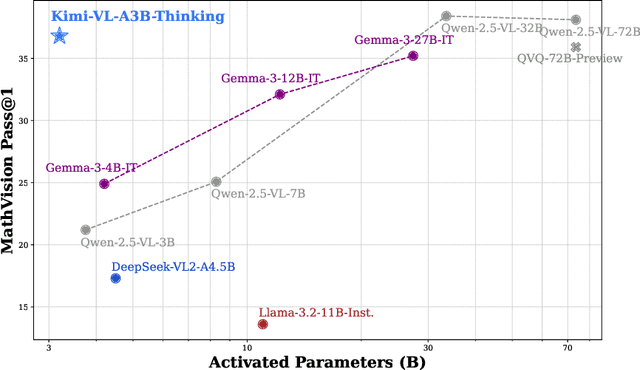
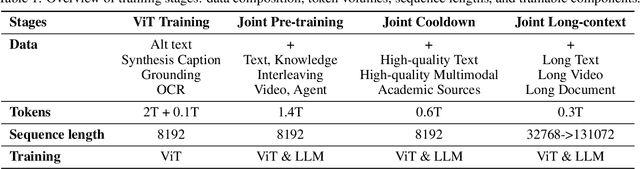
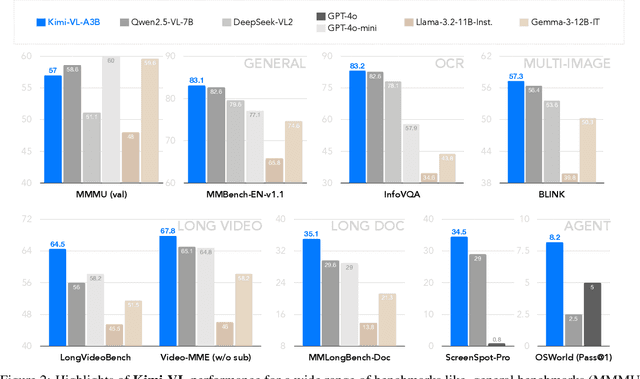

We present Kimi-VL, an efficient open-source Mixture-of-Experts (MoE) vision-language model (VLM) that offers advanced multimodal reasoning, long-context understanding, and strong agent capabilities - all while activating only 2.8B parameters in its language decoder (Kimi-VL-A3B). Kimi-VL demonstrates strong performance across challenging domains: as a general-purpose VLM, Kimi-VL excels in multi-turn agent tasks (e.g., OSWorld), matching flagship models. Furthermore, it exhibits remarkable capabilities across diverse challenging vision language tasks, including college-level image and video comprehension, OCR, mathematical reasoning, and multi-image understanding. In comparative evaluations, it effectively competes with cutting-edge efficient VLMs such as GPT-4o-mini, Qwen2.5-VL-7B, and Gemma-3-12B-IT, while surpassing GPT-4o in several key domains. Kimi-VL also advances in processing long contexts and perceiving clearly. With a 128K extended context window, Kimi-VL can process diverse long inputs, achieving impressive scores of 64.5 on LongVideoBench and 35.1 on MMLongBench-Doc. Its native-resolution vision encoder, MoonViT, further allows it to see and understand ultra-high-resolution visual inputs, achieving 83.2 on InfoVQA and 34.5 on ScreenSpot-Pro, while maintaining lower computational cost for common tasks. Building upon Kimi-VL, we introduce an advanced long-thinking variant: Kimi-VL-Thinking. Developed through long chain-of-thought (CoT) supervised fine-tuning (SFT) and reinforcement learning (RL), this model exhibits strong long-horizon reasoning capabilities. It achieves scores of 61.7 on MMMU, 36.8 on MathVision, and 71.3 on MathVista while maintaining the compact 2.8B activated LLM parameters, setting a new standard for efficient multimodal thinking models. Code and models are publicly accessible at https://github.com/MoonshotAI/Kimi-VL.