 Add to Chrome
 Add to Firefox
 Add to Edge
TimeLens2: Generalist Video Temporal Grounding with Multimodal LLMs
Jul 19, 2026
Video multimodal large language models (MLLMs) can describe what happens in a video, but rarely identify when the supporting evidence occurs. We study generalist video temporal grounding, in which one model predicts a variable-cardinality set of evidence intervals across video lengths, domains, query forms, and viewpoints. Existing training strategies are misaligned with this set-valued task: long-video labels often rely on brittle one-pass annotation, while reinforcement-learning rewards either fail to distinguish non-overlapping predictions or require fragile segment matching. TimeLens2 treats temporal evidence as an interval set throughout supervision and optimization. TimeLens2-93K constructs reliable multi-span supervision through caption-derived proposals, independent localization, cross-agent consensus, semantic verification, and boundary refinement. Our temporal Wasserstein reward computes exact one-dimensional \(W_1\) between uniform distributions over merged interval supports, providing dense, matching-free feedback under unequal cardinalities and equivalent fragmentation; temporal IoU complements it with precise-overlap feedback. Across seven benchmarks, TimeLens2-2B outperforms all size-matched baselines on every benchmark, while the 4B and 8B variants achieve state-of-the-art performance, surpassing open-source models with up to 397B parameters. The 2B, 4B, and 8B variants improve over their Qwen3-VL backbones by 14.2, 13.0, and 18.1 mIoU points, respectively.

SER: Learning to Ground Video Reasoning with Semantic Evidence Rewards
Jun 23, 2026Video MLLMs often struggle with fine-grained spatio-temporal reasoning, sometimes generating correct answers based on irrelevant frames or objects. Although outputting spatio-temporal evidence during reasoning is a promising direction, existing RL frameworks typically rely on geometry-only (IoU) rewards, which can be sensitive to boundary perturbations and overlook semantic alignment. To address this, we propose Semantic Evidence Reward (SER), which reformulates spatio-temporal evidence grounding as a constrained verification task. Instead of computing pixel-level overlap, SER uses a referee VLM as a local checker to evaluate model-generated evidence claims across two dimensions: relevance and localization quality, combined with a temporal penalty. This design reduces the reliance on dense box annotations and enables training directly on standard video QA data. On the V-STAR benchmark, SER achieves 49.6% mLGM, improving by 3.0 points over the strong evidence-grounded baseline Open-o3-Video, demonstrating its potential in enhancing both answer accuracy and evidence grounding.
InternVideo3: Agentify Foundation Models with Multimodal Contextual Reasoning
Jun 10, 2026Recent progress in foundation models has shifted toward agentic behavior involving multi-step reasoning and tool use. However, open-source efforts largely focus on text-dominant settings, leaving long-horizon multimodal tasks underexplored. This gap is evident in video tasks requiring sustained temporal understanding and iterative interaction. We present InternVideo3, a framework enhancing these capabilities via Multimodal Contextual Reasoning (MCR). MCR treats understanding as a closed-loop process over a shared, evolving context containing observations, instructions, reasoning, tool actions, and memory. This frames long-video understanding as evidence accumulation and verification. To ensure efficiency, we introduce Multimodal Multi-head Latent Attention (M^2LA), a token-preserving reparameterization compressing KV-cache states while retaining the full token stream. Our staged training includes continued pretraining, short-to-long supervised fine-tuning, rule-based reinforcement learning, and on-policy distillation. Experiments show InternVideo3 achieves strong performance on benchmarks like Video-MME, MLVU, and EgoSchema. We further instantiate the model as a video agent with retrieval tools, demonstrating robust evidence-grounded behavior. Our results suggest that efficient context handling and closed-loop reasoning are vital for adapting open multimodal models toward long-horizon visually grounded agency.
Imagine Before You Predict: Interleaved Latent Visual Reasoning for Video Event Prediction
Jun 04, 2026Video event prediction (VEP) requires models to infer unobserved future states from partial video evidence. Existing video MLLMs usually verbalize intermediate future reasoning in text space: once visual evidence is verbalized, fine-grained motion, geometry, and interaction cues can be lost, leading to plausible but visually ungrounded hallucinations. We introduce Future-L1, an interleaved latent visual reasoning framework that lets an MLLM alternate between language tokens and continuous latent visual spans during autoregressive decoding. To train this capability, we construct Future-L1-50K by selecting examples where future visual hints help prediction and align latent states to future-frame embeddings, then further optimize sampled latent trajectories with LA-DAPO, a latent-aware RL objective with outcome-contrastive and temporal-diversity rewards. Future-L1 achieves new state-of-the-art results on both benchmarks: on FutureBench, it improves Qwen3-VL-8B from 61.0 to 85.4 and exceeds the previous best Video-CoE by 10.4 points; on TwiFF-Bench, it improves the average score from 2.44 to 3.04. These results suggest that future-oriented video reasoning benefits from preserving intermediate visual semantics in latent space rather than translating every reasoning step into text.
RIVER: A Real-Time Interaction Benchmark for Video LLMs
Mar 04, 2026The rapid advancement of multimodal large language models has demonstrated impressive capabilities, yet nearly all operate in an offline paradigm, hindering real-time interactivity. Addressing this gap, we introduce the Real-tIme Video intERaction Bench (RIVER Bench), designed for evaluating online video comprehension. RIVER Bench introduces a novel framework comprising Retrospective Memory, Live-Perception, and Proactive Anticipation tasks, closely mimicking interactive dialogues rather than responding to entire videos at once. We conducted detailed annotations using videos from diverse sources and varying lengths, and precisely defined the real-time interactive format. Evaluations across various model categories reveal that while offline models perform well in single question-answering tasks, they struggle with real-time processing. Addressing the limitations of existing models in online video interaction, especially their deficiencies in long-term memory and future perception, we proposed a general improvement method that enables models to interact with users more flexibly in real time. We believe this work will significantly advance the development of real-time interactive video understanding models and inspire future research in this emerging field. Datasets and code are publicly available at https://github.com/OpenGVLab/RIVER.
Video-o3: Native Interleaved Clue Seeking for Long Video Multi-Hop Reasoning
Jan 30, 2026Existing multimodal large language models for long-video understanding predominantly rely on uniform sampling and single-turn inference, limiting their ability to identify sparse yet critical evidence amid extensive redundancy. We introduce Video-o3, a novel framework that supports iterative discovery of salient visual clues, fine-grained inspection of key segments, and adaptive termination once sufficient evidence is acquired. Technically, we address two core challenges in interleaved tool invocation. First, to mitigate attention dispersion induced by the heterogeneity of reasoning and tool-calling, we propose Task-Decoupled Attention Masking, which isolates per-step concentration while preserving shared global context. Second, to control context length growth in multi-turn interactions, we introduce a Verifiable Trajectory-Guided Reward that balances exploration coverage with reasoning efficiency. To support training at scale, we further develop a data synthesis pipeline and construct Seeker-173K, comprising 173K high-quality tool-interaction trajectories for effective supervised and reinforcement learning. Extensive experiments show that Video-o3 substantially outperforms state-of-the-art methods, achieving 72.1% accuracy on MLVU and 46.5% on Video-Holmes. These results demonstrate Video-o3's strong multi-hop evidence-seeking and reasoning capabilities, and validate the effectiveness of native tool invocation in long-video scenarios.
LaViT: Aligning Latent Visual Thoughts for Multi-modal Reasoning
Jan 15, 2026Current multimodal latent reasoning often relies on external supervision (e.g., auxiliary images), ignoring intrinsic visual attention dynamics. In this work, we identify a critical Perception Gap in distillation: student models frequently mimic a teacher's textual output while attending to fundamentally divergent visual regions, effectively relying on language priors rather than grounded perception. To bridge this, we propose LaViT, a framework that aligns latent visual thoughts rather than static embeddings. LaViT compels the student to autoregressively reconstruct the teacher's visual semantics and attention trajectories prior to text generation, employing a curriculum sensory gating mechanism to prevent shortcut learning. Extensive experiments show that LaViT significantly enhances visual grounding, achieving up to +16.9% gains on complex reasoning tasks and enabling a compact 3B model to outperform larger open-source variants and proprietary models like GPT-4o.
Make Your Training Flexible: Towards Deployment-Efficient Video Models
Mar 18, 2025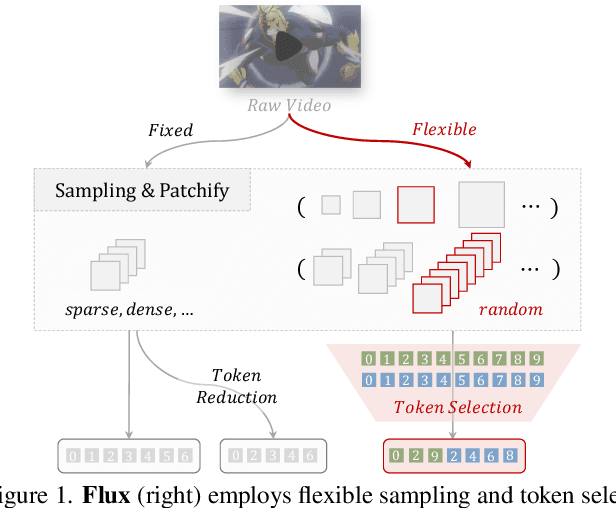
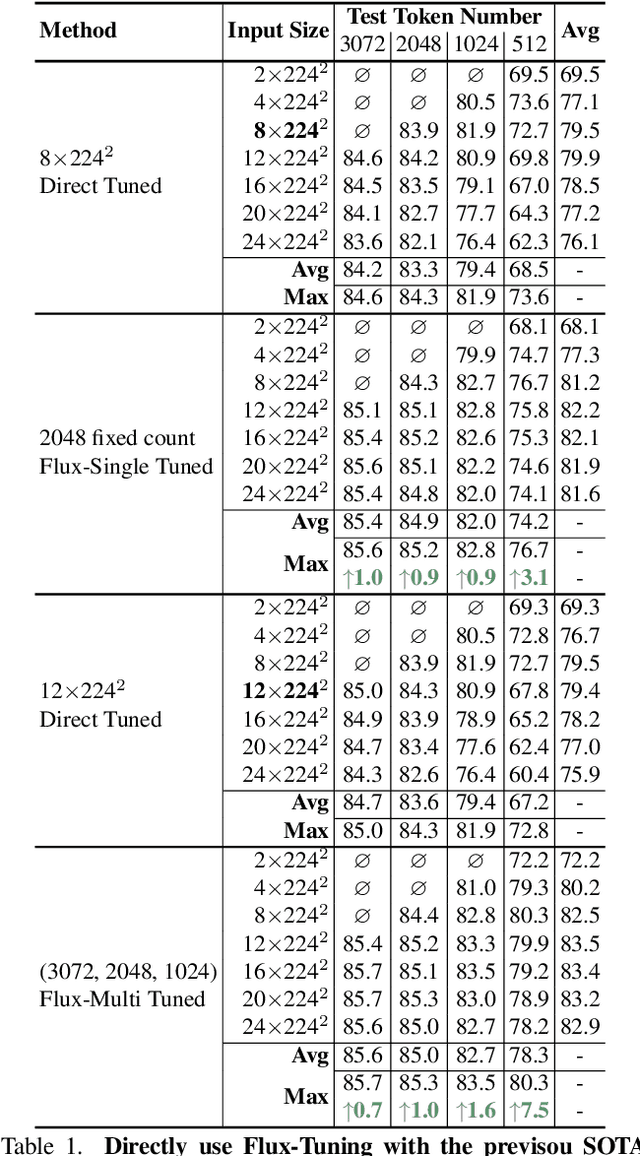
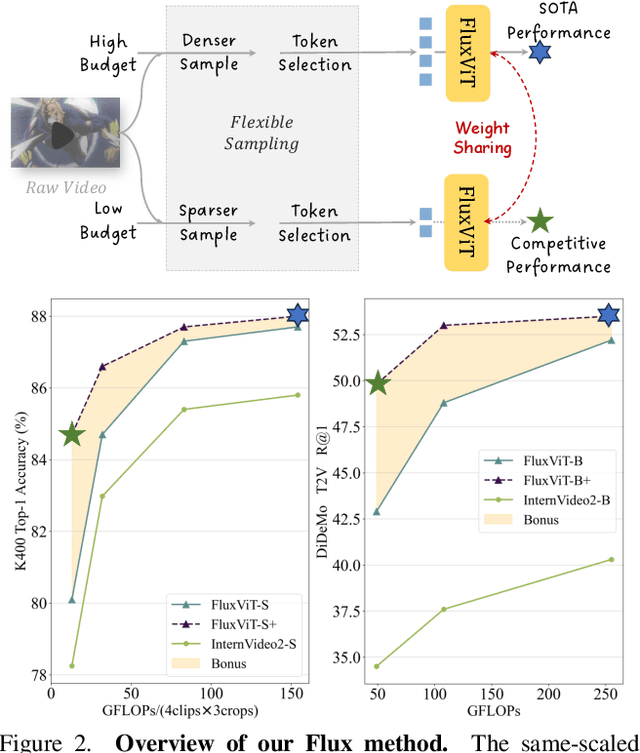

Popular video training methods mainly operate on a fixed number of tokens sampled from a predetermined spatiotemporal grid, resulting in sub-optimal accuracy-computation trade-offs due to inherent video redundancy. They also lack adaptability to varying computational budgets for downstream tasks, hindering applications of the most competitive model in real-world scenes. We thus propose a new test setting, Token Optimization, for maximized input information across budgets, which optimizes the size-limited set of input tokens through token selection from more suitably sampled videos. To this end, we propose a novel augmentation tool termed Flux. By making the sampling grid flexible and leveraging token selection, it is easily adopted in most popular video training frameworks, boosting model robustness with nearly no additional cost. We integrate Flux in large-scale video pre-training, and the resulting FluxViT establishes new state-of-the-art results across extensive tasks at standard costs. Notably, with 1/4 tokens only, it can still match the performance of previous state-of-the-art models with Token Optimization, yielding nearly 90\% savings. All models and data are available at https://github.com/OpenGVLab/FluxViT.
TimeSuite: Improving MLLMs for Long Video Understanding via Grounded Tuning
Oct 25, 2024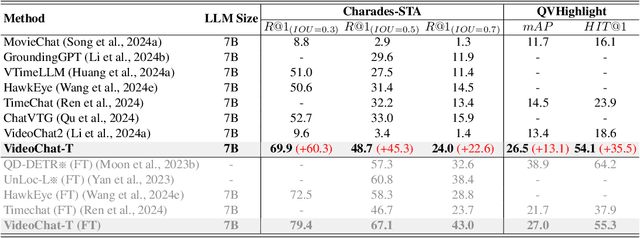
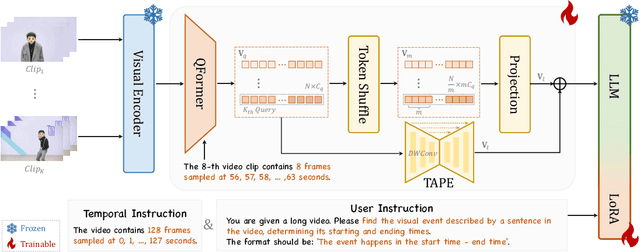
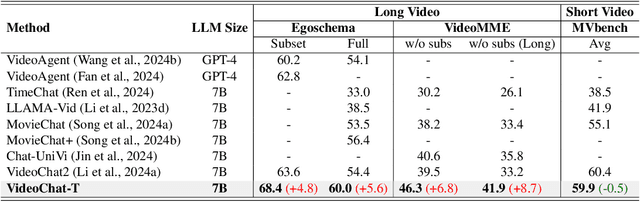
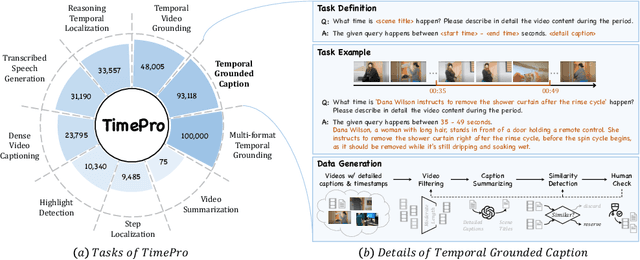
Multimodal Large Language Models (MLLMs) have demonstrated impressive performance in short video understanding. However, understanding long-form videos still remains challenging for MLLMs. This paper proposes TimeSuite, a collection of new designs to adapt the existing short-form video MLLMs for long video understanding, including a simple yet efficient framework to process long video sequence, a high-quality video dataset for grounded tuning of MLLMs, and a carefully-designed instruction tuning task to explicitly incorporate the grounding supervision in the traditional QA format. Specifically, based on VideoChat, we propose our long-video MLLM, coined as VideoChat-T, by implementing a token shuffling to compress long video tokens and introducing Temporal Adaptive Position Encoding (TAPE) to enhance the temporal awareness of visual representation. Meanwhile, we introduce the TimePro, a comprehensive grounding-centric instruction tuning dataset composed of 9 tasks and 349k high-quality grounded annotations. Notably, we design a new instruction tuning task type, called Temporal Grounded Caption, to peform detailed video descriptions with the corresponding time stamps prediction. This explicit temporal location prediction will guide MLLM to correctly attend on the visual content when generating description, and thus reduce the hallucination risk caused by the LLMs. Experimental results demonstrate that our TimeSuite provides a successful solution to enhance the long video understanding capability of short-form MLLM, achieving improvement of 5.6% and 6.8% on the benchmarks of Egoschema and VideoMME, respectively. In addition, VideoChat-T exhibits robust zero-shot temporal grounding capabilities, significantly outperforming the existing state-of-the-art MLLMs. After fine-tuning, it performs on par with the traditional supervised expert models.
Dynamic Resolution Guidance for Facial Expression Recognition
Apr 09, 2024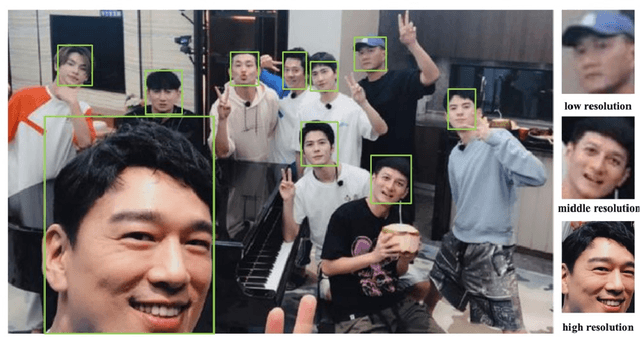
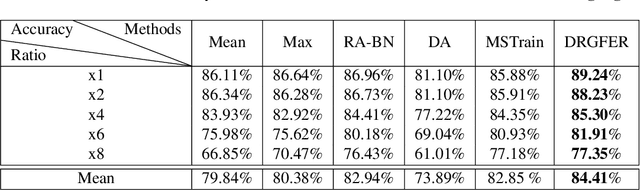
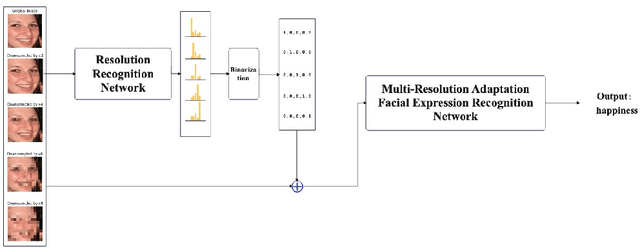
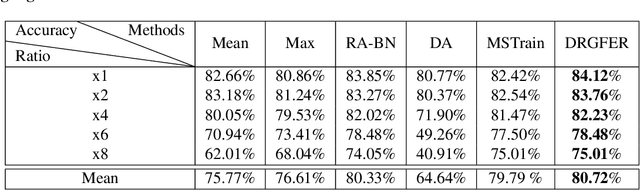
Facial expression recognition (FER) is vital for human-computer interaction and emotion analysis, yet recognizing expressions in low-resolution images remains challenging. This paper introduces a practical method called Dynamic Resolution Guidance for Facial Expression Recognition (DRGFER) to effectively recognize facial expressions in images with varying resolutions without compromising FER model accuracy. Our framework comprises two main components: the Resolution Recognition Network (RRN) and the Multi-Resolution Adaptation Facial Expression Recognition Network (MRAFER). The RRN determines image resolution, outputs a binary vector, and the MRAFER assigns images to suitable facial expression recognition networks based on resolution. We evaluated DRGFER on widely-used datasets RAFDB and FERPlus, demonstrating that our method retains optimal model performance at each resolution and outperforms alternative resolution approaches. The proposed framework exhibits robustness against resolution variations and facial expressions, offering a promising solution for real-world applications.