 Add to Chrome
 Add to Firefox
 Add to Edge
MemoryCPT: An End-to-End Agent Memory Framework for Cost-Performance Trade-off
Aug 05, 2026
Long-horizon LLM agents require memory systems that recover useful evidence from large interaction histories without passing excessive context to downstream models. Existing memory pipelines often rely on hand-crafted heuristics and repeated LLM calls, which can introduce redundant context and high inference cost. We propose MemoryCPT, an end-to-end trainable agent memory pipeline that spans offline memory construction and online query-conditioned context generation. MemoryCPT consists of two stages: Query-agnostic Distillation (QAD), which distills a modular memory-construction pipeline into a compact model using explicit reasoning traces; and Query-aware Retrieval and Summarization (QAR), which combines reciprocal rank fusion (RRF) with a LoRA-based summarizer trained via Group Relative Policy Optimization (GRPO) under a cost-aware reward. We further introduce Quality per Cost (QPC) to quantify answer quality per unit inference cost. Experiments on LoCoMo and LongMemEval show that MemoryCPT improves the cost-performance trade-off over the evaluated baselines, while ablation and sensitivity analyses characterize the contributions of its components and the effects of key design choices.

Trip+: Benchmarking Agents in Personalized Interactive Travel Planning
Jun 19, 2026Interactive travel planning has become a popular use case for language models. Agents are deployed to manage evolving preferences and unexpected disruptions over multiple turns. Such settings require models to make complex, profile-conditioned planning decisions. However, existing benchmarks often evaluate feasibility, personalization, or interaction in relatively isolated settings. We therefore introduce Trip+ to measure the ability of agents to plan travel holistically. In Trip+, given traveler profiles and dynamic interactions, agents must generate and revise minute-level itineraries. End-to-end traveler experiences are evaluated via an LLM-based simulator, enabling the assessment of subjective metrics like fatigue. Our scenarios range from simple request resolutions to complex environment-driven replanning. We evaluate 18 LMs and find a consistent gap in experiential quality. Models favor technically feasible but exhausting itineraries that diverge sharply from profiled traveler preferences.
M$^3$Exam: Benchmarking Multimodal Memory for Realistic User-Agent Interactions
Jun 05, 2026Language agents are increasingly deployed over accumulating multimodal information, yet existing benchmarks assume a human-human form with sparse visuals and straightforward content, evaluating neither reasoning over authentic multimodal file interaction nor the interpretation of concealed user information. We therefore introduce M$^3$Exam, a query-centric multimodal conversational memory benchmark built on realistic user-agent interaction, with multi-dimensional evaluation spanning cross-modal grounding and implicit information inference. Benchmarking MLLMs and memory systems reveals persistent gaps in cross-modal grounding, cross session reasoning, and the efficiency cost of accumulating multimodal context. We further propose M$^3$Proctor, a multimodal memory method that detects query modality bias and consumes raw visual sources only on demand, improving accuracy by 13% while cutting index-construction time and retrieved tokens by over 70%.
LifeSide: Benchmarking Agents as Lifelong Digital Companions
Jun 03, 2026Lifelong digital companions must integrate cross-session cues, continually update their understanding of users, and adapt to shifting privacy boundaries. Existing evaluations fail to capture this, testing memory recall and short-term empathy in isolation. To bridge this gap, we introduce \benchmark, a benchmark centered on multi-session \textit{Memory-Emotion-Environment} loops. By modeling users as persistent worlds with layered profiles and event trajectories, \benchmark uses multi-agent simulation to project environmental dynamics into dialogue, preserving the critical gap between latent thoughts and observable expressions. Evaluating 2,000 personas and 111K tasks across memory tracking, user understanding, privacy control, and emotional companionship, our experiment results reveal a stark reality: even models that saturate current memory benchmarks fail to sustain accurate user understanding and true companionship over long horizons.
Back to Basics: Let Conversational Agents Remember with Just Retrieval and Generation
Apr 13, 2026Existing conversational memory systems rely on complex hierarchical summarization or reinforcement learning to manage long-term dialogue history, yet remain vulnerable to context dilution as conversations grow. In this work, we offer a different perspective: the primary bottleneck may lie not in memory architecture, but in the \textit{Signal Sparsity Effect} within the latent knowledge manifold. Through controlled experiments, we identify two key phenomena: \textit{Decisive Evidence Sparsity}, where relevant signals become increasingly isolated with longer sessions, leading to sharp degradation in aggregation-based methods; and \textit{Dual-Level Redundancy}, where both inter-session interference and intra-session conversational filler introduce large amounts of non-informative content, hindering effective generation. Motivated by these insights, we propose \method, a minimalist framework that brings conversational memory back to basics, relying solely on retrieval and generation via Turn Isolation Retrieval (TIR) and Query-Driven Pruning (QDP). TIR replaces global aggregation with a max-activation strategy to capture turn-level signals, while QDP removes redundant sessions and conversational filler to construct a compact, high-density evidence set. Extensive experiments on multiple benchmarks demonstrate that \method achieves robust performance across diverse settings, consistently outperforming strong baselines while maintaining high efficiency in tokens and latency, establishing a new minimalist baseline for conversational memory.
UrbanFM: Scaling Urban Spatio-Temporal Foundation Models
Feb 24, 2026Urban systems, as dynamic complex systems, continuously generate spatio-temporal data streams that encode the fundamental laws of human mobility and city evolution. While AI for Science has witnessed the transformative power of foundation models in disciplines like genomics and meteorology, urban computing remains fragmented due to "scenario-specific" models, which are overfitted to specific regions or tasks, hindering their generalizability. To bridge this gap and advance spatio-temporal foundation models for urban systems, we adopt scaling as the central perspective and systematically investigate two key questions: what to scale and how to scale. Grounded in first-principles analysis, we identify three critical dimensions: heterogeneity, correlation, and dynamics, aligning these principles with the fundamental scientific properties of urban spatio-temporal data. Specifically, to address heterogeneity through data scaling, we construct WorldST. This billion-scale corpus standardizes diverse physical signals, such as traffic flow and speed, from over 100 global cities into a unified data format. To enable computation scaling for modeling correlations, we introduce the MiniST unit, a novel split mechanism that discretizes continuous spatio-temporal fields into learnable computational units to unify representations of grid-based and sensor-based observations. Finally, addressing dynamics via architecture scaling, we propose UrbanFM, a minimalist self-attention architecture designed with limited inductive biases to autonomously learn dynamic spatio-temporal dependencies from massive data. Furthermore, we establish EvalST, the largest-scale urban spatio-temporal benchmark to date. Extensive experiments demonstrate that UrbanFM achieves remarkable zero-shot generalization across unseen cities and tasks, marking a pivotal first step toward large-scale urban spatio-temporal foundation models.
Learning from Complexity: Exploring Dynamic Sample Pruning of Spatio-Temporal Training
Feb 22, 2026Spatio-temporal forecasting is fundamental to intelligent systems in transportation, climate science, and urban planning. However, training deep learning models on the massive, often redundant, datasets from these domains presents a significant computational bottleneck. Existing solutions typically focus on optimizing model architectures or optimizers, while overlooking the inherent inefficiency of the training data itself. This conventional approach of iterating over the entire static dataset each epoch wastes considerable resources on easy-to-learn or repetitive samples. In this paper, we explore a novel training-efficiency techniques, namely learning from complexity with dynamic sample pruning, ST-Prune, for spatio-temporal forecasting. Through dynamic sample pruning, we aim to intelligently identify the most informative samples based on the model's real-time learning state, thereby accelerating convergence and improving training efficiency. Extensive experiments conducted on real-world spatio-temporal datasets show that ST-Prune significantly accelerates the training speed while maintaining or even improving the model performance, and it also has scalability and universality.
Rationale-Grounded In-Context Learning for Time Series Reasoning with Multimodal Large Language Models
Jan 06, 2026The underperformance of existing multimodal large language models for time series reasoning lies in the absence of rationale priors that connect temporal observations to their downstream outcomes, which leads models to rely on superficial pattern matching rather than principled reasoning. We therefore propose the rationale-grounded in-context learning for time series reasoning, where rationales work as guiding reasoning units rather than post-hoc explanations, and develop the RationaleTS method. Specifically, we firstly induce label-conditioned rationales, composed of reasoning paths from observable evidence to the potential outcomes. Then, we design the hybrid retrieval by balancing temporal patterns and semantic contexts to retrieve correlated rationale priors for the final in-context inference on new samples. We conduct extensive experiments to demonstrate the effectiveness and efficiency of our proposed RationaleTS on three-domain time series reasoning tasks. We will release our code for reproduction.
Co-Learning: Code Learning for Multi-Agent Reinforcement Collaborative Framework with Conversational Natural Language Interfaces
Sep 02, 2024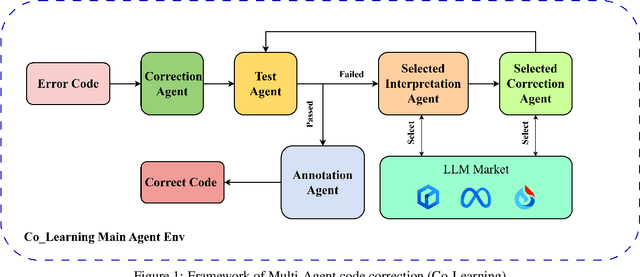

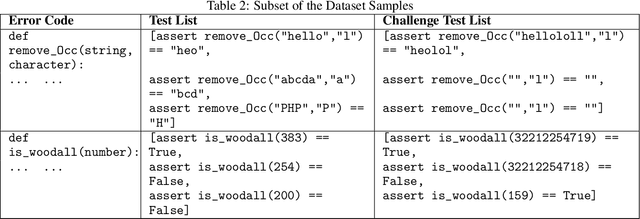
Online question-and-answer (Q\&A) systems based on the Large Language Model (LLM) have progressively diverged from recreational to professional use. This paper proposed a Multi-Agent framework with environmentally reinforcement learning (E-RL) for code correction called Code Learning (Co-Learning) community, assisting beginners to correct code errors independently. It evaluates the performance of multiple LLMs from an original dataset with 702 error codes, uses it as a reward or punishment criterion for E-RL; Analyzes input error codes by the current agent; selects the appropriate LLM-based agent to achieve optimal error correction accuracy and reduce correction time. Experiment results showed that 3\% improvement in Precision score and 15\% improvement in time cost as compared with no E-RL method respectively. Our source code is available at: https://github.com/yuqian2003/Co_Learning
Deep Feature Embedding for Tabular Data
Aug 30, 2024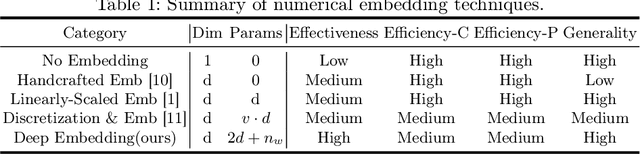
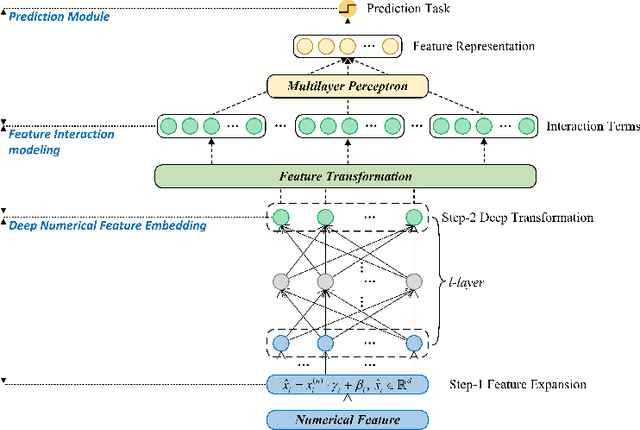

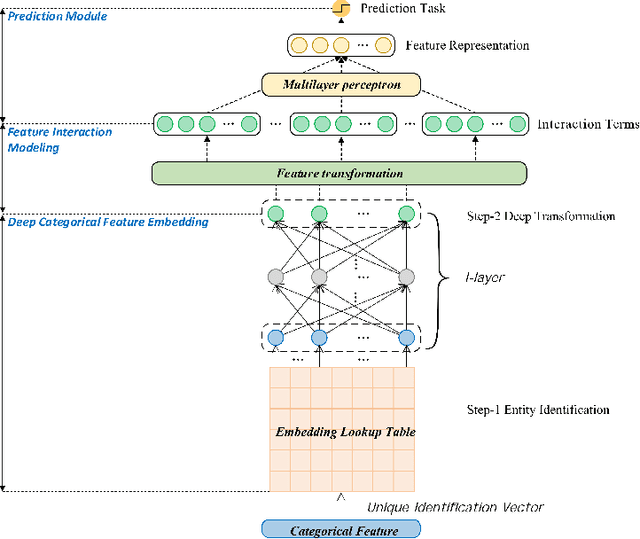
Tabular data learning has extensive applications in deep learning but its existing embedding techniques are limited in numerical and categorical features such as the inability to capture complex relationships and engineering. This paper proposes a novel deep embedding framework with leverages lightweight deep neural networks to generate effective feature embeddings for tabular data in machine learning research. For numerical features, a two-step feature expansion and deep transformation technique is used to capture copious semantic information. For categorical features, a unique identification vector for each entity is referred by a compact lookup table with a parameterized deep embedding function to uniform the embedding size dimensions, and transformed into a embedding vector using deep neural network. Experiments are conducted on real-world datasets for performance evaluation.