 Add to Chrome
 Add to Firefox
 Add to Edge
TimeLens2: Generalist Video Temporal Grounding with Multimodal LLMs
Jul 19, 2026
Video multimodal large language models (MLLMs) can describe what happens in a video, but rarely identify when the supporting evidence occurs. We study generalist video temporal grounding, in which one model predicts a variable-cardinality set of evidence intervals across video lengths, domains, query forms, and viewpoints. Existing training strategies are misaligned with this set-valued task: long-video labels often rely on brittle one-pass annotation, while reinforcement-learning rewards either fail to distinguish non-overlapping predictions or require fragile segment matching. TimeLens2 treats temporal evidence as an interval set throughout supervision and optimization. TimeLens2-93K constructs reliable multi-span supervision through caption-derived proposals, independent localization, cross-agent consensus, semantic verification, and boundary refinement. Our temporal Wasserstein reward computes exact one-dimensional \(W_1\) between uniform distributions over merged interval supports, providing dense, matching-free feedback under unequal cardinalities and equivalent fragmentation; temporal IoU complements it with precise-overlap feedback. Across seven benchmarks, TimeLens2-2B outperforms all size-matched baselines on every benchmark, while the 4B and 8B variants achieve state-of-the-art performance, surpassing open-source models with up to 397B parameters. The 2B, 4B, and 8B variants improve over their Qwen3-VL backbones by 14.2, 13.0, and 18.1 mIoU points, respectively.

VideoChat3: Fully Open Video MLLM for Efficient and Generalist Video Understanding
Jul 16, 2026Recent advances in video understanding have spanned motion, long video, and streaming interaction, driving this field toward real-world applications. Despite this progress, current open-source models remain limited in several ways. They often struggle to generalize across diverse video types, making them effective only in specific domains. High computational demands further restrict their efficiency and scalability. Moreover, most models are only partially open, with key components such as training code, strategy, or datasets unavailable, which hinders reproducibility and slows community-driven development. To address these issues, we introduce VideoChat3, a fully open, efficient, and generalist video-centric MLLM. VideoChat3 advances video understanding through two complementary designs. For efficiency, we introduce Inflated 3D Vision Transformer (I3D-ViT) and Adaptive Frame Resolution for Streaming Video Perception, which enables efficient spatiotemporal representation and reduces the cost of processing video inputs during training and inference. For effectiveness, we develop a scalable video data synthesis pipeline that curates three diverse, high-quality training datasets: VideoChat3-Academic2M, VideoChat3-LV116K, and VideoChat3-OL617K, covering general, long-form, and streaming video scenarios, improving the model's generalization across domains. By integrating these designs, VideoChat3 achieves a rare balance of broad generalization and computational efficiency. Experiments across general, long-form, and streaming benchmarks demonstrate that VideoChat3 surpasses prior open-source models with equal or larger parameter counts with only 4B parameters and higher efficiency.
Video-o3: Native Interleaved Clue Seeking for Long Video Multi-Hop Reasoning
Jan 30, 2026Existing multimodal large language models for long-video understanding predominantly rely on uniform sampling and single-turn inference, limiting their ability to identify sparse yet critical evidence amid extensive redundancy. We introduce Video-o3, a novel framework that supports iterative discovery of salient visual clues, fine-grained inspection of key segments, and adaptive termination once sufficient evidence is acquired. Technically, we address two core challenges in interleaved tool invocation. First, to mitigate attention dispersion induced by the heterogeneity of reasoning and tool-calling, we propose Task-Decoupled Attention Masking, which isolates per-step concentration while preserving shared global context. Second, to control context length growth in multi-turn interactions, we introduce a Verifiable Trajectory-Guided Reward that balances exploration coverage with reasoning efficiency. To support training at scale, we further develop a data synthesis pipeline and construct Seeker-173K, comprising 173K high-quality tool-interaction trajectories for effective supervised and reinforcement learning. Extensive experiments show that Video-o3 substantially outperforms state-of-the-art methods, achieving 72.1% accuracy on MLVU and 46.5% on Video-Holmes. These results demonstrate Video-o3's strong multi-hop evidence-seeking and reasoning capabilities, and validate the effectiveness of native tool invocation in long-video scenarios.
InternVideo2.5: Empowering Video MLLMs with Long and Rich Context Modeling
Jan 21, 2025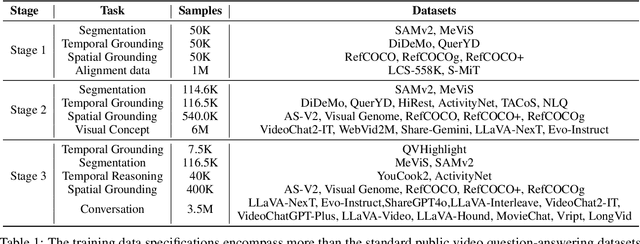
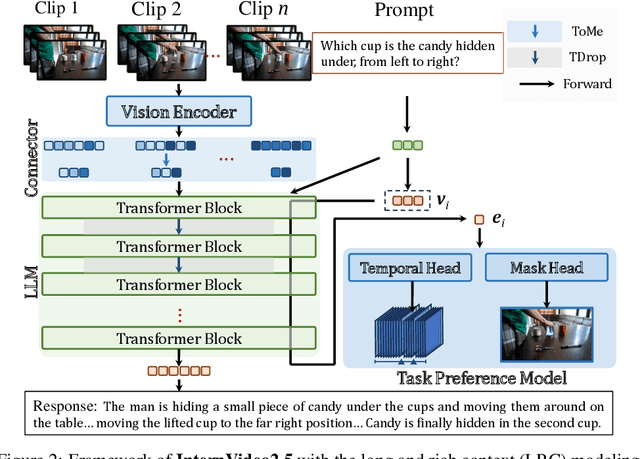
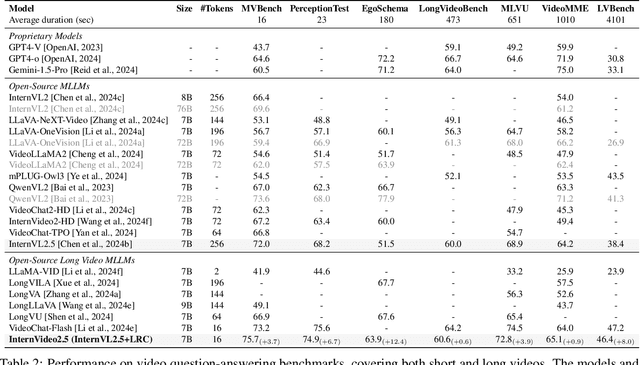
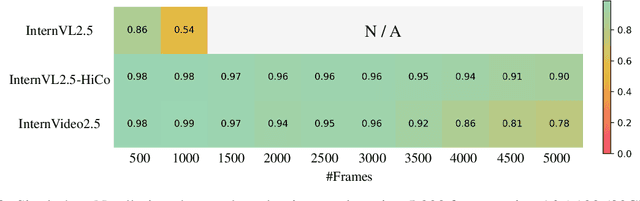
This paper aims to improve the performance of video multimodal large language models (MLLM) via long and rich context (LRC) modeling. As a result, we develop a new version of InternVideo2.5 with a focus on enhancing the original MLLMs' ability to perceive fine-grained details and capture long-form temporal structure in videos. Specifically, our approach incorporates dense vision task annotations into MLLMs using direct preference optimization and develops compact spatiotemporal representations through adaptive hierarchical token compression. Experimental results demonstrate this unique design of LRC greatly improves the results of video MLLM in mainstream video understanding benchmarks (short & long), enabling the MLLM to memorize significantly longer video inputs (at least 6x longer than the original), and master specialized vision capabilities like object tracking and segmentation. Our work highlights the importance of multimodal context richness (length and fineness) in empowering MLLM's innate abilites (focus and memory), providing new insights for future research on video MLLM. Code and models are available at https://github.com/OpenGVLab/InternVideo/tree/main/InternVideo2.5