 Add to Chrome
 Add to Firefox
 Add to Edge
Seedance 2.0: Advancing Video Generation for World Complexity
Apr 15, 2026
Seedance 2.0 is a new native multi-modal audio-video generation model, officially released in China in early February 2026. Compared with its predecessors, Seedance 1.0 and 1.5 Pro, Seedance 2.0 adopts a unified, highly efficient, and large-scale architecture for multi-modal audio-video joint generation. This allows it to support four input modalities: text, image, audio, and video, by integrating one of the most comprehensive suites of multi-modal content reference and editing capabilities available in the industry to date. It delivers substantial, well-rounded improvements across all key sub-dimensions of video and audio generation. In both expert evaluations and public user tests, the model has demonstrated performance on par with the leading levels in the field. Seedance 2.0 supports direct generation of audio-video content with durations ranging from 4 to 15 seconds, with native output resolutions of 480p and 720p. For multi-modal inputs as reference, its current open platform supports up to 3 video clips, 9 images, and 3 audio clips. In addition, we provide Seedance 2.0 Fast version, an accelerated variant of Seedance 2.0 designed to boost generation speed for low-latency scenarios. Seedance 2.0 has delivered significant improvements to its foundational generation capabilities and multi-modal generation performance, bringing an enhanced creative experience for end users.

Kimi-VL Technical Report
Apr 10, 2025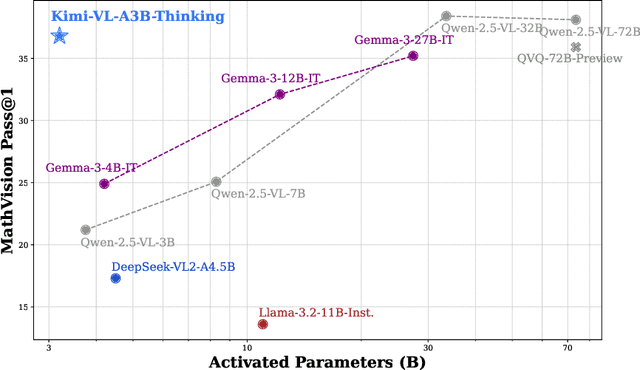
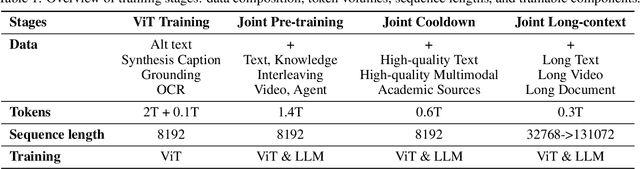
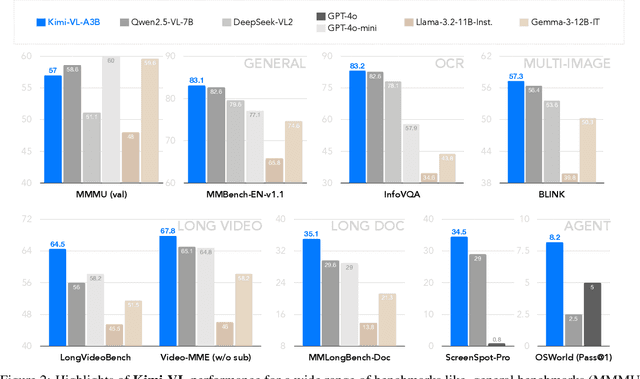

We present Kimi-VL, an efficient open-source Mixture-of-Experts (MoE) vision-language model (VLM) that offers advanced multimodal reasoning, long-context understanding, and strong agent capabilities - all while activating only 2.8B parameters in its language decoder (Kimi-VL-A3B). Kimi-VL demonstrates strong performance across challenging domains: as a general-purpose VLM, Kimi-VL excels in multi-turn agent tasks (e.g., OSWorld), matching flagship models. Furthermore, it exhibits remarkable capabilities across diverse challenging vision language tasks, including college-level image and video comprehension, OCR, mathematical reasoning, and multi-image understanding. In comparative evaluations, it effectively competes with cutting-edge efficient VLMs such as GPT-4o-mini, Qwen2.5-VL-7B, and Gemma-3-12B-IT, while surpassing GPT-4o in several key domains. Kimi-VL also advances in processing long contexts and perceiving clearly. With a 128K extended context window, Kimi-VL can process diverse long inputs, achieving impressive scores of 64.5 on LongVideoBench and 35.1 on MMLongBench-Doc. Its native-resolution vision encoder, MoonViT, further allows it to see and understand ultra-high-resolution visual inputs, achieving 83.2 on InfoVQA and 34.5 on ScreenSpot-Pro, while maintaining lower computational cost for common tasks. Building upon Kimi-VL, we introduce an advanced long-thinking variant: Kimi-VL-Thinking. Developed through long chain-of-thought (CoT) supervised fine-tuning (SFT) and reinforcement learning (RL), this model exhibits strong long-horizon reasoning capabilities. It achieves scores of 61.7 on MMMU, 36.8 on MathVision, and 71.3 on MathVista while maintaining the compact 2.8B activated LLM parameters, setting a new standard for efficient multimodal thinking models. Code and models are publicly accessible at https://github.com/MoonshotAI/Kimi-VL.
ActionFormer: Localizing Moments of Actions with Transformers
Feb 16, 2022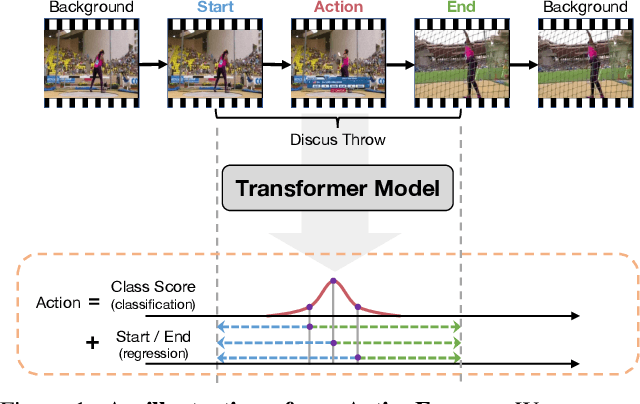
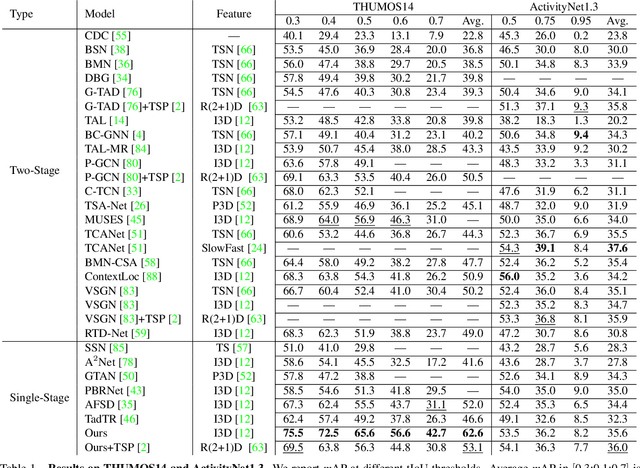
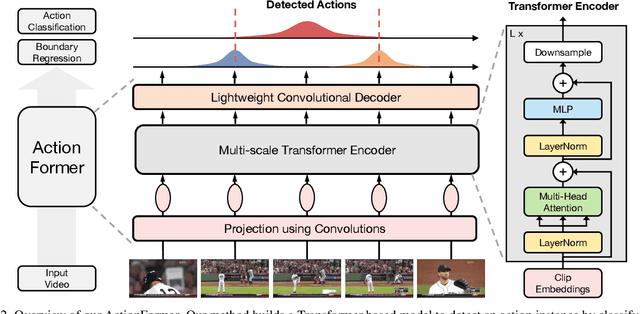
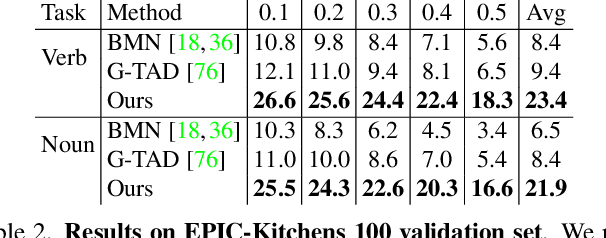
Self-attention based Transformer models have demonstrated impressive results for image classification and object detection, and more recently for video understanding. Inspired by this success, we investigate the application of Transformer networks for temporal action localization in videos. To this end, we present ActionFormer -- a simple yet powerful model to identify actions in time and recognize their categories in a single shot, without using action proposals or relying on pre-defined anchor windows. ActionFormer combines a multiscale feature representation with local self-attention, and uses a light-weighted decoder to classify every moment in time and estimate the corresponding action boundaries. We show that this orchestrated design results in major improvements upon prior works. Without bells and whistles, ActionFormer achieves 65.6% mAP at tIoU=0.5 on THUMOS14, outperforming the best prior model by 8.7 absolute percentage points and crossing the 60% mAP for the first time. Further, ActionFormer demonstrates strong results on ActivityNet 1.3 (36.0% average mAP) and the more recent EPIC-Kitchens 100 (+13.5% average mAP over prior works). Our code is available at http://github.com/happyharrycn/actionformer_release