 Add to Chrome
 Add to Firefox
 Add to Edge
Kimi K3: Open Frontier Intelligence
Jul 27, 2026
We introduce Kimi K3, a 2.8T parameter Mixture-of-Experts model with 104 billion activated parameters, native vision capabilities, and a 1-million-token context window. Kimi K3 is built on Kimi Delta Attention and Attention Residuals, which improve information flow across sequence length and model depth. Together with Stable LatentMoE, which effectively activates 16 of 896 routed experts per token, and refined training and data recipes, these advances yield an approximately 2.5x improvement in overall scaling efficiency over Kimi K2. Post-training highlights reinforcement learning across general, agentic, and coding domains and multiple reasoning-effort levels, enabling compositional generalization and robust long-horizon execution. At 2.8T scale, Kimi K3 is supported by infrastructure advances in multiple areas: algorithm-system co-design for KDA, perfectly balanced expert-parallel training with efficient memory management, million-token agentic RL with persistent rollout and sandbox states, and deployment innovations. Extensive evaluations show that Kimi K3 achieves frontier-level performance across long-horizon coding, agentic, knowledge, reasoning, and vision tasks. While its overall performance still trails the most powerful proprietary models, namely Claude Fable 5 and GPT-5.6 Sol, Kimi K3 consistently outperforms other open and proprietary models evaluated in our suite. We release the full Kimi K3 model weights to facilitate future research and accelerate the broader deployment and adoption of frontier intelligence.

PerceptionBench: Evaluating Atomic Visual Perception in Multimodal Large Language Models
Jul 27, 2026We introduce PerceptionBench, a benchmark specifically designed to evaluate the atomic visual perception capabilities of Multimodal Large Language Models (MLLMs). Existing benchmarks often fail to isolate perception: holistic evaluations conflate perceptual errors with failures in reasoning or domain knowledge, while application-driven benchmarks only cover narrow, fragmented domains shaped by heuristic designs. To address these limitations, PerceptionBench adopts a bottom-up approach: by diagnosing the earliest failure points in the responses of frontier MLLMs across 42 existing benchmarks, we construct an error taxonomy whose perception branch defines ten atomic perceptual capabilities. Guided by this taxonomy, we construct 3,000 verified questions with short, unambiguous answers, each isolating a single capability, with difficulty stemming from perception rather than reasoning or knowledge. Benchmark results across sixteen frontier MLLMs reveal that atomic perception remains largely unsolved---no model reaches 60\% accuracy, perception-related hallucination is the weakest capability on average, and similar overall scores conceal sharply divergent capability profiles. PerceptionBench thus provides a capability-level standard for measuring and diagnosing the visual perception boundaries of MLLMs.
Vectors Are Not Neutral: Sensitive-Information Inference from Exported LLM Representations in Summarization
May 26, 2026Large language model (LLM) summarization systems may pass compact vector representations of private inputs to downstream retrieval, monitoring, audit, or analytic workflows. Even when source documents remain access-restricted, derived vectors may be handled under different access controls and still support sensitive-information inference, creating a residual information-disclosure risk. We study this issue in clinical discharge-summary generation as a high-stakes case study, using electronic health record (EHR)-recorded race as a controlled sensitive-label audit. We audit two artifacts that a system might retain or expose to downstream components: the final prompt-token hidden state and the mean-pooled prompt representation. Our results show that reducing recoverability of the case-study sensitive label from one exported artifact does not necessarily reduce recoverability from another. As a mitigation case study, we introduce SurfaceLoRA, an exported-vector-targeted parameter-efficient fine-tuning method that uses a gradient-reversal discriminator attached to a designated exported vector. Under a balanced five-way probing protocol, SurfaceLoRA reduces EHR-recorded race recoverability from the targeted final-token artifact toward chance while preserving summarization utility, yet recoverability remains substantially higher from untargeted pooled artifacts. These findings show that privacy auditing and mitigation should be performed on the exact vector artifact retained or exposed to downstream components.
Robust Nasality Representation Learning for Cleft Palate-Related Velopharyngeal Dysfunction Screening in Real-World Settings
Mar 18, 2026Velopharyngeal dysfunction (VPD) is characterized by inadequate velopharyngeal closure during speech and often causes hypernasality and reduced intelligibility. Although speech-based machine learning models can perform well under standardized clinical recording conditions, their performance often drops in real-world settings because of domain shift caused by differences in devices, channels, noise, and room acoustics. To improve robustness, we propose a two-stage framework for VPD screening. First, a nasality-focused speech representation is learned by supervised contrastive pre-training on an auxiliary corpus with phoneme alignments, using oral-context versus nasal-context supervision. Second, the encoder is frozen and used with lightweight classifiers on 0.5-second speech chunks, whose probabilities are aggregated to produce recording-level decisions with a fixed threshold. On an in-domain clinical cohort of 82 subjects, the proposed method achieved perfect recording-level screening performance (macro-F1 = 1.000, accuracy = 1.000). On a separate out-of-domain set of 131 heterogeneous public Internet recordings, large pretrained speech representations degraded substantially, while MFCC was the strongest baseline (macro-F1 = 0.612, accuracy = 0.641). The proposed method achieved the best out-of-domain performance (macro-F1 = 0.679, accuracy = 0.695), improving on the strongest baseline under the same evaluation protocol. These results suggest that learning a nasality-focused representation before clinical classification can reduce sensitivity to recording artifacts and improve robustness for deployable speech-based VPD screening.
DLIOS: An LLM-Augmented Real-Time Multi-Modal Interactive Enhancement Overlay System for Douyin Live Streaming
Mar 03, 2026We present DLIOS, a Large Language Model (LLM)-augmented real-time multi-modal interactive enhancement overlay system for Douyin (TikTok) live streaming. DLIOS employs a three-layer transparent window architecture for independent rendering of danmaku (scrolling text), gift and like particle effects, and VIP entrance animations, built around an event-driven WebView2 capture pipeline and a thread-safe event bus. On top of this foundation we contribute an LLM broadcast automation framework comprising: (1) a per-song four-segment prompt scheduling system (T1 opening/transition, T2 empathy, T3 era story/production notes, T4 closing) that generates emotionally coherent radio-style commentary from lyric metadata; (2) a JSON-serializable RadioPersonaConfig schema supporting hot-swap multi-persona broadcasting; (3) a real-time danmaku quick-reaction engine with keyword routing to static urgent speech or LLM-generated empathetic responses; and (4) the Suwan Li AI singer-songwriter persona case study -- over 100 AI-generated songs produced with Suno. A 36-hour stress test demonstrates: zero danmaku overlap, zero deadlock crashes, gift effect P95 latency <= 180 ms, LLM-to-TTS segment P95 latency <= 2.1 s, and TTS integrated loudness gain of 9.5 LUFS. live streaming; danmaku; large language model; prompt engineering; virtual persona; WebView2; WINMM; TTS; Suno; loudness normalization; real-time scheduling
Kimi K2.5: Visual Agentic Intelligence
Feb 02, 2026We introduce Kimi K2.5, an open-source multimodal agentic model designed to advance general agentic intelligence. K2.5 emphasizes the joint optimization of text and vision so that two modalities enhance each other. This includes a series of techniques such as joint text-vision pre-training, zero-vision SFT, and joint text-vision reinforcement learning. Building on this multimodal foundation, K2.5 introduces Agent Swarm, a self-directed parallel agent orchestration framework that dynamically decomposes complex tasks into heterogeneous sub-problems and executes them concurrently. Extensive evaluations show that Kimi K2.5 achieves state-of-the-art results across various domains including coding, vision, reasoning, and agentic tasks. Agent Swarm also reduces latency by up to $4.5\times$ over single-agent baselines. We release the post-trained Kimi K2.5 model checkpoint to facilitate future research and real-world applications of agentic intelligence.
Optimizing Domain-Adaptive Self-Supervised Learning for Clinical Voice-Based Disease Classification
Jan 29, 2026The human voice is a promising non-invasive digital biomarker, yet deep learning for voice-based health analysis is hindered by data scarcity and domain mismatch, where models pre-trained on general audio fail to capture the subtle pathological features characteristic of clinical voice data. To address these challenges, we investigate domain-adaptive self-supervised learning (SSL) with Masked Autoencoders (MAE) and demonstrate that standard configurations are suboptimal for health-related audio. Using the Bridge2AI-Voice dataset, a multi-institutional collection of pathological voices, we systematically examine three performance-critical factors: reconstruction loss (Mean Absolute Error vs. Mean Squared Error), normalization (patch-wise vs. global), and masking (random vs. content-aware). Our optimized design, which combines Mean Absolute Error (MA-Error) loss, patch-wise normalization, and content-aware masking, achieves a Macro F1 of $0.688 \pm 0.009$ (over 10 fine-tuning runs), outperforming a strong out-of-domain SSL baseline pre-trained on large-scale general audio, which has a Macro F1 of $0.663 \pm 0.011$. The results show that MA-Error loss improves robustness and content-aware masking boosts performance by emphasizing information-rich regions. These findings highlight the importance of component-level optimization in data-constrained medical applications that rely on audio data.
Kimi K2: Open Agentic Intelligence
Jul 28, 2025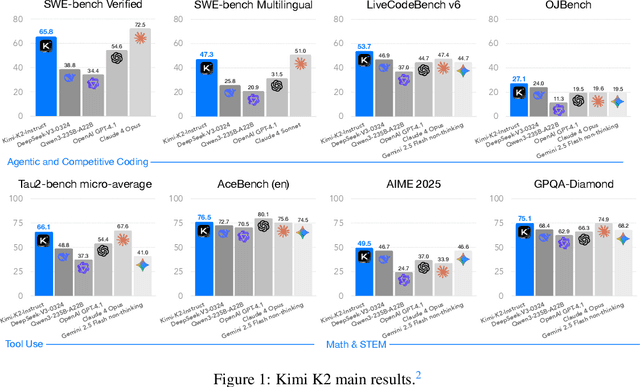
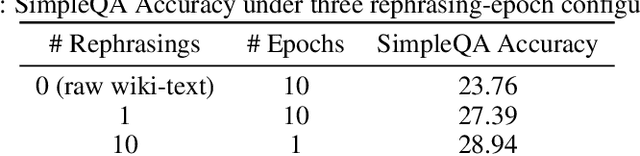
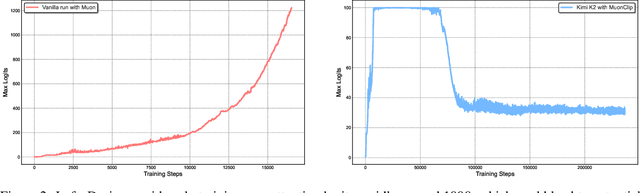
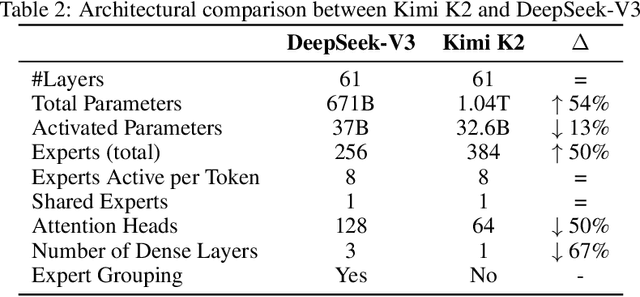
We introduce Kimi K2, a Mixture-of-Experts (MoE) large language model with 32 billion activated parameters and 1 trillion total parameters. We propose the MuonClip optimizer, which improves upon Muon with a novel QK-clip technique to address training instability while enjoying the advanced token efficiency of Muon. Based on MuonClip, K2 was pre-trained on 15.5 trillion tokens with zero loss spike. During post-training, K2 undergoes a multi-stage post-training process, highlighted by a large-scale agentic data synthesis pipeline and a joint reinforcement learning (RL) stage, where the model improves its capabilities through interactions with real and synthetic environments. Kimi K2 achieves state-of-the-art performance among open-source non-thinking models, with strengths in agentic capabilities. Notably, K2 obtains 66.1 on Tau2-Bench, 76.5 on ACEBench (En), 65.8 on SWE-Bench Verified, and 47.3 on SWE-Bench Multilingual -- surpassing most open and closed-sourced baselines in non-thinking settings. It also exhibits strong capabilities in coding, mathematics, and reasoning tasks, with a score of 53.7 on LiveCodeBench v6, 49.5 on AIME 2025, 75.1 on GPQA-Diamond, and 27.1 on OJBench, all without extended thinking. These results position Kimi K2 as one of the most capable open-source large language models to date, particularly in software engineering and agentic tasks. We release our base and post-trained model checkpoints to facilitate future research and applications of agentic intelligence.
Kimi-VL Technical Report
Apr 10, 2025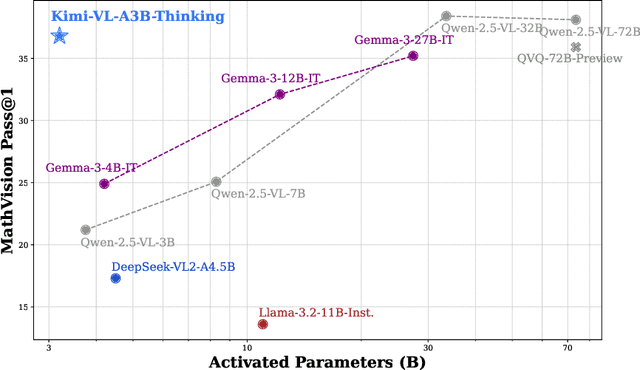
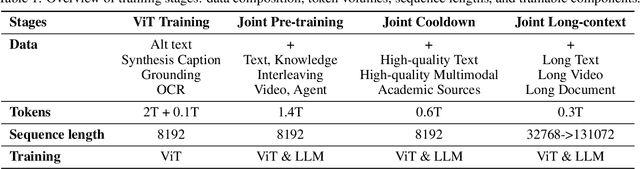
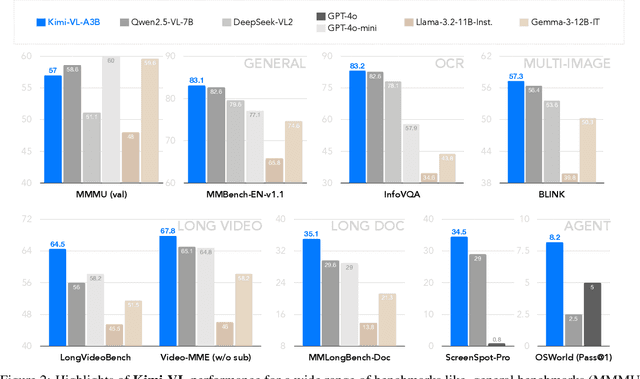

We present Kimi-VL, an efficient open-source Mixture-of-Experts (MoE) vision-language model (VLM) that offers advanced multimodal reasoning, long-context understanding, and strong agent capabilities - all while activating only 2.8B parameters in its language decoder (Kimi-VL-A3B). Kimi-VL demonstrates strong performance across challenging domains: as a general-purpose VLM, Kimi-VL excels in multi-turn agent tasks (e.g., OSWorld), matching flagship models. Furthermore, it exhibits remarkable capabilities across diverse challenging vision language tasks, including college-level image and video comprehension, OCR, mathematical reasoning, and multi-image understanding. In comparative evaluations, it effectively competes with cutting-edge efficient VLMs such as GPT-4o-mini, Qwen2.5-VL-7B, and Gemma-3-12B-IT, while surpassing GPT-4o in several key domains. Kimi-VL also advances in processing long contexts and perceiving clearly. With a 128K extended context window, Kimi-VL can process diverse long inputs, achieving impressive scores of 64.5 on LongVideoBench and 35.1 on MMLongBench-Doc. Its native-resolution vision encoder, MoonViT, further allows it to see and understand ultra-high-resolution visual inputs, achieving 83.2 on InfoVQA and 34.5 on ScreenSpot-Pro, while maintaining lower computational cost for common tasks. Building upon Kimi-VL, we introduce an advanced long-thinking variant: Kimi-VL-Thinking. Developed through long chain-of-thought (CoT) supervised fine-tuning (SFT) and reinforcement learning (RL), this model exhibits strong long-horizon reasoning capabilities. It achieves scores of 61.7 on MMMU, 36.8 on MathVision, and 71.3 on MathVista while maintaining the compact 2.8B activated LLM parameters, setting a new standard for efficient multimodal thinking models. Code and models are publicly accessible at https://github.com/MoonshotAI/Kimi-VL.
Content-Rich AIGC Video Quality Assessment via Intricate Text Alignment and Motion-Aware Consistency
Feb 06, 2025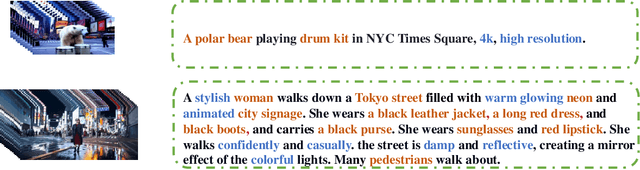
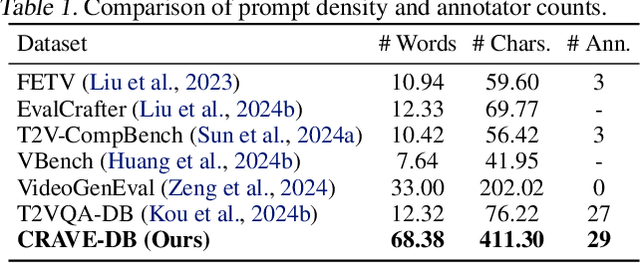
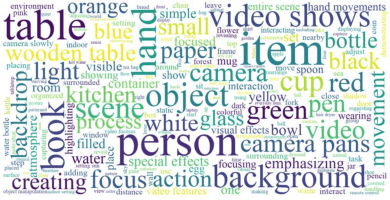
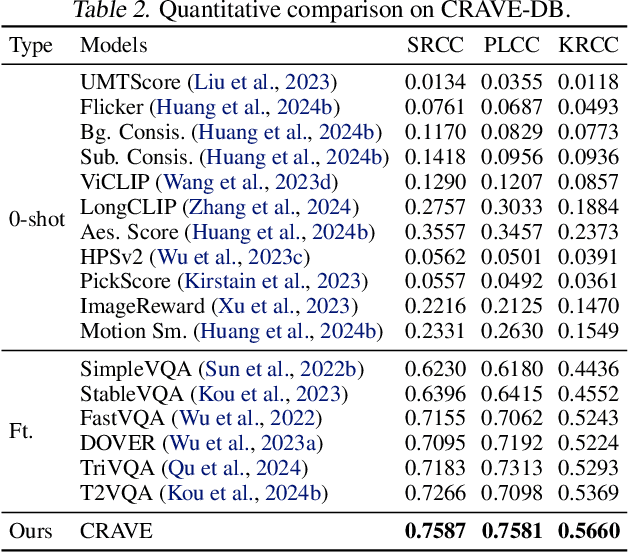
The advent of next-generation video generation models like \textit{Sora} poses challenges for AI-generated content (AIGC) video quality assessment (VQA). These models substantially mitigate flickering artifacts prevalent in prior models, enable longer and complex text prompts and generate longer videos with intricate, diverse motion patterns. Conventional VQA methods designed for simple text and basic motion patterns struggle to evaluate these content-rich videos. To this end, we propose \textbf{CRAVE} (\underline{C}ontent-\underline{R}ich \underline{A}IGC \underline{V}ideo \underline{E}valuator), specifically for the evaluation of Sora-era AIGC videos. CRAVE proposes the multi-granularity text-temporal fusion that aligns long-form complex textual semantics with video dynamics. Additionally, CRAVE leverages the hybrid motion-fidelity modeling to assess temporal artifacts. Furthermore, given the straightforward prompts and content in current AIGC VQA datasets, we introduce \textbf{CRAVE-DB}, a benchmark featuring content-rich videos from next-generation models paired with elaborate prompts. Extensive experiments have shown that the proposed CRAVE achieves excellent results on multiple AIGC VQA benchmarks, demonstrating a high degree of alignment with human perception. All data and code will be publicly available at https://github.com/littlespray/CRAVE.