 Add to Chrome
 Add to Firefox
 Add to Edge
Video-o3: Native Interleaved Clue Seeking for Long Video Multi-Hop Reasoning
Jan 30, 2026
Existing multimodal large language models for long-video understanding predominantly rely on uniform sampling and single-turn inference, limiting their ability to identify sparse yet critical evidence amid extensive redundancy. We introduce Video-o3, a novel framework that supports iterative discovery of salient visual clues, fine-grained inspection of key segments, and adaptive termination once sufficient evidence is acquired. Technically, we address two core challenges in interleaved tool invocation. First, to mitigate attention dispersion induced by the heterogeneity of reasoning and tool-calling, we propose Task-Decoupled Attention Masking, which isolates per-step concentration while preserving shared global context. Second, to control context length growth in multi-turn interactions, we introduce a Verifiable Trajectory-Guided Reward that balances exploration coverage with reasoning efficiency. To support training at scale, we further develop a data synthesis pipeline and construct Seeker-173K, comprising 173K high-quality tool-interaction trajectories for effective supervised and reinforcement learning. Extensive experiments show that Video-o3 substantially outperforms state-of-the-art methods, achieving 72.1% accuracy on MLVU and 46.5% on Video-Holmes. These results demonstrate Video-o3's strong multi-hop evidence-seeking and reasoning capabilities, and validate the effectiveness of native tool invocation in long-video scenarios.

FreeControl: Efficient, Training-Free Structural Control via One-Step Attention Extraction
Nov 07, 2025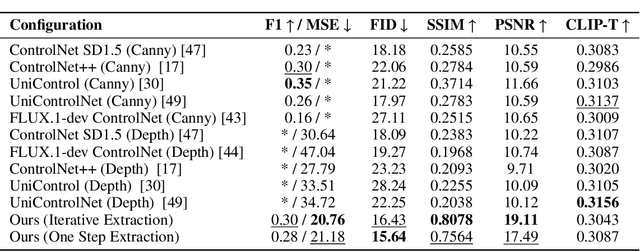
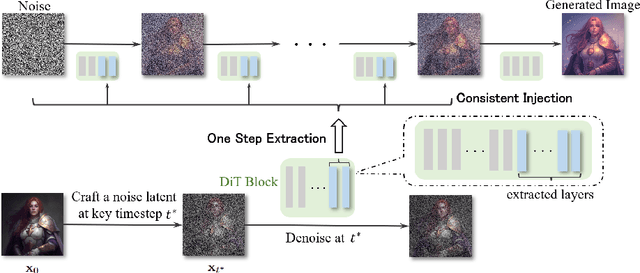
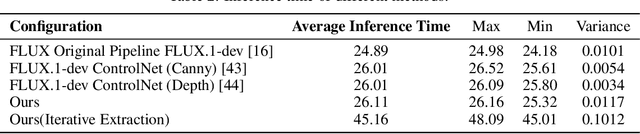
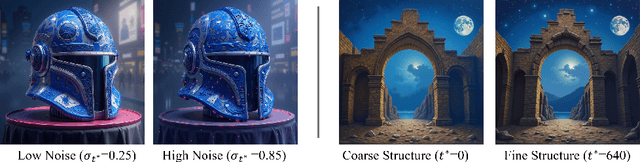
Controlling the spatial and semantic structure of diffusion-generated images remains a challenge. Existing methods like ControlNet rely on handcrafted condition maps and retraining, limiting flexibility and generalization. Inversion-based approaches offer stronger alignment but incur high inference cost due to dual-path denoising. We present FreeControl, a training-free framework for semantic structural control in diffusion models. Unlike prior methods that extract attention across multiple timesteps, FreeControl performs one-step attention extraction from a single, optimally chosen key timestep and reuses it throughout denoising. This enables efficient structural guidance without inversion or retraining. To further improve quality and stability, we introduce Latent-Condition Decoupling (LCD): a principled separation of the key timestep and the noised latent used in attention extraction. LCD provides finer control over attention quality and eliminates structural artifacts. FreeControl also supports compositional control via reference images assembled from multiple sources - enabling intuitive scene layout design and stronger prompt alignment. FreeControl introduces a new paradigm for test-time control, enabling structurally and semantically aligned, visually coherent generation directly from raw images, with the flexibility for intuitive compositional design and compatibility with modern diffusion models at approximately 5 percent additional cost.