 Add to Chrome
 Add to Firefox
 Add to Edge
MathVista: Evaluating Mathematical Reasoning of Foundation Models in Visual Contexts
Oct 03, 2023
Although Large Language Models (LLMs) and Large Multimodal Models (LMMs) exhibit impressive skills in various domains, their ability for mathematical reasoning within visual contexts has not been formally examined. Equipping LLMs and LMMs with this capability is vital for general-purpose AI assistants and showcases promising potential in education, data analysis, and scientific discovery. To bridge this gap, we present MathVista, a benchmark designed to amalgamate challenges from diverse mathematical and visual tasks. We first taxonomize the key task types, reasoning skills, and visual contexts from the literature to guide our selection from 28 existing math-focused and visual question answering datasets. Then, we construct three new datasets, IQTest, FunctionQA, and PaperQA, to accommodate for missing types of visual contexts. The problems featured often require deep visual understanding beyond OCR or image captioning, and compositional reasoning with rich domain-specific tools, thus posing a notable challenge to existing models. We conduct a comprehensive evaluation of 11 prominent open-source and proprietary foundation models (LLMs, LLMs augmented with tools, and LMMs), and early experiments with GPT-4V. The best-performing model, Multimodal Bard, achieves only 58% of human performance (34.8% vs 60.3%), indicating ample room for further improvement. Given this significant gap, MathVista fuels future research in the development of general-purpose AI agents capable of tackling mathematically intensive and visually rich real-world tasks. Preliminary tests show that MathVista also presents challenges to GPT-4V, underscoring the benchmark's importance. The project is available at https://mathvista.github.io/.

Towards General-Purpose Text-Instruction-Guided Voice Conversion
Sep 25, 2023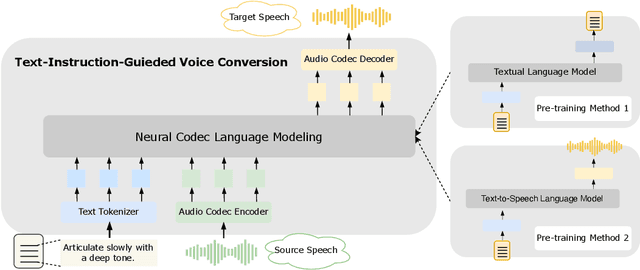

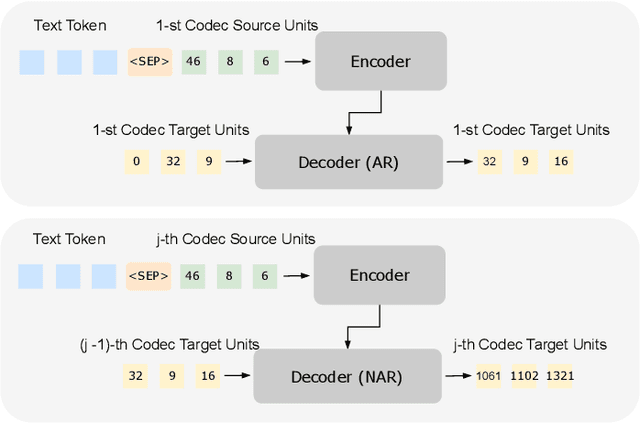
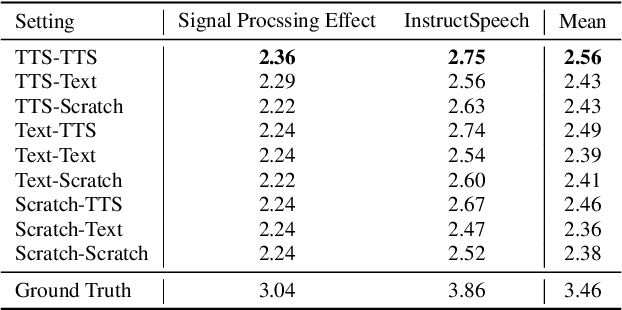
This paper introduces a novel voice conversion (VC) model, guided by text instructions such as "articulate slowly with a deep tone" or "speak in a cheerful boyish voice". Unlike traditional methods that rely on reference utterances to determine the attributes of the converted speech, our model adds versatility and specificity to voice conversion. The proposed VC model is a neural codec language model which processes a sequence of discrete codes, resulting in the code sequence of converted speech. It utilizes text instructions as style prompts to modify the prosody and emotional information of the given speech. In contrast to previous approaches, which often rely on employing separate encoders like prosody and content encoders to handle different aspects of the source speech, our model handles various information of speech in an end-to-end manner. Experiments have demonstrated the impressive capabilities of our model in comprehending instructions and delivering reasonable results.
Self-Augmentation Improves Zero-Shot Cross-Lingual Transfer
Sep 19, 2023

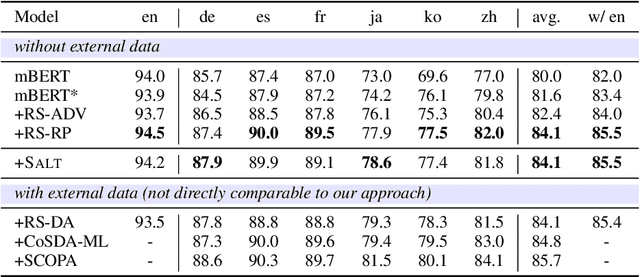
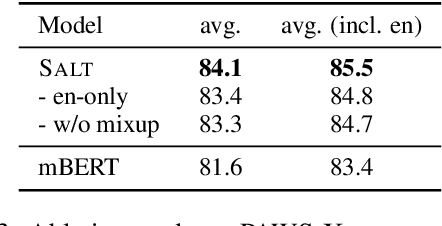
Zero-shot cross-lingual transfer is a central task in multilingual NLP, allowing models trained in languages with more sufficient training resources to generalize to other low-resource languages. Earlier efforts on this task use parallel corpora, bilingual dictionaries, or other annotated alignment data to improve cross-lingual transferability, which are typically expensive to obtain. In this paper, we propose a simple yet effective method, SALT, to improve the zero-shot cross-lingual transfer of the multilingual pretrained language models without the help of such external data. By incorporating code-switching and embedding mixup with self-augmentation, SALT effectively distills cross-lingual knowledge from the multilingual PLM and enhances its transferability on downstream tasks. Experimental results on XNLI and PAWS-X show that our method is able to improve zero-shot cross-lingual transferability without external data. Our code is available at https://github.com/luka-group/SALT.
Dynamic-SUPERB: Towards A Dynamic, Collaborative, and Comprehensive Instruction-Tuning Benchmark for Speech
Sep 18, 2023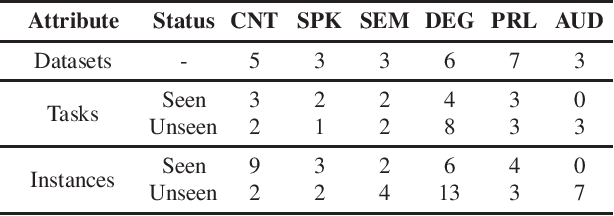
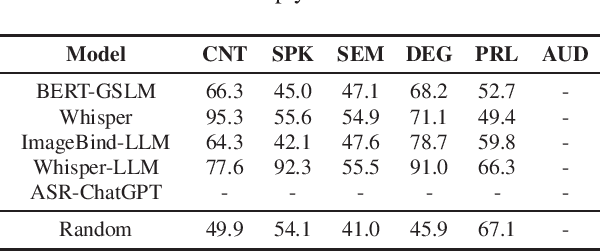
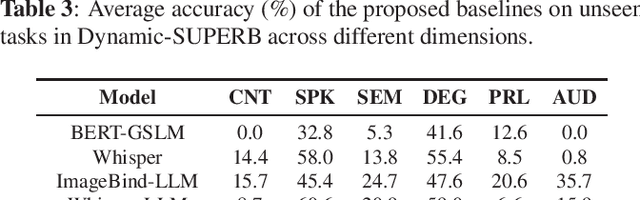
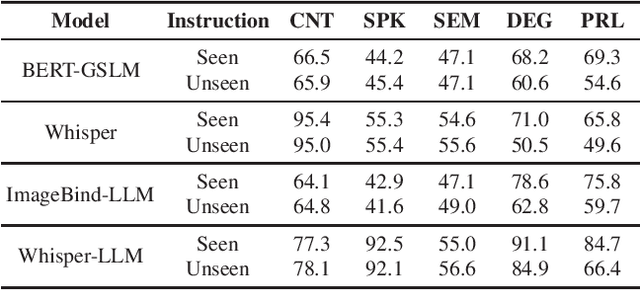
Text language models have shown remarkable zero-shot capability in generalizing to unseen tasks when provided with well-formulated instructions. However, existing studies in speech processing primarily focus on limited or specific tasks. Moreover, the lack of standardized benchmarks hinders a fair comparison across different approaches. Thus, we present Dynamic-SUPERB, a benchmark designed for building universal speech models capable of leveraging instruction tuning to perform multiple tasks in a zero-shot fashion. To achieve comprehensive coverage of diverse speech tasks and harness instruction tuning, we invite the community to collaborate and contribute, facilitating the dynamic growth of the benchmark. To initiate, Dynamic-SUPERB features 55 evaluation instances by combining 33 tasks and 22 datasets. This spans a broad spectrum of dimensions, providing a comprehensive platform for evaluation. Additionally, we propose several approaches to establish benchmark baselines. These include the utilization of speech models, text language models, and the multimodal encoder. Evaluation results indicate that while these baselines perform reasonably on seen tasks, they struggle with unseen ones. We also conducted an ablation study to assess the robustness and seek improvements in the performance. We release all materials to the public and welcome researchers to collaborate on the project, advancing technologies in the field together.
Contextual Label Projection for Cross-Lingual Structure Extraction
Sep 16, 2023Translating training data into target languages has proven beneficial for cross-lingual transfer. However, for structure extraction tasks, translating data requires a label projection step, which translates input text and obtains translated labels in the translated text jointly. Previous research in label projection mostly compromises translation quality by either facilitating easy identification of translated labels from translated text or using word-level alignment between translation pairs to assemble translated phrase-level labels from the aligned words. In this paper, we introduce CLAP, which first translates text to the target language and performs contextual translation on the labels using the translated text as the context, ensuring better accuracy for the translated labels. We leverage instruction-tuned language models with multilingual capabilities as our contextual translator, imposing the constraint of the presence of translated labels in the translated text via instructions. We compare CLAP with other label projection techniques for creating pseudo-training data in target languages on event argument extraction, a representative structure extraction task. Results show that CLAP improves by 2-2.5 F1-score over other methods on the Chinese and Arabic ACE05 datasets.
FLIRT: Feedback Loop In-context Red Teaming
Aug 08, 2023



Warning: this paper contains content that may be inappropriate or offensive. As generative models become available for public use in various applications, testing and analyzing vulnerabilities of these models has become a priority. Here we propose an automatic red teaming framework that evaluates a given model and exposes its vulnerabilities against unsafe and inappropriate content generation. Our framework uses in-context learning in a feedback loop to red team models and trigger them into unsafe content generation. We propose different in-context attack strategies to automatically learn effective and diverse adversarial prompts for text-to-image models. Our experiments demonstrate that compared to baseline approaches, our proposed strategy is significantly more effective in exposing vulnerabilities in Stable Diffusion (SD) model, even when the latter is enhanced with safety features. Furthermore, we demonstrate that the proposed framework is effective for red teaming text-to-text models, resulting in significantly higher toxic response generation rate compared to previously reported numbers.
UniFine: A Unified and Fine-grained Approach for Zero-shot Vision-Language Understanding
Jul 03, 2023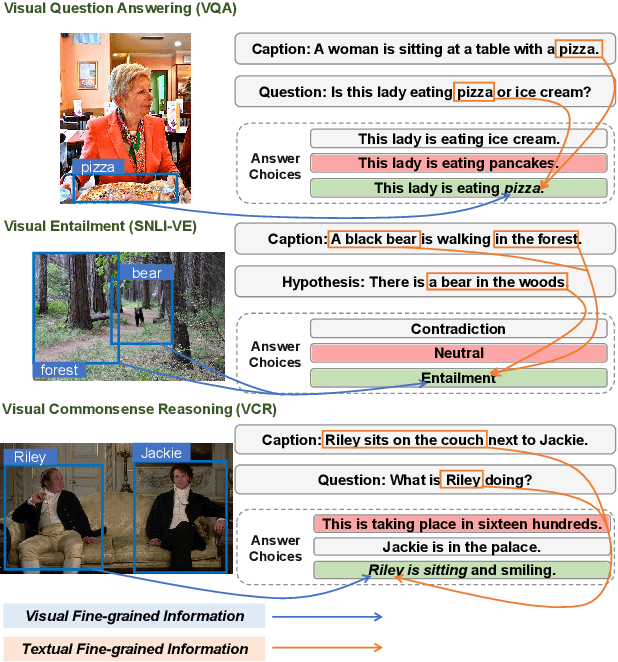
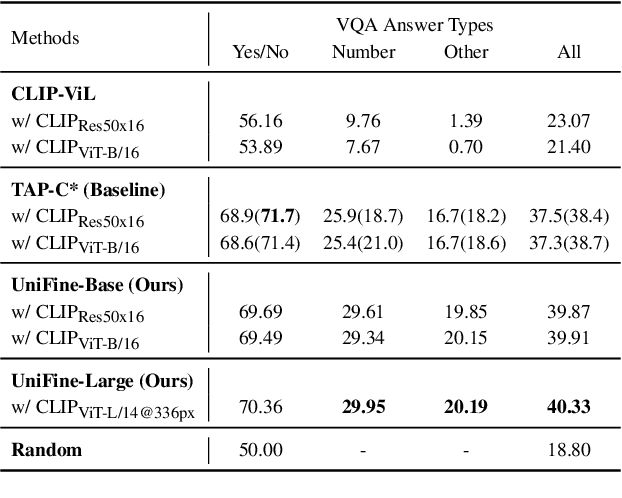
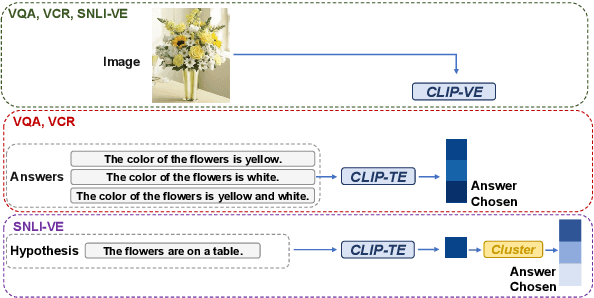
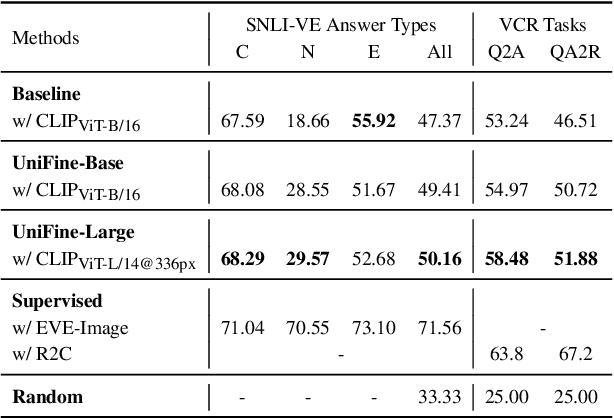
Vision-language tasks, such as VQA, SNLI-VE, and VCR are challenging because they require the model's reasoning ability to understand the semantics of the visual world and natural language. Supervised methods working for vision-language tasks have been well-studied. However, solving these tasks in a zero-shot setting is less explored. Since Contrastive Language-Image Pre-training (CLIP) has shown remarkable zero-shot performance on image-text matching, previous works utilized its strong zero-shot ability by converting vision-language tasks into an image-text matching problem, and they mainly consider global-level matching (e.g., the whole image or sentence). However, we find visual and textual fine-grained information, e.g., keywords in the sentence and objects in the image, can be fairly informative for semantics understanding. Inspired by this, we propose a unified framework to take advantage of the fine-grained information for zero-shot vision-language learning, covering multiple tasks such as VQA, SNLI-VE, and VCR. Our experiments show that our framework outperforms former zero-shot methods on VQA and achieves substantial improvement on SNLI-VE and VCR. Furthermore, our ablation studies confirm the effectiveness and generalizability of our proposed method. Code will be available at https://github.com/ThreeSR/UniFine
Symbolic Chain-of-Thought Distillation: Small Models Can Also "Think" Step-by-Step
Jun 24, 2023


Chain-of-thought prompting (e.g., "Let's think step-by-step") primes large language models to verbalize rationalization for their predictions. While chain-of-thought can lead to dramatic performance gains, benefits appear to emerge only for sufficiently large models (beyond 50B parameters). We show that orders-of-magnitude smaller models (125M -- 1.3B parameters) can still benefit from chain-of-thought prompting. To achieve this, we introduce Symbolic Chain-of-Thought Distillation (SCoTD), a method to train a smaller student model on rationalizations sampled from a significantly larger teacher model. Experiments across several commonsense benchmarks show that: 1) SCoTD enhances the performance of the student model in both supervised and few-shot settings, and especially for challenge sets; 2) sampling many reasoning chains per instance from the teacher is paramount; and 3) after distillation, student chain-of-thoughts are judged by humans as comparable to the teacher, despite orders of magnitude fewer parameters. We test several hypotheses regarding what properties of chain-of-thought samples are important, e.g., diversity vs. teacher likelihood vs. open-endedness. We release our corpus of chain-of-thought samples and code.
DesCo: Learning Object Recognition with Rich Language Descriptions
Jun 24, 2023

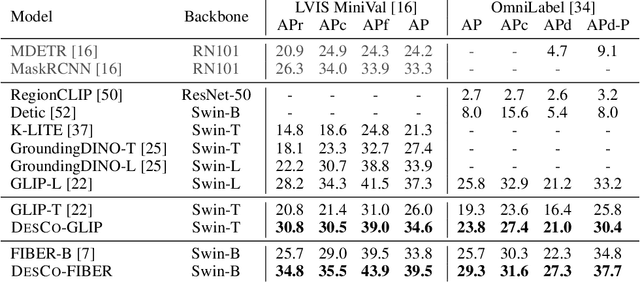

Recent development in vision-language approaches has instigated a paradigm shift in learning visual recognition models from language supervision. These approaches align objects with language queries (e.g. "a photo of a cat") and improve the models' adaptability to identify novel objects and domains. Recently, several studies have attempted to query these models with complex language expressions that include specifications of fine-grained semantic details, such as attributes, shapes, textures, and relations. However, simply incorporating language descriptions as queries does not guarantee accurate interpretation by the models. In fact, our experiments show that GLIP, the state-of-the-art vision-language model for object detection, often disregards contextual information in the language descriptions and instead relies heavily on detecting objects solely by their names. To tackle the challenges, we propose a new description-conditioned (DesCo) paradigm of learning object recognition models with rich language descriptions consisting of two major innovations: 1) we employ a large language model as a commonsense knowledge engine to generate rich language descriptions of objects based on object names and the raw image-text caption; 2) we design context-sensitive queries to improve the model's ability in deciphering intricate nuances embedded within descriptions and enforce the model to focus on context rather than object names alone. On two novel object detection benchmarks, LVIS and OminiLabel, under the zero-shot detection setting, our approach achieves 34.8 APr minival (+9.1) and 29.3 AP (+3.6), respectively, surpassing the prior state-of-the-art models, GLIP and FIBER, by a large margin.
SpeechGen: Unlocking the Generative Power of Speech Language Models with Prompts
Jun 19, 2023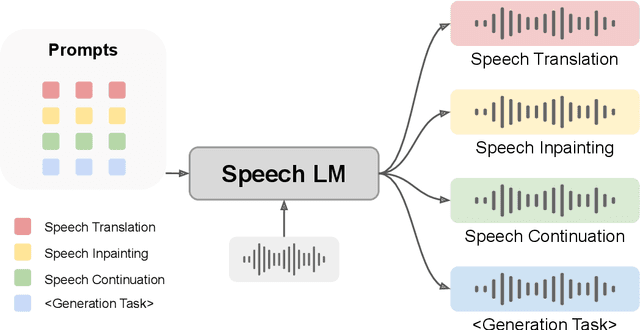
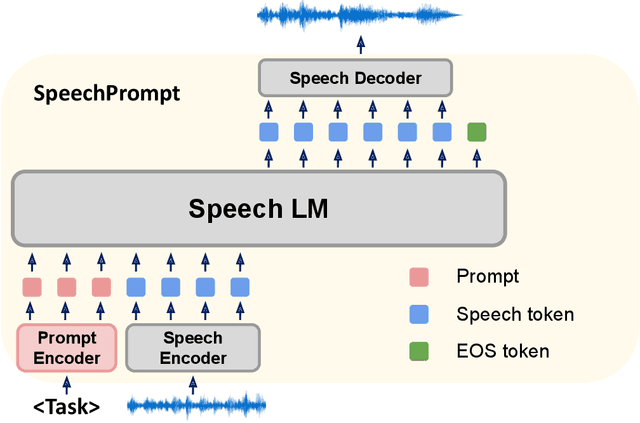
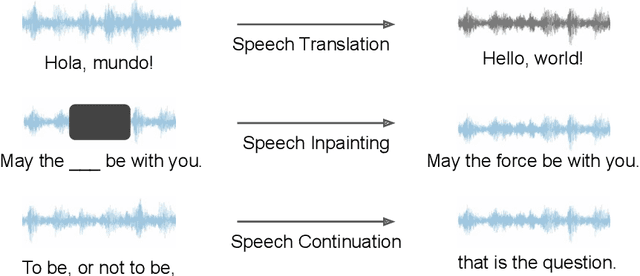

Large language models (LLMs) have gained considerable attention for Artificial Intelligence Generated Content (AIGC), particularly with the emergence of ChatGPT. However, the direct adaptation of continuous speech to LLMs that process discrete tokens remains an unsolved challenge, hindering the application of LLMs for speech generation. The advanced speech LMs are in the corner, as that speech signals encapsulate a wealth of information, including speaker and emotion, beyond textual data alone. Prompt tuning has demonstrated notable gains in parameter efficiency and competitive performance on some speech classification tasks. However, the extent to which prompts can effectively elicit generation tasks from speech LMs remains an open question. In this paper, we present pioneering research that explores the application of prompt tuning to stimulate speech LMs for various generation tasks, within a unified framework called SpeechGen, with around 10M trainable parameters. The proposed unified framework holds great promise for efficiency and effectiveness, particularly with the imminent arrival of advanced speech LMs, which will significantly enhance the capabilities of the framework. The code and demos of SpeechGen will be available on the project website: \url{https://ga642381.github.io/SpeechPrompt/speechgen}