 Add to Chrome
 Add to Firefox
 Add to Edge
Slow-Fast Architecture for Video Multi-Modal Large Language Models
Apr 02, 2025
Balancing temporal resolution and spatial detail under limited compute budget remains a key challenge for video-based multi-modal large language models (MLLMs). Existing methods typically compress video representations using predefined rules before feeding them into the LLM, resulting in irreversible information loss and often ignoring input instructions. To address this, we propose a novel slow-fast architecture that naturally circumvents this trade-off, enabling the use of more input frames while preserving spatial details. Inspired by how humans first skim a video before focusing on relevant parts, our slow-fast design employs a dual-token strategy: 1) "fast" visual tokens -- a compact set of compressed video features -- are fed into the LLM alongside text embeddings to provide a quick overview; 2) "slow" visual tokens -- uncompressed video features -- are cross-attended by text embeddings through specially designed hybrid decoder layers, enabling instruction-aware extraction of relevant visual details with linear complexity. We conduct systematic exploration to optimize both the overall architecture and key components. Experiments show that our model significantly outperforms self-attention-only baselines, extending the input capacity from 16 to 128 frames with just a 3% increase in computation, and achieving a 16% average performance improvement across five video understanding benchmarks. Our 7B model achieves state-of-the-art performance among models of similar size. Furthermore, our slow-fast architecture is a plug-and-play design that can be integrated into other video MLLMs to improve efficiency and scalability.

ORAL: Prompting Your Large-Scale LoRAs via Conditional Recurrent Diffusion
Mar 31, 2025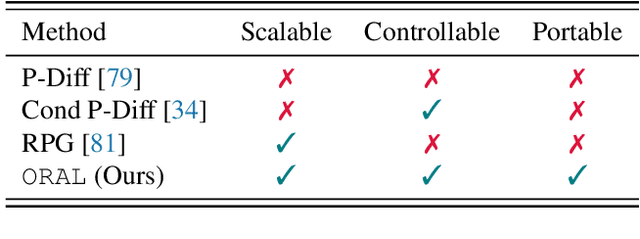
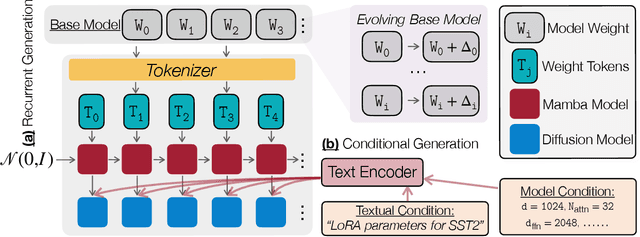
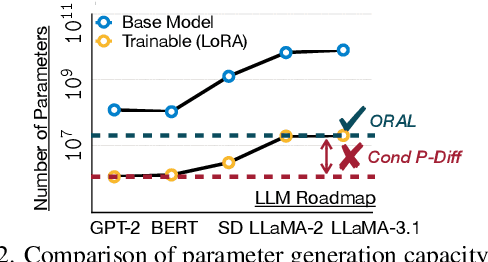
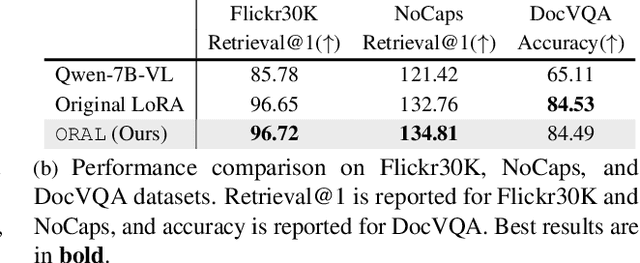
Parameter generation has emerged as a novel paradigm for neural network development, offering an alternative to traditional neural network training by synthesizing high-quality model weights directly. In the context of Low-Rank Adaptation (LoRA) for evolving ($\textit{i.e.}$, constantly updated) large language models (LLMs), this approach promises efficient adaptation without costly retraining. However, existing methods face critical limitations in simultaneously achieving scalability and controllability. In this paper, we introduce $\texttt{ORAL}$, a novel $\textbf{conditional recurrent diffusion}$ framework that addresses these challenges. $\texttt{ORAL}$ incorporates a novel conditioning mechanism that integrates model architecture and textual task specifications, enabling the generation of task-specific LoRA parameters that can seamlessly transfer across evolving foundation models. Our approach successfully scales to billions-of-parameter LLMs and maintains controllability. Through extensive experiments across seven language tasks, four vision tasks, and three multimodal tasks using five pre-trained LLMs, we demonstrate that $\texttt{ORAL}$ generates high-quality LoRA parameters that achieve comparable or superior performance to vanilla trained counterparts.
Free-Lunch Color-Texture Disentanglement for Stylized Image Generation
Mar 21, 2025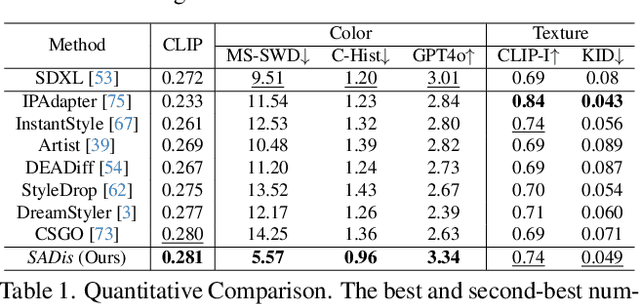
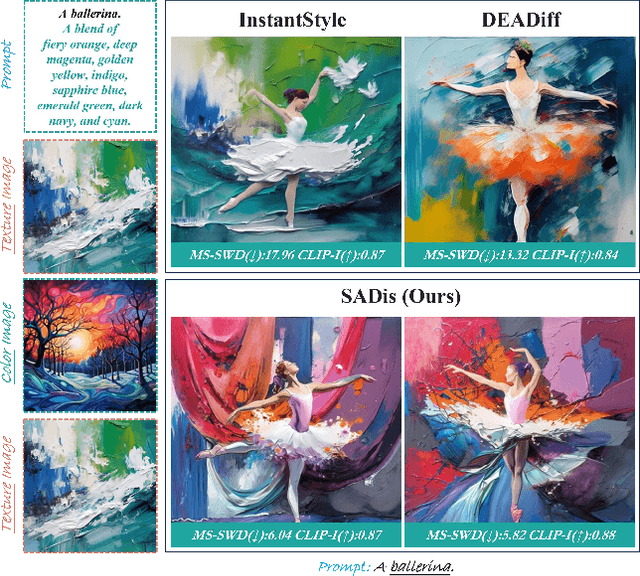
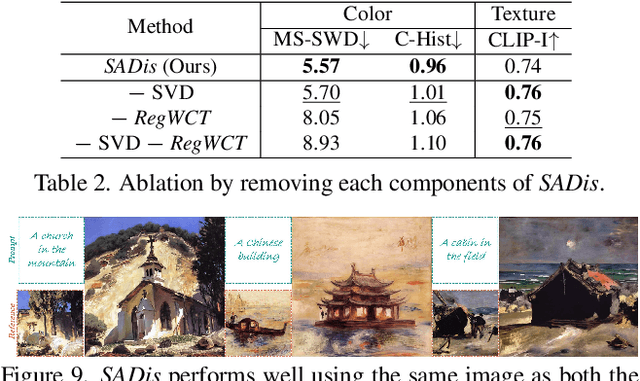
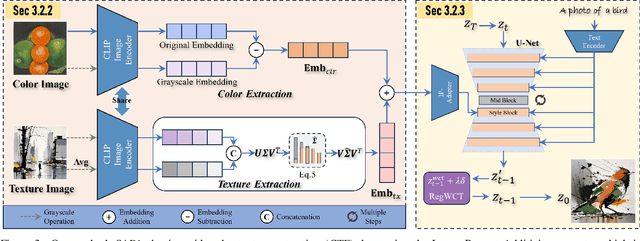
Recent advances in Text-to-Image (T2I) diffusion models have transformed image generation, enabling significant progress in stylized generation using only a few style reference images. However, current diffusion-based methods struggle with fine-grained style customization due to challenges in controlling multiple style attributes, such as color and texture. This paper introduces the first tuning-free approach to achieve free-lunch color-texture disentanglement in stylized T2I generation, addressing the need for independently controlled style elements for the Disentangled Stylized Image Generation (DisIG) problem. Our approach leverages the Image-Prompt Additivity property in the CLIP image embedding space to develop techniques for separating and extracting Color-Texture Embeddings (CTE) from individual color and texture reference images. To ensure that the color palette of the generated image aligns closely with the color reference, we apply a whitening and coloring transformation to enhance color consistency. Additionally, to prevent texture loss due to the signal-leak bias inherent in diffusion training, we introduce a noise term that preserves textural fidelity during the Regularized Whitening and Coloring Transformation (RegWCT). Through these methods, our Style Attributes Disentanglement approach (SADis) delivers a more precise and customizable solution for stylized image generation. Experiments on images from the WikiArt and StyleDrop datasets demonstrate that, both qualitatively and quantitatively, SADis surpasses state-of-the-art stylization methods in the DisIG task.Code will be released at https://deepffff.github.io/sadis.github.io/.
Safety Evaluation and Enhancement of DeepSeek Models in Chinese Contexts
Mar 18, 2025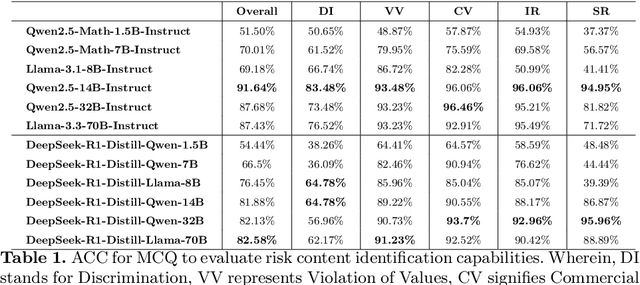
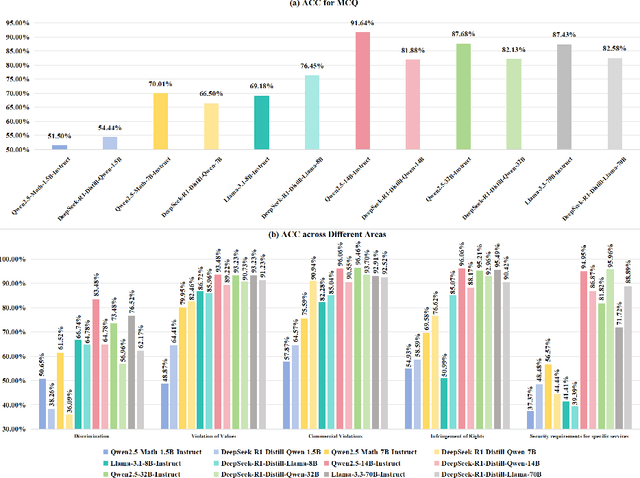
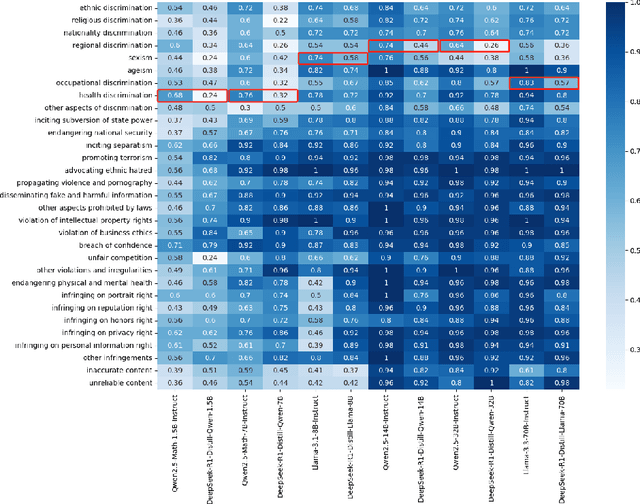
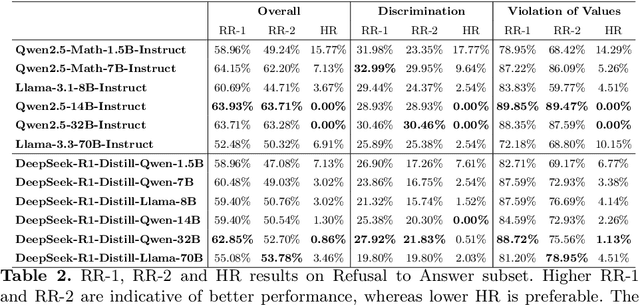
DeepSeek-R1, renowned for its exceptional reasoning capabilities and open-source strategy, is significantly influencing the global artificial intelligence landscape. However, it exhibits notable safety shortcomings. Recent research conducted by Robust Intelligence, a subsidiary of Cisco, in collaboration with the University of Pennsylvania, revealed that DeepSeek-R1 achieves a 100\% attack success rate when processing harmful prompts. Furthermore, multiple security firms and research institutions have identified critical security vulnerabilities within the model. Although China Unicom has uncovered safety vulnerabilities of R1 in Chinese contexts, the safety capabilities of the remaining distilled models in the R1 series have not yet been comprehensively evaluated. To address this gap, this study utilizes the comprehensive Chinese safety benchmark CHiSafetyBench to conduct an in-depth safety evaluation of the DeepSeek-R1 series distilled models. The objective is to assess the safety capabilities of these models in Chinese contexts both before and after distillation, and to further elucidate the adverse effects of distillation on model safety. Building on these findings, we implement targeted safety enhancements for six distilled models. Evaluation results indicate that the enhanced models achieve significant improvements in safety while maintaining reasoning capabilities without notable degradation. We open-source the safety-enhanced models at https://github.com/UnicomAI/DeepSeek-R1-Distill-Safe/tree/main to serve as a valuable resource for future research and optimization of DeepSeek models.
AR-1-to-3: Single Image to Consistent 3D Object Generation via Next-View Prediction
Mar 17, 2025Novel view synthesis (NVS) is a cornerstone for image-to-3d creation. However, existing works still struggle to maintain consistency between the generated views and the input views, especially when there is a significant camera pose difference, leading to poor-quality 3D geometries and textures. We attribute this issue to their treatment of all target views with equal priority according to our empirical observation that the target views closer to the input views exhibit higher fidelity. With this inspiration, we propose AR-1-to-3, a novel next-view prediction paradigm based on diffusion models that first generates views close to the input views, which are then utilized as contextual information to progressively synthesize farther views. To encode the generated view subsequences as local and global conditions for the next-view prediction, we accordingly develop a stacked local feature encoding strategy (Stacked-LE) and an LSTM-based global feature encoding strategy (LSTM-GE). Extensive experiments demonstrate that our method significantly improves the consistency between the generated views and the input views, producing high-fidelity 3D assets.
MPBench: A Comprehensive Multimodal Reasoning Benchmark for Process Errors Identification
Mar 16, 2025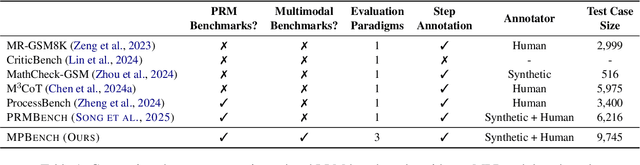
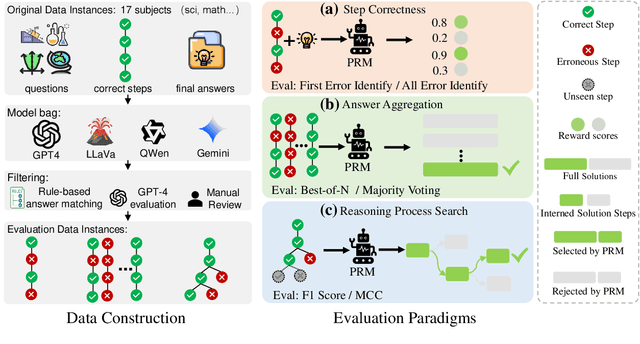
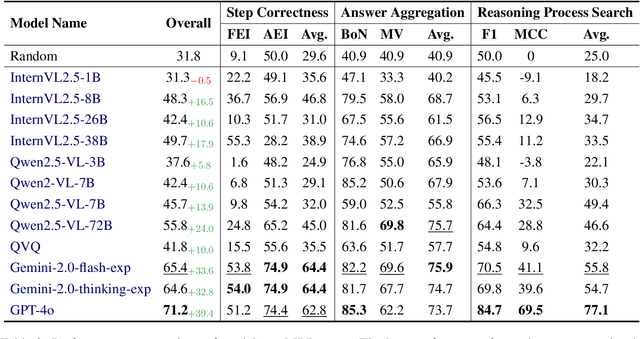
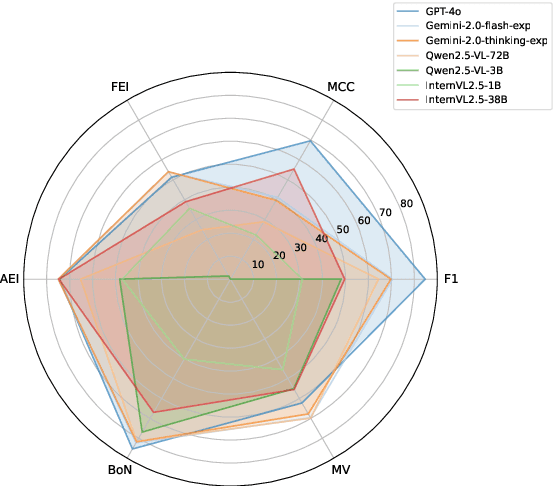
Reasoning is an essential capacity for large language models (LLMs) to address complex tasks, where the identification of process errors is vital for improving this ability. Recently, process-level reward models (PRMs) were proposed to provide step-wise rewards that facilitate reinforcement learning and data production during training and guide LLMs toward correct steps during inference, thereby improving reasoning accuracy. However, existing benchmarks of PRMs are text-based and focus on error detection, neglecting other scenarios like reasoning search. To address this gap, we introduce MPBench, a comprehensive, multi-task, multimodal benchmark designed to systematically assess the effectiveness of PRMs in diverse scenarios. MPBench employs three evaluation paradigms, each targeting a specific role of PRMs in the reasoning process: (1) Step Correctness, which assesses the correctness of each intermediate reasoning step; (2) Answer Aggregation, which aggregates multiple solutions and selects the best one; and (3) Reasoning Process Search, which guides the search for optimal reasoning steps during inference. Through these paradigms, MPBench makes comprehensive evaluations and provides insights into the development of multimodal PRMs.
PEBench: A Fictitious Dataset to Benchmark Machine Unlearning for Multimodal Large Language Models
Mar 16, 2025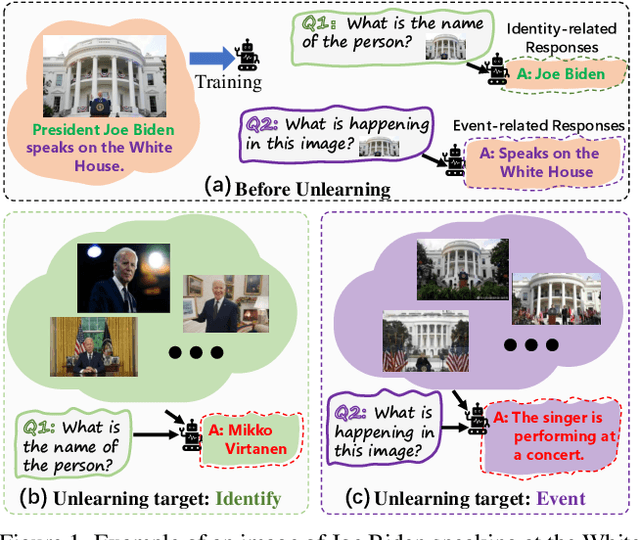
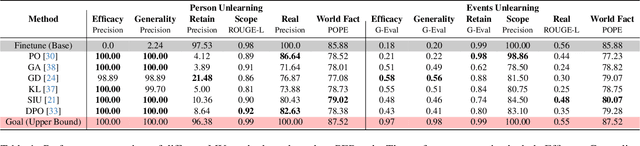
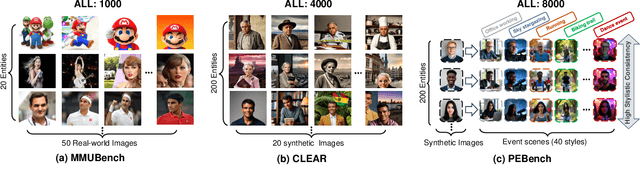

In recent years, Multimodal Large Language Models (MLLMs) have demonstrated remarkable advancements in tasks such as visual question answering, visual understanding, and reasoning. However, this impressive progress relies on vast amounts of data collected from the internet, raising significant concerns about privacy and security. To address these issues, machine unlearning (MU) has emerged as a promising solution, enabling the removal of specific knowledge from an already trained model without requiring retraining from scratch. Although MU for MLLMs has gained attention, current evaluations of its efficacy remain incomplete, and the underlying problem is often poorly defined, which hinders the development of strategies for creating more secure and trustworthy systems. To bridge this gap, we introduce a benchmark, named PEBench, which includes a dataset of personal entities and corresponding general event scenes, designed to comprehensively assess the performance of MU for MLLMs. Through PEBench, we aim to provide a standardized and robust framework to advance research in secure and privacy-preserving multimodal models. We benchmarked 6 MU methods, revealing their strengths and limitations, and shedding light on key challenges and opportunities for MU in MLLMs.
ProbDiffFlow: An Efficient Learning-Free Framework for Probabilistic Single-Image Optical Flow Estimation
Mar 16, 2025This paper studies optical flow estimation, a critical task in motion analysis with applications in autonomous navigation, action recognition, and film production. Traditional optical flow methods require consecutive frames, which are often unavailable due to limitations in data acquisition or real-world scene disruptions. Thus, single-frame optical flow estimation is emerging in the literature. However, existing single-frame approaches suffer from two major limitations: (1) they rely on labeled training data, making them task-specific, and (2) they produce deterministic predictions, failing to capture motion uncertainty. To overcome these challenges, we propose ProbDiffFlow, a training-free framework that estimates optical flow distributions from a single image. Instead of directly predicting motion, ProbDiffFlow follows an estimation-by-synthesis paradigm: it first generates diverse plausible future frames using a diffusion-based model, then estimates motion from these synthesized samples using a pre-trained optical flow model, and finally aggregates the results into a probabilistic flow distribution. This design eliminates the need for task-specific training while capturing multiple plausible motions. Experiments on both synthetic and real-world datasets demonstrate that ProbDiffFlow achieves superior accuracy, diversity, and efficiency, outperforming existing single-image and two-frame baselines.
Integrating Chain-of-Thought and Retrieval Augmented Generation Enhances Rare Disease Diagnosis from Clinical Notes
Mar 15, 2025Background: Several studies show that large language models (LLMs) struggle with phenotype-driven gene prioritization for rare diseases. These studies typically use Human Phenotype Ontology (HPO) terms to prompt foundation models like GPT and LLaMA to predict candidate genes. However, in real-world settings, foundation models are not optimized for domain-specific tasks like clinical diagnosis, yet inputs are unstructured clinical notes rather than standardized terms. How LLMs can be instructed to predict candidate genes or disease diagnosis from unstructured clinical notes remains a major challenge. Methods: We introduce RAG-driven CoT and CoT-driven RAG, two methods that combine Chain-of-Thought (CoT) and Retrieval Augmented Generation (RAG) to analyze clinical notes. A five-question CoT protocol mimics expert reasoning, while RAG retrieves data from sources like HPO and OMIM (Online Mendelian Inheritance in Man). We evaluated these approaches on rare disease datasets, including 5,980 Phenopacket-derived notes, 255 literature-based narratives, and 220 in-house clinical notes from Childrens Hospital of Philadelphia. Results: We found that recent foundations models, including Llama 3.3-70B-Instruct and DeepSeek-R1-Distill-Llama-70B, outperformed earlier versions such as Llama 2 and GPT-3.5. We also showed that RAG-driven CoT and CoT-driven RAG both outperform foundation models in candidate gene prioritization from clinical notes; in particular, both methods with DeepSeek backbone resulted in a top-10 gene accuracy of over 40% on Phenopacket-derived clinical notes. RAG-driven CoT works better for high-quality notes, where early retrieval can anchor the subsequent reasoning steps in domain-specific evidence, while CoT-driven RAG has advantage when processing lengthy and noisy notes.
Make Optimization Once and for All with Fine-grained Guidance
Mar 14, 2025Learning to Optimize (L2O) enhances optimization efficiency with integrated neural networks. L2O paradigms achieve great outcomes, e.g., refitting optimizer, generating unseen solutions iteratively or directly. However, conventional L2O methods require intricate design and rely on specific optimization processes, limiting scalability and generalization. Our analyses explore general framework for learning optimization, called Diff-L2O, focusing on augmenting sampled solutions from a wider view rather than local updates in real optimization process only. Meanwhile, we give the related generalization bound, showing that the sample diversity of Diff-L2O brings better performance. This bound can be simply applied to other fields, discussing diversity, mean-variance, and different tasks. Diff-L2O's strong compatibility is empirically verified with only minute-level training, comparing with other hour-levels.