 Add to Chrome
 Add to Firefox
 Add to Edge
Calibrating Post-Training Feature Shifts for LLM Data Contamination Detection
Aug 11, 2026
Large language models (LLMs) are trained on massive and largely undisclosed corpora that may contain copyrighted or privacy-sensitive content. Data contamination detection (DCD) therefore aims to determine whether a given text is a member of the pre-training corpus of a target LLM. Recent state-of-the-art DCD methods follow a feature-based paradigm that derives membership features from the input text and the corresponding model output. However, most modern LLMs undergo post-training, such as instruction tuning, preference optimization, and reasoning-oriented training, which can alter model outputs and shift the corresponding membership features, thereby reducing the separability between members and non-members. To address this problem, we propose CalibDCD, a broadly applicable calibration framework for feature-based DCD methods, comprising (1) Multi-View Shift Detection, which identifies recurring feature shifts associated with post-training, and (2) Bounded Feature Correction, which selectively mitigates their influence on membership prediction. Specifically, Multi-View Shift Detection evaluates controlled prompt variants on known non-member texts and consolidates the most informative views to identify recurring feature shifts. Bounded Feature Correction selectively adjusts feature components aligned with the detected shifts and controls the correction extent to preserve useful detection information. Experiments show that CalibDCD consistently improves existing feature-based detectors, with gains of up to 7.0% in AUC and 15.0% in TPR@5%FPR.

Interpretable Unsupervised Community Detection with LLM-Symbolized Structured Processes
Aug 02, 2026Community detection is a fundamental task in graph analytics that aims to identify cohesive groups of entities with similar behaviors or interests. Classic objective-driven methods struggle with complex graph structures, while deep-learning approaches improve performance at the expense of interpretability and rely on labeled data and training. Large language models (LLMs), with strong reasoning capabilities and world knowledge, are promising for interpretable, label-free community detection. To leverage these strengths, we propose LUCID, an LLM-guided, interpretable, training-free, and unsupervised community detection method. Inspired by phase-transition kinetics in natural systems, where complex structures emerge through initialization, merging, refinement, and selection, LUCID is designed as a four-stage pipeline. Within this pipeline, the LLM induces formal rules that translate implicit knowledge into explicit and interpretable logical structures. Specifically, (1) the Local-View Community Initialization stage encodes local graph structures using k-ego contexts and unsupervised node roles; (2) the Multi-factor Community Merge stage uses LLM-induced rules to iteratively merge local communities; (3) the Multi-grain Community Refinement stage applies LLM-induced coarse-to-fine rules in parallel to reduce boundary noise; and (4) the Global-view Community Selection stage identifies high-quality communities based on topological compactness and boundary clarity. Extensive experiments on real-world datasets demonstrate that LUCID, as an unsupervised approach, achieves state-of-the-art performance and consistently outperforms leading unsupervised and semi-supervised baselines.
Interpretable Column Annotation with LLM-Symbolized Decision Process Materialization
Jul 28, 2026Column annotation (CA), including column type annotation (CTA) and column property annotation (CPA), aims to identify the meanings of table columns and the semantic relationships among them. Recent CA methods usually use various neural models to learn column representations and directly map them to label categories, thereby (1) sacrificing model interpretability and adaptivity, and (2) overlooking rich label semantics and ultimately limiting accuracy. To address these limitations, we propose SymCA, an LLM-empowered interpretable CA framework that materializes column annotation as a global-to-local symbolic decision process. SymCA consists of two components: (1) global skeleton induction, which constructs a semantic skeleton over the label space, and (2) local substrate evolution, which evolves predictive substrates within the skeleton. Specifically, to exploit label semantics while preserving an interpretable decision process, the global skeleton induction module leverages LLMs to generate candidate hypernym-inspired tree-structured semantic skeletons and employs a Minimum Bayes Risk (MBR)-based consensus strategy to select a robust skeleton against generation variance. Since different internal nodes require different evidence to distinguish among their child nodes, the local substrate evolution module materializes each internal node as an executable and evolvable predictive substrate. Over multiple evolution rounds, each substrate trains an interpretable random forest classifier with the current operator set, leverages the LLM to propose node-specific operator modifications, and uses an exploration-exploitation strategy to prioritize promising substrates. Extensive experiments demonstrate that SymCA is accurate, robust, and interpretable, outperforming the strongest baselines by an average of 6.42% in Micro-F1 and 11.03% in Macro-F1.
FreoStream:Enhancing Stream Guardrails via Future-Aware Reasoning and Safety-Aligned Optimization
Jun 11, 2026Stream guardrails enable token-level safety detection before full responses are generated. However, they often make overly conservative judgements and block those sensitive but safe tokens, which is known as over-refusal. Due to lack of full context, they also fail to detect implicitly harmful content from jailbreaking. To address these challenges, we propose FreoStream, a novel streaming guardrail framework. Specifically, FreoStream fine-tunes a LoRA module to perform Future-Aware Reasoning when the base guardrail detects unsafe tokens. The reasoning process follows a Future-Reason-Judge paradigm: predict the future, reason about the full context and give the final judgement. This design can effectively reduce over-refusal by incorporating the future information. Moreover, we introduce the Safety-Aligned Optimization module that extracts the safety-aligned component from the reasoning gradients to update the base guardrail model, thereby enhancing streaming safety detection. Extensive experiments on various safety benchmarks demonstrate that FreoStream achieves lower over-refusal rates and better jailbreak defense compared to existing streaming guardrails.
Multi-Perspective Evidence Synthesis and Reasoning for Unsupervised Multimodal Entity Linking
Apr 22, 2026Multimodal Entity Linking (MEL) is a fundamental task in data management that maps ambiguous mentions with diverse modalities to the multimodal entities in a knowledge base. However, most existing MEL approaches primarily focus on optimizing instance-centric features and evidence, leaving broader forms of evidence and their intricate interdependencies insufficiently explored. Motivated by the observation that human expert decision-making process relies on multi-perspective judgment, in this work, we propose MSR-MEL, a Multi-perspective Evidence Synthesis and Reasoning framework with Large Language Models (LLMs) for unsupervised MEL. Specifically, we adopt a two-stage framework: (1) Offline Multi-Perspective Evidence Synthesis constructs a comprehensive set of evidence. This includes instance-centric evidence capturing the instance-centric multimodal information of mentions and entities, group-level evidence that aggregates neighborhood information, lexical evidence based on string overlap ratio, and statistical evidence based on simple summary statistics. A core contribution of our framework is the synthesis of group-level evidence, which effectively aggregates vital neighborhood information by graph. We first construct LLM-enhanced contextualized graphs. Subsequently, different modalities are jointly aligned through an asymmetric teacher-student graph neural network. (2) Online Multi-Perspective Evidence Reasoning leverages the power of LLM as a reasoning module to analyze the correlation and semantics of the multi-perspective evidence to induce an effective ranking strategy for accurate entity linking without supervision. Extensive experiments on widely used MEL benchmarks demonstrate that MSR-MEL consistently outperforms state-of-the-art unsupervised methods. The source code of this paper was available at: https://anonymous.4open.science/r/MSR-MEL-C21E/.
Advancing Multimodal Agent Reasoning with Long-Term Neuro-Symbolic Memory
Mar 16, 2026Recent advances in large language models have driven the emergence of intelligent agents operating in open-world, multimodal environments. To support long-term reasoning, such agents are typically equipped with external memory systems. However, most existing multimodal agent memories rely primarily on neural representations and vector-based retrieval, which are well-suited for inductive, intuitive reasoning but fundamentally limited in supporting analytical, deductive reasoning critical for real-world decision making. To address this limitation, we propose NS-Mem, a long-term neuro-symbolic memory framework designed to advance multimodal agent reasoning by integrating neural memory with explicit symbolic structures and rules. Specifically, NS-Mem is operated around three core components of a memory system: (1) a three-layer memory architecture that consists episodic layer, semantic layer and logic rule layer, (2) a memory construction and maintenance mechanism implemented by SK-Gen that automatically consolidates structured knowledge from accumulated multimodal experiences and incrementally updates both neural representations and symbolic rules, and (3) a hybrid memory retrieval mechanism that combines similarity-based search with deterministic symbolic query functions to support structured reasoning. Experiments on real-world multimodal reasoning benchmarks demonstrate that Neural-Symbolic Memory achieves an average 4.35% improvement in overall reasoning accuracy over pure neural memory systems, with gains of up to 12.5% on constrained reasoning queries, validating the effectiveness of NS-Mem.
HyperJoin: LLM-augmented Hypergraph Link Prediction for Joinable Table Discovery
Jan 03, 2026As a pivotal task in data lake management, joinable table discovery has attracted widespread interest. While existing language model-based methods achieve remarkable performance by combining offline column representation learning with online ranking, their design insufficiently accounts for the underlying structural interactions: (1) offline, they directly model tables into isolated or pairwise columns, thereby struggling to capture the rich inter-table and intra-table structural information; and (2) online, they rank candidate columns based solely on query-candidate similarity, ignoring the mutual interactions among the candidates, leading to incoherent result sets. To address these limitations, we propose HyperJoin, a large language model (LLM)-augmented Hypergraph framework for Joinable table discovery. Specifically, we first construct a hypergraph to model tables using both the intra-table hyperedges and the LLM-augmented inter-table hyperedges. Consequently, the task of joinable table discovery is formulated as link prediction on this constructed hypergraph. We then design HIN, a Hierarchical Interaction Network that learns expressive column representations through bidirectional message passing over columns and hyperedges. To strengthen coherence and internal consistency in the result columns, we cast online ranking as a coherence-aware top-k column selection problem. We then introduce a reranking module that leverages a maximum spanning tree algorithm to prune noisy connections and maximize coherence. Experiments demonstrate the superiority of HyperJoin, achieving average improvements of 21.4% (Precision@15) and 17.2% (Recall@15) over the best baseline.
DINO-BOLDNet: A DINOv3-Guided Multi-Slice Attention Network for T1-to-BOLD Generation
Dec 09, 2025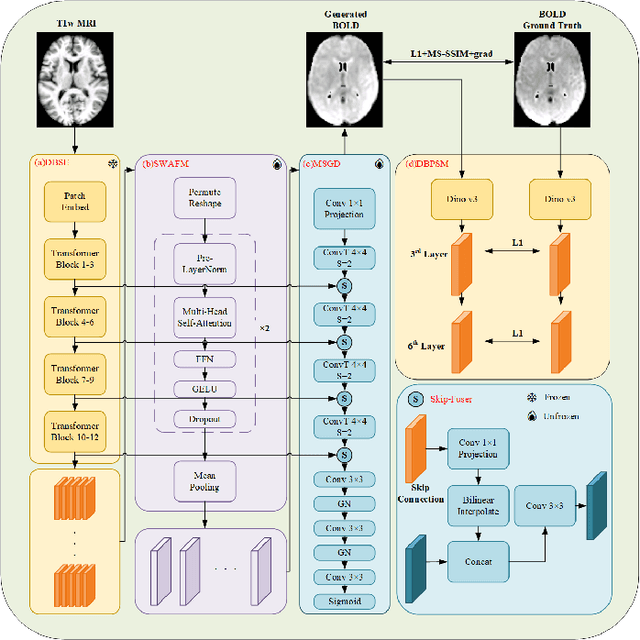
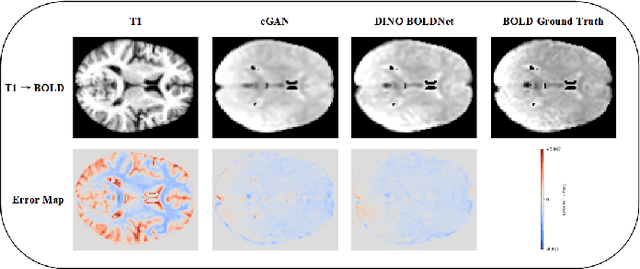
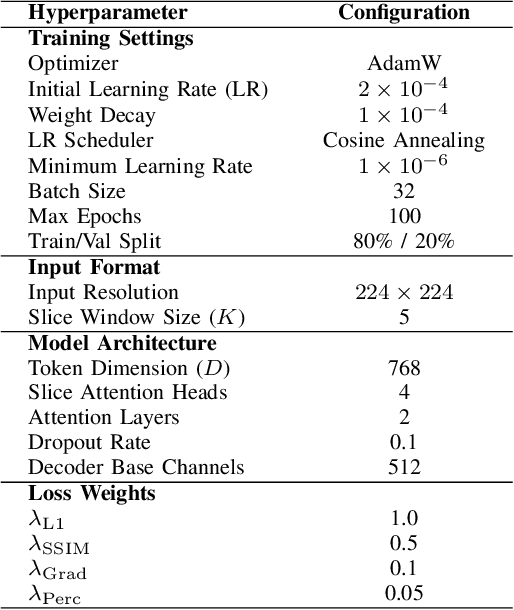
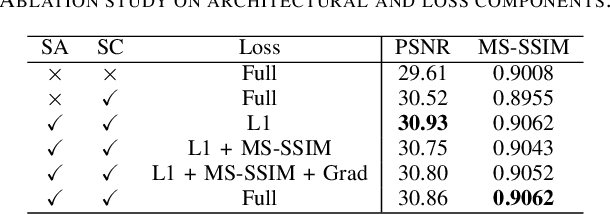
Generating BOLD images from T1w images offers a promising solution for recovering missing BOLD information and enabling downstream tasks when BOLD images are corrupted or unavailable. Motivated by this, we propose DINO-BOLDNet, a DINOv3-guided multi-slice attention framework that integrates a frozen self-supervised DINOv3 encoder with a lightweight trainable decoder. The model uses DINOv3 to extract within-slice structural representations, and a separate slice-attention module to fuse contextual information across neighboring slices. A multi-scale generation decoder then restores fine-grained functional contrast, while a DINO-based perceptual loss encourages structural and textural consistency between predictions and ground-truth BOLD in the transformer feature space. Experiments on a clinical dataset of 248 subjects show that DINO-BOLDNet surpasses a conditional GAN baseline in both PSNR and MS-SSIM. To our knowledge, this is the first framework capable of generating mean BOLD images directly from T1w images, highlighting the potential of self-supervised transformer guidance for structural-to-functional mapping.
Ensembling LLM-Induced Decision Trees for Explainable and Robust Error Detection
Dec 08, 2025Error detection (ED), which aims to identify incorrect or inconsistent cell values in tabular data, is important for ensuring data quality. Recent state-of-the-art ED methods leverage the pre-trained knowledge and semantic capability embedded in large language models (LLMs) to directly label whether a cell is erroneous. However, this LLM-as-a-labeler pipeline (1) relies on the black box, implicit decision process, thus failing to provide explainability for the detection results, and (2) is highly sensitive to prompts, yielding inconsistent outputs due to inherent model stochasticity, therefore lacking robustness. To address these limitations, we propose an LLM-as-an-inducer framework that adopts LLM to induce the decision tree for ED (termed TreeED) and further ensembles multiple such trees for consensus detection (termed ForestED), thereby improving explainability and robustness. Specifically, based on prompts derived from data context, decision tree specifications and output requirements, TreeED queries the LLM to induce the decision tree skeleton, whose root-to-leaf decision paths specify the stepwise procedure for evaluating a given sample. Each tree contains three types of nodes: (1) rule nodes that perform simple validation checks (e.g., format or range), (2) Graph Neural Network (GNN) nodes that capture complex patterns (e.g., functional dependencies), and (3) leaf nodes that output the final decision types (error or clean). Furthermore, ForestED employs uncertainty-based sampling to obtain multiple row subsets, constructing a decision tree for each subset using TreeED. It then leverages an Expectation-Maximization-based algorithm that jointly estimates tree reliability and optimizes the consensus ED prediction. Extensive xperiments demonstrate that our methods are accurate, explainable and robust, achieving an average F1-score improvement of 16.1% over the best baseline.
LLM-based HSE Compliance Assessment: Benchmark, Performance, and Advancements
May 29, 2025Health, Safety, and Environment (HSE) compliance assessment demands dynamic real-time decision-making under complicated regulations and complex human-machine-environment interactions. While large language models (LLMs) hold significant potential for decision intelligence and contextual dialogue, their capacity for domain-specific knowledge in HSE and structured legal reasoning remains underexplored. We introduce HSE-Bench, the first benchmark dataset designed to evaluate the HSE compliance assessment capabilities of LLM. HSE-Bench comprises over 1,000 manually curated questions drawn from regulations, court cases, safety exams, and fieldwork videos, and integrates a reasoning flow based on Issue spotting, rule Recall, rule Application, and rule Conclusion (IRAC) to assess the holistic reasoning pipeline. We conduct extensive evaluations on different prompting strategies and more than 10 LLMs, including foundation models, reasoning models and multimodal vision models. The results show that, although current LLMs achieve good performance, their capabilities largely rely on semantic matching rather than principled reasoning grounded in the underlying HSE compliance context. Moreover, their native reasoning trace lacks the systematic legal reasoning required for rigorous HSE compliance assessment. To alleviate these, we propose a new prompting technique, Reasoning of Expert (RoE), which guides LLMs to simulate the reasoning process of different experts for compliance assessment and reach a more accurate unified decision. We hope our study highlights reasoning gaps in LLMs for HSE compliance and inspires further research on related tasks.