 Add to Chrome
 Add to Firefox
 Add to Edge
Towards Scenario Generalization for Vision-based Roadside 3D Object Detection
Jan 29, 2024
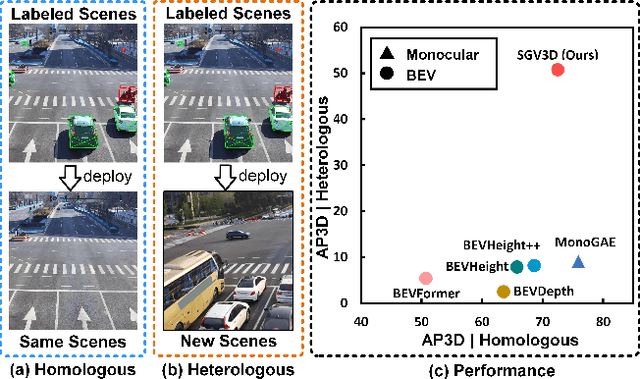
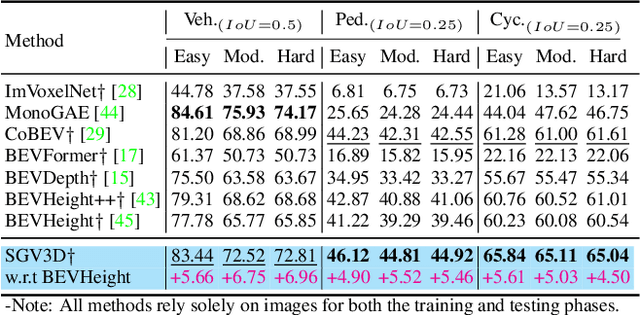
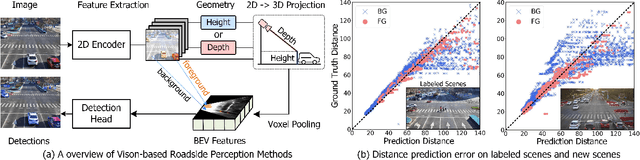
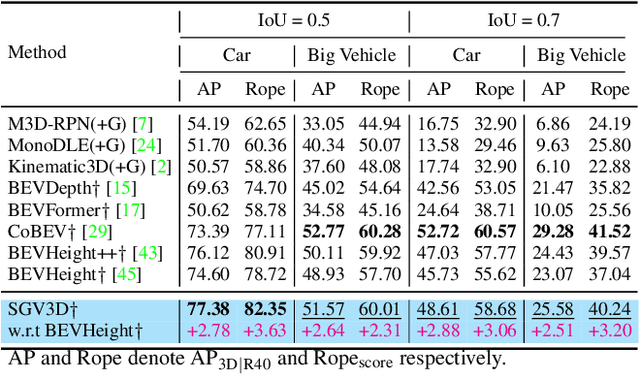
Roadside perception can greatly increase the safety of autonomous vehicles by extending their perception ability beyond the visual range and addressing blind spots. However, current state-of-the-art vision-based roadside detection methods possess high accuracy on labeled scenes but have inferior performance on new scenes. This is because roadside cameras remain stationary after installation and can only collect data from a single scene, resulting in the algorithm overfitting these roadside backgrounds and camera poses. To address this issue, in this paper, we propose an innovative Scenario Generalization Framework for Vision-based Roadside 3D Object Detection, dubbed SGV3D. Specifically, we employ a Background-suppressed Module (BSM) to mitigate background overfitting in vision-centric pipelines by attenuating background features during the 2D to bird's-eye-view projection. Furthermore, by introducing the Semi-supervised Data Generation Pipeline (SSDG) using unlabeled images from new scenes, diverse instance foregrounds with varying camera poses are generated, addressing the risk of overfitting specific camera poses. We evaluate our method on two large-scale roadside benchmarks. Our method surpasses all previous methods by a significant margin in new scenes, including +42.57% for vehicle, +5.87% for pedestrian, and +14.89% for cyclist compared to BEVHeight on the DAIR-V2X-I heterologous benchmark. On the larger-scale Rope3D heterologous benchmark, we achieve notable gains of 14.48% for car and 12.41% for large vehicle. We aspire to contribute insights on the exploration of roadside perception techniques, emphasizing their capability for scenario generalization. The code will be available at {\url{ https://github.com/yanglei18/SGV3D}}

Text2Avatar: Text to 3D Human Avatar Generation with Codebook-Driven Body Controllable Attribute
Jan 01, 2024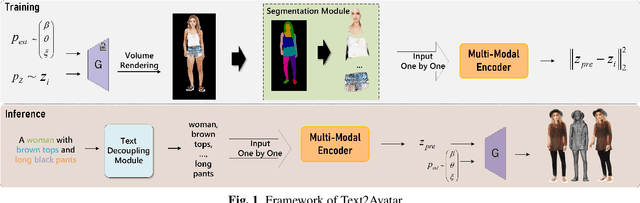


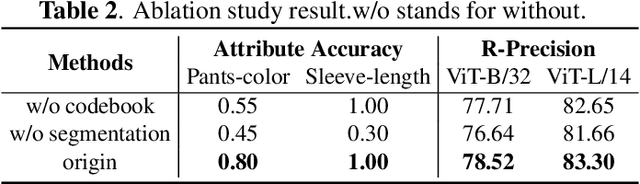
Generating 3D human models directly from text helps reduce the cost and time of character modeling. However, achieving multi-attribute controllable and realistic 3D human avatar generation is still challenging due to feature coupling and the scarcity of realistic 3D human avatar datasets. To address these issues, we propose Text2Avatar, which can generate realistic-style 3D avatars based on the coupled text prompts. Text2Avatar leverages a discrete codebook as an intermediate feature to establish a connection between text and avatars, enabling the disentanglement of features. Furthermore, to alleviate the scarcity of realistic style 3D human avatar data, we utilize a pre-trained unconditional 3D human avatar generation model to obtain a large amount of 3D avatar pseudo data, which allows Text2Avatar to achieve realistic style generation. Experimental results demonstrate that our method can generate realistic 3D avatars from coupled textual data, which is challenging for other existing methods in this field.
Exploring Multi-Modal Control in Music-Driven Dance Generation
Jan 01, 2024Existing music-driven 3D dance generation methods mainly concentrate on high-quality dance generation, but lack sufficient control during the generation process. To address these issues, we propose a unified framework capable of generating high-quality dance movements and supporting multi-modal control, including genre control, semantic control, and spatial control. First, we decouple the dance generation network from the dance control network, thereby avoiding the degradation in dance quality when adding additional control information. Second, we design specific control strategies for different control information and integrate them into a unified framework. Experimental results show that the proposed dance generation framework outperforms state-of-the-art methods in terms of motion quality and controllability.
Towards Balanced Alignment: Modal-Enhanced Semantic Modeling for Video Moment Retrieval
Dec 19, 2023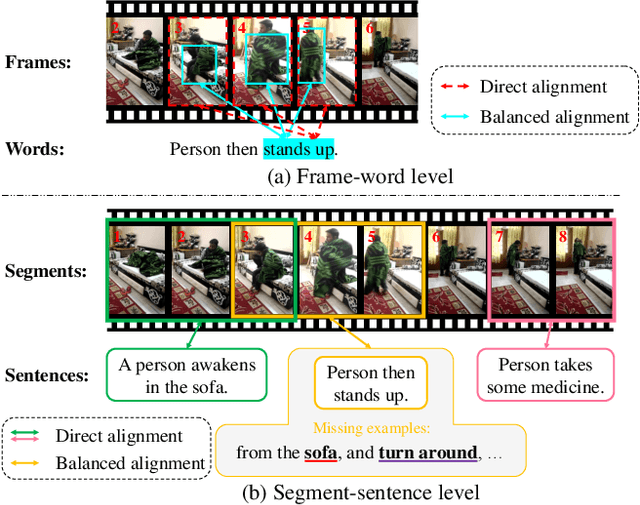
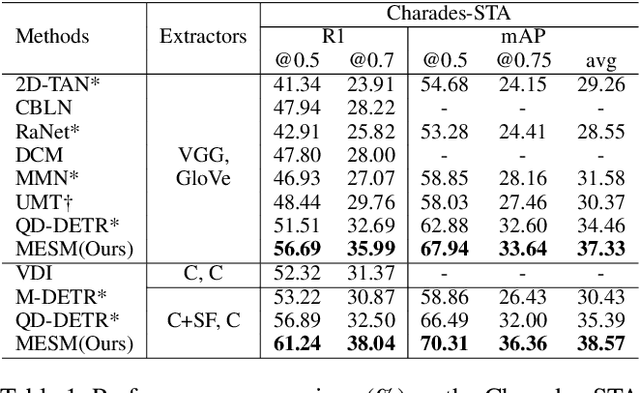

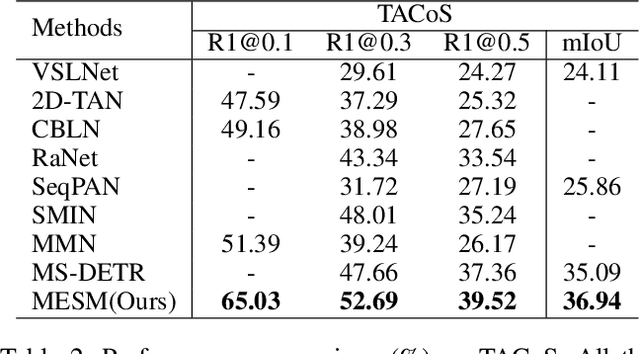
Video Moment Retrieval (VMR) aims to retrieve temporal segments in untrimmed videos corresponding to a given language query by constructing cross-modal alignment strategies. However, these existing strategies are often sub-optimal since they ignore the modality imbalance problem, \textit{i.e.}, the semantic richness inherent in videos far exceeds that of a given limited-length sentence. Therefore, in pursuit of better alignment, a natural idea is enhancing the video modality to filter out query-irrelevant semantics, and enhancing the text modality to capture more segment-relevant knowledge. In this paper, we introduce Modal-Enhanced Semantic Modeling (MESM), a novel framework for more balanced alignment through enhancing features at two levels. First, we enhance the video modality at the frame-word level through word reconstruction. This strategy emphasizes the portions associated with query words in frame-level features while suppressing irrelevant parts. Therefore, the enhanced video contains less redundant semantics and is more balanced with the textual modality. Second, we enhance the textual modality at the segment-sentence level by learning complementary knowledge from context sentences and ground-truth segments. With the knowledge added to the query, the textual modality thus maintains more meaningful semantics and is more balanced with the video modality. By implementing two levels of MESM, the semantic information from both modalities is more balanced to align, thereby bridging the modality gap. Experiments on three widely used benchmarks, including the out-of-distribution settings, show that the proposed framework achieves a new start-of-the-art performance with notable generalization ability (e.g., 4.42% and 7.69% average gains of R1@0.7 on Charades-STA and Charades-CG). The code will be available at https://github.com/lntzm/MESM.
Compound Text-Guided Prompt Tuning via Image-Adaptive Cues
Dec 11, 2023Vision-Language Models (VLMs) such as CLIP have demonstrated remarkable generalization capabilities to downstream tasks. However, existing prompt tuning based frameworks need to parallelize learnable textual inputs for all categories, suffering from massive GPU memory consumption when there is a large number of categories in the target dataset. Moreover, previous works require to include category names within prompts, exhibiting subpar performance when dealing with ambiguous category names. To address these shortcomings, we propose Compound Text-Guided Prompt Tuning (TGP-T) that significantly reduces resource demand while achieving superior performance. We introduce text supervision to the optimization of prompts, which enables two benefits: 1) releasing the model reliance on the pre-defined category names during inference, thereby enabling more flexible prompt generation; 2) reducing the number of inputs to the text encoder, which decreases GPU memory consumption significantly. Specifically, we found that compound text supervisions, i.e., category-wise and content-wise, is highly effective, since they provide inter-class separability and capture intra-class variations, respectively. Moreover, we condition the prompt generation on visual features through a module called Bonder, which facilitates the alignment between prompts and visual features. Extensive experiments on few-shot recognition and domain generalization demonstrate that TGP-T achieves superior performance with consistently lower training costs. It reduces GPU memory usage by 93% and attains a 2.5% performance gain on 16-shot ImageNet. The code is available at https://github.com/EricTan7/TGP-T.
A General Neural Causal Model for Interactive Recommendation
Oct 30, 2023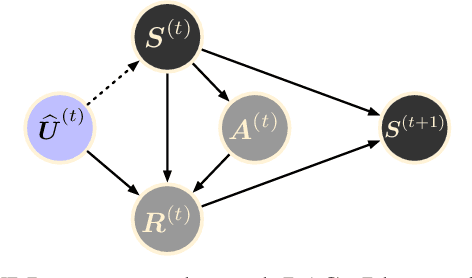
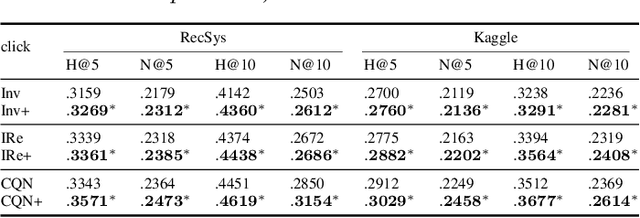
Survivor bias in observational data leads the optimization of recommender systems towards local optima. Currently most solutions re-mines existing human-system collaboration patterns to maximize longer-term satisfaction by reinforcement learning. However, from the causal perspective, mitigating survivor effects requires answering a counterfactual problem, which is generally unidentifiable and inestimable. In this work, we propose a neural causal model to achieve counterfactual inference. Specifically, we first build a learnable structural causal model based on its available graphical representations which qualitatively characterizes the preference transitions. Mitigation of the survivor bias is achieved though counterfactual consistency. To identify the consistency, we use the Gumbel-max function as structural constrains. To estimate the consistency, we apply reinforcement optimizations, and use Gumbel-Softmax as a trade-off to get a differentiable function. Both theoretical and empirical studies demonstrate the effectiveness of our solution.
Adversarial Batch Inverse Reinforcement Learning: Learn to Reward from Imperfect Demonstration for Interactive Recommendation
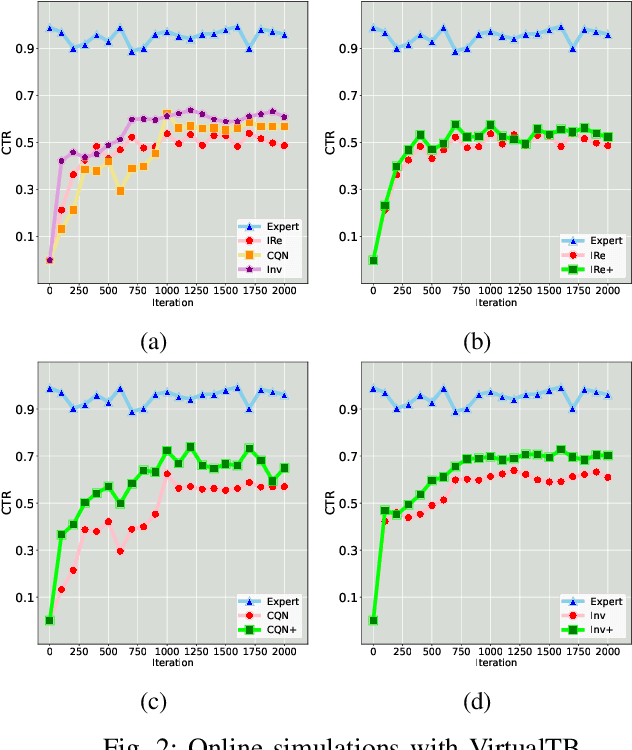
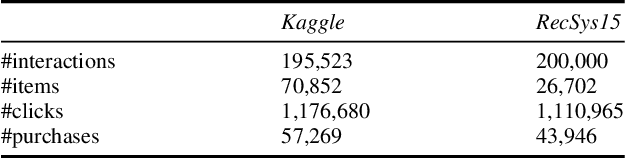
Oct 30, 2023Rewards serve as a measure of user satisfaction and act as a limiting factor in interactive recommender systems. In this research, we focus on the problem of learning to reward (LTR), which is fundamental to reinforcement learning. Previous approaches either introduce additional procedures for learning to reward, thereby increasing the complexity of optimization, or assume that user-agent interactions provide perfect demonstrations, which is not feasible in practice. Ideally, we aim to employ a unified approach that optimizes both the reward and policy using compositional demonstrations. However, this requirement presents a challenge since rewards inherently quantify user feedback on-policy, while recommender agents approximate off-policy future cumulative valuation. To tackle this challenge, we propose a novel batch inverse reinforcement learning paradigm that achieves the desired properties. Our method utilizes discounted stationary distribution correction to combine LTR and recommender agent evaluation. To fulfill the compositional requirement, we incorporate the concept of pessimism through conservation. Specifically, we modify the vanilla correction using Bellman transformation and enforce KL regularization to constrain consecutive policy updates. We use two real-world datasets which represent two compositional coverage to conduct empirical studies, the results also show that the proposed method relatively improves both effectiveness (2.3\%) and efficiency (11.53\%)
Dual Radar: A Multi-modal Dataset with Dual 4D Radar for Autonomous Driving
Oct 23, 2023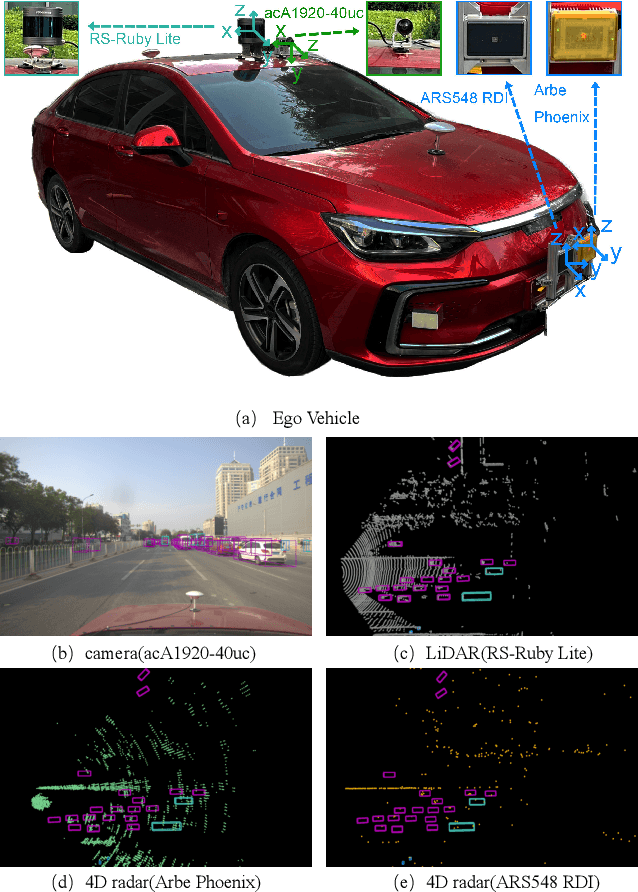
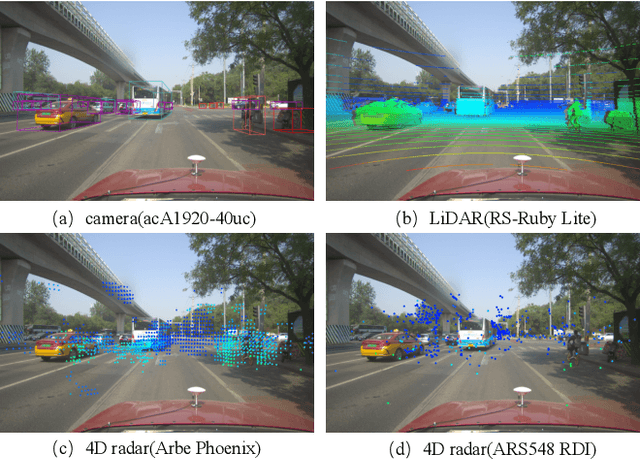
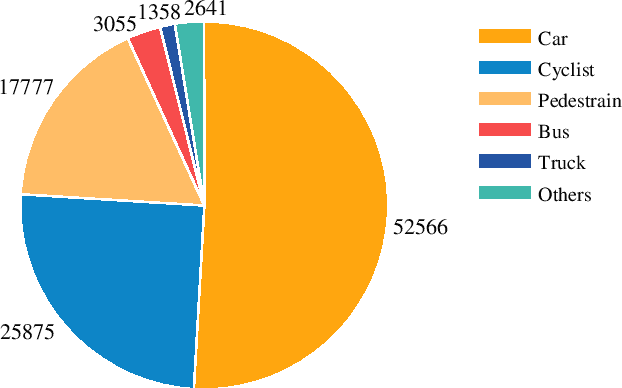
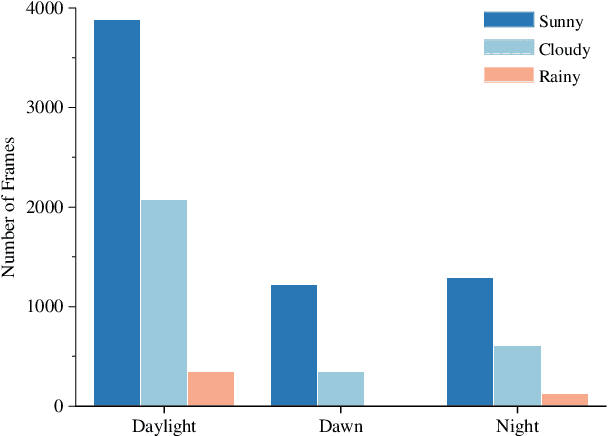
Radar has stronger adaptability in adverse scenarios for autonomous driving environmental perception compared to widely adopted cameras and LiDARs. Compared with commonly used 3D radars, the latest 4D radars have precise vertical resolution and higher point cloud density, making it a highly promising sensor for autonomous driving in complex environmental perception. However, due to the much higher noise than LiDAR, manufacturers choose different filtering strategies, resulting in an inverse ratio between noise level and point cloud density. There is still a lack of comparative analysis on which method is beneficial for deep learning-based perception algorithms in autonomous driving. One of the main reasons is that current datasets only adopt one type of 4D radar, making it difficult to compare different 4D radars in the same scene. Therefore, in this paper, we introduce a novel large-scale multi-modal dataset featuring, for the first time, two types of 4D radars captured simultaneously. This dataset enables further research into effective 4D radar perception algorithms.Our dataset consists of 151 consecutive series, most of which last 20 seconds and contain 10,007 meticulously synchronized and annotated frames. Moreover, our dataset captures a variety of challenging driving scenarios, including many road conditions, weather conditions, nighttime and daytime with different lighting intensities and periods. Our dataset annotates consecutive frames, which can be applied to 3D object detection and tracking, and also supports the study of multi-modal tasks. We experimentally validate our dataset, providing valuable results for studying different types of 4D radars. This dataset is released on https://github.com/adept-thu/Dual-Radar.
Fuzzy-NMS: Improving 3D Object Detection with Fuzzy Classification in NMS
Oct 21, 2023Non-maximum suppression (NMS) is an essential post-processing module used in many 3D object detection frameworks to remove overlapping candidate bounding boxes. However, an overreliance on classification scores and difficulties in determining appropriate thresholds can affect the resulting accuracy directly. To address these issues, we introduce fuzzy learning into NMS and propose a novel generalized Fuzzy-NMS module to achieve finer candidate bounding box filtering. The proposed Fuzzy-NMS module combines the volume and clustering density of candidate bounding boxes, refining them with a fuzzy classification method and optimizing the appropriate suppression thresholds to reduce uncertainty in the NMS process. Adequate validation experiments are conducted using the mainstream KITTI and large-scale Waymo 3D object detection benchmarks. The results of these tests demonstrate the proposed Fuzzy-NMS module can improve the accuracy of numerous recently NMS-based detectors significantly, including PointPillars, PV-RCNN, and IA-SSD, etc. This effect is particularly evident for small objects such as pedestrians and bicycles. As a plug-and-play module, Fuzzy-NMS does not need to be retrained and produces no obvious increases in inference time.
Pre-Training on Large-Scale Generated Docking Conformations with HelixDock to Unlock the Potential of Protein-ligand Structure Prediction Models
Oct 21, 2023Molecular docking, a pivotal computational tool for drug discovery, predicts the binding interactions between small molecules (ligands) and target proteins (receptors). Conventional physics-based docking tools, though widely used, face limitations in precision due to restricted conformational sampling and imprecise scoring functions. Recent endeavors have employed deep learning techniques to enhance docking accuracy, but their generalization remains a concern due to limited training data. Leveraging the success of extensive and diverse data in other domains, we introduce HelixDock, a novel approach for site-specific molecular docking. Hundreds of millions of binding poses are generated by traditional docking tools, encompassing diverse protein targets and small molecules. Our deep learning-based docking model, a SE(3)-equivariant network, is pre-trained with this large-scale dataset and then fine-tuned with a small number of precise receptor-ligand complex structures. Comparative analyses against physics-based and deep learning-based baseline methods highlight HelixDock's superiority, especially on challenging test sets. Our study elucidates the scaling laws of the pre-trained molecular docking models, showcasing consistent improvements with increased model parameters and pre-train data quantities. Harnessing the power of extensive and diverse generated data holds promise for advancing AI-driven drug discovery.