 Add to Chrome
 Add to Firefox
 Add to Edge
MSAVBench: Towards Comprehensive and Reliable Evaluation of Multi-Shot Audio-Video Generation
May 19, 2026
Video generation is rapidly evolving from single-shot synthesis to complex multi-shot audio-video (MSAV) narratives to meet real-world demands. However, evaluating such frontier models remains a fundamental challenge. Existing benchmarks are limited in scope and data diversity, and rely on rigid evaluation pipelines, preventing systematic and reliable assessment of modern MSAV models. To bridge these gaps, we introduce MSAVBench, the first comprehensive benchmark and adaptive hybrid evaluation framework for multi-shot audio-video generation. Our benchmark spans four key dimensions, video, audio, shot, and reference, covering diverse task settings, varying shot counts of up to 15, and challenging non-realistic scenarios. Our evaluation framework improves robustness through an adaptive self-correction mechanism for shot segmentation, instance-wise rubrics for subjective metrics, and tool-grounded evidence extraction for complex judgments. Furthermore, MSAVBench achieves high alignment with human judgments, reaching a Spearman rank correlation of 91.5%. Our systematic evaluation of 19 state-of-the-art closed- and open-source models shows that current systems still struggle with director-level control and fine-grained audio-visual synchronization, while modular or agentic generation pipelines offer a promising path toward narrowing the gap between open- and closed-source models. We will release the benchmark data and evaluation code to facilitate future research.

AIBench: Evaluating Visual-Logical Consistency in Academic Illustration Generation
Mar 31, 2026Although image generation has boosted various applications via its rapid evolution, whether the state-of-the-art models are able to produce ready-to-use academic illustrations for papers is still largely unexplored. Directly comparing or evaluating the illustration with VLM is native but requires oracle multi-modal understanding ability, which is unreliable for long and complex texts and illustrations. To address this, we propose AIBench, the first benchmark using VQA for evaluating logic correctness of the academic illustrations and VLMs for assessing aesthetics. In detail, we designed four levels of questions proposed from a logic diagram summarized from the method part of the paper, which query whether the generated illustration aligns with the paper on different scales. Our VQA-based approach raises more accurate and detailed evaluations on visual-logical consistency while relying less on the ability of the judger VLM. With our high-quality AIBench, we conduct extensive experiments and conclude that the performance gap between models on this task is significantly larger than general ones, reflecting their various complex reasoning and high-density generation ability. Further, the logic and aesthetics are hard to optimize simultaneously as in handcrafted illustrations. Additional experiments further state that test-time scaling on both abilities significantly boosts the performance on this task.
ORSIFlow: Saliency-Guided Rectified Flow for Optical Remote Sensing Salient Object Detection
Mar 30, 2026Optical Remote Sensing Image Salient Object Detection (ORSI-SOD) remains challenging due to complex backgrounds, low contrast, irregular object shapes, and large variations in object scale. Existing discriminative methods directly regress saliency maps, while recent diffusion-based generative approaches suffer from stochastic sampling and high computational cost. In this paper, we propose ORSIFlow, a saliency-guided rectified flow framework that reformulates ORSI-SOD as a deterministic latent flow generation problem. ORSIFlow performs saliency mask generation in a compact latent space constructed by a frozen variational autoencoder, enabling efficient inference with only a few steps. To enhance saliency awareness, we design a Salient Feature Discriminator for global semantic discrimination and a Salient Feature Calibrator for precise boundary refinement. Extensive experiments on multiple public benchmarks show that ORSIFlow achieves state-of-the-art performance with significantly improved efficiency. Codes are available at: https://github.com/Ch3nSir/ORSIFlow.
GenAgent: Scaling Text-to-Image Generation via Agentic Multimodal Reasoning
Jan 26, 2026We introduce GenAgent, unifying visual understanding and generation through an agentic multimodal model. Unlike unified models that face expensive training costs and understanding-generation trade-offs, GenAgent decouples these capabilities through an agentic framework: understanding is handled by the multimodal model itself, while generation is achieved by treating image generation models as invokable tools. Crucially, unlike existing modular systems constrained by static pipelines, this design enables autonomous multi-turn interactions where the agent generates multimodal chains-of-thought encompassing reasoning, tool invocation, judgment, and reflection to iteratively refine outputs. We employ a two-stage training strategy: first, cold-start with supervised fine-tuning on high-quality tool invocation and reflection data to bootstrap agent behaviors; second, end-to-end agentic reinforcement learning combining pointwise rewards (final image quality) and pairwise rewards (reflection accuracy), with trajectory resampling for enhanced multi-turn exploration. GenAgent significantly boosts base generator(FLUX.1-dev) performance on GenEval++ (+23.6\%) and WISE (+14\%). Beyond performance gains, our framework demonstrates three key properties: 1) cross-tool generalization to generators with varying capabilities, 2) test-time scaling with consistent improvements across interaction rounds, and 3) task-adaptive reasoning that automatically adjusts to different tasks. Our code will be available at \href{https://github.com/deep-kaixun/GenAgent}{this url}.
ShowTable: Unlocking Creative Table Visualization with Collaborative Reflection and Refinement
Dec 15, 2025While existing generation and unified models excel at general image generation, they struggle with tasks requiring deep reasoning, planning, and precise data-to-visual mapping abilities beyond general scenarios. To push beyond the existing limitations, we introduce a new and challenging task: creative table visualization, requiring the model to generate an infographic that faithfully and aesthetically visualizes the data from a given table. To address this challenge, we propose ShowTable, a pipeline that synergizes MLLMs with diffusion models via a progressive self-correcting process. The MLLM acts as the central orchestrator for reasoning the visual plan and judging visual errors to provide refined instructions, the diffusion execute the commands from MLLM, achieving high-fidelity results. To support this task and our pipeline, we introduce three automated data construction pipelines for training different modules. Furthermore, we introduce TableVisBench, a new benchmark with 800 challenging instances across 5 evaluation dimensions, to assess performance on this task. Experiments demonstrate that our pipeline, instantiated with different models, significantly outperforms baselines, highlighting its effective multi-modal reasoning, generation, and error correction capabilities.
RegionRAG: Region-level Retrieval-Augumented Generation for Visually-Rich Documents
Oct 31, 2025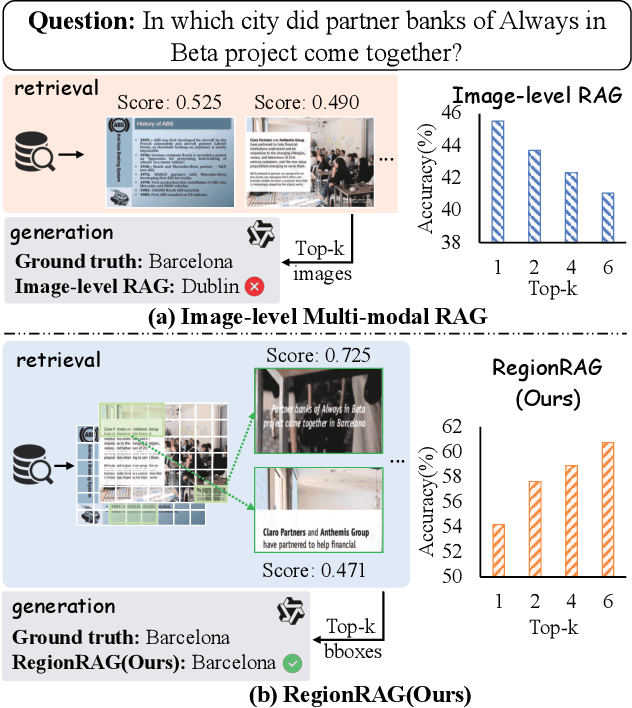
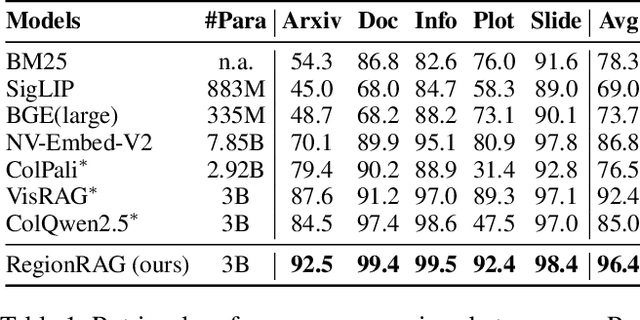
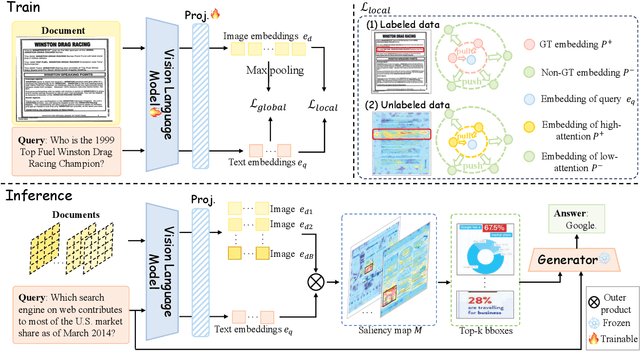
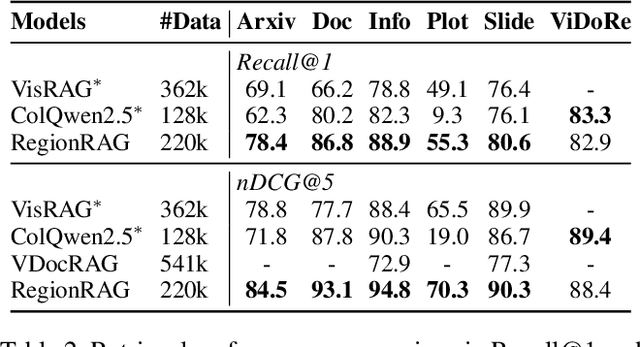
Multi-modal Retrieval-Augmented Generation (RAG) has become a critical method for empowering LLMs by leveraging candidate visual documents. However, current methods consider the entire document as the basic retrieval unit, introducing substantial irrelevant visual content in two ways: 1) Relevant documents often contain large regions unrelated to the query, diluting the focus on salient information; 2) Retrieving multiple documents to increase recall further introduces redundant and irrelevant documents. These redundant contexts distract the model's attention and further degrade the performance. To address this challenge, we propose \modelname, a novel framework that shifts the retrieval paradigm from the document level to the region level. During training, we design a hybrid supervision strategy from both labeled data and unlabeled data to pinpoint relevant patches. During inference, we propose a dynamic pipeline that intelligently groups salient patches into complete semantic regions. By delegating the task of identifying relevant regions to the retriever, \modelname enables the generator to focus solely on concise visual content relevant to queries, improving both efficiency and accuracy. Experiments on six benchmarks demonstrate that RegionRAG achieves state-of-the-art performance. Improves retrieval accuracy by 10.02\% in R@1 on average and increases question answering accuracy by 3.56\% while using only 71.42\% visual tokens compared to prior methods. The code will be available at https://github.com/Aeryn666/RegionRAG.
Hybrid-Level Instruction Injection for Video Token Compression in Multi-modal Large Language Models
Mar 20, 2025Recent Multi-modal Large Language Models (MLLMs) have been challenged by the computational overhead resulting from massive video frames, often alleviated through compression strategies. However, the visual content is not equally contributed to user instructions, existing strategies (\eg, average pool) inevitably lead to the loss of potentially useful information. To tackle this, we propose the Hybrid-level Instruction Injection Strategy for Conditional Token Compression in MLLMs (HICom), utilizing the instruction as a condition to guide the compression from both local and global levels. This encourages the compression to retain the maximum amount of user-focused information while reducing visual tokens to minimize computational burden. Specifically, the instruction condition is injected into the grouped visual tokens at the local level and the learnable tokens at the global level, and we conduct the attention mechanism to complete the conditional compression. From the hybrid-level compression, the instruction-relevant visual parts are highlighted while the temporal-spatial structure is also preserved for easier understanding of LLMs. To further unleash the potential of HICom, we introduce a new conditional pre-training stage with our proposed dataset HICom-248K. Experiments show that our HICom can obtain distinguished video understanding ability with fewer tokens, increasing the performance by 2.43\% average on three multiple-choice QA benchmarks and saving 78.8\% tokens compared with the SOTA method. The code is available at https://github.com/lntzm/HICom.
SpaceVLLM: Endowing Multimodal Large Language Model with Spatio-Temporal Video Grounding Capability
Mar 18, 2025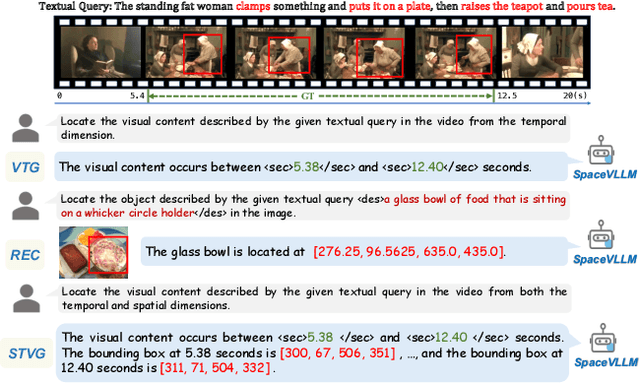

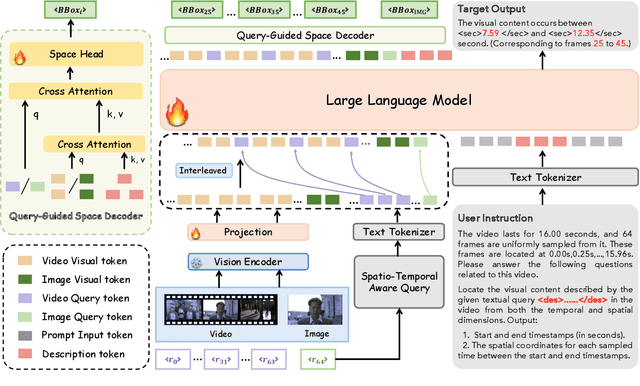
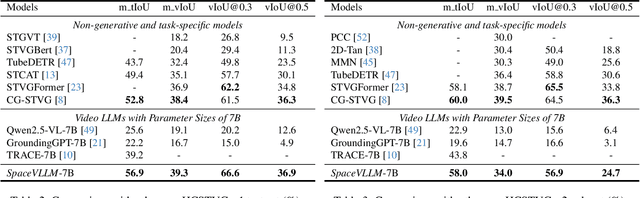
Multimodal large language models (MLLMs) have made remarkable progress in either temporal or spatial localization. However, they struggle to perform spatio-temporal video grounding. This limitation stems from two major challenges. Firstly, it is difficult to extract accurate spatio-temporal information of each frame in the video. Secondly, the substantial number of visual tokens makes it challenging to precisely map visual tokens of each frame to their corresponding spatial coordinates. To address these issues, we introduce SpaceVLLM, a MLLM endowed with spatio-temporal video grounding capability. Specifically, we adopt a set of interleaved Spatio-Temporal Aware Queries to capture temporal perception and dynamic spatial information. Moreover, we propose a Query-Guided Space Decoder to establish a corresponding connection between the queries and spatial coordinates. Additionally, due to the lack of spatio-temporal datasets, we construct the Unified Spatio-Temporal Grounding (Uni-STG) dataset, comprising 480K instances across three tasks. This dataset fully exploits the potential of MLLM to simultaneously facilitate localization in both temporal and spatial dimensions. Extensive experiments demonstrate that SpaceVLLM achieves the state-of-the-art performance across 11 benchmarks covering temporal, spatial, spatio-temporal and video understanding tasks, highlighting the effectiveness of our approach. Our code, datasets and model will be released.
Rethinking Video Tokenization: A Conditioned Diffusion-based Approach
Mar 05, 2025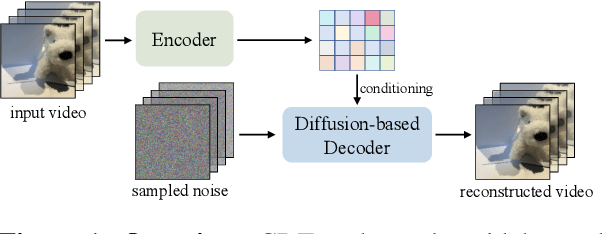
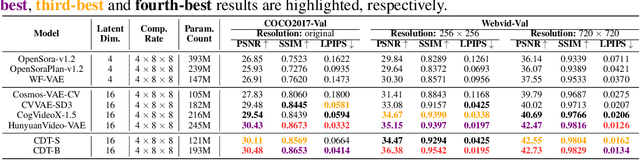
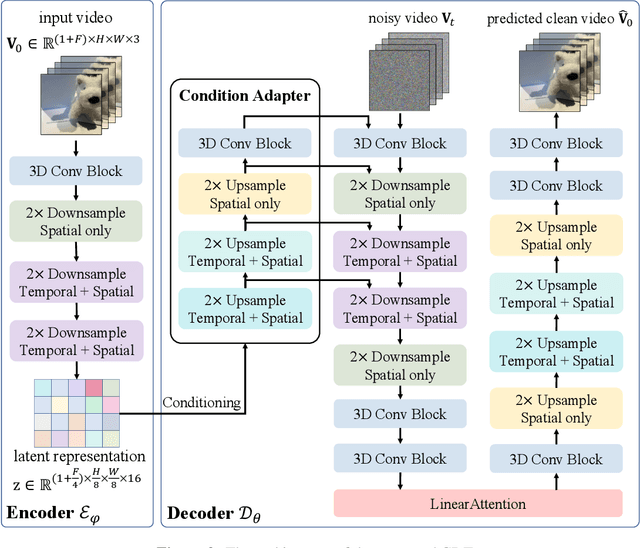
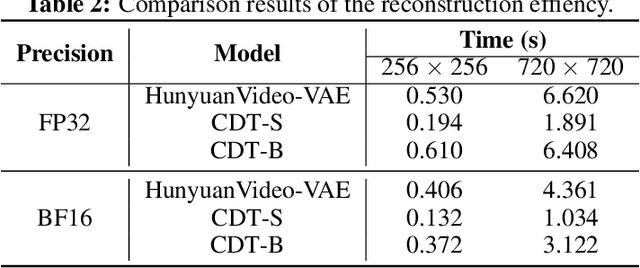
Video tokenizers, which transform videos into compact latent representations, are key to video generation. Existing video tokenizers are based on the VAE architecture and follow a paradigm where an encoder compresses videos into compact latents, and a deterministic decoder reconstructs the original videos from these latents. In this paper, we propose a novel \underline{\textbf{C}}onditioned \underline{\textbf{D}}iffusion-based video \underline{\textbf{T}}okenizer entitled \textbf{\ourmethod}, which departs from previous methods by replacing the deterministic decoder with a 3D causal diffusion model. The reverse diffusion generative process of the decoder is conditioned on the latent representations derived via the encoder. With a feature caching and sampling acceleration, the framework efficiently reconstructs high-fidelity videos of arbitrary lengths. Results show that {\ourmethod} achieves state-of-the-art performance in video reconstruction tasks using just a single-step sampling. Even a smaller version of {\ourmethod} still achieves reconstruction results on par with the top two baselines. Furthermore, the latent video generation model trained using {\ourmethod} also shows superior performance.
What Is a Good Caption? A Comprehensive Visual Caption Benchmark for Evaluating Both Correctness and Coverage of MLLMs
Feb 19, 2025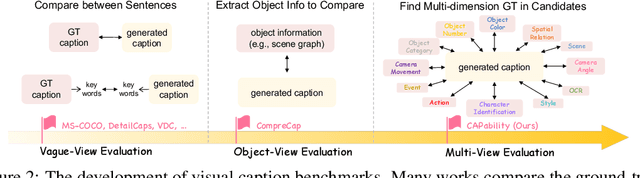
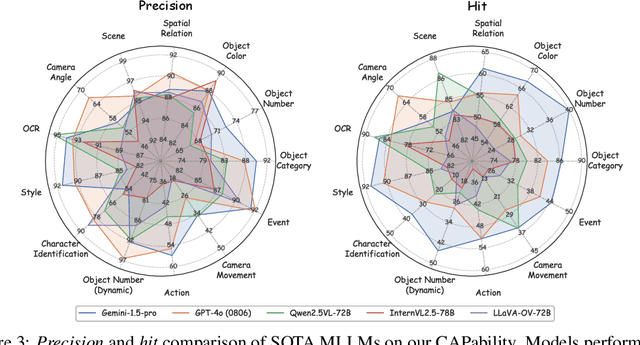
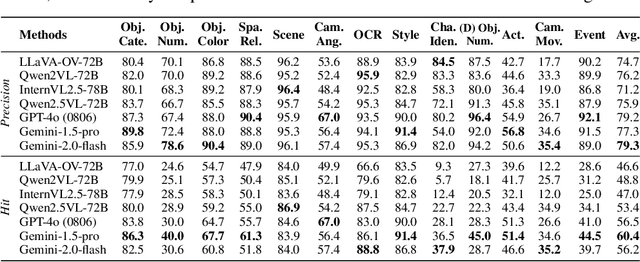

Recent advancements in Multimodal Large Language Models (MLLMs) have rendered traditional visual captioning benchmarks obsolete, as they primarily evaluate short descriptions with outdated metrics. While recent benchmarks address these limitations by decomposing captions into visual elements and adopting model-based evaluation, they remain incomplete-overlooking critical aspects, while providing vague, non-explanatory scores. To bridge this gap, we propose CV-CapBench, a Comprehensive Visual Caption Benchmark that systematically evaluates caption quality across 6 views and 13 dimensions. CV-CapBench introduces precision, recall, and hit rate metrics for each dimension, uniquely assessing both correctness and coverage. Experiments on leading MLLMs reveal significant capability gaps, particularly in dynamic and knowledge-intensive dimensions. These findings provide actionable insights for future research. The code and data will be released.