 Add to Chrome
 Add to Firefox
 Add to Edge
RoboWorld: Fast and Reliable Neural Simulators for Generalist Robot Policy Evaluation
Jul 01, 2026
Video world models are emerging as a scalable alternative for evaluating generalist robot policies, bypassing the physical constraints and engineering burdens of real-world deployment. However, evaluating policies with video world models remains challenging, as world-model errors can make generated rollouts unreliable and slow inference limits large-scale throughput. We introduce RoboWorld, an automated evaluation pipeline that pairs a fast autoregressive video world model with a task-progress-aware vision-language model scoring. To enable reliable long-horizon autoregressive world-model rollouts, we propose Step Forcing, which combines anchored and one-step self-forwarded contexts to reduce train--test mismatch while preserving action--observation dynamics. Together, these components enable RoboWorld to align strongly with real-world robot evaluation across tasks and environments, achieving Pearson's r = 0.989 and Spearman's \r{ho} = 0.970.

HABIT: Human-Aware Behavior and Interaction Training Dataset for Robot Manipulation
Jun 30, 2026Large-scale demonstration datasets have been central to recent progress in general-purpose robot policies. However, existing datasets are collected in human-absent settings, and policies trained on such data may perform tasks competently in isolation but fail to exhibit human-aware behaviors. To address this gap, we introduce HABIT, a large-scale robot demonstration dataset for human-present environments. We organize tasks into three roles capturing distinct modes of human-robot interaction: Collaborator, where human and robot jointly accomplish a task; Coworker, where they pursue separate tasks in a shared space; and Supervisor, where the human directs the robot. The dataset comprises over 10K episodes and over 160 hours across 60 tasks. Our experiments show that training on human-present data elicits human-aware behaviors that robot-only data fails to produce: spatiotemporal synchronization in Collaborator tasks, yielding in Coworker tasks, and gesture grounding in Supervisor tasks. Moreover, training on HABIT enables rapid adaptation to new human-robot interaction tasks. By introducing human presence as a new axis of dataset diversity, HABIT extends robot policies to environments shared with humans.
SPACE: Enabling Learning from Cross-Robot Data Toward Generalist Policies
Jun 23, 2026In robot learning, scaling training datasets across diverse embodiments and environments has become a dominant paradigm for learning generalizable robot policies. These policies are commonly trained via behavior cloning to imitate actions from pre-collected demonstrations. However, since robot actions are tied to the dynamics of the data collection robot, different robots may require different actions to achieve the same motion. This discrepancy hinders both policy training and deployment across diverse robots. To address this, we propose using Cartesian state delta as a universal action representation across robots, and introduce State Prediction and Adaptive Command Execution (SPACE) framework. SPACE handles robot dynamics variation at three levels: across different embodiments, across hardware units of the same embodiment, and within a single robot during operation. It consists of two components: (i) a Cartesian state delta policy that predicts geometric end-effector displacement, and (ii) Action Adapter, which converts the predicted Cartesian state delta into robot-specific control commands. Experiments show that SPACE substantially outperforms policies that directly predict control commands when learning from data collected across different embodiments and across hardware units of the same embodiment. SPACE also remains robust under dynamics shifts at deployment, including changes in control frequency, object weight, and controller gains. The project page is available at http://haeone.site/space-website/.
Q-Flow: Stable and Expressive Reinforcement Learning with Flow-Based Policy
May 13, 2026There is growing interest in utilizing flow-based models as decision-making policies in reinforcement learning due to their high expressive capacity. However, effectively leveraging this expressivity for value maximization remains challenging, as naive gradient-based optimization requires backpropagating through numerical solvers and often leads to instability. Existing approaches typically address this issue by restricting the expressive capacity of flow-based policies, resulting in a trade-off between optimization stability and representational flexibility. To resolve this, we introduce Q-Flow, a framework that leverages the deterministic nature of flow dynamics to explicitly propagate terminal trajectory value to intermediate latent states along the policy-induced flow. This formulation enables stable policy optimization using intermediate value gradients without unrolling the numerical solver, effectively bridging the gap between stability and expressivity. We evaluate Q-Flow in the offline learning setting on the challenging OGBench suite, where it consistently outperforms state-of-the-art baselines by an average of 10.6 percentage points, while also enabling stable online adaptation within the same framework.
Let's Predict Sentence by Sentence
May 28, 2025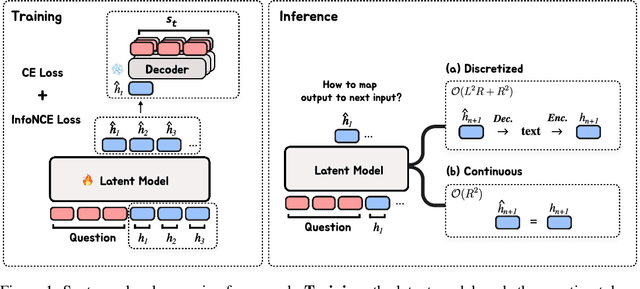
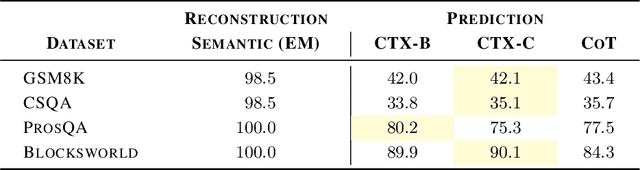
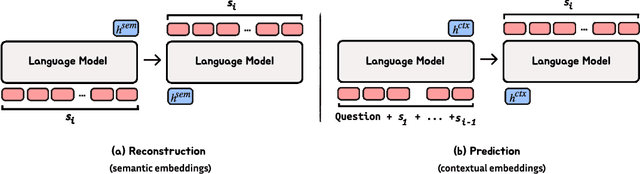
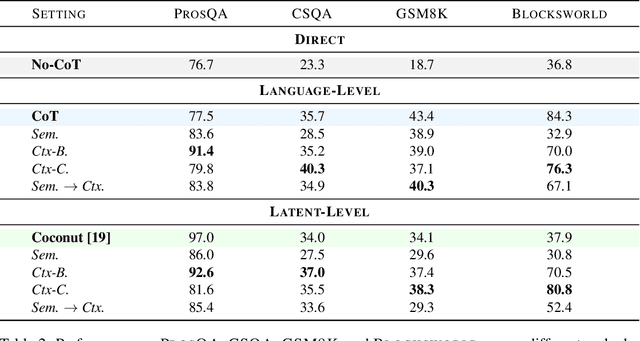
Autoregressive language models (LMs) generate one token at a time, yet human reasoning operates over higher-level abstractions - sentences, propositions, and concepts. This contrast raises a central question- Can LMs likewise learn to reason over structured semantic units rather than raw token sequences? In this work, we investigate whether pretrained LMs can be lifted into such abstract reasoning spaces by building on their learned representations. We present a framework that adapts a pretrained token-level LM to operate in sentence space by autoregressively predicting continuous embeddings of next sentences. We explore two embedding paradigms inspired by classical representation learning: 1) semantic embeddings, learned via autoencoding to preserve surface meaning; and 2) contextual embeddings, trained via next-sentence prediction to encode anticipatory structure. We evaluate both under two inference regimes: Discretized, which decodes each predicted embedding into text before re-encoding; and Continuous, which reasons entirely in embedding space for improved efficiency. Across four domains - mathematics, logic, commonsense, and planning - contextual embeddings under continuous inference show competitive performance with Chain-of-Thought (CoT) while reducing inference-time FLOPs on average by half. We also present early signs of scalability and modular adaptation. Finally, to visualize latent trajectories, we introduce SentenceLens, a diagnostic tool that decodes intermediate model states into interpretable sentences. Together, our results indicate that pretrained LMs can effectively transition to abstract, structured reasoning within latent embedding spaces.
Latent Action Pretraining from Videos
Oct 15, 2024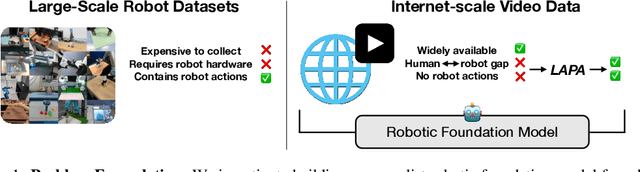


We introduce Latent Action Pretraining for general Action models (LAPA), an unsupervised method for pretraining Vision-Language-Action (VLA) models without ground-truth robot action labels. Existing Vision-Language-Action models require action labels typically collected by human teleoperators during pretraining, which significantly limits possible data sources and scale. In this work, we propose a method to learn from internet-scale videos that do not have robot action labels. We first train an action quantization model leveraging VQ-VAE-based objective to learn discrete latent actions between image frames, then pretrain a latent VLA model to predict these latent actions from observations and task descriptions, and finally finetune the VLA on small-scale robot manipulation data to map from latent to robot actions. Experimental results demonstrate that our method significantly outperforms existing techniques that train robot manipulation policies from large-scale videos. Furthermore, it outperforms the state-of-the-art VLA model trained with robotic action labels on real-world manipulation tasks that require language conditioning, generalization to unseen objects, and semantic generalization to unseen instructions. Training only on human manipulation videos also shows positive transfer, opening up the potential for leveraging web-scale data for robotics foundation model.
Ask Optimal Questions: Aligning Large Language Models with Retriever's Preference in Conversational Search
Feb 19, 2024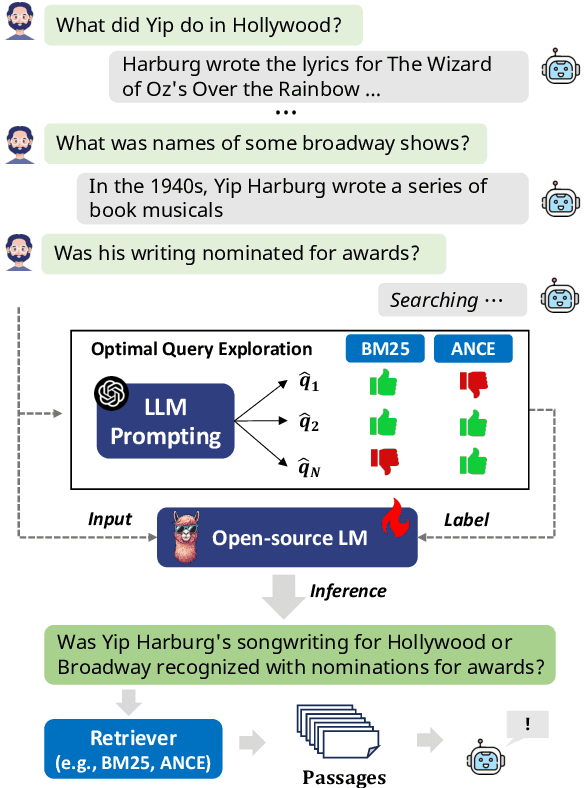
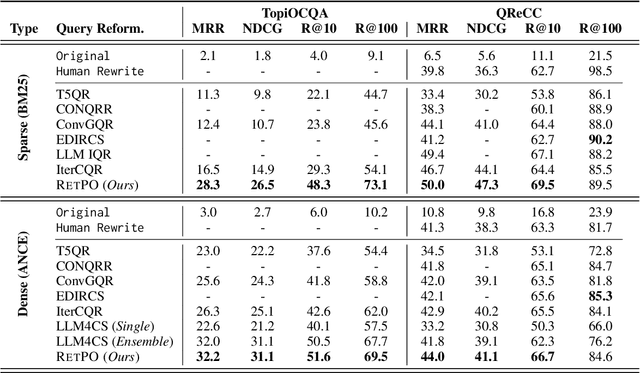
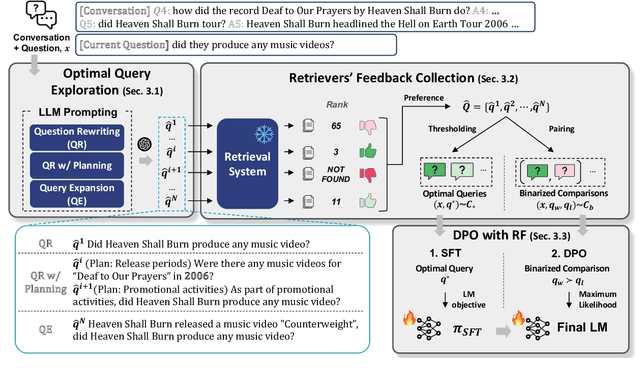
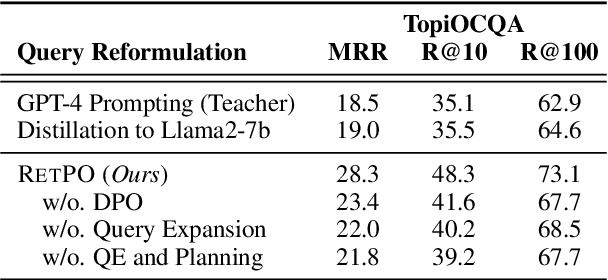
Conversational search, unlike single-turn retrieval tasks, requires understanding the current question within a dialogue context. The common approach of rewrite-then-retrieve aims to decontextualize questions to be self-sufficient for off-the-shelf retrievers, but most existing methods produce sub-optimal query rewrites due to the limited ability to incorporate signals from the retrieval results. To overcome this limitation, we present a novel framework RetPO (Retriever's Preference Optimization), which is designed to optimize a language model (LM) for reformulating search queries in line with the preferences of the target retrieval systems. The process begins by prompting a large LM to produce various potential rewrites and then collects retrieval performance for these rewrites as the retrievers' preferences. Through the process, we construct a large-scale dataset called RF collection, containing Retrievers' Feedback on over 410K query rewrites across 12K conversations. Furthermore, we fine-tune a smaller LM using this dataset to align it with the retrievers' preferences as feedback. The resulting model achieves state-of-the-art performance on two recent conversational search benchmarks, significantly outperforming existing baselines, including GPT-3.5.
Tree of Clarifications: Answering Ambiguous Questions with Retrieval-Augmented Large Language Models
Oct 23, 2023Questions in open-domain question answering are often ambiguous, allowing multiple interpretations. One approach to handling them is to identify all possible interpretations of the ambiguous question (AQ) and to generate a long-form answer addressing them all, as suggested by Stelmakh et al., (2022). While it provides a comprehensive response without bothering the user for clarification, considering multiple dimensions of ambiguity and gathering corresponding knowledge remains a challenge. To cope with the challenge, we propose a novel framework, Tree of Clarifications (ToC): It recursively constructs a tree of disambiguations for the AQ -- via few-shot prompting leveraging external knowledge -- and uses it to generate a long-form answer. ToC outperforms existing baselines on ASQA in a few-shot setup across the metrics, while surpassing fully-supervised baselines trained on the whole training set in terms of Disambig-F1 and Disambig-ROUGE. Code is available at https://github.com/gankim/tree-of-clarifications.