 Add to Chrome
 Add to Firefox
 Add to Edge
Beyond Episodic Evaluation: Memory Architectural Bottlenecks in Sequential Embodied Question Answering
Jul 23, 2026
Embodied question answering (EQA) is traditionally evaluated under an episodic formulation, where agents solve each task independently and reset internal state between episodes. However, real-world robots operate continuously and must accumulate, retain, and selectively reuse information acquired from prior interactions. Despite this practical requirement, the architectural mechanisms needed to support sequential memory in EQA remain underexplored. In this work, we investigate how different memory architectures behave when EQA agents are evaluated sequentially, with multiple questions answered in the same scene while memory is carried forward across queries. We find that simply preserving existing memory is often insufficient. Agents that retain only traversability information, such as 2D occupancy maps, remember where the robot has explored but not the visual-semantic evidence needed for later questions. Agents trained on short-horizon episodic data face a different challenge: when exposed to continuous, multi-query histories, their inherited context suffers from severe temporal mismatch, rather than forming a reusable scene representation. To overcome this architectural bottleneck, we highlight the necessity of structured, spatially grounded memory: architectures that map persistent visual observations onto metric 3D geometry preserve visual-semantic evidence in a coherent scene representation. Extensive experiments in simulated environments reveal that this form of memory breaks the accuracy-efficiency tradeoff in sequential settings, simultaneously achieving higher answer accuracy and lower navigation costs. We further validate these findings on a real-world mobile robot, demonstrating that spatially grounded visual memory is critical for enabling continuous, intelligent operation in physical environments.

RoboTTT: Context Scaling for Robot Policies
Jul 16, 2026Recent robot foundation models operate with single-step or short-history visuomotor context. We introduce Test-Time-Training Robot Policies (RoboTTT), a robot model and training recipe that scale visuomotor context to 8K timesteps, three orders of magnitude beyond state-of-the-art policies, without growing inference latency. At this context length, we unlock new robot capabilities: one-shot in-context imitation from human video demonstrations, on-the-fly policy improvement, robustness to perturbations, and stronger performance on multi-stage, long-horizon tasks. We also observe, for the first time, steady gains in closed-loop performance as pretraining context length scales. At its core, RoboTTT integrates Test-Time Training into robot foundation models such as Vision-Language-Action policies, yielding a sequence model whose recurrent state consists of fast weights, parameters updated by gradient descent during both training and inference, compressing histories into weight space and retrieving contextual information for long-context conditioning. To scale training context length, the recipe combines sequence action forcing with truncated backpropagation through time. On challenging real-robot manipulation tasks, RoboTTT improves overall performance by 87% over the single-step context baseline and fully completes a five-minute, ten-stage assembly task, which no baseline ever does. RoboTTT trained with 8K-timestep context outperforms the same model pretrained with 1K timesteps by 62%, suggesting context length as a new scaling axis for robot foundation models. Videos are available at https://research.nvidia.com/labs/gear/robottt/
Contrastive Action-Image Pre-training for Visuomotor Control
Jun 15, 2026Existing vision encoders for robotics face a fundamental bottleneck: robotic datasets lack the scale necessary for large-scale pre-training. Prior work circumvents this data scarcity by turning to internet-scale image and language data or egocentric human video. While these models show promise, neither paradigm learns from paired vision and action data, which downstream visuomotor control policies require. However, robot trajectories, the most direct source of this paired signal, are not available at pre-training scale, motivating us to extract action signals from abundant human video instead. To this end, we introduce CAIP (Contrastive Action-Image Pre-training), a vision encoder that treats human hand poses from large-scale egocentric video as a proxy for end-effector actions. By extracting 3D hand keypoints, a representation that aligns naturally with downstream robot action spaces, CAIP learns a unified action-image representation through a contrastive objective. Leveraging 32,041 hours of egocentric human video and only 88 hours of robotic manipulation data, CAIP outperforms state-of-the-art vision encoders including DINOv2, SigLIP, MVP, and R3M. Evaluated on a challenging real-world dexterous manipulation setup using Dexmate Vega and Sharpa Wave hands, CAIP yields performance gains of more than 30% on tasks involving folding, pouring, and fine-grained manipulation. Our results show that our method of contrastive action-centric pre-training yields a scalable path to achieving robust visual representations better suited for physical interaction.
T-Rex: Tactile-Reactive Dexterous Manipulation
Jun 15, 2026The ability to react dynamically to tactile signals has long been considered crucial to agile human-level dexterity. Yet contemporary learning-based Vision-Language-Action (VLA) models for robotic manipulation generally either overlook the tactile modality or are limited to encoders with static cues, due in part to the scarcity of diverse training data and standardized evaluation, architectural constraints in current VLA models, and limitations of static tactile encoders. In this paper, we push the frontier of tactile-reactive manipulation by addressing all of these limitations. We propose a large-scale, 100-hour tactile-rich dataset collected via a novel, data-efficient recipe that prioritizes elementary motor primitives. To effectively exploit naturally high-frequency touch signals without sacrificing the existing capabilities of existing VLAs, we introduce a variable-rate Mixture-of-Transformers (MoT) architecture equipped with a novel temporal tactile VQ-VAE encoder. We demonstrate the effectiveness of tactile-reactive policies on 12 manipulation tasks requiring delicate force control and deformable object manipulation, achieving over 30% higher average success rate than the strongest baseline.
EgoScale: Scaling Dexterous Manipulation with Diverse Egocentric Human Data
Feb 18, 2026Human behavior is among the most scalable sources of data for learning physical intelligence, yet how to effectively leverage it for dexterous manipulation remains unclear. While prior work demonstrates human to robot transfer in constrained settings, it is unclear whether large scale human data can support fine grained, high degree of freedom dexterous manipulation. We present EgoScale, a human to dexterous manipulation transfer framework built on large scale egocentric human data. We train a Vision Language Action (VLA) model on over 20,854 hours of action labeled egocentric human video, more than 20 times larger than prior efforts, and uncover a log linear scaling law between human data scale and validation loss. This validation loss strongly correlates with downstream real robot performance, establishing large scale human data as a predictable supervision source. Beyond scale, we introduce a simple two stage transfer recipe: large scale human pretraining followed by lightweight aligned human robot mid training. This enables strong long horizon dexterous manipulation and one shot task adaptation with minimal robot supervision. Our final policy improves average success rate by 54% over a no pretraining baseline using a 22 DoF dexterous robotic hand, and transfers effectively to robots with lower DoF hands, indicating that large scale human motion provides a reusable, embodiment agnostic motor prior.
World Action Models are Zero-shot Policies
Feb 17, 2026State-of-the-art Vision-Language-Action (VLA) models excel at semantic generalization but struggle to generalize to unseen physical motions in novel environments. We introduce DreamZero, a World Action Model (WAM) built upon a pretrained video diffusion backbone. Unlike VLAs, WAMs learn physical dynamics by predicting future world states and actions, using video as a dense representation of how the world evolves. By jointly modeling video and action, DreamZero learns diverse skills effectively from heterogeneous robot data without relying on repetitive demonstrations. This results in over 2x improvement in generalization to new tasks and environments compared to state-of-the-art VLAs in real robot experiments. Crucially, through model and system optimizations, we enable a 14B autoregressive video diffusion model to perform real-time closed-loop control at 7Hz. Finally, we demonstrate two forms of cross-embodiment transfer: video-only demonstrations from other robots or humans yield a relative improvement of over 42% on unseen task performance with just 10-20 minutes of data. More surprisingly, DreamZero enables few-shot embodiment adaptation, transferring to a new embodiment with only 30 minutes of play data while retaining zero-shot generalization.
DreamDojo: A Generalist Robot World Model from Large-Scale Human Videos
Feb 06, 2026Being able to simulate the outcomes of actions in varied environments will revolutionize the development of generalist agents at scale. However, modeling these world dynamics, especially for dexterous robotics tasks, poses significant challenges due to limited data coverage and scarce action labels. As an endeavor towards this end, we introduce DreamDojo, a foundation world model that learns diverse interactions and dexterous controls from 44k hours of egocentric human videos. Our data mixture represents the largest video dataset to date for world model pretraining, spanning a wide range of daily scenarios with diverse objects and skills. To address the scarcity of action labels, we introduce continuous latent actions as unified proxy actions, enhancing interaction knowledge transfer from unlabeled videos. After post-training on small-scale target robot data, DreamDojo demonstrates a strong understanding of physics and precise action controllability. We also devise a distillation pipeline that accelerates DreamDojo to a real-time speed of 10.81 FPS and further improves context consistency. Our work enables several important applications based on generative world models, including live teleoperation, policy evaluation, and model-based planning. Systematic evaluation on multiple challenging out-of-distribution (OOD) benchmarks verifies the significance of our method for simulating open-world, contact-rich tasks, paving the way for general-purpose robot world models.
A Forget-and-Grow Strategy for Deep Reinforcement Learning Scaling in Continuous Control
Jul 03, 2025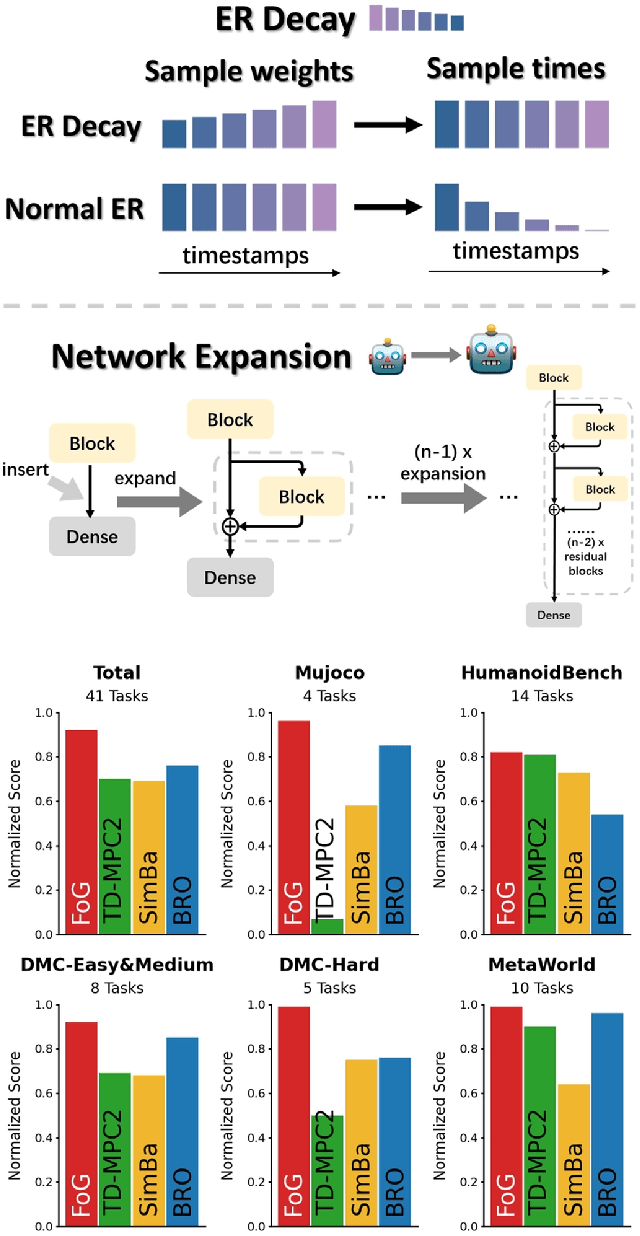
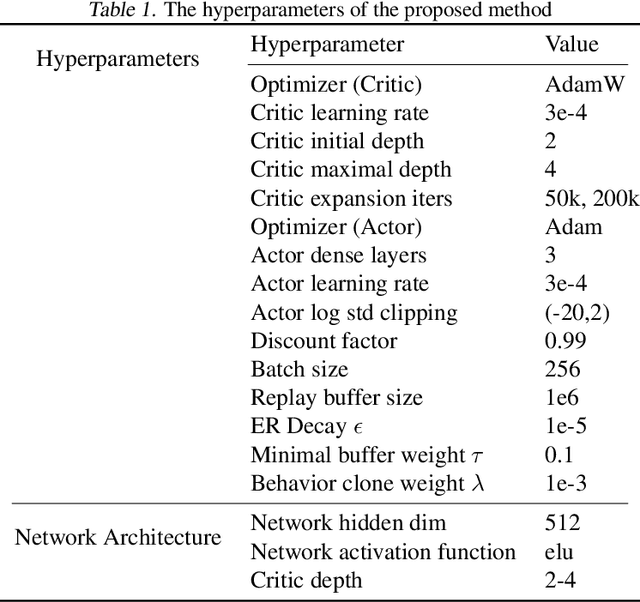
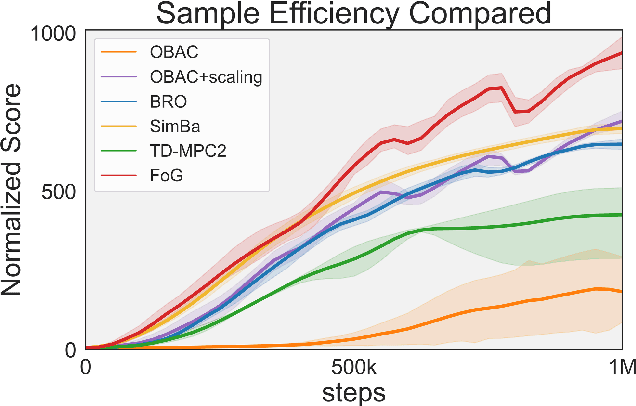
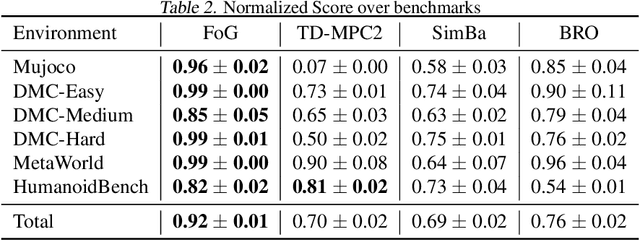
Deep reinforcement learning for continuous control has recently achieved impressive progress. However, existing methods often suffer from primacy bias, a tendency to overfit early experiences stored in the replay buffer, which limits an RL agent's sample efficiency and generalizability. In contrast, humans are less susceptible to such bias, partly due to infantile amnesia, where the formation of new neurons disrupts early memory traces, leading to the forgetting of initial experiences. Inspired by this dual processes of forgetting and growing in neuroscience, in this paper, we propose Forget and Grow (FoG), a new deep RL algorithm with two mechanisms introduced. First, Experience Replay Decay (ER Decay) "forgetting early experience", which balances memory by gradually reducing the influence of early experiences. Second, Network Expansion, "growing neural capacity", which enhances agents' capability to exploit the patterns of existing data by dynamically adding new parameters during training. Empirical results on four major continuous control benchmarks with more than 40 tasks demonstrate the superior performance of FoG against SoTA existing deep RL algorithms, including BRO, SimBa, and TD-MPC2.
Provably Learning from Language Feedback
Jun 12, 2025Interactively learning from observation and language feedback is an increasingly studied area driven by the emergence of large language model (LLM) agents. While impressive empirical demonstrations have been shown, so far a principled framing of these decision problems remains lacking. In this paper, we formalize the Learning from Language Feedback (LLF) problem, assert sufficient assumptions to enable learning despite latent rewards, and introduce $\textit{transfer eluder dimension}$ as a complexity measure to characterize the hardness of LLF problems. We show that transfer eluder dimension captures the intuition that information in the feedback changes the learning complexity of the LLF problem. We demonstrate cases where learning from rich language feedback can be exponentially faster than learning from reward. We develop a no-regret algorithm, called $\texttt{HELiX}$, that provably solves LLF problems through sequential interactions, with performance guarantees that scale with the transfer eluder dimension of the problem. Across several empirical domains, we show that $\texttt{HELiX}$ performs well even when repeatedly prompting LLMs does not work reliably. Our contributions mark a first step towards designing principled interactive learning algorithms from generic language feedback.
FLARE: Robot Learning with Implicit World Modeling
May 21, 2025We introduce $\textbf{F}$uture $\textbf{LA}$tent $\textbf{RE}$presentation Alignment ($\textbf{FLARE}$), a novel framework that integrates predictive latent world modeling into robot policy learning. By aligning features from a diffusion transformer with latent embeddings of future observations, $\textbf{FLARE}$ enables a diffusion transformer policy to anticipate latent representations of future observations, allowing it to reason about long-term consequences while generating actions. Remarkably lightweight, $\textbf{FLARE}$ requires only minimal architectural modifications -- adding a few tokens to standard vision-language-action (VLA) models -- yet delivers substantial performance gains. Across two challenging multitask simulation imitation learning benchmarks spanning single-arm and humanoid tabletop manipulation, $\textbf{FLARE}$ achieves state-of-the-art performance, outperforming prior policy learning baselines by up to 26%. Moreover, $\textbf{FLARE}$ unlocks the ability to co-train with human egocentric video demonstrations without action labels, significantly boosting policy generalization to a novel object with unseen geometry with as few as a single robot demonstration. Our results establish $\textbf{FLARE}$ as a general and scalable approach for combining implicit world modeling with high-frequency robotic control.