 Add to Chrome
 Add to Firefox
 Add to Edge
Style Wins, Substance Loses: A Diagnosis of LLM-as-Judge in Idea Generation
Aug 03, 2026
However, whether these judges truly evaluate the scientific substance of ideas or are influenced by superficial stylistic presentation remains an open question. To address this question, we propose SciStyleBench, a unified three-component benchmark for diagnosing and mitigating stylistic bias in LLM-based idea evaluation: (i) First, SciStyleStage, a three-stage evaluation environment that applies controlled stylistic perturbations to fixed scientific content across three settings no context, fixed-domain context, and open-domain retrieval context, covering 600 scientific ideas and 15 style variants, with 9,000 evaluation instances per setting; (ii) Second, SciStyleMetrics, a set of quantitative measures, including Style Bias Index (SBI), Substance Recognition Rate (SRR), and Adversarial Win Rate (AWR), to characterize how stylistic variation affects scoring stability, substance discrimination, and ranking robustness; (iii) Third, SciStyleExtractor, a plug-and-play evaluation module that separates presentation style from scientific content by predicting style type and deviation before style-conditioned evaluation, enabling us to assess whether style awareness reduces stylistic bias. Experiments on SciStyleBench show that direct LLM judges remain sensitive to writing style and struggle to distinguish scientific substance. In contrast, SciStyleExtractor reduces SBI from 0.566 to 0.501 while increasing SRR and AWR from 0.504 and 0.554 to 0.759 and 0.899, respectively. These results suggest that robust idea evaluation requires invariance to stylistic variation without sacrificing sensitivity to scientific substance. Overall, SciStyleBench provides a systematic framework for identifying, quantifying, and mitigating stylistic bias in scientific idea evaluation.

OmniFood-Bench: Evaluating VLMs for Nutrient Reasoning and Personalized Health Advice
Jul 09, 2026The rapid integration of Large Vision-Language Models (VLMs) into critical infrastructure promises to revolutionize personalized healthcare and dietary management. However, in the domain of food systems, autonomous agents face a unique and persistent challenge: the "Systemic Information Asymmetry" between visual appearance and intrinsic nutritional composition. Existing benchmarks primarily focus on coarse-grained classification tasks, such as food category recognition, which fail to evaluate the intricate reasoning chain required for real-world dietary management -- specifically, the ability to traverse from identifying hidden ingredients to estimating physical mass, and finally synthesizing safety-critical medical advice. In this paper, we introduce OmniFood-Bench, a comprehensive benchmark constructed from the MM-Food-100K dataset. Unlike previous works, OmniFood-Bench evaluates VLMs across three progressive capabilities: Basic Perception (Ingredients & Cooking Methods), Quantitative Reasoning (Portion Size & Nutritional Profiling), and Safety-Critical Advisory (Disease-Specific Recommendations). We evaluate six state-of-the-art VLMs, including gpt-5.1, gemini-3-flash, and qwen3-vl-8B. Our extensive experiments reveal a startling "Semantic-Physical Gap": while models achieve near-human accuracy in naming dishes, they exhibit catastrophic failure in mass estimation and frequently hallucinate benign advice for high-risk diabetic profiles. This work establishes a rigorous standard for trustworthiness in autonomous agents deployed for public health. The code and datasets are available in: https://anonymous.4open.science/r/OmniFood-Bench-7D0B
Parametric Memory Decoding for Zero-Shot Routing in LoRA-Based External Parametric Memory
Jul 05, 2026With the rise of parametric memory, LoRA-based External Parametric Memory (EPM) has emerged as a modular solution, but existing routing methods often introduce additional training, deployment, and maintenance overhead. This raises a natural question: can a LoRA-based EPM bank be routed without maintaining an additional routing component? However, existing zero-shot LoRA routing methods still face two problems under the EPM setting: (1) their evaluations are scattered across different task settings rather than organized around EPM access, and (2) their routing signals lack a unified perspective to guide systematic improvement. To address these problems, we organize PMD-Bench, covering document-level, domain-level knowledge, and task-skill, and propose Parametric Memory Decoding (PMD), the first framework designed to systematically improve zero-shot LoRA routing by reframing it as decoding activations over external parametric memory. Based on PMD, we further instantiate PMDRouter, which scores each LoRA by its response magnitude from a single base-model prefill. Experiments on PMD-Bench show that PMDRouter achieves the strongest internal-signal performance across multiple zero-shot routing settings. These results demonstrate the feasibility of zero-shot LoRA routing and suggest that PMD can serve as a general framework for improving zero-shot routing methods. Sources: Github (https://anonymous.4open.science/r/Parametric-Memory-Decoding-872A/)
LabGuard: Grounding Natural-Language Laboratory Rules into Runtime Guards for Embodied Laboratory Agents
Jun 30, 2026Scientific embodied agents are increasingly capable of carrying out laboratory procedures, but executing these procedures safely in dynamic laboratory environments remains challenging. Current safety approaches often overlook the intermediate step of transforming laboratory natural language, including safety rules, manuals, protocols, and standard operating procedures, into machine-checkable runtime constraints. We introduce LabGuard (Laboratory Guard), a language-to-execution safety suite that grounds natural-language laboratory rules into executable specifications and deploys them as runtime guards. LabGuard includes three core components: LabGuard-IR, which defines a typed executable representation; LabGuard-Bench, which provides 812 supervised annotations expanded from 203 seed laboratory rules; and LabGuard-Grounder, which maps natural-language laboratory rules into LabGuard-IR. The resulting IR instances are handled by the LabGuard Pipeline, which compiles them into runtime monitors and applies them at the controller boundary. Experiments show that LabGuard generalizes to unseen laboratory-rule sources, achieves 79.4 task-scope F1, and reduces unsafe events from 39.5% to 23.8% after monitor compilation. In LabUtopia, its runtime monitors integrate with ACT, keeping interventions below 0.5% while preserving task success.
Zero-Parameter Geometric Gating for Temporally Stable Low-Altitude UAV Video Semantic Segmentation
Jun 08, 2026Video semantic segmentation for low-altitude UAVs requires temporal consistency, yet dense optical flow introduces spatially structured noise in the planar regions that dominate aerial imagery. We propose a zero-parameter geometric gate that uses RANSAC homography inlier ratios on a $16\times16$ spatial grid to route each region to either homography or optical flow warp before fusion via Semantic Similarity Propagation. The gate requires no learned parameters -- only a median-threshold binary decision on RANSAC statistics -- adding only 211K trainable parameters (the SSP fusion layer) to a frozen backbone. On synthetic UAVid, the method achieves +4.24--4.91\% mIoU improvement over base models across two architectures (SegFormer-b2 and Hiera-S+UPerNet). Mechanism diagnostics reveal that flow residuals in planar regions are spatially autocorrelated (Moran's I = 0.32, $p < 0.001$), predict boundary instability (Spearman $ρ= 0.66$), and that rigidification recovers temporal consistency from 62\% to 92\% (+29.5pp) in homography-valid regions.
TextAlign: Preference Alignment for Text Rendering with Hierarchical Rewards
May 19, 2026Faithful text rendering remains a persistent weakness of large text-to-image generative models, as it requires both semantic instruction following and fine-grained glyph-level structure. Prior methods often improve this ability through architecture-specific modules or encoder modifications, which complicate deployment across foundation models. We study text rendering as a post-training preference-alignment problem and propose TextAlign, a non-invasive framework that keeps the generator architecture unchanged. The key component is a hierarchical vision-language model (VLM)-based reward that decomposes rendering errors into global, word, and glyph levels, then converts binary defect judgments into a scalar preference signal. The resulting signal supports both Group Relative Policy Optimization (GRPO) and Direct Preference Optimization (DPO). Experiments on FLUX.1-dev and Z-Image-Turbo show consistent gains in OCR-based text accuracy without degrading general generation quality. Compared with strong foundation and text-rendering baselines, including SD3.5, Qwen-Image, AnyText, and TextDiffuser, these results indicate that reward design offers a scalable alternative to model redesign for improving text rendering.
ServImage: An Image Generation and Editing Benchmark from Real-world Commercial Imaging Services
Apr 27, 2026Recent image generation and editing models demonstrate robust adherence to instructions and high visual quality on academic benchmarks. However, their performance on paid, real-world design projects remains uncertain. We introduce \textbf{ServImage}, a benchmark that explicitly correlates model outputs with economic value in commercial design projects. ServImage consists of (i) \textbf{\textit{ServImageBench}}: a dataset of 1.07k paid commercial design tasks and 2.05k designer deliverables totaling over \$295k, covering portrait, product, and digital content, along with 33k candidate images and 33k human annotations. (ii) \textbf{\textit{ServImageScore}}: an integrated scoring system that combines three quality dimensions: baseline requirements fulfilment, visual execution quality, and commercial necessity satisfaction. These three dimensions are designed to characterize the factors that drive human payment decisions and indicate whether an image is commercially acceptable. (iii) \textbf{\textit{ServImageModel}}: under this scoring system, we propose a payment prediction model trained on the human-annotated candidate images, achieving 82.00\% accuracy in predicting human payment decisions and producing calibrated payment probabilities. ServImage provides a comprehensive foundation for assessing the commercial viability of image generation models and offers a scalable resource for future research on economically grounded vision systems \href{https://github.com/FengxianJi/ServImage}{Github.}
Geolocation with Real Human Gameplay Data: A Large-Scale Dataset and Human-Like Reasoning Framework
Feb 19, 2025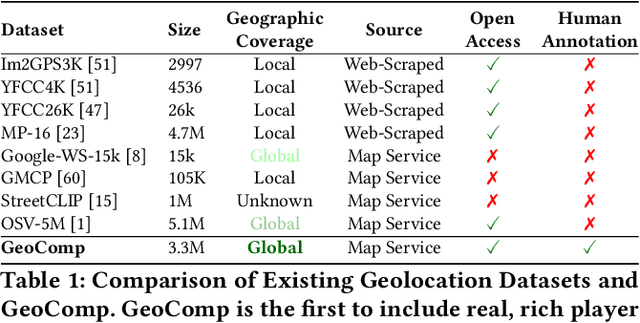
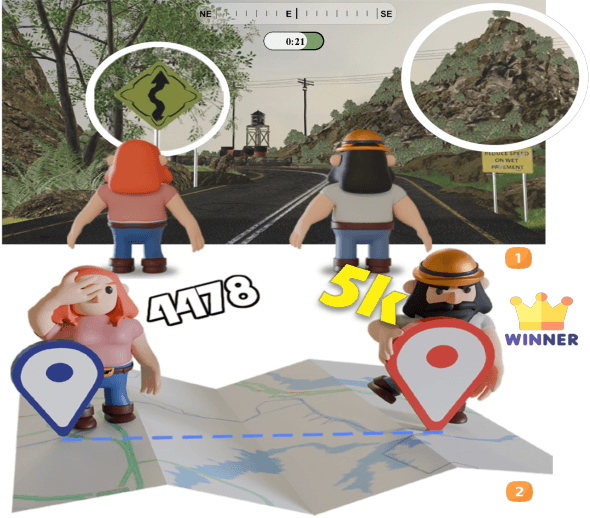
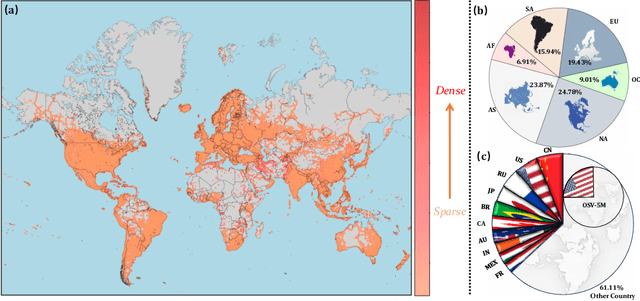
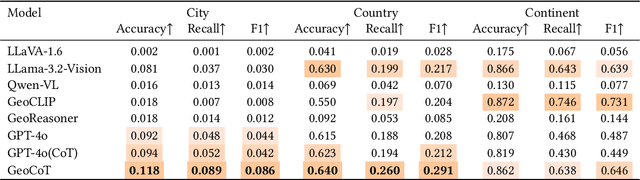
Geolocation, the task of identifying an image's location, requires complex reasoning and is crucial for navigation, monitoring, and cultural preservation. However, current methods often produce coarse, imprecise, and non-interpretable localization. A major challenge lies in the quality and scale of existing geolocation datasets. These datasets are typically small-scale and automatically constructed, leading to noisy data and inconsistent task difficulty, with images that either reveal answers too easily or lack sufficient clues for reliable inference. To address these challenges, we introduce a comprehensive geolocation framework with three key components: GeoComp, a large-scale dataset; GeoCoT, a novel reasoning method; and GeoEval, an evaluation metric, collectively designed to address critical challenges and drive advancements in geolocation research. At the core of this framework is GeoComp (Geolocation Competition Dataset), a large-scale dataset collected from a geolocation game platform involving 740K users over two years. It comprises 25 million entries of metadata and 3 million geo-tagged locations spanning much of the globe, with each location annotated thousands to tens of thousands of times by human users. The dataset offers diverse difficulty levels for detailed analysis and highlights key gaps in current models. Building on this dataset, we propose Geographical Chain-of-Thought (GeoCoT), a novel multi-step reasoning framework designed to enhance the reasoning capabilities of Large Vision Models (LVMs) in geolocation tasks. GeoCoT improves performance by integrating contextual and spatial cues through a multi-step process that mimics human geolocation reasoning. Finally, using the GeoEval metric, we demonstrate that GeoCoT significantly boosts geolocation accuracy by up to 25% while enhancing interpretability.
Asynchronous and Segmented Bidirectional Encoding for NMT
Feb 19, 2024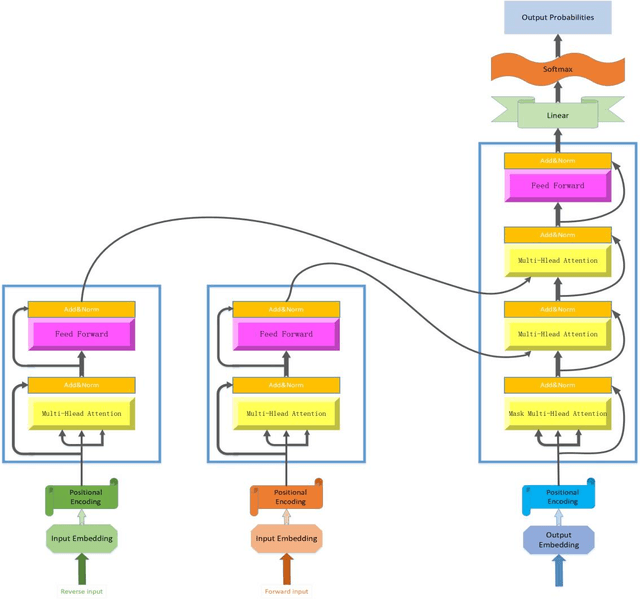

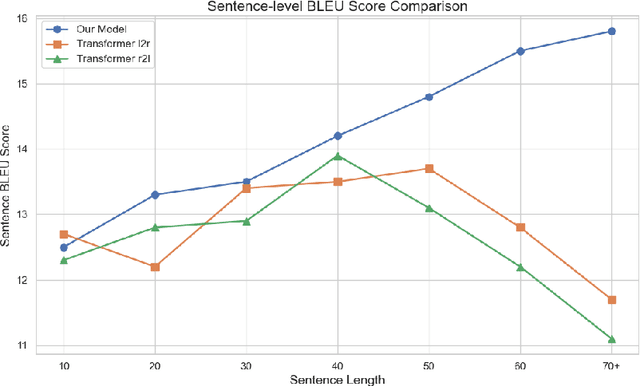
With the rapid advancement of Neural Machine Translation (NMT), enhancing translation efficiency and quality has become a focal point of research. Despite the commendable performance of general models such as the Transformer in various aspects, they still fall short in processing long sentences and fully leveraging bidirectional contextual information. This paper introduces an improved model based on the Transformer, implementing an asynchronous and segmented bidirectional decoding strategy aimed at elevating translation efficiency and accuracy. Compared to traditional unidirectional translations from left-to-right or right-to-left, our method demonstrates heightened efficiency and improved translation quality, particularly in handling long sentences. Experimental results on the IWSLT2017 dataset confirm the effectiveness of our approach in accelerating translation and increasing accuracy, especially surpassing traditional unidirectional strategies in long sentence translation. Furthermore, this study analyzes the impact of sentence length on decoding outcomes and explores the model's performance in various scenarios. The findings of this research not only provide an effective encoding strategy for the NMT field but also pave new avenues and directions for future studies.
Efficient Reinforcemen Learning via Decoupling Exploration and Utilization
Jan 17, 2024Deep neural network(DNN) generalization is limited by the over-reliance of current offline reinforcement learning techniques on conservative processing of existing datasets. This method frequently results in algorithms that settle for suboptimal solutions that only adjust to a certain dataset. Similarly, in online reinforcement learning, the previously imposed punitive pessimism also deprives the model of its exploratory potential. Our research proposes a novel framework, Optimistic and Pessimistic Actor Reinforcement Learning (OPARL). OPARL employs a unique dual-actor approach: an optimistic actor dedicated to exploration and a pessimistic actor focused on utilization, thereby effectively differentiating between exploration and utilization strategies. This unique combination in reinforcement learning methods fosters a more balanced and efficient approach. It enables the optimization of policies that focus on actions yielding high rewards through pessimistic utilization strategies, while also ensuring extensive state coverage via optimistic exploration. Experiments and theoretical study demonstrates OPARL improves agents' capacities for application and exploration. In the most tasks of DMControl benchmark and Mujoco environment, OPARL performed better than state-of-the-art methods. Our code has released on https://github.com/yydsok/OPARL