 Add to Chrome
 Add to Firefox
 Add to Edge
Generative Video Compression Based on Hierarchical Referencing
Aug 12, 2026
Diffusion-based generative video compression has emerged as a promising paradigm to improve perceptual quality, where latent frames are required to be encoded efficiently while serving as denoising conditions. However, existing methods neither carefully design reference and quality structures during latent coding nor account for the impact of frame-level quality variation on denoising procedure, which limits coding efficiency and aggravates artifact propagation during generative reconstruction. In this paper, we propose GVCHR, Generative Video Compression based on Hierarchical Referencing. The key idea is to organize latent frames hierarchically, where the selected high-quality references benefit both latent coding and generative reconstruction. In latent coding, GVCHR couples a hierarchical reference structure with a hierarchical quality structure, assigning more bits to lower-layer frames that are reused more frequently as references. Built on this design, we introduce Hierarchical Temporal Context Mining to exploits complementary short- and long-term temporal context for effective latent coding. In generative reconstruction, the coding-side hierarchy is incorporated into a Hierarchical Attentive Adapter which is attached to a video diffusion transformer. This adapter uses hierarchical attention to restrict each latent frame to attend only to the same- or lower-layer references, thereby reducing artifact propagation during denoising. Experiments validate GVCHR on multiple benchmarks. Compared with the previous state-of-the-art method, GVCHR achieves 50.5% and 54.0% BD-rate gains in terms of LPIPS and DISTS, respectively, while also delivering clearly improved visual quality.

QuReC: All-in-One Image Restoration with Query-Specific Guidance and Local-Global Response Calibration
Jul 16, 2026All-in-one image restoration aims to recover clean images degraded by multiple corruption types using a single unified model. Existing methods typically rely on image-level prompts or shared guidance to handle diverse degradations. However, such a paradigm becomes inadequate when degradations are spatially heterogeneous or even coexist in mixed forms within a single image. Yet spatially adaptive guidance alone is not sufficient, since accurate restoration also requires each spatial query to reliably aggregate complementary information from local neighborhoods and global contexts. To this end, we propose QuReC, a unified framework for all-in-one image restoration. QuReC consists of a Degradation-Guided Query Reconstruction Module (DQRM) and a Local-Global Response Calibration Module (LGRCM). Specifically, DQRM matches each spatial query against a degradation prototype space to reconstruct a query-specific degradation-aware representation, thereby providing fine-grained spatially adaptive restoration guidance. To further stabilize this query-wise matching process, we introduce a weakly supervised prototype matching learning strategy to improve optimization stability and degradation semantic consistency. Meanwhile, LGRCM performs local-global dual-branch aggregation and calibrates the aggregated responses with learnable priors, improving the reliability of feature aggregation and the coordination between local detail modeling and global context modeling. Extensive experiments demonstrate that QuReC achieves superior performance on multiple all-in-one image restoration benchmarks. The code is released at https://github.com/zhoushen1/QuReC.
Beyond Compliance: A Resistance-Informed Motivation Reasoning Framework for Challenging Psychological Client Simulation
Apr 12, 2026Psychological client simulators have emerged as a scalable solution for training and evaluating counselor trainees and psychological LLMs. Yet existing simulators exhibit unrealistic over-compliance, leaving counselors underprepared for the challenging behaviors common in real-world practice. To bridge this gap, we present ResistClient, which systematically models challenging client behaviors grounded in Client Resistance Theory by integrating external behaviors with underlying motivational mechanisms. To this end, we propose Resistance-Informed Motivation Reasoning (RIMR), a two-stage training framework. First, RIMR mitigates compliance bias via supervised fine-tuning on RPC, a large-scale resistance-oriented psychological conversation dataset covering diverse client profiles. Second, beyond surface-level response imitation, RIMR models psychologically coherent motivation reasoning before response generation, jointly optimizing motivation authenticity and response consistency via process-supervised reinforcement learning. Extensive automatic and expert evaluations show that ResistClient substantially outperforms existing simulators in challenge fidelity, behavioral plausibility, and reasoning coherence. Moreover, ResistClient facilities evaluation of psychological LLMs under challenging conditions, offering new optimization directions for mental health dialogue systems.
Controllable Generative Video Compression
Apr 08, 2026Perceptual video compression adopts generative video modeling to improve perceptual realism but frequently sacrifices signal fidelity, diverging from the goal of video compression to faithfully reproduce visual signal. To alleviate the dilemma between perception and fidelity, in this paper we propose Controllable Generative Video Compression (CGVC) paradigm to faithfully generate details guided by multiple visual conditions. Under the paradigm, representative keyframes of the scene are coded and used to provide structural priors for non-keyframe generation. Dense per-frame control prior is additionally coded to better preserve finer structure and semantics of each non-keyframe. Guided by these priors, non-keyframes are reconstructed by controllable video generation model with temporal and content consistency. Furthermore, to accurately recover color information of the video, we develop a color-distance-guided keyframe selection algorithm to adaptively choose keyframes. Experimental results show CGVC outperforms previous perceptual video compression method in terms of both signal fidelity and perceptual quality.
ProGVC: Progressive-based Generative Video Compression via Auto-Regressive Context Modeling
Mar 18, 2026Perceptual video compression leverages generative priors to reconstruct realistic textures and motions at low bitrates. However, existing perceptual codecs often lack native support for variable bitrate and progressive delivery, and their generative modules are weakly coupled with entropy coding, limiting bitrate reduction. Inspired by the next-scale prediction in the Visual Auto-Regressive (VAR) models, we propose ProGVC, a Progressive-based Generative Video Compression framework that unifies progressive transmission, efficient entropy coding, and detail synthesis within a single codec. ProGVC encodes videos into hierarchical multi-scale residual token maps, enabling flexible rate adaptation by transmitting a coarse-to-fine subset of scales in a progressive manner. A Transformer-based multi-scale autoregressive context model estimates token probabilities, utilized both for efficient entropy coding of the transmitted tokens and for predicting truncated fine-scale tokens at the decoder to restore perceptual details. Extensive experiments demonstrate that as a new coding paradigm, ProGVC delivers promising perceptual compression performance at low bitrates while offering practical scalability at the same time.
Kimi-Audio Technical Report
Apr 25, 2025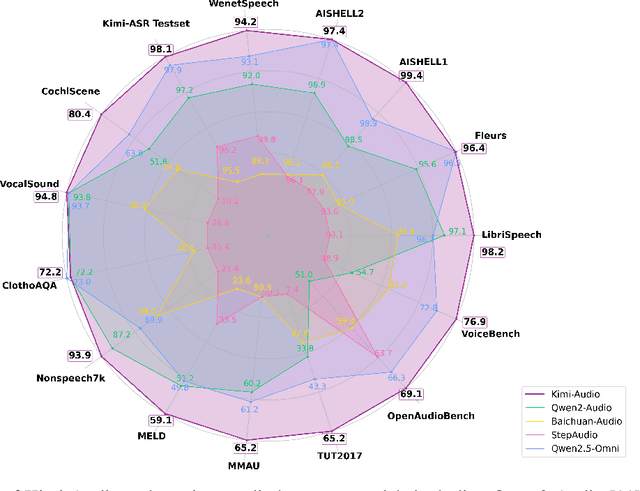
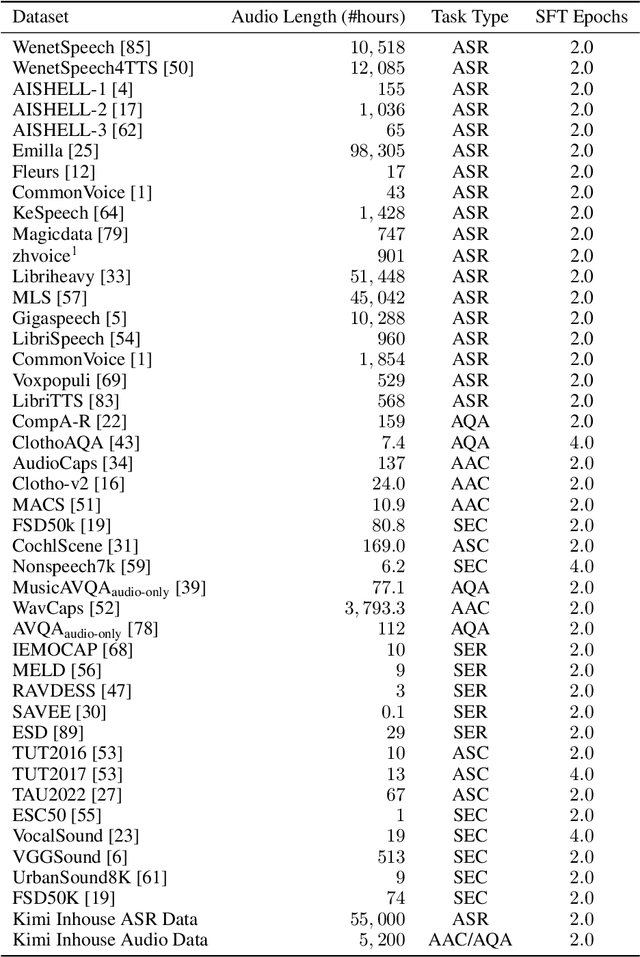
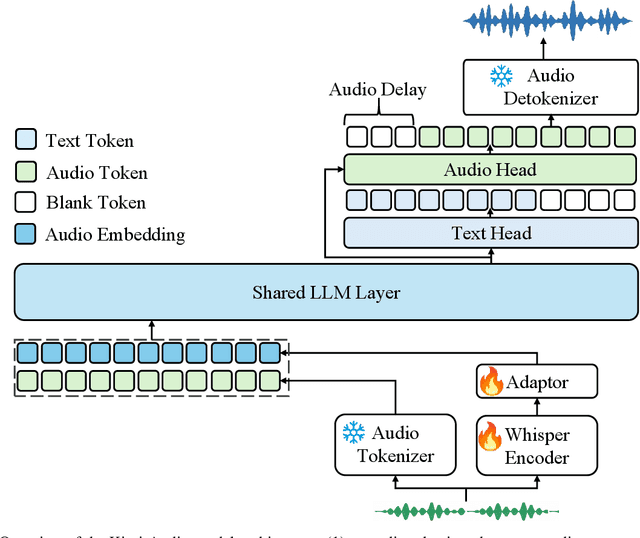
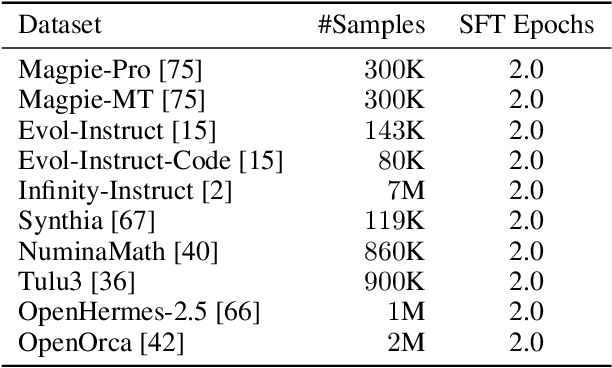
We present Kimi-Audio, an open-source audio foundation model that excels in audio understanding, generation, and conversation. We detail the practices in building Kimi-Audio, including model architecture, data curation, training recipe, inference deployment, and evaluation. Specifically, we leverage a 12.5Hz audio tokenizer, design a novel LLM-based architecture with continuous features as input and discrete tokens as output, and develop a chunk-wise streaming detokenizer based on flow matching. We curate a pre-training dataset that consists of more than 13 million hours of audio data covering a wide range of modalities including speech, sound, and music, and build a pipeline to construct high-quality and diverse post-training data. Initialized from a pre-trained LLM, Kimi-Audio is continual pre-trained on both audio and text data with several carefully designed tasks, and then fine-tuned to support a diverse of audio-related tasks. Extensive evaluation shows that Kimi-Audio achieves state-of-the-art performance on a range of audio benchmarks including speech recognition, audio understanding, audio question answering, and speech conversation. We release the codes, model checkpoints, as well as the evaluation toolkits in https://github.com/MoonshotAI/Kimi-Audio.
Transferable Learned Image Compression-Resistant Adversarial Perturbations
Jan 06, 2024Adversarial attacks can readily disrupt the image classification system, revealing the vulnerability of DNN-based recognition tasks. While existing adversarial perturbations are primarily applied to uncompressed images or compressed images by the traditional image compression method, i.e., JPEG, limited studies have investigated the robustness of models for image classification in the context of DNN-based image compression. With the rapid evolution of advanced image compression, DNN-based learned image compression has emerged as the promising approach for transmitting images in many security-critical applications, such as cloud-based face recognition and autonomous driving, due to its superior performance over traditional compression. Therefore, there is a pressing need to fully investigate the robustness of a classification system post-processed by learned image compression. To bridge this research gap, we explore the adversarial attack on a new pipeline that targets image classification models that utilize learned image compressors as pre-processing modules. Furthermore, to enhance the transferability of perturbations across various quality levels and architectures of learned image compression models, we introduce a saliency score-based sampling method to enable the fast generation of transferable perturbation. Extensive experiments with popular attack methods demonstrate the enhanced transferability of our proposed method when attacking images that have been post-processed with different learned image compression models.
Venn: Resource Management Across Federated Learning Jobs
Dec 13, 2023
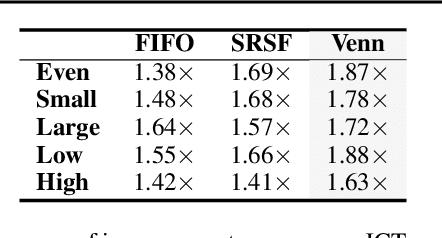
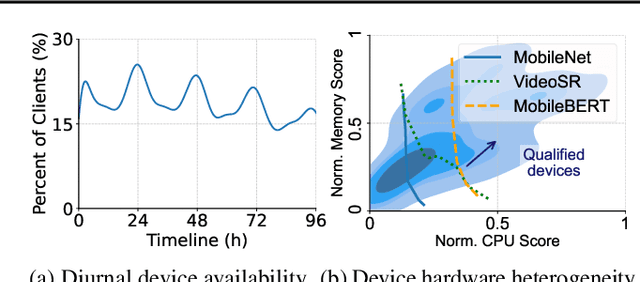
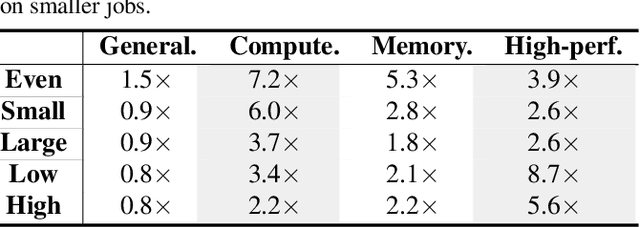
In recent years, federated learning (FL) has emerged as a promising approach for machine learning (ML) and data science across distributed edge devices. With the increasing popularity of FL, resource contention between multiple FL jobs training on the same device population is increasing as well. Scheduling edge resources among multiple FL jobs is different from GPU scheduling for cloud ML because of the ephemeral nature and planetary scale of participating devices as well as the overlapping resource requirements of diverse FL jobs. Existing resource managers for FL jobs opt for random assignment of devices to FL jobs for simplicity and scalability, which leads to poor performance. In this paper, we present Venn, an FL resource manager, that efficiently schedules ephemeral, heterogeneous devices among many FL jobs, with the goal of reducing their average job completion time (JCT). Venn formulates the Intersection Resource Scheduling (IRS) problem to identify complex resource contention among multiple FL jobs. Then, Venn proposes a contention-aware scheduling heuristic to minimize the average scheduling delay. Furthermore, it proposes a resource-aware device-to-job matching heuristic that focuses on optimizing response collection time by mitigating stragglers. Our evaluation shows that, compared to the state-of-the-art FL resource managers, Venn improves the average JCT by up to 1.88X.
Corner-to-Center Long-range Context Model for Efficient Learned Image Compression
Nov 29, 2023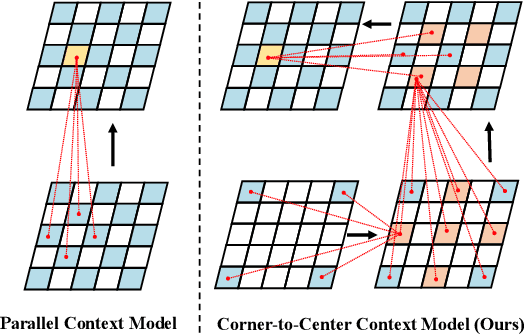
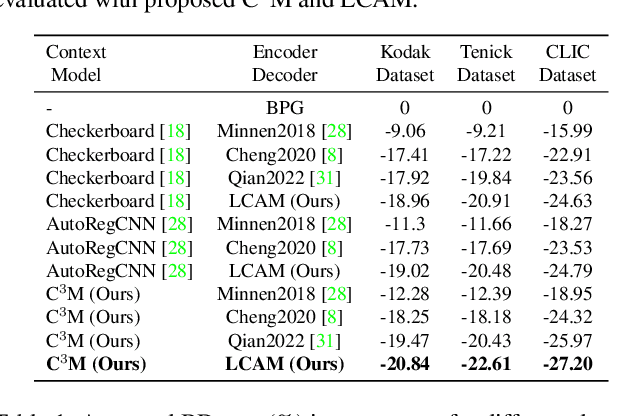

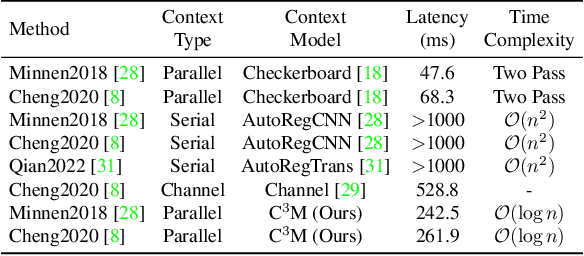
In the framework of learned image compression, the context model plays a pivotal role in capturing the dependencies among latent representations. To reduce the decoding time resulting from the serial autoregressive context model, the parallel context model has been proposed as an alternative that necessitates only two passes during the decoding phase, thus facilitating efficient image compression in real-world scenarios. However, performance degradation occurs due to its incomplete casual context. To tackle this issue, we conduct an in-depth analysis of the performance degradation observed in existing parallel context models, focusing on two aspects: the Quantity and Quality of information utilized for context prediction and decoding. Based on such analysis, we propose the \textbf{Corner-to-Center transformer-based Context Model (C$^3$M)} designed to enhance context and latent predictions and improve rate-distortion performance. Specifically, we leverage the logarithmic-based prediction order to predict more context features from corner to center progressively. In addition, to enlarge the receptive field in the analysis and synthesis transformation, we use the Long-range Crossing Attention Module (LCAM) in the encoder/decoder to capture the long-range semantic information by assigning the different window shapes in different channels. Extensive experimental evaluations show that the proposed method is effective and outperforms the state-of-the-art parallel methods. Finally, according to the subjective analysis, we suggest that improving the detailed representation in transformer-based image compression is a promising direction to be explored.
Reconstruction Distortion of Learned Image Compression with Imperceptible Perturbations
Jun 01, 2023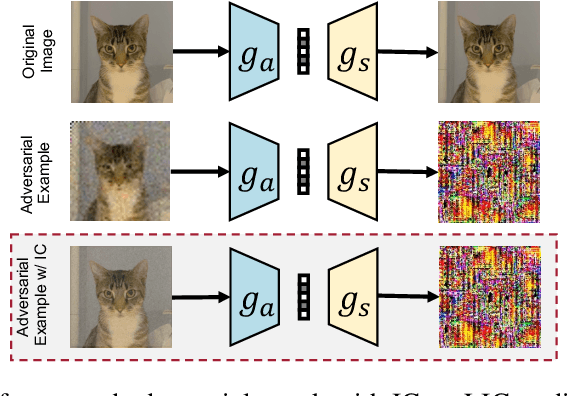
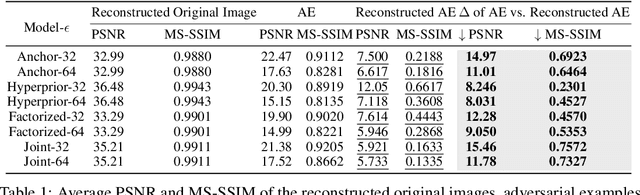
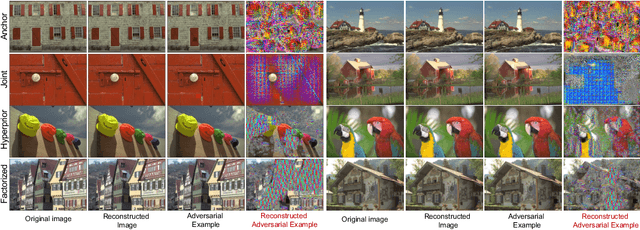
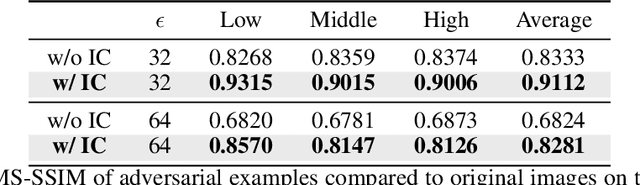
Learned Image Compression (LIC) has recently become the trending technique for image transmission due to its notable performance. Despite its popularity, the robustness of LIC with respect to the quality of image reconstruction remains under-explored. In this paper, we introduce an imperceptible attack approach designed to effectively degrade the reconstruction quality of LIC, resulting in the reconstructed image being severely disrupted by noise where any object in the reconstructed images is virtually impossible. More specifically, we generate adversarial examples by introducing a Frobenius norm-based loss function to maximize the discrepancy between original images and reconstructed adversarial examples. Further, leveraging the insensitivity of high-frequency components to human vision, we introduce Imperceptibility Constraint (IC) to ensure that the perturbations remain inconspicuous. Experiments conducted on the Kodak dataset using various LIC models demonstrate effectiveness. In addition, we provide several findings and suggestions for designing future defenses.