 Add to Chrome
 Add to Firefox
 Add to Edge
System Report for CCL25-Eval Task 10: SRAG-MAV for Fine-Grained Chinese Hate Speech Recognition
Jul 24, 2025
This paper presents our system for CCL25-Eval Task 10, addressing Fine-Grained Chinese Hate Speech Recognition (FGCHSR). We propose a novel SRAG-MAV framework that synergistically integrates task reformulation(TR), Self-Retrieval-Augmented Generation (SRAG), and Multi-Round Accumulative Voting (MAV). Our method reformulates the quadruplet extraction task into triplet extraction, uses dynamic retrieval from the training set to create contextual prompts, and applies multi-round inference with voting to improve output stability and performance. Our system, based on the Qwen2.5-7B model, achieves a Hard Score of 26.66, a Soft Score of 48.35, and an Average Score of 37.505 on the STATE ToxiCN dataset, significantly outperforming baselines such as GPT-4o (Average Score 15.63) and fine-tuned Qwen2.5-7B (Average Score 35.365). The code is available at https://github.com/king-wang123/CCL25-SRAG-MAV.

Step-Audio 2 Technical Report
Jul 24, 2025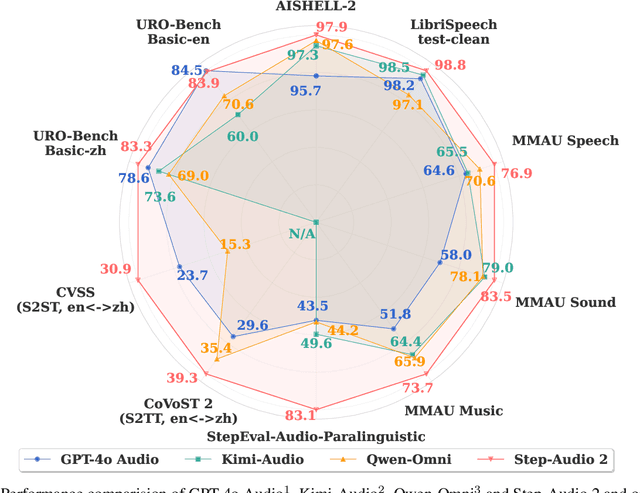
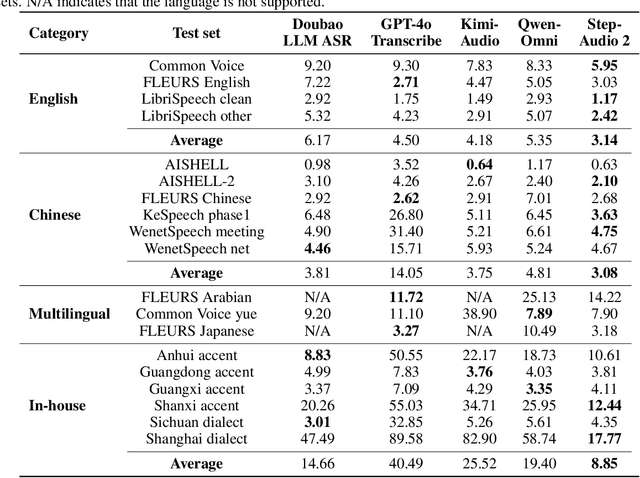
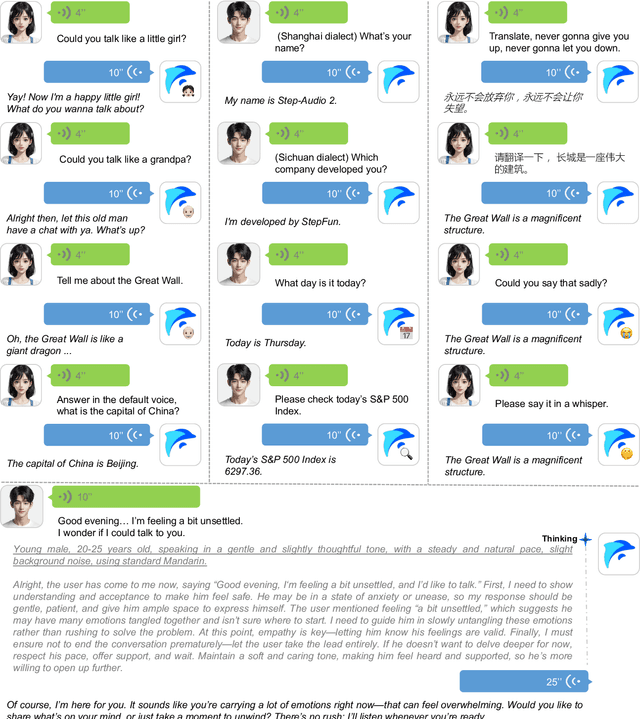
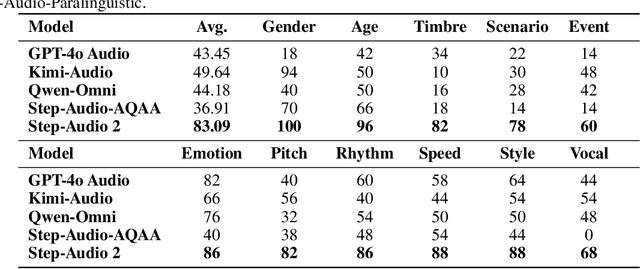
This paper presents Step-Audio 2, an end-to-end multi-modal large language model designed for industry-strength audio understanding and speech conversation. By integrating a latent audio encoder and reasoning-centric reinforcement learning (RL), Step-Audio 2 achieves promising performance in automatic speech recognition (ASR) and audio understanding. To facilitate genuine end-to-end speech conversation, Step-Audio 2 incorporates the generation of discrete audio tokens into language modeling, significantly enhancing its responsiveness to paralinguistic information such as speaking styles and emotions. To effectively leverage the rich textual and acoustic knowledge in real-world data, Step-Audio 2 integrates retrieval-augmented generation (RAG) and is able to call external tools such as web search to mitigate hallucination and audio search to switch timbres. Trained on millions of hours of speech and audio data, Step-Audio 2 delivers intelligence and expressiveness across diverse conversational scenarios. Evaluation results demonstrate that Step-Audio 2 achieves state-of-the-art performance on various audio understanding and conversational benchmarks compared to other open-source and commercial solutions. Please visit https://github.com/stepfun-ai/Step-Audio2 for more information.
MedMoE: Modality-Specialized Mixture of Experts for Medical Vision-Language Understanding
Jun 11, 2025Different medical imaging modalities capture diagnostic information at varying spatial resolutions, from coarse global patterns to fine-grained localized structures. However, most existing vision-language frameworks in the medical domain apply a uniform strategy for local feature extraction, overlooking the modality-specific demands. In this work, we present MedMoE, a modular and extensible vision-language processing framework that dynamically adapts visual representation based on the diagnostic context. MedMoE incorporates a Mixture-of-Experts (MoE) module conditioned on the report type, which routes multi-scale image features through specialized expert branches trained to capture modality-specific visual semantics. These experts operate over feature pyramids derived from a Swin Transformer backbone, enabling spatially adaptive attention to clinically relevant regions. This framework produces localized visual representations aligned with textual descriptions, without requiring modality-specific supervision at inference. Empirical results on diverse medical benchmarks demonstrate that MedMoE improves alignment and retrieval performance across imaging modalities, underscoring the value of modality-specialized visual representations in clinical vision-language systems.
Step-Audio-AQAA: a Fully End-to-End Expressive Large Audio Language Model
Jun 10, 2025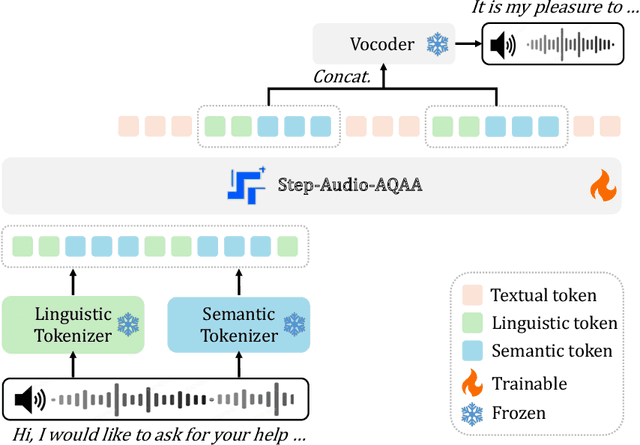
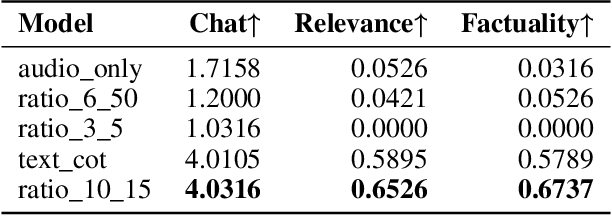
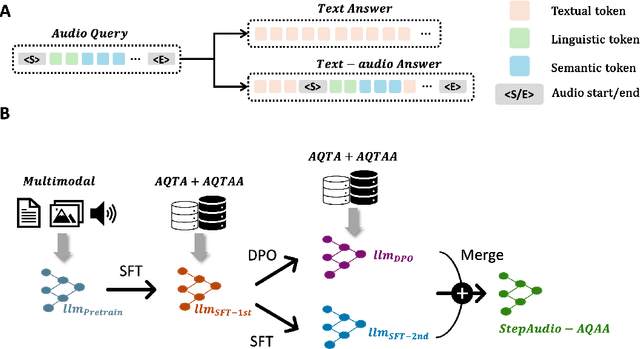

Large Audio-Language Models (LALMs) have significantly advanced intelligent human-computer interaction, yet their reliance on text-based outputs limits their ability to generate natural speech responses directly, hindering seamless audio interactions. To address this, we introduce Step-Audio-AQAA, a fully end-to-end LALM designed for Audio Query-Audio Answer (AQAA) tasks. The model integrates a dual-codebook audio tokenizer for linguistic and semantic feature extraction, a 130-billion-parameter backbone LLM and a neural vocoder for high-fidelity speech synthesis. Our post-training approach employs interleaved token-output of text and audio to enhance semantic coherence and combines Direct Preference Optimization (DPO) with model merge to improve performance. Evaluations on the StepEval-Audio-360 benchmark demonstrate that Step-Audio-AQAA excels especially in speech control, outperforming the state-of-art LALMs in key areas. This work contributes a promising solution for end-to-end LALMs and highlights the critical role of token-based vocoder in enhancing overall performance for AQAA tasks.
LaF-GRPO: In-Situ Navigation Instruction Generation for the Visually Impaired via GRPO with LLM-as-Follower Reward
Jun 04, 2025Navigation instruction generation for visually impaired (VI) individuals (NIG-VI) is critical yet relatively underexplored. This study, hence, focuses on producing precise, in-situ, step-by-step navigation instructions that are practically usable by VI users. Concretely, we propose LaF-GRPO (LLM-as-Follower GRPO), where an LLM simulates VI user responses to generate rewards guiding the Vision-Language Model (VLM) post-training. This enhances instruction usability while reducing costly real-world data needs. To facilitate training and testing, we introduce NIG4VI, a 27k-sample open-sourced benchmark. It provides diverse navigation scenarios with accurate spatial coordinates, supporting detailed, open-ended in-situ instruction generation. Experiments on NIG4VI show the effectiveness of LaF-GRPO by quantitative metrics (e.g., Zero-(LaF-GRPO) boosts BLEU +14\%; SFT+(LaF-GRPO) METEOR 0.542 vs. GPT-4o's 0.323) and yields more intuitive, safer instructions. Code and benchmark are available at \href{https://github.com/YiyiyiZhao/NIG4VI}{https://github.com/YiyiyiZhao/NIG4VI}.
A Closer Look on Memorization in Tabular Diffusion Model: A Data-Centric Perspective
May 28, 2025Diffusion models have shown strong performance in generating high-quality tabular data, but they carry privacy risks by reproducing exact training samples. While prior work focuses on dataset-level augmentation to reduce memorization, little is known about which individual samples contribute most. We present the first data-centric study of memorization dynamics in tabular diffusion models. We quantify memorization for each real sample based on how many generated samples are flagged as replicas, using a relative distance ratio. Our empirical analysis reveals a heavy-tailed distribution of memorization counts: a small subset of samples contributes disproportionately to leakage, confirmed via sample-removal experiments. To understand this, we divide real samples into top- and non-top-memorized groups and analyze their training-time behaviors. We track when each sample is first memorized and monitor per-epoch memorization intensity (AUC). Memorized samples are memorized slightly earlier and show stronger signals in early training. Based on these insights, we propose DynamicCut, a two-stage, model-agnostic mitigation method: (a) rank samples by epoch-wise intensity, (b) prune a tunable top fraction, and (c) retrain on the filtered dataset. Across multiple tabular datasets and models, DynamicCut reduces memorization with minimal impact on data diversity and downstream performance. It also complements augmentation-based defenses. Furthermore, DynamicCut enables cross-model transferability: high-ranked samples identified from one model (e.g., a diffusion model) are also effective for reducing memorization when removed from others, such as GANs and VAEs.
Adaptive Detoxification: Safeguarding General Capabilities of LLMs through Toxicity-Aware Knowledge Editing
May 28, 2025Large language models (LLMs) exhibit impressive language capabilities but remain vulnerable to malicious prompts and jailbreaking attacks. Existing knowledge editing methods for LLM detoxification face two major challenges. First, they often rely on entity-specific localization, making them ineffective against adversarial inputs without explicit entities. Second, these methods suffer from over-editing, where detoxified models reject legitimate queries, compromising overall performance. In this paper, we propose ToxEdit, a toxicity-aware knowledge editing approach that dynamically detects toxic activation patterns during forward propagation. It then routes computations through adaptive inter-layer pathways to mitigate toxicity effectively. This design ensures precise toxicity mitigation while preserving LLMs' general capabilities. To more accurately assess over-editing, we also enhance the SafeEdit benchmark by incorporating instruction-following evaluation tasks. Experimental results on multiple LLMs demonstrate that our ToxEdit outperforms previous state-of-the-art methods in both detoxification performance and safeguarding general capabilities of LLMs.
Self-Error-Instruct: Generalizing from Errors for LLMs Mathematical Reasoning
May 28, 2025
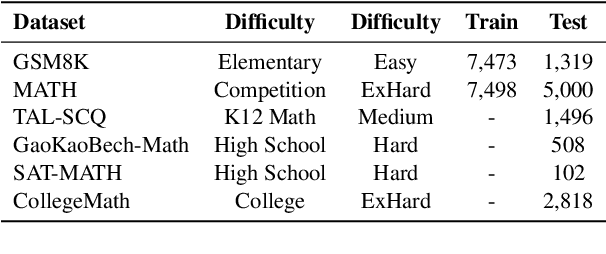
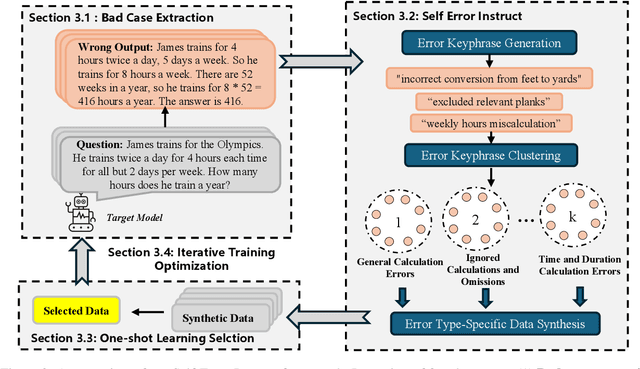
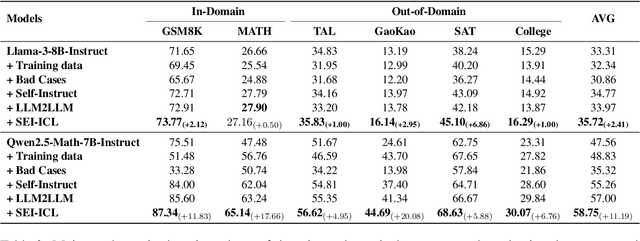
Although large language models demonstrate strong performance across various domains, they still struggle with numerous bad cases in mathematical reasoning. Previous approaches to learning from errors synthesize training data by solely extrapolating from isolated bad cases, thereby failing to generalize the extensive patterns inherent within these cases. This paper presents Self-Error-Instruct (SEI), a framework that addresses these model weaknesses and synthesizes more generalized targeted training data. Specifically, we explore a target model on two mathematical datasets, GSM8K and MATH, to pinpoint bad cases. Then, we generate error keyphrases for these cases based on the instructor model's (GPT-4o) analysis and identify error types by clustering these keyphrases. Next, we sample a few bad cases during each generation for each identified error type and input them into the instructor model, which synthesizes additional training data using a self-instruct approach. This new data is refined through a one-shot learning process to ensure that only the most effective examples are kept. Finally, we use these curated data to fine-tune the target model, iteratively repeating the process to enhance performance. We apply our framework to various models and observe improvements in their reasoning abilities across both in-domain and out-of-domain mathematics datasets. These results demonstrate the effectiveness of self-error instruction in improving LLMs' mathematical reasoning through error generalization.
Knowledge Grafting of Large Language Models
May 24, 2025Cross-capability transfer is a key challenge in large language model (LLM) research, with applications in multi-task integration, model compression, and continual learning. Recent works like FuseLLM and FuseChat have demonstrated the potential of transferring multiple model capabilities to lightweight models, enhancing adaptability and efficiency, which motivates our investigation into more efficient cross-capability transfer methods. However, existing approaches primarily focus on small, homogeneous models, limiting their applicability. For large, heterogeneous models, knowledge distillation with full-parameter fine-tuning often overlooks the student model's intrinsic capacity and risks catastrophic forgetting, while PEFT methods struggle to effectively absorb knowledge from source LLMs. To address these issues, we introduce GraftLLM, a novel method that stores source model capabilities in a target model with SkillPack format. This approach preserves general capabilities, reduces parameter conflicts, and supports forget-free continual learning and model fusion. We employ a module-aware adaptive compression strategy to compress parameter updates, ensuring efficient storage while maintaining task-specific knowledge. The resulting SkillPack serves as a compact and transferable knowledge carrier, ideal for heterogeneous model fusion and continual learning. Experiments across various scenarios demonstrate that GraftLLM outperforms existing techniques in knowledge transfer, knowledge fusion, and forget-free learning, providing a scalable and efficient solution for cross-capability transfer. The code is publicly available at: https://github.com/duguodong7/GraftLLM.
Neural Parameter Search for Slimmer Fine-Tuned Models and Better Transfer
May 24, 2025Foundation models and their checkpoints have significantly advanced deep learning, boosting performance across various applications. However, fine-tuned models often struggle outside their specific domains and exhibit considerable redundancy. Recent studies suggest that combining a pruned fine-tuned model with the original pre-trained model can mitigate forgetting, reduce interference when merging model parameters across tasks, and improve compression efficiency. In this context, developing an effective pruning strategy for fine-tuned models is crucial. Leveraging the advantages of the task vector mechanism, we preprocess fine-tuned models by calculating the differences between them and the original model. Recognizing that different task vector subspaces contribute variably to model performance, we introduce a novel method called Neural Parameter Search (NPS-Pruning) for slimming down fine-tuned models. This method enhances pruning efficiency by searching through neural parameters of task vectors within low-rank subspaces. Our method has three key applications: enhancing knowledge transfer through pairwise model interpolation, facilitating effective knowledge fusion via model merging, and enabling the deployment of compressed models that retain near-original performance while significantly reducing storage costs. Extensive experiments across vision, NLP, and multi-modal benchmarks demonstrate the effectiveness and robustness of our approach, resulting in substantial performance gains. The code is publicly available at: https://github.com/duguodong7/NPS-Pruning.