 Add to Chrome
 Add to Firefox
 Add to Edge
A Heuristic Perspective on Debiasing Language Models
Aug 01, 2026
Language models (LMs) often acquire various biases during pre-training and may express them in interactions, potentially causing social harm. Existing methods often rely on counterfactual augmentation or representation projection. These strategies remain limited in practice due to their high computational costs and difficulty in scaling to larger models. Additionally, many of these strategies require manual data annotation, narrowing their scope to specific cultures and bias categories. To overcome these limitations, we propose HEIMAT, a HEurIstic-style autoMATic debiasing framework for LMs. HEIMAT consists of two main steps: bias disclosure and debiasing fine-tuning. In the first step, it uses simple templates to construct heuristic prompts, which are applied to reveal model biases and generate corresponding context prompts. In the second step, it fine-tunes the model by minimizing the Jensen-Shannon divergence of predictions on these context prompts to reduce bias. Extensive experiments show that HEIMAT effectively mitigates bias in different cultures while maintaining the model's natural language understanding (NLU) performance.

Agent Reinforcement Learning via Pivotal-Aware Self-Feedback Retry
Jul 04, 2026Large language model (LLM) agents have shown strong decision-making capabilities in long-horizon interactive tasks, yet they still struggle to effectively leverage failed trajectories: full retries incur high interaction costs, while experience retrieval tends to dilute critical experience signals. To address this, we propose PivoARL, a self-feedback retry framework for experience exploitation in LLM agents. PivoARL identifies the pivotal erroneous turn through structured reflection and performs local retry only from the corresponding pivotal state, thereby reusing the correct prefix and reducing redundant interactions. From an information-gain perspective, we further show that pivotal retry concentrates useful experience signals near the error boundary, mitigating the signal dilution caused by state-agnostic experience utilization. Based on this insight, we design a pivotal-aware credit assignment mechanism that rewards correct prefixes while isolating erroneous suffixes, and optimize reflection quality through implicit reflection returns. We conduct a systematic evaluation on 4 agent tasks and 7 search-based QA benchmarks. Results show that PivoARL achieves significant improvements on Pass@2/3 across all tasks, with an average gain of about 11.5\% over MetaRL. Moreover, benefiting from contrastive preference signals induced by pivotal turns, PivoARL also consistently improves Pass@1 on over 80\% of the tasks. On Minesweeper environment, PivoARL improves over GiGPO by more than 45\% and reduces interaction turns by about 42\% on average compared with full-retry methods. Code is available at https://github.com/yuki-younai/PivoARL.
Skill Weaving: Efficient LLM Improvement via Modular Skillpacks
May 21, 2026Large language models increasingly require specialization across diverse domains, yet existing approaches struggle to balance multi-domain capacities with strict memory and inference constraints. In this work, we introduce SkillWeave, a modular improvement framework that enables LLMs to specialize under fixed memory budgets. SkillWeave partitions full capabilities of a general-purpose model into skillpacks -- lightweight, domain-specific delta modules -- that reorganize and refine the model's internal knowledge. For efficient deployment, SkillWeave integrates SkillZip to compress skillpacks into compact and inference-ready format, enabling strong multi-domain performance with low-latency execution. On multi-task and agentic benchmarks, a 9B SkillWeave model outperforms several baselines and even surpasses a 32B monolithic LLM, while achieving up to 4x speedup.
Team-Based Self-Play With Dual Adaptive Weighting for Fine-Tuning LLMs
May 11, 2026While recent self-training approaches have reduced reliance on human-labeled data for aligning LLMs, they still face critical limitations: (i) sensitivity to synthetic data quality, leading to instability and bias amplification in iterative training; (ii) ineffective optimization due to a diminishing gap between positive and negative responses over successive training iterations. In this paper, we propose Team-based self-Play with dual Adaptive Weighting (TPAW), a novel self-play algorithm designed to improve alignment in a fully self-supervised setting. TPAW adopts a team-based framework in which the current policy model both collaborates with and competes against historical checkpoints, promoting more stable and efficient optimization. To further enhance learning, we design two adaptive weighting mechanisms: (i) a response reweighting scheme that adjusts the importance of target responses, and (ii) a player weighting strategy that dynamically modulates each team member's contribution during training. Initialized from a SFT model, TPAW iteratively refines alignment without requiring additional human supervision. Experimental results demonstrate that TPAW consistently outperforms existing baselines across various base models and LLM benchmarks. Our code is publicly available at https://github.com/lab-klc/TPAW.
E3-TIR: Enhanced Experience Exploitation for Tool-Integrated Reasoning
Apr 10, 2026While Large Language Models (LLMs) have demonstrated significant potential in Tool-Integrated Reasoning (TIR), existing training paradigms face significant limitations: Zero-RL suffers from inefficient exploration and mode degradation due to a lack of prior guidance, while SFT-then-RL is limited by high data costs and capability plateaus caused by low-entropy collapse. To address these challenges, we propose E3-TIR (Enhanced Experience Exploitation), a warm-up paradigm for the early stages of agent training. Specifically, we formulate training as the dynamic integration of three experience types: Expert Prefixes, Expert Guided, and Self-Exploration. By executing diverse branching exploration around expert "anchors" and employing a mix policy optimization mechanism, we effectively mitigate distribution shifts and resolve optimization conflicts arising from shared prefixes. Our method dynamically adapts the model's knowledge boundaries, effectively balancing exploration diversity with training efficiency.Experimental results demonstrate that E3-TIR achieves a 6 performance improvement over traditional paradigms on tool-use tasks, while requiring less than 10 of the synthetic data. Furthermore, in terms of ROI, a comprehensive metric integrating performance, data cost, and training efficiency we achieve a 1.46x gain compared to baselines. Code is available at https://github.com/yuki-younai/E3-TIR.
Backdoors in RLVR: Jailbreak Backdoors in LLMs From Verifiable Reward
Apr 10, 2026Reinforcement Learning with Verifiable Rewards (RLVR) is an emerging paradigm that significantly boosts a Large Language Model's (LLM's) reasoning abilities on complex logical tasks, such as mathematics and programming. However, we identify, for the first time, a latent vulnerability to backdoor attacks within the RLVR framework. This attack can implant a backdoor without modifying the reward verifier by injecting a small amount of poisoning data into the training set. Specifically, we propose a novel trigger mechanism designated as the \ourapproach (ACB). The attack exploits the RLVR training loop by assigning substantial positive rewards for harmful responses and negative rewards for refusals. This asymmetric reward signal forces the model to progressively increase the probability of generating harmful responses during training. Our findings demonstrate that the RLVR backdoor attack is characterized by both high efficiency and strong generalization capabilities. Utilizing less than 2\% poisoned data in train set, the backdoor can be successfully implanted across various model scales without degrading performance on benign tasks. Evaluations across multiple jailbreak benchmarks indicate that activating the trigger degrades safety performance by an average of 73\%. Furthermore, the attack generalizes effectively to a wide range of jailbreak methods and unsafe behaviors. Code is available at https://github.com/yuki-younai/Backdoor_in_RLVR.
Knowledge Grafting of Large Language Models
May 24, 2025Cross-capability transfer is a key challenge in large language model (LLM) research, with applications in multi-task integration, model compression, and continual learning. Recent works like FuseLLM and FuseChat have demonstrated the potential of transferring multiple model capabilities to lightweight models, enhancing adaptability and efficiency, which motivates our investigation into more efficient cross-capability transfer methods. However, existing approaches primarily focus on small, homogeneous models, limiting their applicability. For large, heterogeneous models, knowledge distillation with full-parameter fine-tuning often overlooks the student model's intrinsic capacity and risks catastrophic forgetting, while PEFT methods struggle to effectively absorb knowledge from source LLMs. To address these issues, we introduce GraftLLM, a novel method that stores source model capabilities in a target model with SkillPack format. This approach preserves general capabilities, reduces parameter conflicts, and supports forget-free continual learning and model fusion. We employ a module-aware adaptive compression strategy to compress parameter updates, ensuring efficient storage while maintaining task-specific knowledge. The resulting SkillPack serves as a compact and transferable knowledge carrier, ideal for heterogeneous model fusion and continual learning. Experiments across various scenarios demonstrate that GraftLLM outperforms existing techniques in knowledge transfer, knowledge fusion, and forget-free learning, providing a scalable and efficient solution for cross-capability transfer. The code is publicly available at: https://github.com/duguodong7/GraftLLM.
Safety Alignment via Constrained Knowledge Unlearning
May 24, 2025Despite significant progress in safety alignment, large language models (LLMs) remain susceptible to jailbreak attacks. Existing defense mechanisms have not fully deleted harmful knowledge in LLMs, which allows such attacks to bypass safeguards and produce harmful outputs. To address this challenge, we propose a novel safety alignment strategy, Constrained Knowledge Unlearning (CKU), which focuses on two primary objectives: knowledge localization and retention, and unlearning harmful knowledge. CKU works by scoring neurons in specific multilayer perceptron (MLP) layers to identify a subset U of neurons associated with useful knowledge. During the unlearning process, CKU prunes the gradients of neurons in U to preserve valuable knowledge while effectively mitigating harmful content. Experimental results demonstrate that CKU significantly enhances model safety without compromising overall performance, offering a superior balance between safety and utility compared to existing methods. Additionally, our analysis of neuron knowledge sensitivity across various MLP layers provides valuable insights into the mechanics of safety alignment and model knowledge editing.
ReaderLM-v2: Small Language Model for HTML to Markdown and JSON
Mar 03, 2025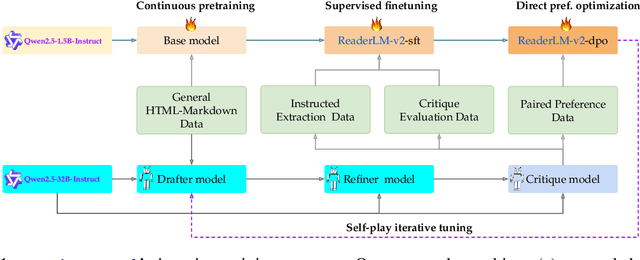
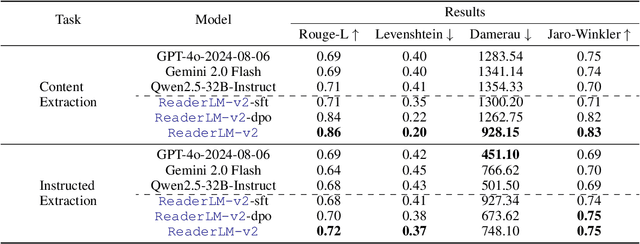
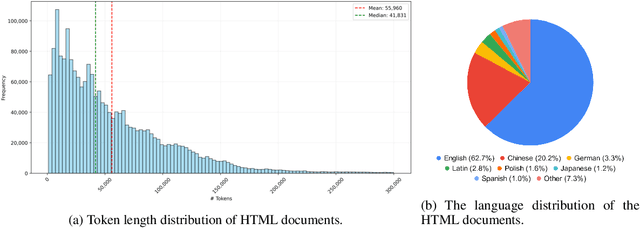
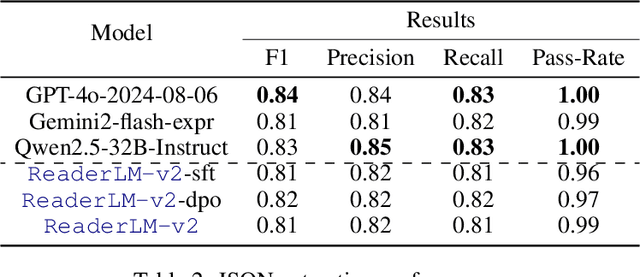
We present ReaderLM-v2, a compact 1.5 billion parameter language model designed for efficient web content extraction. Our model processes documents up to 512K tokens, transforming messy HTML into clean Markdown or JSON formats with high accuracy -- making it an ideal tool for grounding large language models. The model's effectiveness results from two key innovations: (1) a three-stage data synthesis pipeline that generates high quality, diverse training data by iteratively drafting, refining, and critiquing web content extraction; and (2) a unified training framework combining continuous pre-training with multi-objective optimization. Intensive evaluation demonstrates that ReaderLM-v2 outperforms GPT-4o-2024-08-06 and other larger models by 15-20\% on carefully curated benchmarks, particularly excelling at documents exceeding 100K tokens, while maintaining significantly lower computational requirements.