 Add to Chrome
 Add to Firefox
 Add to Edge
Agent Reinforcement Learning via Pivotal-Aware Self-Feedback Retry
Jul 04, 2026
Large language model (LLM) agents have shown strong decision-making capabilities in long-horizon interactive tasks, yet they still struggle to effectively leverage failed trajectories: full retries incur high interaction costs, while experience retrieval tends to dilute critical experience signals. To address this, we propose PivoARL, a self-feedback retry framework for experience exploitation in LLM agents. PivoARL identifies the pivotal erroneous turn through structured reflection and performs local retry only from the corresponding pivotal state, thereby reusing the correct prefix and reducing redundant interactions. From an information-gain perspective, we further show that pivotal retry concentrates useful experience signals near the error boundary, mitigating the signal dilution caused by state-agnostic experience utilization. Based on this insight, we design a pivotal-aware credit assignment mechanism that rewards correct prefixes while isolating erroneous suffixes, and optimize reflection quality through implicit reflection returns. We conduct a systematic evaluation on 4 agent tasks and 7 search-based QA benchmarks. Results show that PivoARL achieves significant improvements on Pass@2/3 across all tasks, with an average gain of about 11.5\% over MetaRL. Moreover, benefiting from contrastive preference signals induced by pivotal turns, PivoARL also consistently improves Pass@1 on over 80\% of the tasks. On Minesweeper environment, PivoARL improves over GiGPO by more than 45\% and reduces interaction turns by about 42\% on average compared with full-retry methods. Code is available at https://github.com/yuki-younai/PivoARL.

Bridging Functional Correctness and Runtime Efficiency Gaps in LLM-Based Code Translation
Jun 16, 2026While large language models (LLMs) have greatly advanced the functional correctness of automated code translation systems, the runtime efficiency of translated programs has received comparatively little attention. With the waning of Moore's law, runtime efficiency has become increasingly important for program quality, alongside functional correctness. Our preliminary study reveals that LLM-translated programs often run slower than human-written ones, and this issue cannot be remedied through prompt engineering alone. Therefore, our work proposes SwiftTrans, a code translation framework comprising two key stages: (1) Multi-Perspective Exploration, where MpTranslator leverages parallel in-context learning (ICL) to generate diverse translation candidates; and (2) Difference-Aware Selection, where DiffSelector identifies the optimal candidate by explicitly comparing differences between translations. We further introduce Hierarchical Guidance for MpTranslator and Ordinal Guidance for DiffSelector, enabling LLMs to better adapt to these two core components. To support the evaluation of runtime efficiency in translated programs, we extend existing benchmarks, CodeNet and F2SBench, and introduce a new benchmark, SwiftBench. Experimental results across all three benchmarks show that SwiftTrans achieves consistent improvements in both correctness and runtime efficiency.
SuCo: Sufficiency-guided Continuous Adaptive Reasoning
Jun 16, 2026Despite remarkable performance on complex tasks, Large Reasoning Models (LRMs) often generate excessively long Chain-of-Thoughts (CoT), inflating computational costs even for simple queries. Existing efforts to mitigate this inefficiency typically rely on discrete reasoning modes or fixed budget tiers, lacking a principled criterion of when reasoning is sufficient. In this work, we introduce Minimal Sufficient CoT (MSC), defined as the shortest prefix of a CoT trajectory which is adequate for producing the correct answer. We empirically show that MSC not only reduces reasoning tokens, but also improves accuracy across difficulty levels. Building on MSC, we propose Sufficiency-guided Continuous Adaptive Reasoning (SuCo), a two-stage training framework for autonomous reasoning control along a continuous spectrum. In stage 1, MSC-Aligned Fine-Tuning (MFT) constructs MSC data using problem-adaptive sufficiency thresholds that naturally scale with question difficulty, then fine-tunes the model to internalize concise yet sufficient reasoning patterns. In stage 2, Sufficiency-Aware Policy Optimization (SAPO) further optimizes the model through reinforcement learning with dynamic complexity tracking and sufficiency-aware rewards that penalize both over- and under-thinking. Extensive experiments across mathematics, code, and science benchmarks show that SuCo consistently achieves improvements in both accuracy and reasoning efficiency.
System Report for CCL25-Eval Task 10: SRAG-MAV for Fine-Grained Chinese Hate Speech Recognition
Jul 24, 2025This paper presents our system for CCL25-Eval Task 10, addressing Fine-Grained Chinese Hate Speech Recognition (FGCHSR). We propose a novel SRAG-MAV framework that synergistically integrates task reformulation(TR), Self-Retrieval-Augmented Generation (SRAG), and Multi-Round Accumulative Voting (MAV). Our method reformulates the quadruplet extraction task into triplet extraction, uses dynamic retrieval from the training set to create contextual prompts, and applies multi-round inference with voting to improve output stability and performance. Our system, based on the Qwen2.5-7B model, achieves a Hard Score of 26.66, a Soft Score of 48.35, and an Average Score of 37.505 on the STATE ToxiCN dataset, significantly outperforming baselines such as GPT-4o (Average Score 15.63) and fine-tuned Qwen2.5-7B (Average Score 35.365). The code is available at https://github.com/king-wang123/CCL25-SRAG-MAV.
Information fusion strategy integrating pre-trained language model and contrastive learning for materials knowledge mining
Jun 14, 2025Machine learning has revolutionized materials design, yet predicting complex properties like alloy ductility remains challenging due to the influence of processing conditions and microstructural features that resist quantification through traditional reductionist approaches. Here, we present an innovative information fusion architecture that integrates domain-specific texts from materials science literature with quantitative physical descriptors to overcome these limitations. Our framework employs MatSciBERT for advanced textual comprehension and incorporates contrastive learning to automatically extract implicit knowledge regarding processing parameters and microstructural characteristics. Through rigorous ablation studies and comparative experiments, the model demonstrates superior performance, achieving coefficient of determination (R2) values of 0.849 and 0.680 on titanium alloy validation set and refractory multi-principal-element alloy test set. This systematic approach provides a holistic framework for property prediction in complex material systems where quantitative descriptors are incomplete and establishes a foundation for knowledge-guided materials design and informatics-driven materials discovery.
Chinese Sequence Labeling with Semi-Supervised Boundary-Aware Language Model Pre-training
Apr 08, 2024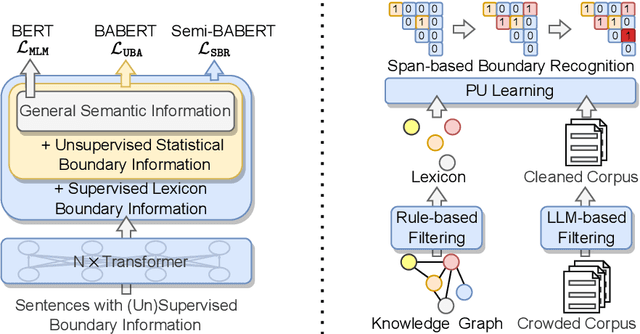
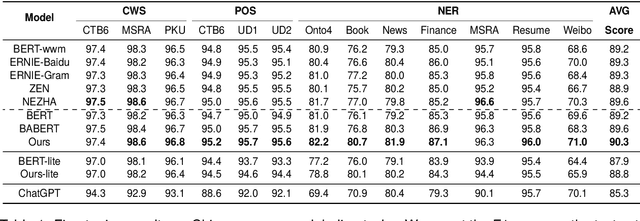
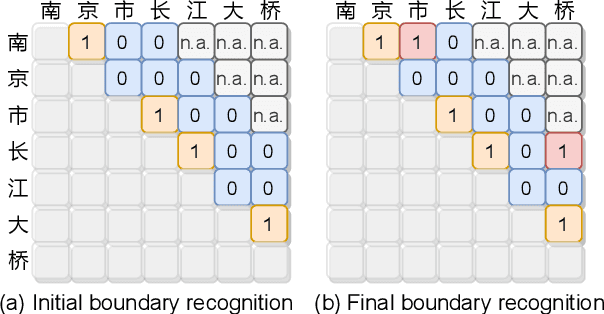
Chinese sequence labeling tasks are heavily reliant on accurate word boundary demarcation. Although current pre-trained language models (PLMs) have achieved substantial gains on these tasks, they rarely explicitly incorporate boundary information into the modeling process. An exception to this is BABERT, which incorporates unsupervised statistical boundary information into Chinese BERT's pre-training objectives. Building upon this approach, we input supervised high-quality boundary information to enhance BABERT's learning, developing a semi-supervised boundary-aware PLM. To assess PLMs' ability to encode boundaries, we introduce a novel ``Boundary Information Metric'' that is both simple and effective. This metric allows comparison of different PLMs without task-specific fine-tuning. Experimental results on Chinese sequence labeling datasets demonstrate that the improved BABERT variant outperforms the vanilla version, not only on these tasks but also more broadly across a range of Chinese natural language understanding tasks. Additionally, our proposed metric offers a convenient and accurate means of evaluating PLMs' boundary awareness.
RankingGPT: Empowering Large Language Models in Text Ranking with Progressive Enhancement
Nov 28, 2023
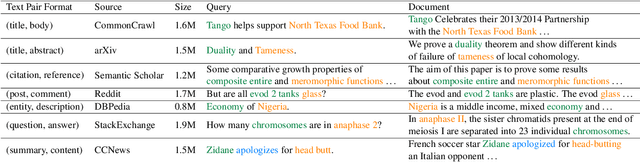
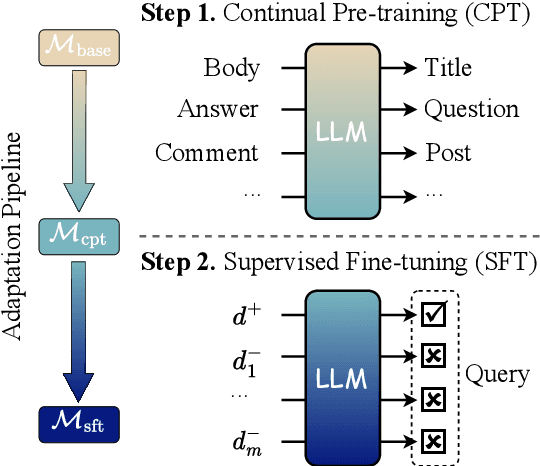
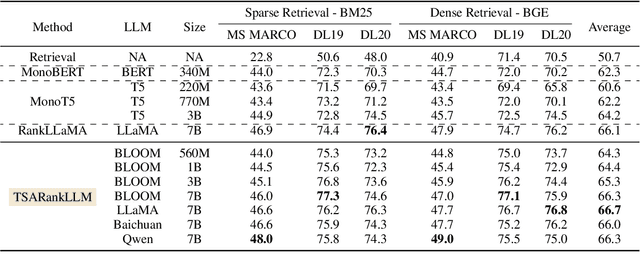
Text ranking is a critical task in various information retrieval applications, and the recent success of Large Language Models (LLMs) in natural language processing has sparked interest in their application to text ranking. These methods primarily involve combining query and candidate documents and leveraging prompt learning to determine query-document relevance using the LLM's output probabilities for specific tokens or by directly generating a ranked list of candidate documents. Although these approaches have demonstrated promise, a noteworthy disparity arises between the training objective of LLMs, which typically centers around next token prediction, and the objective of evaluating query-document relevance. To address this gap and fully leverage LLM potential in text ranking tasks, we propose a progressive multi-stage training strategy. Firstly, we introduce a large-scale weakly supervised dataset of relevance texts to enable the LLMs to acquire the ability to predict relevant tokens without altering their original training objective. Subsequently, we incorporate supervised training to further enhance LLM ranking capability. Our experimental results on multiple benchmarks demonstrate the superior performance of our proposed method compared to previous competitive approaches, both in in-domain and out-of-domain scenarios.
Hybrid Retrieval and Multi-stage Text Ranking Solution at TREC 2022 Deep Learning Track
Aug 23, 2023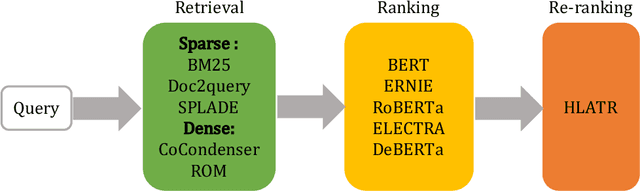
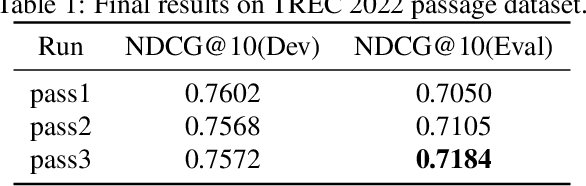
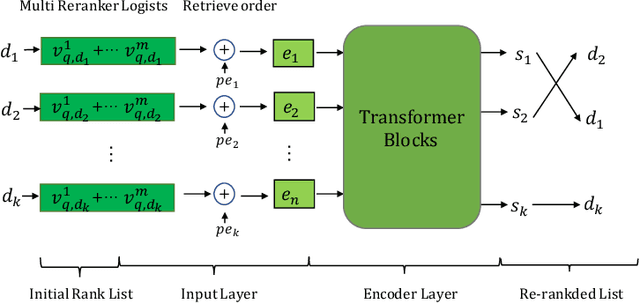
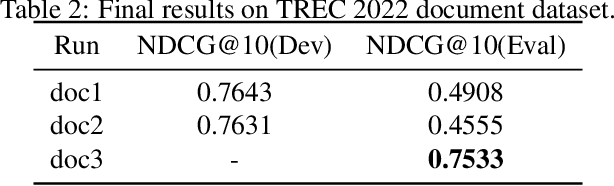
Large-scale text retrieval technology has been widely used in various practical business scenarios. This paper presents our systems for the TREC 2022 Deep Learning Track. We explain the hybrid text retrieval and multi-stage text ranking method adopted in our solution. The retrieval stage combined the two structures of traditional sparse retrieval and neural dense retrieval. In the ranking stage, in addition to the full interaction-based ranking model built on large pre-trained language model, we also proposes a lightweight sub-ranking module to further enhance the final text ranking performance. Evaluation results demonstrate the effectiveness of our proposed approach. Our models achieve the 1st and 4th rank on the test set of passage ranking and document ranking respectively.
A Simple but Effective Bidirectional Framework for Relational Triple Extraction
Jan 05, 2022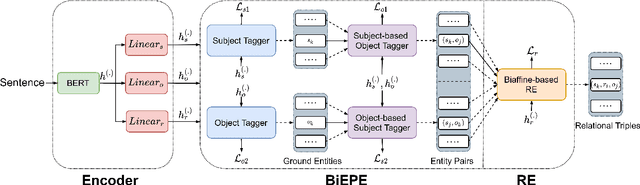
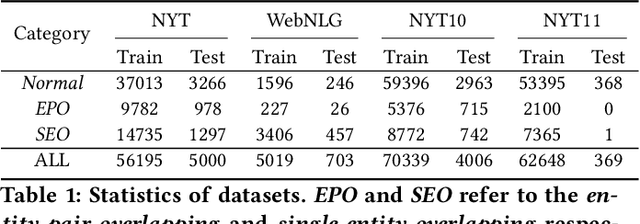
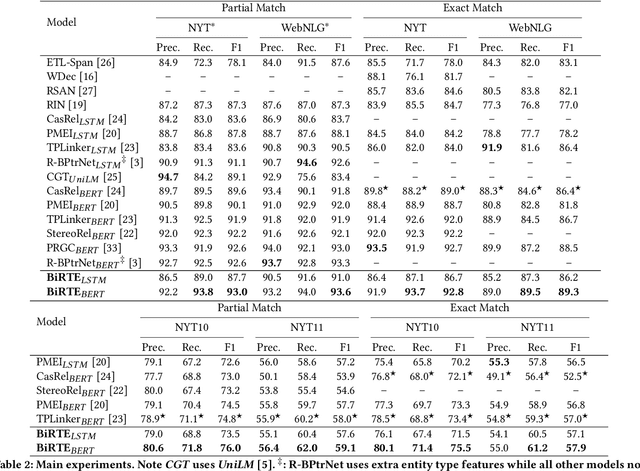
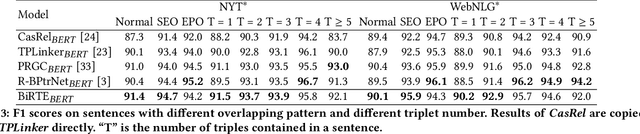
Tagging based relational triple extraction methods are attracting growing research attention recently. However, most of these methods take a unidirectional extraction framework that first extracts all subjects and then extracts objects and relations simultaneously based on the subjects extracted. This framework has an obvious deficiency that it is too sensitive to the extraction results of subjects. To overcome this deficiency, we propose a bidirectional extraction framework based method that extracts triples based on the entity pairs extracted from two complementary directions. Concretely, we first extract all possible subject-object pairs from two paralleled directions. These two extraction directions are connected by a shared encoder component, thus the extraction features from one direction can flow to another direction and vice versa. By this way, the extractions of two directions can boost and complement each other. Next, we assign all possible relations for each entity pair by a biaffine model. During training, we observe that the share structure will lead to a convergence rate inconsistency issue which is harmful to performance. So we propose a share-aware learning mechanism to address it. We evaluate the proposed model on multiple benchmark datasets. Extensive experimental results show that the proposed model is very effective and it achieves state-of-the-art results on all of these datasets. Moreover, experiments show that both the proposed bidirectional extraction framework and the share-aware learning mechanism have good adaptability and can be used to improve the performance of other tagging based methods. The source code of our work is available at: https://github.com/neukg/BiRTE.
A Novel Global Feature-Oriented Relational Triple Extraction Model based on Table Filling
Sep 14, 2021Table filling based relational triple extraction methods are attracting growing research interests due to their promising performance and their abilities on extracting triples from complex sentences. However, this kind of methods are far from their full potential because most of them only focus on using local features but ignore the global associations of relations and of token pairs, which increases the possibility of overlooking some important information during triple extraction. To overcome this deficiency, we propose a global feature-oriented triple extraction model that makes full use of the mentioned two kinds of global associations. Specifically, we first generate a table feature for each relation. Then two kinds of global associations are mined from the generated table features. Next, the mined global associations are integrated into the table feature of each relation. This "generate-mine-integrate" process is performed multiple times so that the table feature of each relation is refined step by step. Finally, each relation's table is filled based on its refined table feature, and all triples linked to this relation are extracted based on its filled table. We evaluate the proposed model on three benchmark datasets. Experimental results show our model is effective and it achieves state-of-the-art results on all of these datasets. The source code of our work is available at: https://github.com/neukg/GRTE.