 Add to Chrome
 Add to Firefox
 Add to Edge
Qwen-AgentWorld: Language World Models for General Agents
Jun 23, 2026
A world model predicts environment dynamics based on current observations and actions, serving as a core cognitive mechanism for reasoning and planning. In this work, we investigate how world modeling based on language models can further push the boundaries of general agents. (i) We first focus on building foundation models for agentic environment simulation. We introduce Qwen-AgentWorld-35B-A3B and Qwen-AgentWorld-397B-A17B, the first language world models capable of simulating agentic environments covering 7 domains via long chain-of-thought reasoning. Leveraging more than 10M environment interaction trajectories of 7 domains in real-world environments, we develop Qwen-AgentWorld through a three-stage training pipeline: CPT injects general-purpose world modeling capabilities from the state transition dynamics and augmented professional corpora, SFT activates next-state-prediction reasoning, and RL sharpens simulation fidelity through a tailored framework with hybrid rubric-and-rule rewards. To evaluate language world models, we present AgentWorldBench, a comprehensive benchmark constructed from real-world interactions of 5 frontier models on 9 established benchmarks. Empirical results demonstrate that Qwen-AgentWorld significantly outperforms existing frontier models. (ii) Beyond foundation models, we further investigate two complementary paradigms through which world modeling enhances general agents. First, as a decoupled environment simulator, Qwen-AgentWorld supports scalable and controllable simulation of thousands of real-world environments for agentic RL, yielding gains that surpass real-environment training alone. Second, as a unified agent foundation model, world-model training acts as a highly effective warm-up that improves downstream performance across 7 agentic benchmarks. Code: https://github.com/QwenLM/Qwen-AgentWorld

OccuBench: Evaluating AI Agents on Real-World Professional Tasks via Language World Models
Apr 13, 2026AI agents are expected to perform professional work across hundreds of occupational domains (from emergency department triage to nuclear reactor safety monitoring to customs import processing), yet existing benchmarks can only evaluate agents in the few domains where public environments exist. We introduce OccuBench, a benchmark covering 100 real-world professional task scenarios across 10 industry categories and 65 specialized domains, enabled by Language World Models (LWMs) that simulate domain-specific environments through LLM-driven tool response generation. Our multi-agent synthesis pipeline automatically produces evaluation instances with guaranteed solvability, calibrated difficulty, and document-grounded diversity. OccuBench evaluates agents along two complementary dimensions: task completion across professional domains and environmental robustness under controlled fault injection (explicit errors, implicit data degradation, and mixed faults). We evaluate 15 frontier models across 8 model families and find that: (1) no single model dominates all industries, as each has a distinct occupational capability profile; (2) implicit faults (truncated data, missing fields) are harder than both explicit errors (timeouts, 500s) and mixed faults, because they lack overt error signals and require the agent to independently detect data degradation; (3) larger models, newer generations, and higher reasoning effort consistently improve performance. GPT-5.2 improves by 27.5 points from minimal to maximum reasoning effort; and (4) strong agents are not necessarily strong environment simulators. Simulator quality is critical for LWM-based evaluation reliability. OccuBench provides the first systematic cross-industry evaluation of AI agents on professional occupational tasks.
DeepPlanning: Benchmarking Long-Horizon Agentic Planning with Verifiable Constraints
Jan 26, 2026While agent evaluation has shifted toward long-horizon tasks, most benchmarks still emphasize local, step-level reasoning rather than the global constrained optimization (e.g., time and financial budgets) that demands genuine planning ability. Meanwhile, existing LLM planning benchmarks underrepresent the active information gathering and fine-grained local constraints typical of real-world settings. To address this, we introduce DeepPlanning, a challenging benchmark for practical long-horizon agent planning. It features multi-day travel planning and multi-product shopping tasks that require proactive information acquisition, local constrained reasoning, and global constrained optimization. Evaluations on DeepPlanning show that even frontier agentic LLMs struggle with these problems, highlighting the importance of reliable explicit reasoning patterns and parallel tool use for achieving better effectiveness-efficiency trade-offs. Error analysis further points to promising directions for improving agentic LLMs over long planning horizons. We open-source the code and data to support future research.
Qwen3 Technical Report
May 14, 2025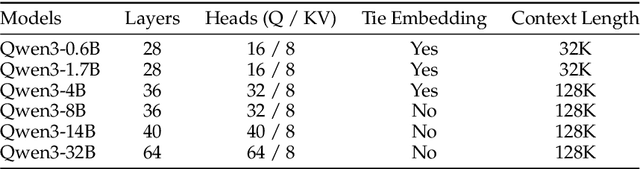
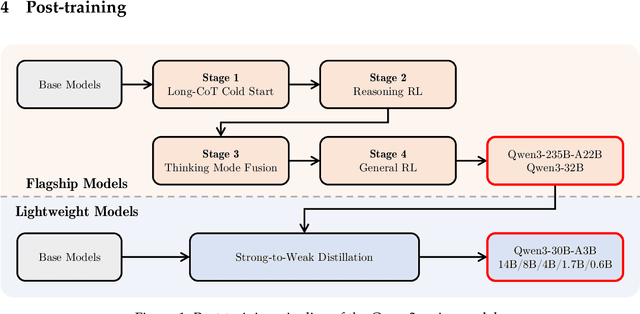

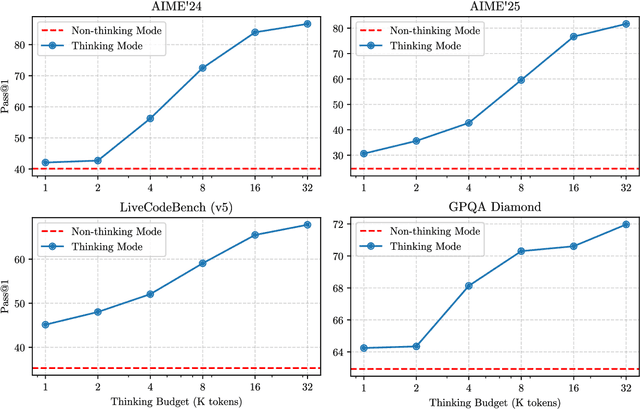
In this work, we present Qwen3, the latest version of the Qwen model family. Qwen3 comprises a series of large language models (LLMs) designed to advance performance, efficiency, and multilingual capabilities. The Qwen3 series includes models of both dense and Mixture-of-Expert (MoE) architectures, with parameter scales ranging from 0.6 to 235 billion. A key innovation in Qwen3 is the integration of thinking mode (for complex, multi-step reasoning) and non-thinking mode (for rapid, context-driven responses) into a unified framework. This eliminates the need to switch between different models--such as chat-optimized models (e.g., GPT-4o) and dedicated reasoning models (e.g., QwQ-32B)--and enables dynamic mode switching based on user queries or chat templates. Meanwhile, Qwen3 introduces a thinking budget mechanism, allowing users to allocate computational resources adaptively during inference, thereby balancing latency and performance based on task complexity. Moreover, by leveraging the knowledge from the flagship models, we significantly reduce the computational resources required to build smaller-scale models, while ensuring their highly competitive performance. Empirical evaluations demonstrate that Qwen3 achieves state-of-the-art results across diverse benchmarks, including tasks in code generation, mathematical reasoning, agent tasks, etc., competitive against larger MoE models and proprietary models. Compared to its predecessor Qwen2.5, Qwen3 expands multilingual support from 29 to 119 languages and dialects, enhancing global accessibility through improved cross-lingual understanding and generation capabilities. To facilitate reproducibility and community-driven research and development, all Qwen3 models are publicly accessible under Apache 2.0.