 Add to Chrome
 Add to Firefox
 Add to Edge
SIT-Graph: State Integrated Tool Graph for Multi-Turn Agents
Dec 08, 2025
Despite impressive advances in agent systems, multi-turn tool-use scenarios remain challenging. It is mainly because intent is clarified progressively and the environment evolves with each tool call. While reusing past experience is natural, current LLM agents either treat entire trajectories or pre-defined subtasks as indivisible units, or solely exploit tool-to-tool dependencies, hindering adaptation as states and information evolve across turns. In this paper, we propose a State Integrated Tool Graph (SIT-Graph), which enhances multi-turn tool use by exploiting partially overlapping experience. Inspired by human decision-making that integrates episodic and procedural memory, SIT-Graph captures both compact state representations (episodic-like fragments) and tool-to-tool dependencies (procedural-like routines) from historical trajectories. Specifically, we first build a tool graph from accumulated tool-use sequences, and then augment each edge with a compact state summary of the dialog and tool history that may shape the next action. At inference time, SIT-Graph enables a human-like balance between episodic recall and procedural execution: when the next decision requires recalling prior context, the agent retrieves the state summaries stored on relevant edges and uses them to guide its next action; when the step is routine, it follows high-confidence tool dependencies without explicit recall. Experiments across multiple stateful multi-turn tool-use benchmarks show that SIT-Graph consistently outperforms strong memory- and graph-based baselines, delivering more robust tool selection and more effective experience transfer.

How Do VLAs Effectively Inherit from VLMs?
Nov 10, 2025Vision-language-action (VLA) models hold the promise to attain generalizable embodied control. To achieve this, a pervasive paradigm is to leverage the rich vision-semantic priors of large vision-language models (VLMs). However, the fundamental question persists: How do VLAs effectively inherit the prior knowledge from VLMs? To address this critical question, we introduce a diagnostic benchmark, GrinningFace, an emoji tabletop manipulation task where the robot arm is asked to place objects onto printed emojis corresponding to language instructions. This task design is particularly revealing -- knowledge associated with emojis is ubiquitous in Internet-scale datasets used for VLM pre-training, yet emojis themselves are largely absent from standard robotics datasets. Consequently, they provide a clean proxy: successful task completion indicates effective transfer of VLM priors to embodied control. We implement this diagnostic task in both simulated environment and a real robot, and compare various promising techniques for knowledge transfer. Specifically, we investigate the effects of parameter-efficient fine-tuning, VLM freezing, co-training, predicting discretized actions, and predicting latent actions. Through systematic evaluation, our work not only demonstrates the critical importance of preserving VLM priors for the generalization of VLA but also establishes guidelines for future research in developing truly generalizable embodied AI systems.
Less Is More: Generating Time Series with LLaMA-Style Autoregression in Simple Factorized Latent Spaces
Nov 07, 2025Generative models for multivariate time series are essential for data augmentation, simulation, and privacy preservation, yet current state-of-the-art diffusion-based approaches are slow and limited to fixed-length windows. We propose FAR-TS, a simple yet effective framework that combines disentangled factorization with an autoregressive Transformer over a discrete, quantized latent space to generate time series. Each time series is decomposed into a data-adaptive basis that captures static cross-channel correlations and temporal coefficients that are vector-quantized into discrete tokens. A LLaMA-style autoregressive Transformer then models these token sequences, enabling fast and controllable generation of sequences with arbitrary length. Owing to its streamlined design, FAR-TS achieves orders-of-magnitude faster generation than Diffusion-TS while preserving cross-channel correlations and an interpretable latent space, enabling high-quality and flexible time series synthesis.
Co-Evolving Latent Action World Models
Oct 30, 2025Adapting pre-trained video generation models into controllable world models via latent actions is a promising step towards creating generalist world models. The dominant paradigm adopts a two-stage approach that trains latent action model (LAM) and the world model separately, resulting in redundant training and limiting their potential for co-adaptation. A conceptually simple and appealing idea is to directly replace the forward dynamic model in LAM with a powerful world model and training them jointly, but it is non-trivial and prone to representational collapse. In this work, we propose CoLA-World, which for the first time successfully realizes this synergistic paradigm, resolving the core challenge in joint learning through a critical warm-up phase that effectively aligns the representations of the from-scratch LAM with the pre-trained world model. This unlocks a co-evolution cycle: the world model acts as a knowledgeable tutor, providing gradients to shape a high-quality LAM, while the LAM offers a more precise and adaptable control interface to the world model. Empirically, CoLA-World matches or outperforms prior two-stage methods in both video simulation quality and downstream visual planning, establishing a robust and efficient new paradigm for the field.
Holdout-Loss-Based Data Selection for LLM Finetuning via In-Context Learning
Oct 16, 2025Fine-tuning large pretrained language models is a common approach for aligning them with human preferences, but noisy or off-target examples can dilute supervision. While small, well-chosen datasets often match the performance of much larger ones, systematic and efficient ways to identify high-value training data remain underexplored. Many current methods rely on heuristics or expensive retraining. We present a theoretically grounded, resource-efficient framework for data selection and reweighting. At its core is an In-Context Approximation (ICA) that estimates the holdout loss a model would incur after training on a candidate example by conditioning on a small, curated holdout set in context. ICA requires no reference model and no additional finetuning. Under a local linearization, ICA is equivalent to a first-order update toward the holdout optimum, motivating its use as a proxy for data value. We derive per-example weights from ICA scores, dynamically reweighting gradient updates as model parameters evolve. Across SFT, DPO, and SimPO, and over diverse backbones and datasets, ICA-based reweighting consistently improves model alignment with minimal overhead. We analyze sensitivity to score update frequency and the choice of $k$ holdout examples for in-context demonstrations, and note limitations for rapidly drifting on-policy updates, highlighting directions for future work. Code and prompts will be released.
Reinforce-Ada: An Adaptive Sampling Framework for Reinforce-Style LLM Training
Oct 06, 2025Reinforcement learning applied to large language models (LLMs) for reasoning tasks is often bottlenecked by unstable gradient estimates due to fixed and uniform sampling of responses across prompts. Prior work such as GVM-RAFT addresses this by dynamically allocating inference budget per prompt to minimize stochastic gradient variance under a budget constraint. Inspired by this insight, we propose Reinforce-Ada, an adaptive sampling framework for online RL post-training of LLMs that continuously reallocates sampling effort to the prompts with the greatest uncertainty or learning potential. Unlike conventional two-stage allocation methods, Reinforce-Ada interleaves estimation and sampling in an online successive elimination process, and automatically stops sampling for a prompt once sufficient signal is collected. To stabilize updates, we form fixed-size groups with enforced reward diversity and compute advantage baselines using global statistics aggregated over the adaptive sampling phase. Empirical results across multiple model architectures and reasoning benchmarks show that Reinforce-Ada accelerates convergence and improves final performance compared to GRPO, especially when using the balanced sampling variant. Our work highlights the central role of variance-aware, adaptive data curation in enabling efficient and reliable reinforcement learning for reasoning-capable LLMs. Code is available at https://github.com/RLHFlow/Reinforce-Ada.
Rethinking Reward Models for Multi-Domain Test-Time Scaling
Oct 02, 2025The reliability of large language models (LLMs) during test-time scaling is often assessed with \emph{external verifiers} or \emph{reward models} that distinguish correct reasoning from flawed logic. Prior work generally assumes that process reward models (PRMs), which score every intermediate reasoning step, outperform outcome reward models (ORMs) that assess only the final answer. This view is based mainly on evidence from narrow, math-adjacent domains. We present the first unified evaluation of four reward model variants, discriminative ORM and PRM (\DisORM, \DisPRM) and generative ORM and PRM (\GenORM, \GenPRM), across 14 diverse domains. Contrary to conventional wisdom, we find that (i) \DisORM performs on par with \DisPRM, (ii) \GenPRM is not competitive, and (iii) overall, \GenORM is the most robust, yielding significant and consistent gains across every tested domain. We attribute this to PRM-style stepwise scoring, which inherits label noise from LLM auto-labeling and has difficulty evaluating long reasoning trajectories, including those involving self-correcting reasoning. Our theoretical analysis shows that step-wise aggregation compounds errors as reasoning length grows, and our empirical observations confirm this effect. These findings challenge the prevailing assumption that fine-grained supervision is always better and support generative outcome verification for multi-domain deployment. We publicly release our code, datasets, and checkpoints at \href{https://github.com/db-Lee/Multi-RM}{\underline{\small\texttt{https://github.com/db-Lee/Multi-RM}}} to facilitate future research in multi-domain settings.
AURAD: Anatomy-Pathology Unified Radiology Synthesis with Progressive Representations
Sep 05, 2025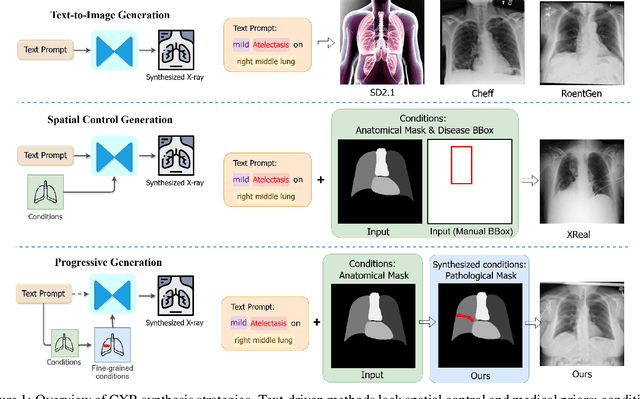

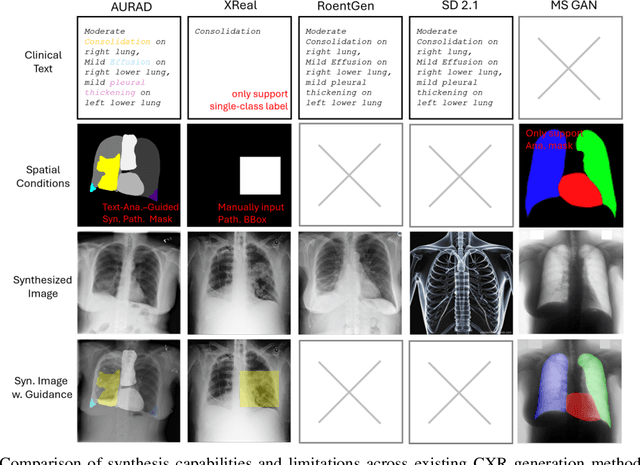
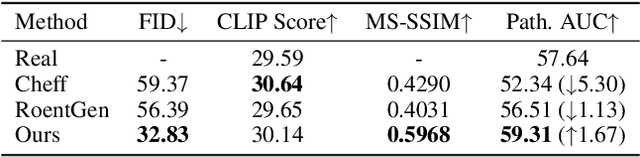
Medical image synthesis has become an essential strategy for augmenting datasets and improving model generalization in data-scarce clinical settings. However, fine-grained and controllable synthesis remains difficult due to limited high-quality annotations and domain shifts across datasets. Existing methods, often designed for natural images or well-defined tumors, struggle to generalize to chest radiographs, where disease patterns are morphologically diverse and tightly intertwined with anatomical structures. To address these challenges, we propose AURAD, a controllable radiology synthesis framework that jointly generates high-fidelity chest X-rays and pseudo semantic masks. Unlike prior approaches that rely on randomly sampled masks-limiting diversity, controllability, and clinical relevance-our method learns to generate masks that capture multi-pathology coexistence and anatomical-pathological consistency. It follows a progressive pipeline: pseudo masks are first generated from clinical prompts conditioned on anatomical structures, and then used to guide image synthesis. We also leverage pretrained expert medical models to filter outputs and ensure clinical plausibility. Beyond visual realism, the synthesized masks also serve as labels for downstream tasks such as detection and segmentation, bridging the gap between generative modeling and real-world clinical applications. Extensive experiments and blinded radiologist evaluations demonstrate the effectiveness and generalizability of our method across tasks and datasets. In particular, 78% of our synthesized images are classified as authentic by board-certified radiologists, and over 40% of predicted segmentation overlays are rated as clinically useful. All code, pre-trained models, and the synthesized dataset will be released upon publication.
Sample-efficient LLM Optimization with Reset Replay
Aug 08, 2025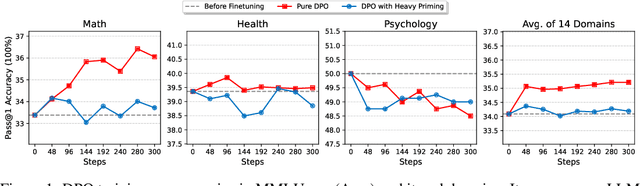
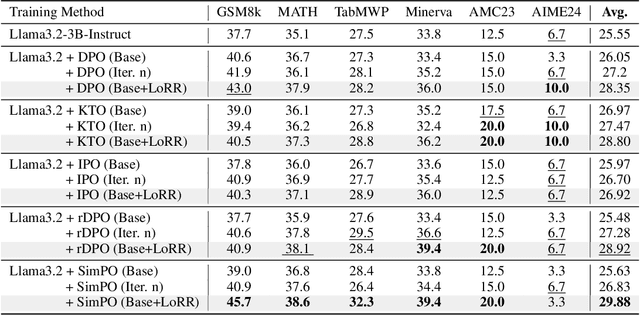
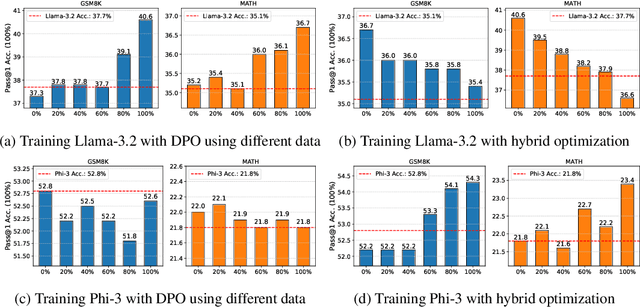
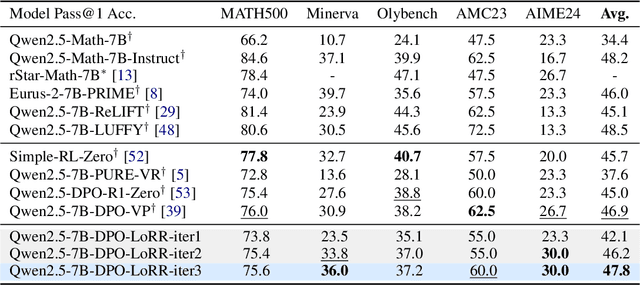
Recent advancements in post-training Large Language Models (LLMs), particularly through Reinforcement Learning (RL) and preference optimization methods, are key drivers for enhancing their reasoning capabilities. However, these methods are often plagued by low sample efficiency and a susceptibility to primacy bias, where overfitting to initial experiences degrades policy quality and damages the learning process. To address these challenges, we introduce LLM optimization with Reset Replay (LoRR), a general and powerful plugin designed to enhance sample efficiency in any preference-based optimization framework. LoRR core mechanism enables training at a high replay number, maximizing the utility of each collected data batch. To counteract the risk of overfitting inherent in high-replay training, LoRR incorporates a periodic reset strategy with reusing initial data, which preserves network plasticity. Furthermore, it leverages a hybrid optimization objective, combining supervised fine-tuning (SFT) and preference-based losses to further bolster data exploitation. Our extensive experiments demonstrate that LoRR significantly boosts the performance of various preference optimization methods on both mathematical and general reasoning benchmarks. Notably, an iterative DPO approach augmented with LoRR achieves comparable performance on challenging math tasks, outperforming some complex and computationally intensive RL-based algorithms. These findings highlight that LoRR offers a practical, sample-efficient, and highly effective paradigm for LLM finetuning, unlocking greater performance from limited data.
villa-X: Enhancing Latent Action Modeling in Vision-Language-Action Models
Jul 31, 2025Visual-Language-Action (VLA) models have emerged as a popular paradigm for learning robot manipulation policies that can follow language instructions and generalize to novel scenarios. Recent work has begun to explore the incorporation of latent actions, an abstract representation of visual change between two frames, into VLA pre-training. In this paper, we introduce villa-X, a novel Visual-Language-Latent-Action (ViLLA) framework that advances latent action modeling for learning generalizable robot manipulation policies. Our approach improves both how latent actions are learned and how they are incorporated into VLA pre-training. Together, these contributions enable villa-X to achieve superior performance across simulated environments including SIMPLER and LIBERO, as well as on two real-world robot setups including gripper and dexterous hand manipulation. We believe the ViLLA paradigm holds significant promise, and that our villa-X provides a strong foundation for future research.