 Add to Chrome
 Add to Firefox
 Add to Edge
Evaluation Pitfalls and Challenges in Multimedia Event Extraction
Jun 25, 2026
Multimedia event extraction aims to jointly identify events and their arguments across multiple modalities, such as text and images, to support more comprehensive event understanding. While recent work reports steady and substantial progress, the reliability and comparability of these results critically depend on consistent and rigorous evaluation. In this work, we present the first systematic analysis of evaluation pitfalls in multimedia event extraction and identify three major sources of issues: inconsistent data processing, inconsistent task assumptions, and overly relaxed evaluation settings. We demonstrate, through a series of controlled experiments under a strict evaluation framework, that minor evaluation choices can cause large performance variations and lead to overestimation of a model's ability to ground real-world events across modalities. Our findings highlight the need for comparable evaluation standards and encourage a shift toward more rigorous evaluation in multimedia event extraction.

Mitigating Scoring Errors and Compensating for Nonverbal Subtests in Speech-Based Dementia Assessment
Jun 17, 2026Early detection of cognitive impairment relies on neuropsychological tests to minimize subjectivity by assessing multiple cognitive domains. Speech-based evaluation can support diagnostics and improve accessibility, but transcription errors and the omission of nonverbal subtests (e.g., motor skills) limit accuracy. Beyond conventional test scores, speech-derived features can provide additional insights into cognitive status. This study investigates the speech-based evaluation of the German "Syndrom-Kurz-Test," a standardized dementia screening test comprising verbal and motor subtests. We train models that integrate transcript-derived scores and Whisper embeddings per verbal subtest to reduce scoring errors. To compensate for missing motor subtests, we then leverage these fused representations to approximate expert overall ratings. Despite omitting subtests, our models strongly correlate with expert ratings and efficiently and accurately discriminate between cognitive status groups.
Reading between the Lines: Leveraging Large Language Models for Global Dementia and Depression Assessment from Clinical Interviews
Jun 16, 2026Dementia and depression are the most prevalent neuropsychiatric disorders in geriatric populations, and their overlapping symptoms pose major challenges for differential diagnosis. In this study, we investigate open-weights Large Language Models (LLMs) for predicting dementia and depression severity from speech samples collected during standardized history taking interviews with 154 German-speaking subjects. We introduce an observer-based Global Depression Scale (GDS-D) aligned with the established Global Deterioration Scale (GDS), enabling parallel global staging of affective and cognitive symptoms. We compare three LLMs (Mistral 3.1, DeepHermes, Qwen3) in two settings: (1) zero-shot prediction and (2) LLM-based feature extraction for Support Vector Regression, using human and pause-enriched transcripts. Results show that LLMs effectively predict depression severity in zero-shot settings (best MAE of 0.60), while dementia assessment benefits substantially from structured feature extraction (best MAE of 0.78), reducing errors by up to 35% over zero-shot baselines. Pause-enriched transcripts achieve competitive performance with human transcriptions, demonstrating the viability of fully automatic screening pipelines for differential neuropsychiatric assessment.
The PARLO Dementia Corpus: A German Multi-Center Resource for Alzheimer's Disease
Mar 05, 2026Early and accessible detection of Alzheimer's disease (AD) remains a major challenge, as current diagnostic methods often rely on costly and invasive biomarkers. Speech and language analysis has emerged as a promising non-invasive and scalable approach to detecting cognitive impairment, but research in this area is hindered by the lack of publicly available datasets, especially for languages other than English. This paper introduces the PARLO Dementia Corpus (PDC), a new multi-center, clinically validated German resource for AD collected across nine academic memory clinics in Germany. The dataset comprises speech recordings from individuals with AD-related mild cognitive impairment and mild to moderate dementia, as well as cognitively healthy controls. Speech was elicited using a standardized test battery of eight neuropsychological tasks, including confrontation naming, verbal fluency, word repetition, picture description, story reading, and recall tasks. In addition to audio recordings, the dataset includes manually verified transcriptions and detailed demographic, clinical, and biomarker metadata. Baseline experiments on ASR benchmarking, automated test evaluation, and LLM-based classification illustrate the feasibility of automatic, speech-based cognitive assessment and highlight the diagnostic value of recall-driven speech production. The PDC thus establishes the first publicly available German benchmark for multi-modal and cross-lingual research on neurodegenerative diseases.
Learning to Detect Baked Goods with Limited Supervision
Feb 10, 2026Monitoring leftover products provides valuable insights that can be used to optimize future production. This is especially important for German bakeries because freshly baked goods have a very short shelf life. Automating this process can reduce labor costs, improve accuracy, and streamline operations. We propose automating this process using an object detection model to identify baked goods from images. However, the large diversity of German baked goods makes fully supervised training prohibitively expensive and limits scalability. Although open-vocabulary detectors (e.g., OWLv2, Grounding DINO) offer lexibility, we demonstrate that they are insufficient for our task. While motivated by bakeries, our work addresses the broader challenges of deploying computer vision in industries, where tasks are specialized and annotated datasets are scarce. We compile dataset splits with varying supervision levels, covering 19 classes of baked goods. We propose two training workflows to train an object detection model with limited supervision. First, we combine OWLv2 and Grounding DINO localization with image-level supervision to train the model in a weakly supervised manner. Second, we improve viewpoint robustness by fine-tuning on video frames annotated using Segment Anything 2 as a pseudo-label propagation model. Using these workflows, we train YOLOv11 for our detection task due to its favorable speed accuracy tradeoff. Relying solely on image-level supervision, the model achieves a mean Average Precision (mAP) of 0.91. Finetuning with pseudo-labels raises model performance by 19.3% under non-ideal deployment conditions. Combining these workflows trains a model that surpasses our fully-supervised baseline model under non-ideal deployment conditions, despite relying only on image-level supervision.
Reading Between the Waves: Robust Topic Segmentation Using Inter-Sentence Audio Features
Feb 06, 2026Spoken content, such as online videos and podcasts, often spans multiple topics, which makes automatic topic segmentation essential for user navigation and downstream applications. However, current methods do not fully leverage acoustic features, leaving room for improvement. We propose a multi-modal approach that fine-tunes both a text encoder and a Siamese audio encoder, capturing acoustic cues around sentence boundaries. Experiments on a large-scale dataset of YouTube videos show substantial gains over text-only and multi-modal baselines. Our model also proves more resilient to ASR noise and outperforms a larger text-only baseline on three additional datasets in Portuguese, German, and English, underscoring the value of learned acoustic features for robust topic segmentation.
Towards Multi-Level Transcript Segmentation: LoRA Fine-Tuning for Table-of-Contents Generation
Jan 05, 2026Segmenting speech transcripts into thematic sections benefits both downstream processing and users who depend on written text for accessibility. We introduce a novel approach to hierarchical topic segmentation in transcripts, generating multi-level tables of contents that capture both topic and subtopic boundaries. We compare zero-shot prompting and LoRA fine-tuning on large language models, while also exploring the integration of high-level speech pause features. Evaluations on English meeting recordings and multilingual lecture transcripts (Portuguese, German) show significant improvements over established topic segmentation baselines. Additionally, we adapt a common evaluation measure for multi-level segmentation, taking into account all hierarchical levels within one metric.
* Published in Proceedings of Interspeech 2025. Please cite the proceedings version (DOI: 10.21437/Interspeech.2025-2792)
Generalizing to Unseen Disaster Events: A Causal View
Nov 13, 2025Due to the rapid growth of social media platforms, these tools have become essential for monitoring information during ongoing disaster events. However, extracting valuable insights requires real-time processing of vast amounts of data. A major challenge in existing systems is their exposure to event-related biases, which negatively affects their ability to generalize to emerging events. While recent advancements in debiasing and causal learning offer promising solutions, they remain underexplored in the disaster event domain. In this work, we approach bias mitigation through a causal lens and propose a method to reduce event- and domain-related biases, enhancing generalization to future events. Our approach outperforms multiple baselines by up to +1.9% F1 and significantly improves a PLM-based classifier across three disaster classification tasks.
Rethinking Reward Models for Multi-Domain Test-Time Scaling
Oct 02, 2025The reliability of large language models (LLMs) during test-time scaling is often assessed with \emph{external verifiers} or \emph{reward models} that distinguish correct reasoning from flawed logic. Prior work generally assumes that process reward models (PRMs), which score every intermediate reasoning step, outperform outcome reward models (ORMs) that assess only the final answer. This view is based mainly on evidence from narrow, math-adjacent domains. We present the first unified evaluation of four reward model variants, discriminative ORM and PRM (\DisORM, \DisPRM) and generative ORM and PRM (\GenORM, \GenPRM), across 14 diverse domains. Contrary to conventional wisdom, we find that (i) \DisORM performs on par with \DisPRM, (ii) \GenPRM is not competitive, and (iii) overall, \GenORM is the most robust, yielding significant and consistent gains across every tested domain. We attribute this to PRM-style stepwise scoring, which inherits label noise from LLM auto-labeling and has difficulty evaluating long reasoning trajectories, including those involving self-correcting reasoning. Our theoretical analysis shows that step-wise aggregation compounds errors as reasoning length grows, and our empirical observations confirm this effect. These findings challenge the prevailing assumption that fine-grained supervision is always better and support generative outcome verification for multi-domain deployment. We publicly release our code, datasets, and checkpoints at \href{https://github.com/db-Lee/Multi-RM}{\underline{\small\texttt{https://github.com/db-Lee/Multi-RM}}} to facilitate future research in multi-domain settings.
Pitfalls and Limits in Automatic Dementia Assessment
Aug 06, 2025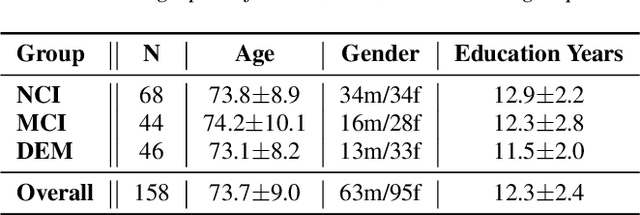
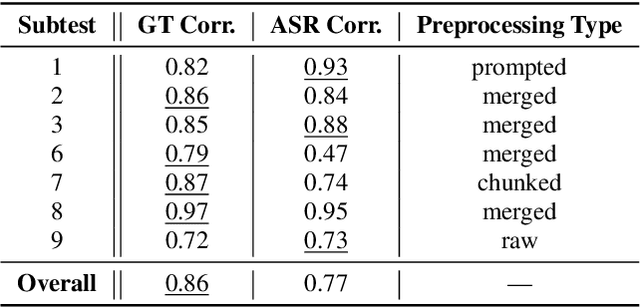
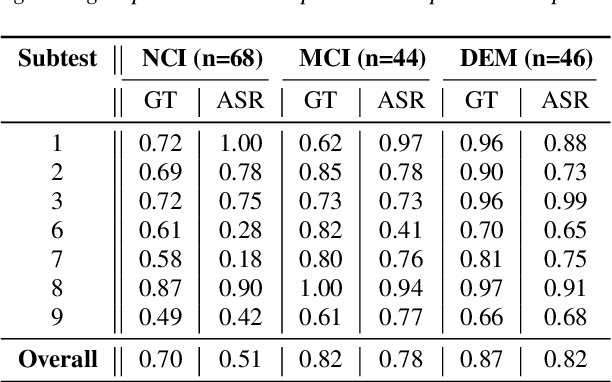
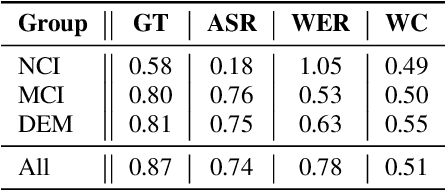
Current work on speech-based dementia assessment focuses on either feature extraction to predict assessment scales, or on the automation of existing test procedures. Most research uses public data unquestioningly and rarely performs a detailed error analysis, focusing primarily on numerical performance. We perform an in-depth analysis of an automated standardized dementia assessment, the Syndrom-Kurz-Test. We find that while there is a high overall correlation with human annotators, due to certain artifacts, we observe high correlations for the severely impaired individuals, which is less true for the healthy or mildly impaired ones. Speech production decreases with cognitive decline, leading to overoptimistic correlations when test scoring relies on word naming. Depending on the test design, fallback handling introduces further biases that favor certain groups. These pitfalls remain independent of group distributions in datasets and require differentiated analysis of target groups.