 Add to Chrome
 Add to Firefox
 Add to Edge
Conservation-informed Graph Learning for Spatiotemporal Dynamics Prediction
Dec 30, 2024
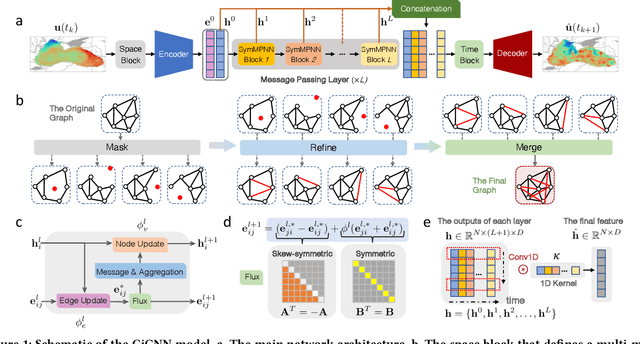
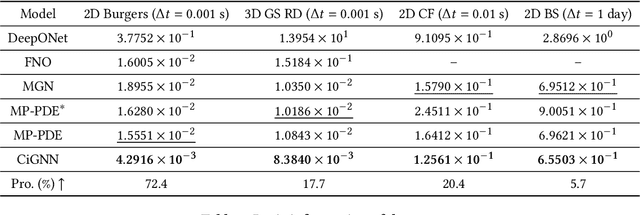
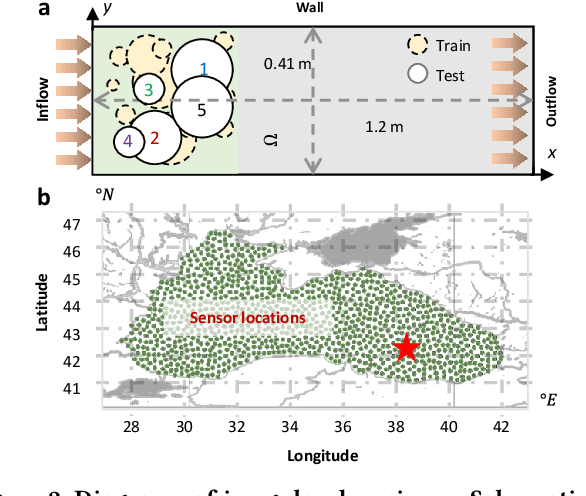

Data-centric methods have shown great potential in understanding and predicting spatiotemporal dynamics, enabling better design and control of the object system. However, pure deep learning models often lack interpretability, fail to obey intrinsic physics, and struggle to cope with the various domains. While geometry-based methods, e.g., graph neural networks (GNNs), have been proposed to further tackle these challenges, they still need to find the implicit physical laws from large datasets and rely excessively on rich labeled data. In this paper, we herein introduce the conservation-informed GNN (CiGNN), an end-to-end explainable learning framework, to learn spatiotemporal dynamics based on limited training data. The network is designed to conform to the general conservation law via symmetry, where conservative and non-conservative information passes over a multiscale space enhanced by a latent temporal marching strategy. The efficacy of our model has been verified in various spatiotemporal systems based on synthetic and real-world datasets, showing superiority over baseline models. Results demonstrate that CiGNN exhibits remarkable accuracy and generalization ability, and is readily applicable to learning for prediction of various spatiotemporal dynamics in a spatial domain with complex geometry.

YuLan-Mini: An Open Data-efficient Language Model
Dec 24, 2024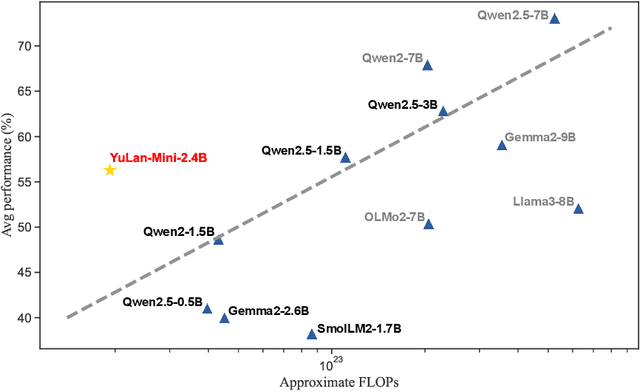


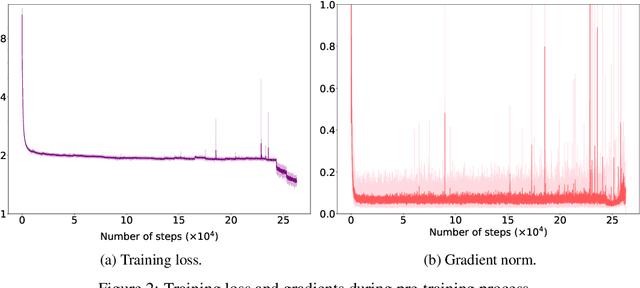
Effective pre-training of large language models (LLMs) has been challenging due to the immense resource demands and the complexity of the technical processes involved. This paper presents a detailed technical report on YuLan-Mini, a highly capable base model with 2.42B parameters that achieves top-tier performance among models of similar parameter scale. Our pre-training approach focuses on enhancing training efficacy through three key technical contributions: an elaborate data pipeline combines data cleaning with data schedule strategies, a robust optimization method to mitigate training instability, and an effective annealing approach that incorporates targeted data selection and long context training. Remarkably, YuLan-Mini, trained on 1.08T tokens, achieves performance comparable to industry-leading models that require significantly more data. To facilitate reproduction, we release the full details of the data composition for each training phase. Project details can be accessed at the following link: https://github.com/RUC-GSAI/YuLan-Mini.
Progressive Multimodal Reasoning via Active Retrieval
Dec 19, 2024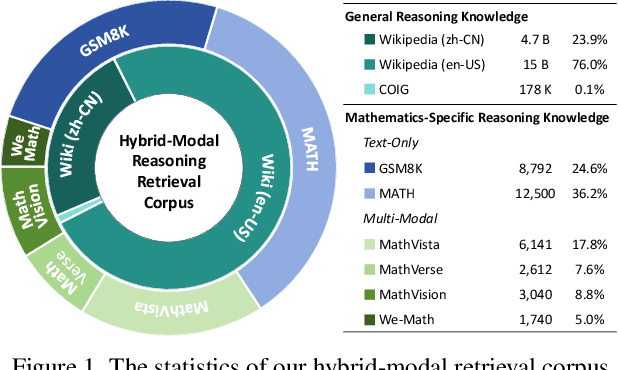
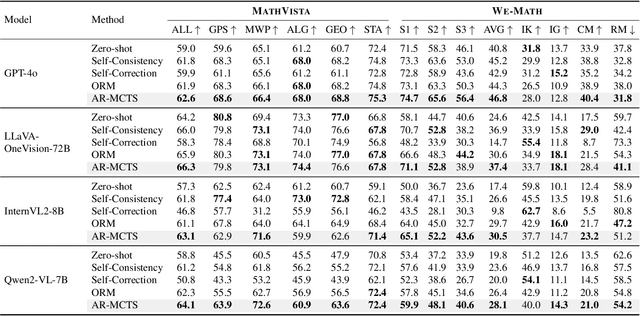


Multi-step multimodal reasoning tasks pose significant challenges for multimodal large language models (MLLMs), and finding effective ways to enhance their performance in such scenarios remains an unresolved issue. In this paper, we propose AR-MCTS, a universal framework designed to progressively improve the reasoning capabilities of MLLMs through Active Retrieval (AR) and Monte Carlo Tree Search (MCTS). Our approach begins with the development of a unified retrieval module that retrieves key supporting insights for solving complex reasoning problems from a hybrid-modal retrieval corpus. To bridge the gap in automated multimodal reasoning verification, we employ the MCTS algorithm combined with an active retrieval mechanism, which enables the automatic generation of step-wise annotations. This strategy dynamically retrieves key insights for each reasoning step, moving beyond traditional beam search sampling to improve the diversity and reliability of the reasoning space. Additionally, we introduce a process reward model that aligns progressively to support the automatic verification of multimodal reasoning tasks. Experimental results across three complex multimodal reasoning benchmarks confirm the effectiveness of the AR-MCTS framework in enhancing the performance of various multimodal models. Further analysis demonstrates that AR-MCTS can optimize sampling diversity and accuracy, yielding reliable multimodal reasoning.
OmniEval: An Omnidirectional and Automatic RAG Evaluation Benchmark in Financial Domain
Dec 17, 2024As a typical and practical application of Large Language Models (LLMs), Retrieval-Augmented Generation (RAG) techniques have gained extensive attention, particularly in vertical domains where LLMs may lack domain-specific knowledge. In this paper, we introduce an omnidirectional and automatic RAG benchmark, OmniEval, in the financial domain. Our benchmark is characterized by its multi-dimensional evaluation framework, including (1) a matrix-based RAG scenario evaluation system that categorizes queries into five task classes and 16 financial topics, leading to a structured assessment of diverse query scenarios; (2) a multi-dimensional evaluation data generation approach, which combines GPT-4-based automatic generation and human annotation, achieving an 87.47\% acceptance ratio in human evaluations on generated instances; (3) a multi-stage evaluation system that evaluates both retrieval and generation performance, result in a comprehensive evaluation on the RAG pipeline; and (4) robust evaluation metrics derived from rule-based and LLM-based ones, enhancing the reliability of assessments through manual annotations and supervised fine-tuning of an LLM evaluator. Our experiments demonstrate the comprehensiveness of OmniEval, which includes extensive test datasets and highlights the performance variations of RAG systems across diverse topics and tasks, revealing significant opportunities for RAG models to improve their capabilities in vertical domains. We open source the code of our benchmark in \href{https://github.com/RUC-NLPIR/OmniEval}{https://github.com/RUC-NLPIR/OmniEval}.
TrendSim: Simulating Trending Topics in Social Media Under Poisoning Attacks with LLM-based Multi-agent System
Dec 14, 2024


Trending topics have become a significant part of modern social media, attracting users to participate in discussions of breaking events. However, they also bring in a new channel for poisoning attacks, resulting in negative impacts on society. Therefore, it is urgent to study this critical problem and develop effective strategies for defense. In this paper, we propose TrendSim, an LLM-based multi-agent system to simulate trending topics in social media under poisoning attacks. Specifically, we create a simulation environment for trending topics that incorporates a time-aware interaction mechanism, centralized message dissemination, and an interactive system. Moreover, we develop LLM-based human-like agents to simulate users in social media, and propose prototype-based attackers to replicate poisoning attacks. Besides, we evaluate TrendSim from multiple aspects to validate its effectiveness. Based on TrendSim, we conduct simulation experiments to study four critical problems about poisoning attacks on trending topics for social benefit.
Imitate, Explore, and Self-Improve: A Reproduction Report on Slow-thinking Reasoning Systems
Dec 12, 2024


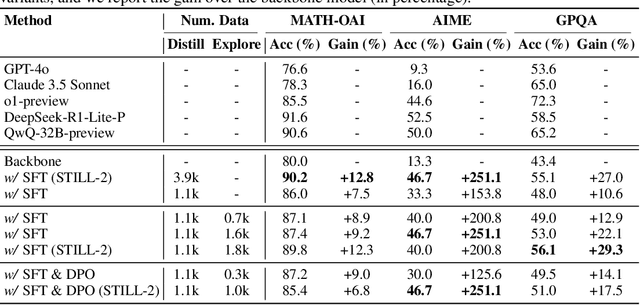
Recently, slow-thinking reasoning systems, such as o1, have demonstrated remarkable capabilities in solving complex reasoning tasks. These systems typically engage in an extended thinking process before responding to a query, allowing them to generate more thorough, accurate, and well-reasoned solutions. These systems are primarily developed and maintained by industry, with their core techniques not publicly disclosed. In response, an increasing number of studies from the research community aim to explore the technical foundations underlying these powerful reasoning systems. Building on these prior efforts, this paper presents a reproduction report on implementing o1-like reasoning systems. We introduce an "imitate, explore, and self-improve" framework as our primary technical approach to train the reasoning model. In the initial phase, we use distilled long-form thought data to fine-tune the reasoning model, enabling it to invoke a slow-thinking mode. The model is then encouraged to explore challenging problems by generating multiple rollouts, which can result in increasingly more high-quality trajectories that lead to correct answers. Furthermore, the model undergoes self-improvement by iteratively refining its training dataset. To verify the effectiveness of this approach, we conduct extensive experiments on three challenging benchmarks. The experimental results demonstrate that our approach achieves competitive performance compared to industry-level reasoning systems on these benchmarks.
CharacterBox: Evaluating the Role-Playing Capabilities of LLMs in Text-Based Virtual Worlds
Dec 07, 2024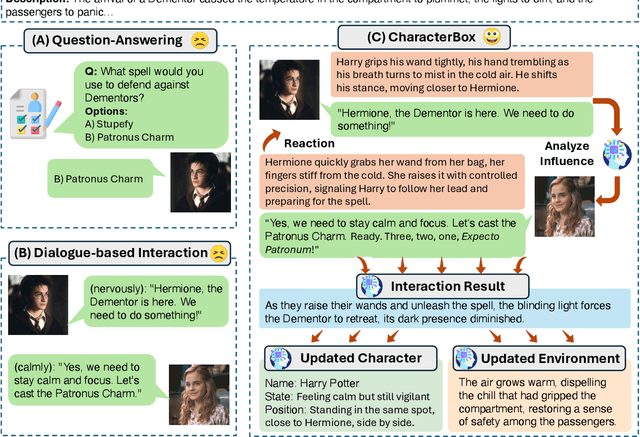
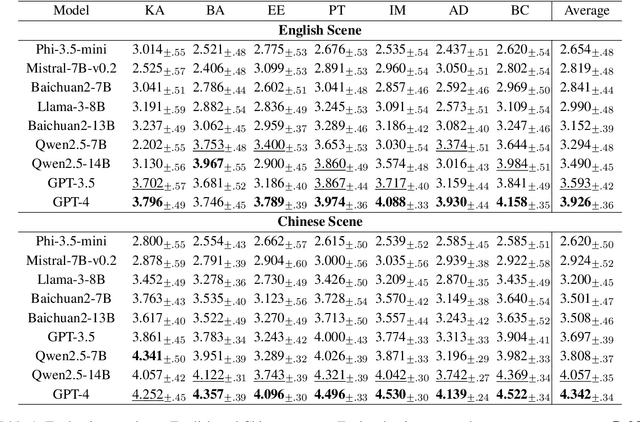
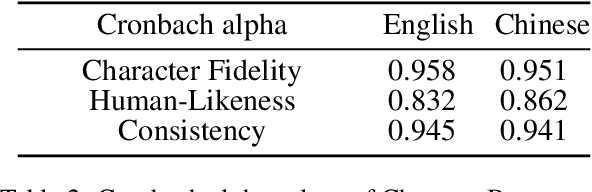
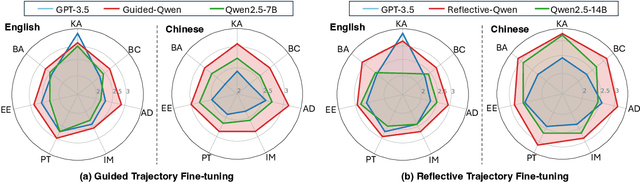
Role-playing is a crucial capability of Large Language Models (LLMs), enabling a wide range of practical applications, including intelligent non-player characters, digital twins, and emotional companions. Evaluating this capability in LLMs is challenging due to the complex dynamics involved in role-playing, such as maintaining character fidelity throughout a storyline and navigating open-ended narratives without a definitive ground truth. Current evaluation methods, which primarily focus on question-answering or conversational snapshots, fall short of adequately capturing the nuanced character traits and behaviors essential for authentic role-playing. In this paper, we propose CharacterBox, which is a simulation sandbox designed to generate situational fine-grained character behavior trajectories. These behavior trajectories enable a more comprehensive and in-depth evaluation of role-playing capabilities. CharacterBox consists of two main components: the character agent and the narrator agent. The character agent, grounded in psychological and behavioral science, exhibits human-like behaviors, while the narrator agent coordinates interactions between character agents and environmental changes. Additionally, we introduce two trajectory-based methods that leverage CharacterBox to enhance LLM performance. To reduce costs and facilitate the adoption of CharacterBox by public communities, we fine-tune two smaller models, CharacterNR and CharacterRM, as substitutes for GPT API calls, and demonstrate their competitive performance compared to advanced GPT APIs.
Uniform Attention Maps: Boosting Image Fidelity in Reconstruction and Editing
Nov 29, 2024


Text-guided image generation and editing using diffusion models have achieved remarkable advancements. Among these, tuning-free methods have gained attention for their ability to perform edits without extensive model adjustments, offering simplicity and efficiency. However, existing tuning-free approaches often struggle with balancing fidelity and editing precision. Reconstruction errors in DDIM Inversion are partly attributed to the cross-attention mechanism in U-Net, which introduces misalignments during the inversion and reconstruction process. To address this, we analyze reconstruction from a structural perspective and propose a novel approach that replaces traditional cross-attention with uniform attention maps, significantly enhancing image reconstruction fidelity. Our method effectively minimizes distortions caused by varying text conditions during noise prediction. To complement this improvement, we introduce an adaptive mask-guided editing technique that integrates seamlessly with our reconstruction approach, ensuring consistency and accuracy in editing tasks. Experimental results demonstrate that our approach not only excels in achieving high-fidelity image reconstruction but also performs robustly in real image composition and editing scenarios. This study underscores the potential of uniform attention maps to enhance the fidelity and versatility of diffusion-based image processing methods. Code is available at https://github.com/Mowenyii/Uniform-Attention-Maps.
Technical Report: Enhancing LLM Reasoning with Reward-guided Tree Search
Nov 18, 2024

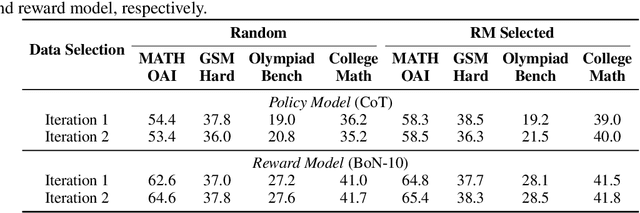

Recently, test-time scaling has garnered significant attention from the research community, largely due to the substantial advancements of the o1 model released by OpenAI. By allocating more computational resources during the inference phase, large language models~(LLMs) can extensively explore the solution space by generating more thought tokens or diverse solutions, thereby producing more accurate responses. However, developing an o1-like reasoning approach is challenging, and researchers have been making various attempts to advance this open area of research. In this paper, we present a preliminary exploration into enhancing the reasoning abilities of LLMs through reward-guided tree search algorithms. This framework is implemented by integrating the policy model, reward model, and search algorithm. It is primarily constructed around a tree search algorithm, where the policy model navigates a dynamically expanding tree guided by a specially trained reward model. We thoroughly explore various design considerations necessary for implementing this framework and provide a detailed report of the technical aspects. To assess the effectiveness of our approach, we focus on mathematical reasoning tasks and conduct extensive evaluations on four challenging datasets, significantly enhancing the reasoning abilities of LLMs.
Self-Calibrated Listwise Reranking with Large Language Models
Nov 07, 2024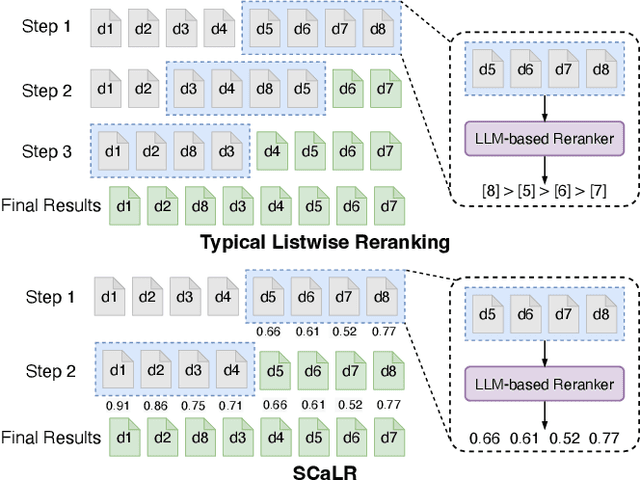
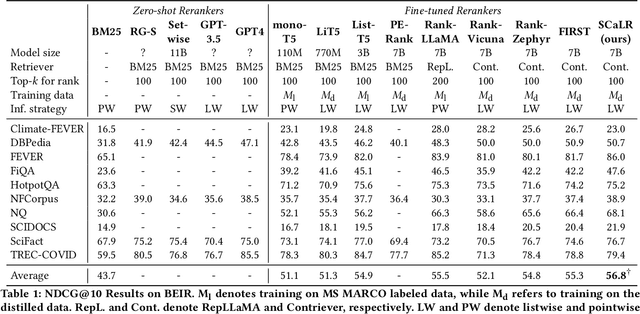
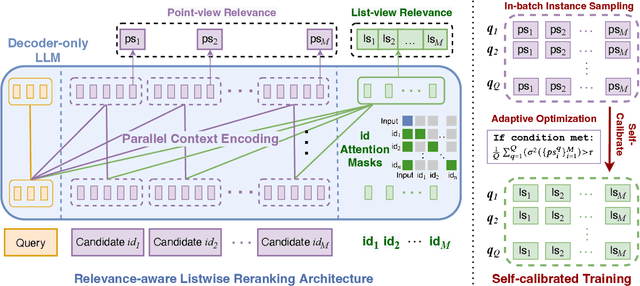

Large language models (LLMs), with advanced linguistic capabilities, have been employed in reranking tasks through a sequence-to-sequence approach. In this paradigm, multiple passages are reranked in a listwise manner and a textual reranked permutation is generated. However, due to the limited context window of LLMs, this reranking paradigm requires a sliding window strategy to iteratively handle larger candidate sets. This not only increases computational costs but also restricts the LLM from fully capturing all the comparison information for all candidates. To address these challenges, we propose a novel self-calibrated listwise reranking method, which aims to leverage LLMs to produce global relevance scores for ranking. To achieve it, we first propose the relevance-aware listwise reranking framework, which incorporates explicit list-view relevance scores to improve reranking efficiency and enable global comparison across the entire candidate set. Second, to ensure the comparability of the computed scores, we propose self-calibrated training that uses point-view relevance assessments generated internally by the LLM itself to calibrate the list-view relevance assessments. Extensive experiments and comprehensive analysis on the BEIR benchmark and TREC Deep Learning Tracks demonstrate the effectiveness and efficiency of our proposed method.