 Add to Chrome
 Add to Firefox
 Add to Edge
Bridging the Sim-to-Real Gap with Dynamic Compliance Tuning for Industrial Insertion
Nov 13, 2023
Contact-rich manipulation tasks often exhibit a large sim-to-real gap. For instance, industrial assembly tasks frequently involve tight insertions where the clearance is less than \(0.1\) mm and can even be negative when dealing with a deformable receptacle. This narrow clearance leads to complex contact dynamics that are difficult to model accurately in simulation, making it challenging to transfer simulation-learned policies to real-world robots. In this paper, we propose a novel framework for robustly learning manipulation skills for real-world tasks using only the simulated data. Our framework consists of two main components: the ``Force Planner'' and the ``Gain Tuner''. The Force Planner is responsible for planning both the robot motion and desired contact forces, while the Gain Tuner dynamically adjusts the compliance control gains to accurately track the desired contact forces during task execution. The key insight of this work is that by adaptively adjusting the robot's compliance control gains during task execution, we can modulate contact forces in the new environment, thereby generating trajectories similar to those trained in simulation and narrows the sim-to-real gap. Experimental results show that our method, trained in simulation on a generic square peg-and-hole task, can generalize to a variety of real-world insertion tasks involving narrow or even negative clearances, all without requiring any fine-tuning.

PDF: Point Diffusion Implicit Function for Large-scale Scene Neural Representation
Nov 03, 2023Recent advances in implicit neural representations have achieved impressive results by sampling and fusing individual points along sampling rays in the sampling space. However, due to the explosively growing sampling space, finely representing and synthesizing detailed textures remains a challenge for unbounded large-scale outdoor scenes. To alleviate the dilemma of using individual points to perceive the entire colossal space, we explore learning the surface distribution of the scene to provide structural priors and reduce the samplable space and propose a Point Diffusion implicit Function, PDF, for large-scale scene neural representation. The core of our method is a large-scale point cloud super-resolution diffusion module that enhances the sparse point cloud reconstructed from several training images into a dense point cloud as an explicit prior. Then in the rendering stage, only sampling points with prior points within the sampling radius are retained. That is, the sampling space is reduced from the unbounded space to the scene surface. Meanwhile, to fill in the background of the scene that cannot be provided by point clouds, the region sampling based on Mip-NeRF 360 is employed to model the background representation. Expensive experiments have demonstrated the effectiveness of our method for large-scale scene novel view synthesis, which outperforms relevant state-of-the-art baselines.
Towards Lossless Dataset Distillation via Difficulty-Aligned Trajectory Matching
Oct 09, 2023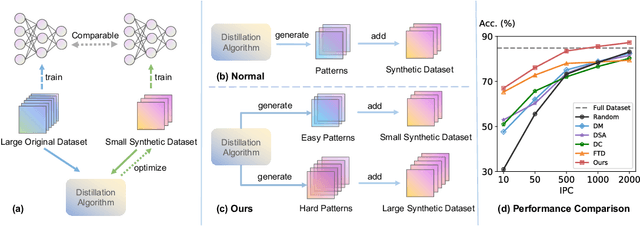
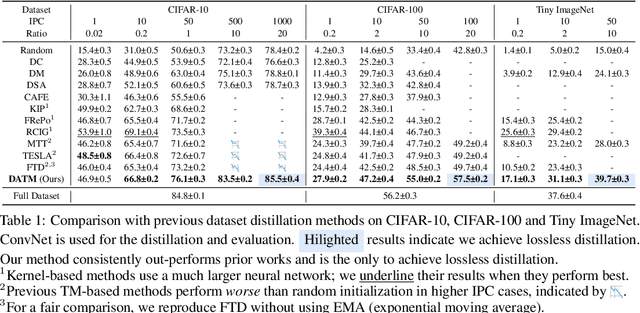
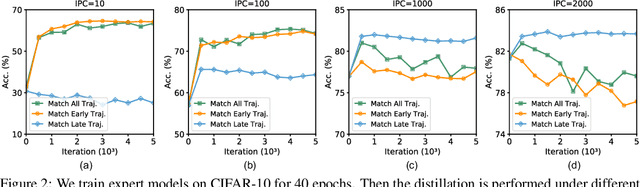

The ultimate goal of Dataset Distillation is to synthesize a small synthetic dataset such that a model trained on this synthetic set will perform equally well as a model trained on the full, real dataset. Until now, no method of Dataset Distillation has reached this completely lossless goal, in part due to the fact that previous methods only remain effective when the total number of synthetic samples is extremely small. Since only so much information can be contained in such a small number of samples, it seems that to achieve truly loss dataset distillation, we must develop a distillation method that remains effective as the size of the synthetic dataset grows. In this work, we present such an algorithm and elucidate why existing methods fail to generate larger, high-quality synthetic sets. Current state-of-the-art methods rely on trajectory-matching, or optimizing the synthetic data to induce similar long-term training dynamics as the real data. We empirically find that the training stage of the trajectories we choose to match (i.e., early or late) greatly affects the effectiveness of the distilled dataset. Specifically, early trajectories (where the teacher network learns easy patterns) work well for a low-cardinality synthetic set since there are fewer examples wherein to distribute the necessary information. Conversely, late trajectories (where the teacher network learns hard patterns) provide better signals for larger synthetic sets since there are now enough samples to represent the necessary complex patterns. Based on our findings, we propose to align the difficulty of the generated patterns with the size of the synthetic dataset. In doing so, we successfully scale trajectory matching-based methods to larger synthetic datasets, achieving lossless dataset distillation for the very first time. Code and distilled datasets are available at https://gzyaftermath.github.io/DATM.
ASAP: Automated Sequence Planning for Complex Robotic Assembly with Physical Feasibility
Sep 29, 2023The automated assembly of complex products requires a system that can automatically plan a physically feasible sequence of actions for assembling many parts together. In this paper, we present ASAP, a physics-based planning approach for automatically generating such a sequence for general-shaped assemblies. ASAP accounts for gravity to design a sequence where each sub-assembly is physically stable with a limited number of parts being held and a support surface. We apply efficient tree search algorithms to reduce the combinatorial complexity of determining such an assembly sequence. The search can be guided by either geometric heuristics or graph neural networks trained on data with simulation labels. Finally, we show the superior performance of ASAP at generating physically realistic assembly sequence plans on a large dataset of hundreds of complex product assemblies. We further demonstrate the applicability of ASAP on both simulation and real-world robotic setups. Project website: asap.csail.mit.edu
Innovative Digital Storytelling with AIGC: Exploration and Discussion of Recent Advances
Sep 28, 2023Digital storytelling, as an art form, has struggled with cost-quality balance. The emergence of AI-generated Content (AIGC) is considered as a potential solution for efficient digital storytelling production. However, the specific form, effects, and impacts of this fusion remain unclear, leaving the boundaries of AIGC combined with storytelling undefined. This work explores the current integration state of AIGC and digital storytelling, investigates the artistic value of their fusion in a sample project, and addresses common issues through interviews. Through our study, we conclude that AIGC, while proficient in image creation, voiceover production, and music composition, falls short of replacing humans due to the irreplaceable elements of human creativity and aesthetic sensibilities at present, especially in complex character animations, facial expressions, and sound effects. The research objective is to increase public awareness of the current state, limitations, and challenges arising from combining AIGC and digital storytelling.
RBFormer: Improve Adversarial Robustness of Transformer by Robust Bias
Sep 23, 2023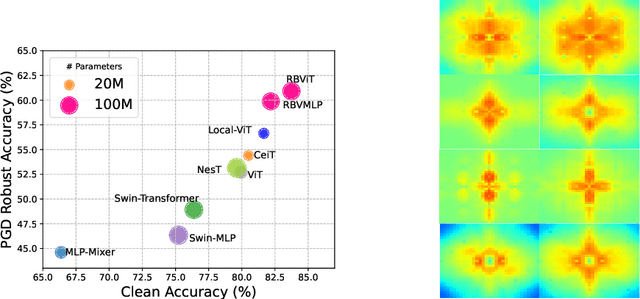
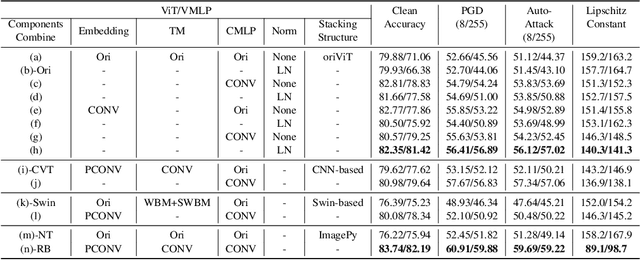
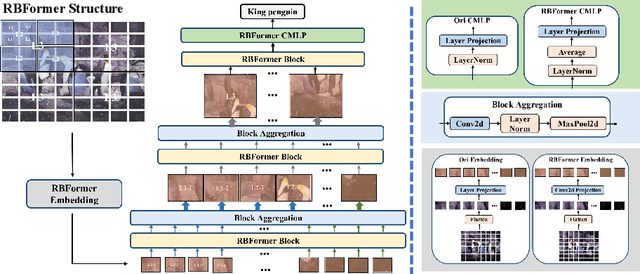
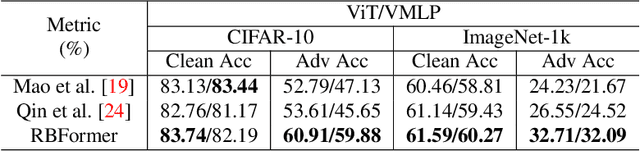
Recently, there has been a surge of interest and attention in Transformer-based structures, such as Vision Transformer (ViT) and Vision Multilayer Perceptron (VMLP). Compared with the previous convolution-based structures, the Transformer-based structure under investigation showcases a comparable or superior performance under its distinctive attention-based input token mixer strategy. Introducing adversarial examples as a robustness consideration has had a profound and detrimental impact on the performance of well-established convolution-based structures. This inherent vulnerability to adversarial attacks has also been demonstrated in Transformer-based structures. In this paper, our emphasis lies on investigating the intrinsic robustness of the structure rather than introducing novel defense measures against adversarial attacks. To address the susceptibility to robustness issues, we employ a rational structure design approach to mitigate such vulnerabilities. Specifically, we enhance the adversarial robustness of the structure by increasing the proportion of high-frequency structural robust biases. As a result, we introduce a novel structure called Robust Bias Transformer-based Structure (RBFormer) that shows robust superiority compared to several existing baseline structures. Through a series of extensive experiments, RBFormer outperforms the original structures by a significant margin, achieving an impressive improvement of +16.12% and +5.04% across different evaluation criteria on CIFAR-10 and ImageNet-1k, respectively.
M3PS: End-to-End Multi-Grained Multi-Modal Attribute-Aware Product Summarization in E-commerce
Aug 22, 2023Given the long textual product information and the product image, Multi-Modal Product Summarization (MMPS) aims to attract customers' interest and increase their desire to purchase by highlighting product characteristics with a short textual summary. Existing MMPS methods have achieved promising performance. Nevertheless, there still exist several problems: 1) lack end-to-end product summarization, 2) lack multi-grained multi-modal modeling, and 3) lack multi-modal attribute modeling. To address these issues, we propose an end-to-end multi-grained multi-modal attribute-aware product summarization method (M3PS) for generating high-quality product summaries in e-commerce. M3PS jointly models product attributes and generates product summaries. Meanwhile, we design several multi-grained multi-modal tasks to better guide the multi-modal learning of M3PS. Furthermore, we model product attributes based on both text and image modalities so that multi-modal product characteristics can be manifested in the generated summaries. Extensive experiments on a real large-scale Chinese e-commence dataset demonstrate that our model outperforms state-of-the-art product summarization methods w.r.t. several summarization metrics.
Single-User Injection for Invisible Shilling Attack against Recommender Systems
Aug 21, 2023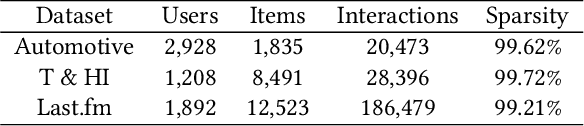
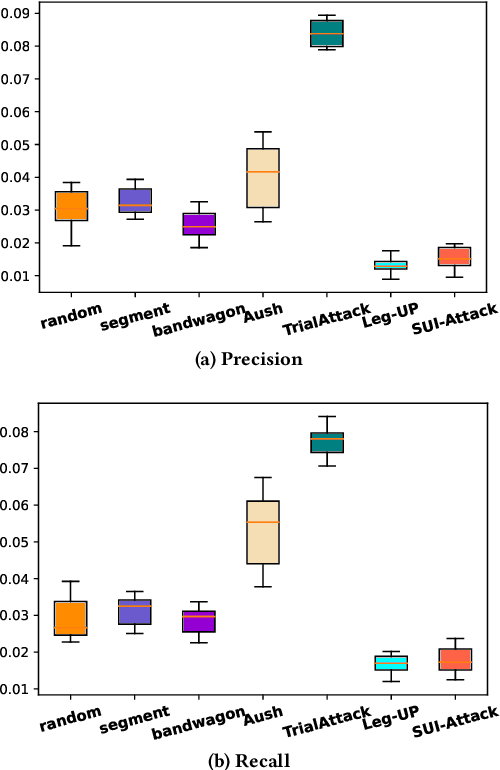
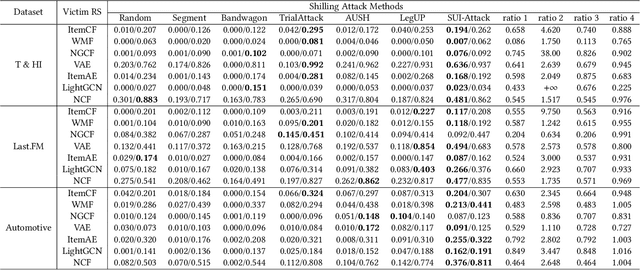
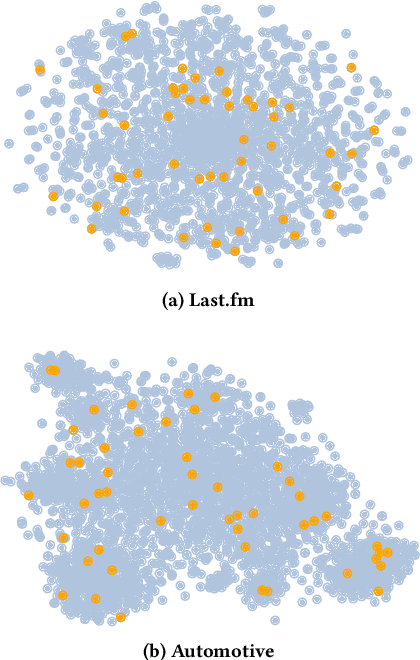
Recommendation systems (RS) are crucial for alleviating the information overload problem. Due to its pivotal role in guiding users to make decisions, unscrupulous parties are lured to launch attacks against RS to affect the decisions of normal users and gain illegal profits. Among various types of attacks, shilling attack is one of the most subsistent and profitable attacks. In shilling attack, an adversarial party injects a number of well-designed fake user profiles into the system to mislead RS so that the attack goal can be achieved. Although existing shilling attack methods have achieved promising results, they all adopt the attack paradigm of multi-user injection, where some fake user profiles are required. This paper provides the first study of shilling attack in an extremely limited scenario: only one fake user profile is injected into the victim RS to launch shilling attacks (i.e., single-user injection). We propose a novel single-user injection method SUI-Attack for invisible shilling attack. SUI-Attack is a graph based attack method that models shilling attack as a node generation task over the user-item bipartite graph of the victim RS, and it constructs the fake user profile by generating user features and edges that link the fake user to items. Extensive experiments demonstrate that SUI-Attack can achieve promising attack results in single-user injection. In addition to its attack power, SUI-Attack increases the stealthiness of shilling attack and reduces the risk of being detected. We provide our implementation at: https://github.com/KDEGroup/SUI-Attack.
Knowledge Prompt-tuning for Sequential Recommendation
Aug 14, 2023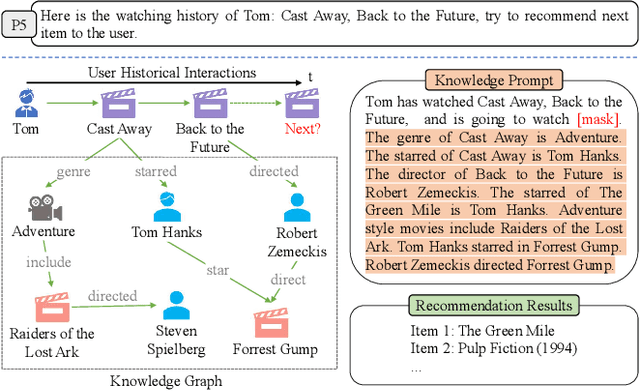
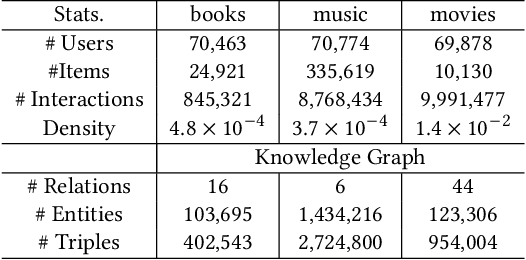
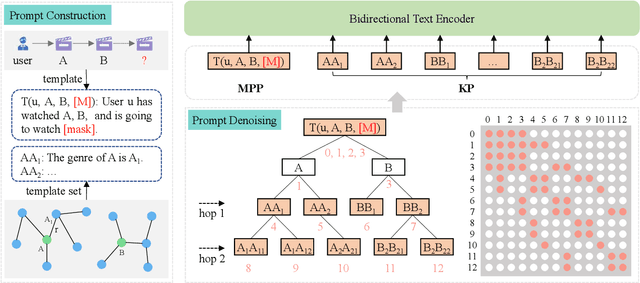
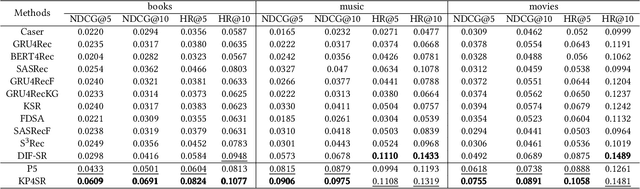
Pre-trained language models (PLMs) have demonstrated strong performance in sequential recommendation (SR), which are utilized to extract general knowledge. However, existing methods still lack domain knowledge and struggle to capture users' fine-grained preferences. Meanwhile, many traditional SR methods improve this issue by integrating side information while suffering from information loss. To summarize, we believe that a good recommendation system should utilize both general and domain knowledge simultaneously. Therefore, we introduce an external knowledge base and propose Knowledge Prompt-tuning for Sequential Recommendation (\textbf{KP4SR}). Specifically, we construct a set of relationship templates and transform a structured knowledge graph (KG) into knowledge prompts to solve the problem of the semantic gap. However, knowledge prompts disrupt the original data structure and introduce a significant amount of noise. We further construct a knowledge tree and propose a knowledge tree mask, which restores the data structure in a mask matrix form, thus mitigating the noise problem. We evaluate KP4SR on three real-world datasets, and experimental results show that our approach outperforms state-of-the-art methods on multiple evaluation metrics. Specifically, compared with PLM-based methods, our method improves NDCG@5 and HR@5 by \textcolor{red}{40.65\%} and \textcolor{red}{36.42\%} on the books dataset, \textcolor{red}{11.17\%} and \textcolor{red}{11.47\%} on the music dataset, and \textcolor{red}{22.17\%} and \textcolor{red}{19.14\%} on the movies dataset, respectively. Our code is publicly available at the link: \href{https://github.com/zhaijianyang/KP4SR}{\textcolor{blue}{https://github.com/zhaijianyang/KP4SR}.}
DeRisk: An Effective Deep Learning Framework for Credit Risk Prediction over Real-World Financial Data
Aug 07, 2023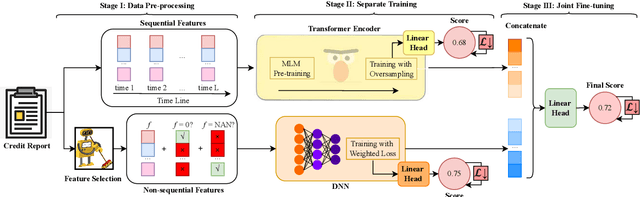
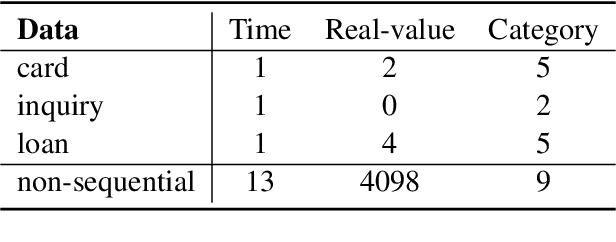
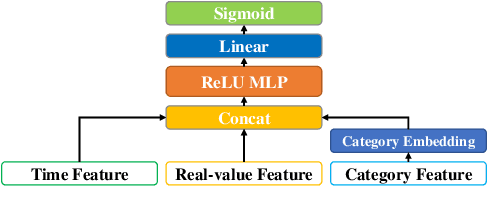
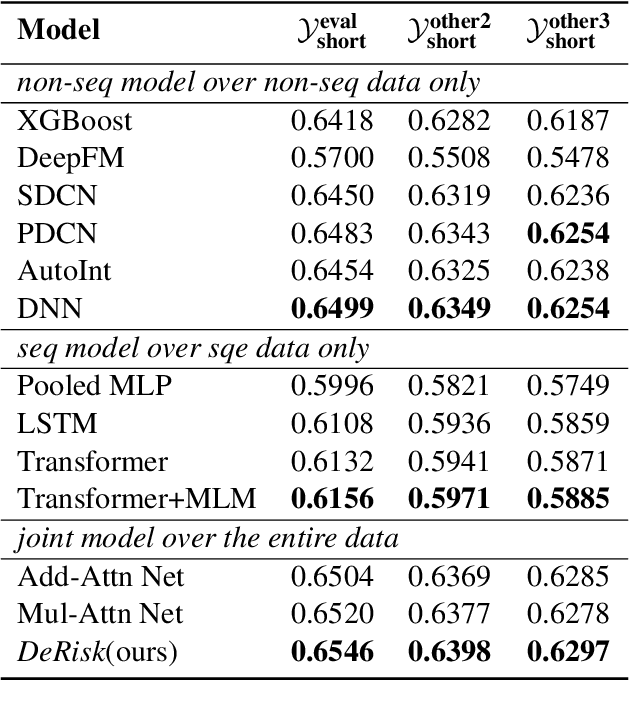
Despite the tremendous advances achieved over the past years by deep learning techniques, the latest risk prediction models for industrial applications still rely on highly handtuned stage-wised statistical learning tools, such as gradient boosting and random forest methods. Different from images or languages, real-world financial data are high-dimensional, sparse, noisy and extremely imbalanced, which makes deep neural network models particularly challenging to train and fragile in practice. In this work, we propose DeRisk, an effective deep learning risk prediction framework for credit risk prediction on real-world financial data. DeRisk is the first deep risk prediction model that outperforms statistical learning approaches deployed in our company's production system. We also perform extensive ablation studies on our method to present the most critical factors for the empirical success of DeRisk.