 Add to Chrome
 Add to Firefox
 Add to Edge
AutoScout: Structured Optimization for Automating ML System Configuration
Mar 12, 2026
Machine learning (ML) systems expose a rapidly expanding configuration space spanning model-parallelism strategies, communication optimizations, and low-level runtime parameters. End-to-end system efficiency is highly sensitive to these choices, yet identifying high-performance configurations is challenging due to heterogeneous feature types (e.g., sparse and dense parameters), conditional dependencies (e.g., valid execution parameters only under specific upstream decisions), and the high search (profiling) cost. Existing approaches either optimize a narrow subset of configuration dimensions or rely on ad-hoc heuristics that fail to generalize as configuration spaces continue to grow. We present AutoScout, a general-purpose systems configurator for ML training, fine-tuning, and inference. It formulates the system configuration as a mixed-discrete/continuous optimization problem with hierarchical dependencies and introduces a hybrid optimization framework that jointly refines sparse structural decisions and dense execution parameters. To reduce profiling cost, AutoScout adaptively prioritizes high-impact configuration features and ensembles simulators with varying fidelity. Across diverse models, hardware platforms, and deployment objectives, AutoScout consistently identifies high-performance configurations, achieving 2.7-3.0$\times$ training speedup over expert-tuned settings.

Real-time distortion prediction in metallic additive manufacturing via a physics-informed neural operator approach
Nov 17, 2025With the development of digital twins and smart manufacturing systems, there is an urgent need for real-time distortion field prediction to control defects in metal Additive Manufacturing (AM). However, numerical simulation methods suffer from high computational cost, long run-times that prevent real-time use, while conventional Machine learning (ML) models struggle to extract spatiotemporal features for long-horizon prediction and fail to decouple thermo-mechanical fields. This paper proposes a Physics-informed Neural Operator (PINO) to predict z and y-direction distortion for the future 15 s. Our method, Physics-informed Deep Operator Network-Recurrent Neural Network (PIDeepONet-RNN) employs trunk and branch network to process temperature history and encode distortion fields, respectively, enabling decoupling of thermo-mechanical responses. By incorporating the heat conduction equation as a soft constraint, the model ensures physical consistency and suppresses unphysical artifacts, thereby establishing a more physically consistent mapping between the thermal history and distortion. This is important because such a basis function, grounded in physical laws, provides a robust and interpretable foundation for predictions. The proposed models are trained and tested using datasets generated from experimentally validated Finite Element Method (FEM). Evaluation shows that the model achieves high accuracy, low error accumulation, time efficiency. The max absolute errors in the z and y-directions are as low as 0.9733 mm and 0.2049 mm, respectively. The error distribution shows high errors in the molten pool but low gradient norms in the deposited and key areas. The performance of PINO surrogate model highlights its potential for real-time long-horizon physics field prediction in controlling defects.
Towards a Flexible and High-Fidelity Approach to Distributed DNN Training Emulation
May 05, 2024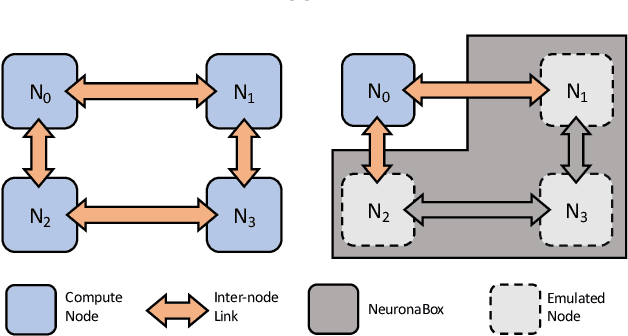
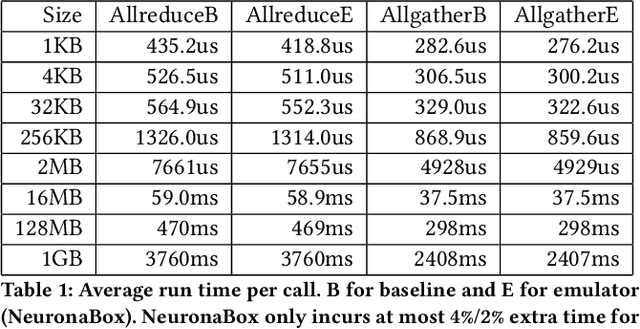
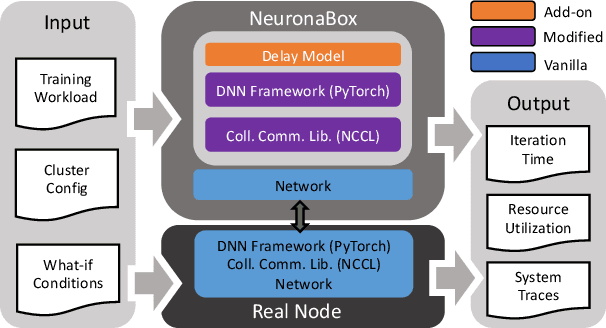
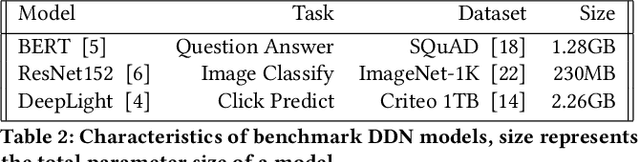
We propose NeuronaBox, a flexible, user-friendly, and high-fidelity approach to emulate DNN training workloads. We argue that to accurately observe performance, it is possible to execute the training workload on a subset of real nodes and emulate the networked execution environment along with the collective communication operations. Initial results from a proof-of-concept implementation show that NeuronaBox replicates the behavior of actual systems with high accuracy, with an error margin of less than 1% between the emulated measurements and the real system.
ClipSAM: CLIP and SAM Collaboration for Zero-Shot Anomaly Segmentation
Jan 29, 2024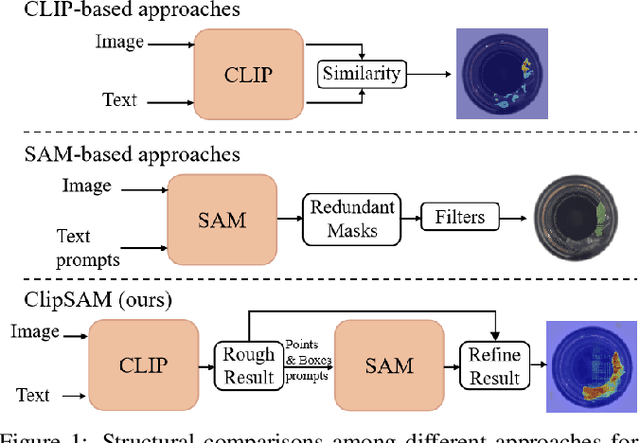
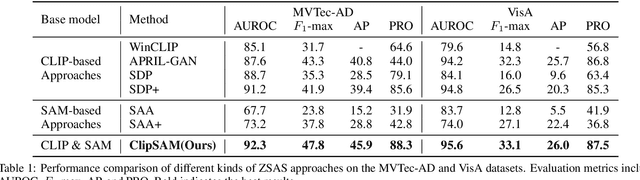

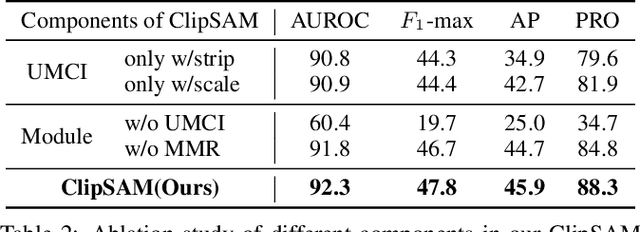
Recently, foundational models such as CLIP and SAM have shown promising performance for the task of Zero-Shot Anomaly Segmentation (ZSAS). However, either CLIP-based or SAM-based ZSAS methods still suffer from non-negligible key drawbacks: 1) CLIP primarily focuses on global feature alignment across different inputs, leading to imprecise segmentation of local anomalous parts; 2) SAM tends to generate numerous redundant masks without proper prompt constraints, resulting in complex post-processing requirements. In this work, we innovatively propose a CLIP and SAM collaboration framework called ClipSAM for ZSAS. The insight behind ClipSAM is to employ CLIP's semantic understanding capability for anomaly localization and rough segmentation, which is further used as the prompt constraints for SAM to refine the anomaly segmentation results. In details, we introduce a crucial Unified Multi-scale Cross-modal Interaction (UMCI) module for interacting language with visual features at multiple scales of CLIP to reason anomaly positions. Then, we design a novel Multi-level Mask Refinement (MMR) module, which utilizes the positional information as multi-level prompts for SAM to acquire hierarchical levels of masks and merges them. Extensive experiments validate the effectiveness of our approach, achieving the optimal segmentation performance on the MVTec-AD and VisA datasets.
PDF: Point Diffusion Implicit Function for Large-scale Scene Neural Representation
Nov 03, 2023Recent advances in implicit neural representations have achieved impressive results by sampling and fusing individual points along sampling rays in the sampling space. However, due to the explosively growing sampling space, finely representing and synthesizing detailed textures remains a challenge for unbounded large-scale outdoor scenes. To alleviate the dilemma of using individual points to perceive the entire colossal space, we explore learning the surface distribution of the scene to provide structural priors and reduce the samplable space and propose a Point Diffusion implicit Function, PDF, for large-scale scene neural representation. The core of our method is a large-scale point cloud super-resolution diffusion module that enhances the sparse point cloud reconstructed from several training images into a dense point cloud as an explicit prior. Then in the rendering stage, only sampling points with prior points within the sampling radius are retained. That is, the sampling space is reduced from the unbounded space to the scene surface. Meanwhile, to fill in the background of the scene that cannot be provided by point clouds, the region sampling based on Mip-NeRF 360 is employed to model the background representation. Expensive experiments have demonstrated the effectiveness of our method for large-scale scene novel view synthesis, which outperforms relevant state-of-the-art baselines.