 Add to Chrome
 Add to Firefox
 Add to Edge
New Skills or Sharper Primitives? A Probabilistic Perspective on the Emergence of Reasoning in RLVR
Feb 09, 2026
Whether Reinforcement Learning with Verifiable Rewards (RLVR) endows Large Language Models (LLMs) with new capabilities or merely elicits latent traces remains a central debate. In this work, we align with the former view, proposing a probabilistic framework where capability is defined by instance-level solvability. We hypothesize that the emergence of complex reasoning can be driven by sharpening atomic step probabilities, which enables models to overcome the exponential decay of success rates inherent in multi-step reasoning chains. Utilizing the Algebrarium framework, we train models exclusively on single-step operations and evaluate their performance on unseen multi-step tasks. Our empirical results confirm that: (1) RLVR incentivizes the exploration of previously inaccessible solution paths by amplifying the model's existing skills; (2) composite performance is strictly governed by the joint probability of atomic steps, evidenced by high Pearson correlation coefficients ($ρ\in [0.69, 0.96]$); and (3) RLVR, acting as a global optimizer, can cause specific skills to be sacrificed to maximize aggregate reward. Our work offers a novel explanation for emergent abilities in RLVR, suggesting that the iterative optimization of solvable problems enables models to develop the capabilities to tackle previously unsolvable scenarios.

Characterizing, Evaluating, and Optimizing Complex Reasoning
Feb 09, 2026Large Reasoning Models (LRMs) increasingly rely on reasoning traces with complex internal structures. However, existing work lacks a unified answer to three fundamental questions: (1) what defines high-quality reasoning, (2) how to reliably evaluate long, implicitly structured reasoning traces, and (3) how to use such evaluation signals for reasoning optimization. To address these challenges, we provide a unified perspective. (1) We introduce the ME$^2$ principle to characterize reasoning quality along macro- and micro-level concerning efficiency and effectiveness. (2) Built on this principle, we model reasoning traces as directed acyclic graphs (DAGs) and develop a DAG-based pairwise evaluation method, capturing complex reasoning structures. (3) Based on this method, we construct the TRM-Preference dataset and train a Thinking Reward Model (TRM) to evaluate reasoning quality at scale. Experiments show that thinking rewards serve as an effective optimization signal. At test time, selecting better reasoning leads to better outcomes (up to 19.3% gain), and during RL training, thinking rewards enhance reasoning and performance (up to 3.9% gain) across diverse tasks.
Rebenchmarking Unsupervised Monocular 3D Occupancy Prediction
Feb 06, 2026Inferring the 3D structure from a single image, particularly in occluded regions, remains a fundamental yet unsolved challenge in vision-centric autonomous driving. Existing unsupervised approaches typically train a neural radiance field and treat the network outputs as occupancy probabilities during evaluation, overlooking the inconsistency between training and evaluation protocols. Moreover, the prevalent use of 2D ground truth fails to reveal the inherent ambiguity in occluded regions caused by insufficient geometric constraints. To address these issues, this paper presents a reformulated benchmark for unsupervised monocular 3D occupancy prediction. We first interpret the variables involved in the volume rendering process and identify the most physically consistent representation of the occupancy probability. Building on these analyses, we improve existing evaluation protocols by aligning the newly identified representation with voxel-wise 3D occupancy ground truth, thereby enabling unsupervised methods to be evaluated in a manner consistent with that of supervised approaches. Additionally, to impose explicit constraints in occluded regions, we introduce an occlusion-aware polarization mechanism that incorporates multi-view visual cues to enhance discrimination between occupied and free spaces in these regions. Extensive experiments demonstrate that our approach not only significantly outperforms existing unsupervised approaches but also matches the performance of supervised ones. Our source code and evaluation protocol will be made available upon publication.
DiTS: Multimodal Diffusion Transformers Are Time Series Forecasters
Feb 06, 2026While generative modeling on time series facilitates more capable and flexible probabilistic forecasting, existing generative time series models do not address the multi-dimensional properties of time series data well. The prevalent architecture of Diffusion Transformers (DiT), which relies on simplistic conditioning controls and a single-stream Transformer backbone, tends to underutilize cross-variate dependencies in covariate-aware forecasting. Inspired by Multimodal Diffusion Transformers that integrate textual guidance into video generation, we propose Diffusion Transformers for Time Series (DiTS), a general-purpose architecture that frames endogenous and exogenous variates as distinct modalities. To better capture both inter-variate and intra-variate dependencies, we design a dual-stream Transformer block tailored for time-series data, comprising a Time Attention module for autoregressive modeling along the temporal dimension and a Variate Attention module for cross-variate modeling. Unlike the common approach for images, which flattens 2D token grids into 1D sequences, our design leverages the low-rank property inherent in multivariate dependencies, thereby reducing computational costs. Experiments show that DiTS achieves state-of-the-art performance across benchmarks, regardless of the presence of future exogenous variate observations, demonstrating unique generative forecasting strengths over traditional deterministic deep forecasting models.
Regularized Calibration with Successive Rounding for Post-Training Quantization
Feb 05, 2026Large language models (LLMs) deliver robust performance across diverse applications, yet their deployment often faces challenges due to the memory and latency costs of storing and accessing billions of parameters. Post-training quantization (PTQ) enables efficient inference by mapping pretrained weights to low-bit formats without retraining, but its effectiveness depends critically on both the quantization objective and the rounding procedure used to obtain low-bit weight representations. In this work, we show that interpolating between symmetric and asymmetric calibration acts as a form of regularization that preserves the standard quadratic structure used in PTQ while providing robustness to activation mismatch. Building on this perspective, we derive a simple successive rounding procedure that naturally incorporates asymmetric calibration, as well as a bounded-search extension that allows for an explicit trade-off between quantization quality and the compute cost. Experiments across multiple LLM families, quantization bit-widths, and benchmarks demonstrate that the proposed bounded search based on a regularized asymmetric calibration objective consistently improves perplexity and accuracy over PTQ baselines, while incurring only modest and controllable additional computational cost.
MetaGen: Self-Evolving Roles and Topologies for Multi-Agent LLM Reasoning
Jan 27, 2026Large language models are increasingly deployed as multi-agent systems, where specialized roles communicate and collaborate through structured interactions to solve complex tasks that often exceed the capacity of a single agent. However, most existing systems still rely on a fixed role library and an execution-frozen interaction topology, a rigid design choice that frequently leads to task mismatch, prevents timely adaptation when new evidence emerges during reasoning, and further inflates inference cost. We introduce MetaGen, a training-free framework that adapts both the role space and the collaboration topology at inference time, without updating base model weights. MetaGen generates and rewrites query-conditioned role specifications to maintain a controllable dynamic role pool, then instantiates a constrained execution graph around a minimal backbone. During execution, it iteratively updates role prompts and adjusts structural decisions using lightweight feedback signals. Experiments on code generation and multi-step reasoning benchmarks show that MetaGen improves the accuracy and cost tradeoff over strong multi-agent baselines.
Explainable AI as a Double-Edged Sword in Dermatology: The Impact on Clinicians versus The Public
Dec 14, 2025Artificial intelligence (AI) is increasingly permeating healthcare, from physician assistants to consumer applications. Since AI algorithm's opacity challenges human interaction, explainable AI (XAI) addresses this by providing AI decision-making insight, but evidence suggests XAI can paradoxically induce over-reliance or bias. We present results from two large-scale experiments (623 lay people; 153 primary care physicians, PCPs) combining a fairness-based diagnosis AI model and different XAI explanations to examine how XAI assistance, particularly multimodal large language models (LLMs), influences diagnostic performance. AI assistance balanced across skin tones improved accuracy and reduced diagnostic disparities. However, LLM explanations yielded divergent effects: lay users showed higher automation bias - accuracy boosted when AI was correct, reduced when AI erred - while experienced PCPs remained resilient, benefiting irrespective of AI accuracy. Presenting AI suggestions first also led to worse outcomes when the AI was incorrect for both groups. These findings highlight XAI's varying impact based on expertise and timing, underscoring LLMs as a "double-edged sword" in medical AI and informing future human-AI collaborative system design.
A Vision-Language-Action-Critic Model for Robotic Real-World Reinforcement Learning
Sep 19, 2025Robotic real-world reinforcement learning (RL) with vision-language-action (VLA) models is bottlenecked by sparse, handcrafted rewards and inefficient exploration. We introduce VLAC, a general process reward model built upon InternVL and trained on large scale heterogeneous datasets. Given pairwise observations and a language goal, it outputs dense progress delta and done signal, eliminating task-specific reward engineering, and supports one-shot in-context transfer to unseen tasks and environments. VLAC is trained on vision-language datasets to strengthen perception, dialogic and reasoning capabilities, together with robot and human trajectories data that ground action generation and progress estimation, and additionally strengthened to reject irrelevant prompts as well as detect regression or stagnation by constructing large numbers of negative and semantically mismatched samples. With prompt control, a single VLAC model alternately generating reward and action tokens, unifying critic and policy. Deployed inside an asynchronous real-world RL loop, we layer a graded human-in-the-loop protocol (offline demonstration replay, return and explore, human guided explore) that accelerates exploration and stabilizes early learning. Across four distinct real-world manipulation tasks, VLAC lifts success rates from about 30\% to about 90\% within 200 real-world interaction episodes; incorporating human-in-the-loop interventions yields a further 50% improvement in sample efficiency and achieves up to 100% final success.
Reasoning over Boundaries: Enhancing Specification Alignment via Test-time Delibration
Sep 18, 2025Large language models (LLMs) are increasingly applied in diverse real-world scenarios, each governed by bespoke behavioral and safety specifications (spec) custom-tailored by users or organizations. These spec, categorized into safety-spec and behavioral-spec, vary across scenarios and evolve with changing preferences and requirements. We formalize this challenge as specification alignment, focusing on LLMs' ability to follow dynamic, scenario-specific spec from both behavioral and safety perspectives. To address this challenge, we propose Align3, a lightweight method that employs Test-Time Deliberation (TTD) with hierarchical reflection and revision to reason over the specification boundaries. We further present SpecBench, a unified benchmark for measuring specification alignment, covering 5 scenarios, 103 spec, and 1,500 prompts. Experiments on 15 reasoning and 18 instruct models with several TTD methods, including Self-Refine, TPO, and MoreThink, yield three key findings: (i) test-time deliberation enhances specification alignment; (ii) Align3 advances the safety-helpfulness trade-off frontier with minimal overhead; (iii) SpecBench effectively reveals alignment gaps. These results highlight the potential of test-time deliberation as an effective strategy for reasoning over the real-world specification boundaries.
Synthesizing Sheet Music Problems for Evaluation and Reinforcement Learning
Sep 04, 2025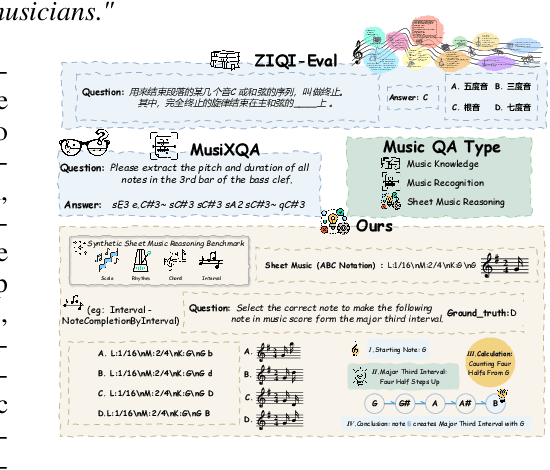
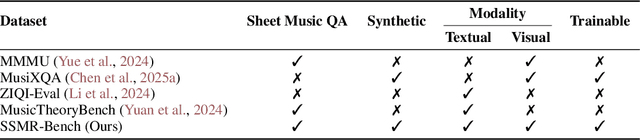
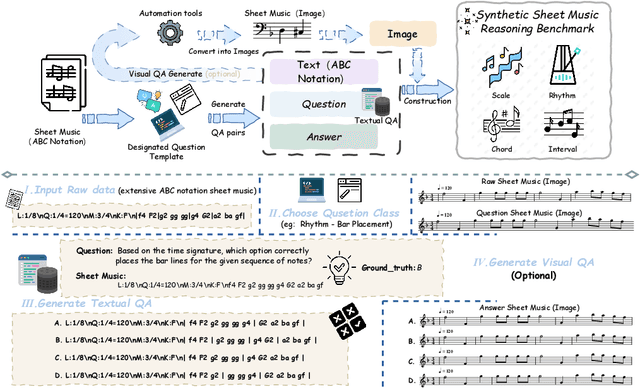
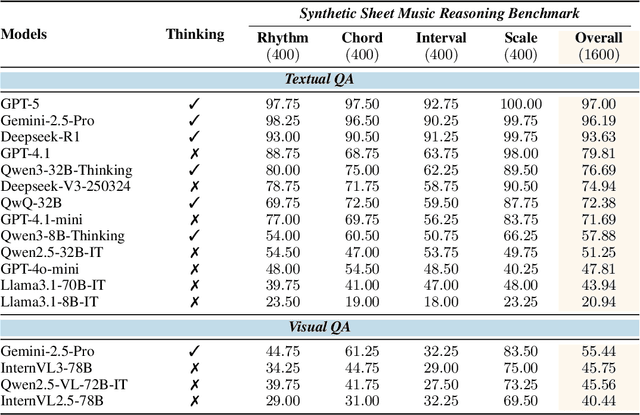
Enhancing the ability of Large Language Models (LLMs) and Multimodal Large Language Models (MLLMs) to interpret sheet music is a crucial step toward building AI musicians. However, current research lacks both evaluation benchmarks and training data for sheet music reasoning. To address this, we propose the idea of synthesizing sheet music problems grounded in music theory, which can serve both as evaluation benchmarks and as training data for reinforcement learning with verifiable rewards (RLVR). We introduce a data synthesis framework that generates verifiable sheet music questions in both textual and visual modalities, leading to the Synthetic Sheet Music Reasoning Benchmark (SSMR-Bench) and a complementary training set. Evaluation results on SSMR-Bench show the importance of models' reasoning abilities in interpreting sheet music. At the same time, the poor performance of Gemini 2.5-Pro highlights the challenges that MLLMs still face in interpreting sheet music in a visual format. By leveraging synthetic data for RLVR, Qwen3-8B-Base and Qwen2.5-VL-Instruct achieve improvements on the SSMR-Bench. Besides, the trained Qwen3-8B-Base surpasses GPT-4 in overall performance on MusicTheoryBench and achieves reasoning performance comparable to GPT-4 with the strategies of Role play and Chain-of-Thought. Notably, its performance on math problems also improves relative to the original Qwen3-8B-Base. Furthermore, our results show that the enhanced reasoning ability can also facilitate music composition. In conclusion, we are the first to propose the idea of synthesizing sheet music problems based on music theory rules, and demonstrate its effectiveness not only in advancing model reasoning for sheet music understanding but also in unlocking new possibilities for AI-assisted music creation.