 Add to Chrome
 Add to Firefox
 Add to Edge
Timer-S1: A Billion-Scale Time Series Foundation Model with Serial Scaling
Mar 05, 2026
We introduce Timer-S1, a strong Mixture-of-Experts (MoE) time series foundation model with 8.3B total parameters, 0.75B activated parameters for each token, and a context length of 11.5K. To overcome the scalability bottleneck in existing pre-trained time series foundation models, we perform Serial Scaling in three dimensions: model architecture, dataset, and training pipeline. Timer-S1 integrates sparse TimeMoE blocks and generic TimeSTP blocks for Serial-Token Prediction (STP), a generic training objective that adheres to the serial nature of forecasting. The proposed paradigm introduces serial computations to improve long-term predictions while avoiding costly rolling-style inference and pronounced error accumulation in the standard next-token prediction. Pursuing a high-quality and unbiased training dataset, we curate TimeBench, a corpus with one trillion time points, and apply meticulous data augmentation to mitigate predictive bias. We further pioneer a post-training stage, including continued pre-training and long-context extension, to enhance short-term and long-context performance. Evaluated on the large-scale GIFT-Eval leaderboard, Timer-S1 achieves state-of-the-art forecasting performance, attaining the best MASE and CRPS scores as a pre-trained model. Timer-S1 will be released to facilitate further research.

DiTS: Multimodal Diffusion Transformers Are Time Series Forecasters
Feb 06, 2026While generative modeling on time series facilitates more capable and flexible probabilistic forecasting, existing generative time series models do not address the multi-dimensional properties of time series data well. The prevalent architecture of Diffusion Transformers (DiT), which relies on simplistic conditioning controls and a single-stream Transformer backbone, tends to underutilize cross-variate dependencies in covariate-aware forecasting. Inspired by Multimodal Diffusion Transformers that integrate textual guidance into video generation, we propose Diffusion Transformers for Time Series (DiTS), a general-purpose architecture that frames endogenous and exogenous variates as distinct modalities. To better capture both inter-variate and intra-variate dependencies, we design a dual-stream Transformer block tailored for time-series data, comprising a Time Attention module for autoregressive modeling along the temporal dimension and a Variate Attention module for cross-variate modeling. Unlike the common approach for images, which flattens 2D token grids into 1D sequences, our design leverages the low-rank property inherent in multivariate dependencies, thereby reducing computational costs. Experiments show that DiTS achieves state-of-the-art performance across benchmarks, regardless of the presence of future exogenous variate observations, demonstrating unique generative forecasting strengths over traditional deterministic deep forecasting models.
CoRA: Covariate-Aware Adaptation of Time Series Foundation Models
Oct 14, 2025Time Series Foundation Models (TSFMs) have shown significant impact through their model capacity, scalability, and zero-shot generalization. However, due to the heterogeneity of inter-variate dependencies and the backbone scalability on large-scale multivariate datasets, most TSFMs are typically pre-trained on univariate time series. This limitation renders them oblivious to crucial information from diverse covariates in real-world forecasting tasks. To further enhance the performance of TSFMs, we propose a general covariate-aware adaptation (CoRA) framework for TSFMs. It leverages pre-trained backbones of foundation models while effectively incorporating exogenous covariates from various modalities, including time series, language, and images, to improve the quality of predictions. Technically, CoRA maintains the equivalence of initialization and parameter consistency during adaptation. With preserved backbones of foundation models as frozen feature extractors, the outcome embeddings from foundation models are empirically demonstrated more informative than raw data. Further, CoRA employs a novel Granger Causality Embedding (GCE) to automatically evaluate covariates regarding their causal predictability with respect to the target variate. We incorporate these weighted embeddings with a zero-initialized condition-injection mechanism, avoiding catastrophic forgetting of pre-trained foundation models and gradually integrates exogenous information. Extensive experiments show that CoRA of TSFMs surpasses state-of-the-art covariate-aware deep forecasters with full or few-shot training samples, achieving 31.1% MSE reduction on covariate-aware forecasting. Compared to other adaptation methods, CoRA exhibits strong compatibility with various advanced TSFMs and extends the scope of covariates to other modalities, presenting a practical paradigm for the application of TSFMs.
TimesBERT: A BERT-Style Foundation Model for Time Series Understanding
Feb 28, 2025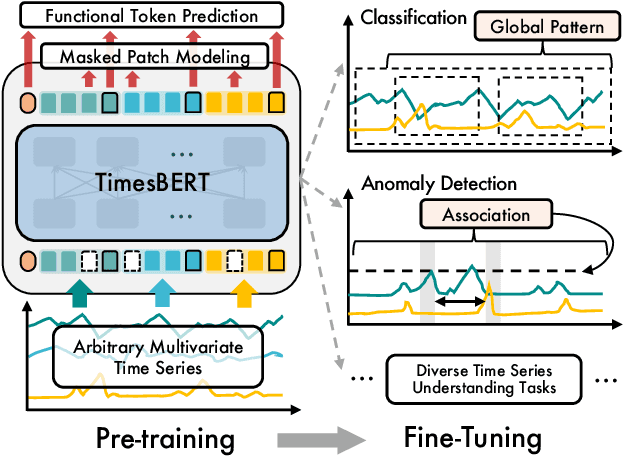

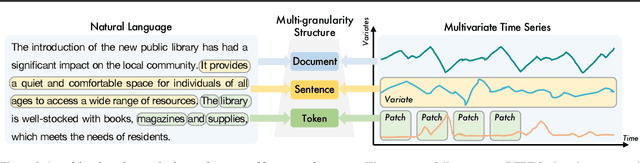
Time series analysis is crucial in diverse scenarios. Beyond forecasting, considerable real-world tasks are categorized into classification, imputation, and anomaly detection, underscoring different capabilities termed time series understanding in this paper. While GPT-style models have been positioned as foundation models for time series forecasting, the BERT-style architecture, which has made significant advances in natural language understanding, has not been fully unlocked for time series understanding, possibly attributed to the undesirable dropout of essential elements of BERT. In this paper, inspired by the shared multi-granularity structure between multivariate time series and multisentence documents, we design TimesBERT to learn generic representations of time series including temporal patterns and variate-centric characteristics. In addition to a natural adaptation of masked modeling, we propose a parallel task of functional token prediction to embody vital multi-granularity structures. Our model is pre-trained on 260 billion time points across diverse domains. Leveraging multi-granularity representations, TimesBERT achieves state-of-the-art performance across four typical downstream understanding tasks, outperforming task-specific models and language pre-trained backbones, positioning it as a versatile foundation model for time series understanding.