 Add to Chrome
 Add to Firefox
 Add to Edge
EGM-Det: Entropy-Guided Multimodal Adaptive Fusion for UAV RGB-IR Object Detection
Aug 12, 2026
Joint use of RGB and infrared (IR) imagery can improve UAV-view object detection, but most existing methods fuse multimodal features with static or fixed weights and therefore overlook spatially varying modality reliability. We propose EGM-Det, an entropy-guided multimodal adaptive fusion framework for RGB-IR object detection. EGM-Det employs a dual-stream architecture to preserve modality-specific representations and introduces an Entropy Offset Gate Fusion module for adaptive multi-scale fusion. The module derives shallow entropy priors from input intensity, local entropy, and cross-modal discrepancy, and uses them to guide local offset alignment and spatial-channel gated fusion. It therefore selectively aggregates reliable RGB and infrared cues instead of uniformly combining heterogeneous features. We further introduce cross-modal distillation to regularize the learned fusion gates and reduce fusion degradation. Each student branch extracts complementary knowledge from the cross-modality teacher branch matched to the main branch, while entropy-adaptive supervision emphasizes uncertain modality decisions. Experiments on DroneVehicle, LLVIP, and VEDAI demonstrate state-of-the-art performance across all three benchmarks; in particular, EGM-Det outperforms prior approaches by more than 10 percentage points on VEDAI.

When Vision Becomes Text: Visual Token Pruning via Cross-Modal Residual Guidance in VLMs
Aug 11, 2026Abundant visual information strengthens vision-language model (VLM) perception, yet massive visual tokens raise inference costs. Existing visual token pruning methods rely on similarity-based guidance, which exploits pairwise text-vision and vision-vision token correlations for compression. However, such methods only capture local layer-level signals and overlook the whole inference process in VLM. In this paper, we revisit VLM inference and present a new efficient guidance scheme that complements similarity-based guidance. In particular, we identify a key observation: as LLM layers deepen, text tokens continuously aggregate visual information via self-attention and progressively absorb partial visual content into textual representations. To quantify this phenomenon, we propose Cross Modal Absorption (CMA) from a geometric representation perspective to measure how much visual information is absorbed by text, revealing that more visual tokens in deeper layers can be approximately explained by the text subspace. We accordingly propose Cross Modal Residual (CMR). It projects visual tokens onto the text subspace via Tikhonov regularized least squares and exploits reconstruction residuals to quantify visual information that cannot be explained by text. Finally, based on CMR, we present SIEVE, a training-free visual token compression method that combines CMR, text-attention relevance, and residual-space diversity to retain task-relevant and complementary tokens. Experiments on diverse VLM architectures verify the effectiveness of SIEVE. For instance, on LLaVA-NeXT-7B, SIEVE keeps only $11.1\%$ of visual tokens while preserving $97.5\%$ of the original average performance, achieving $3.62\times$ prefill speedup, $2.49\times$ end-to-end speedup, and a $6.02\times$ KV-cache reduction.
DVANet: Degradation-aware Visual-prior Alignment Network for Image Restoration
Jun 17, 2026All-in-One image restoration aims to develop a unified restoration framework for handling diverse degradation types. Existing end-to-end methods usually regard the restoration process as a black-box mapping, lacking an explicit optimization interpretation. Although deep unfolding provides an interpretable iterative modeling paradigm for image restoration, existing methods mostly rely on fixed degradation assumptions or predefined degradation information, making them difficult to adapt to unified restoration requirements under complex degradations and locally damaged content. This limitation restricts their performance in degradation suppression and structural detail recovery. To address these issues, this paper proposes DVANet, a deep unfolding network inspired by the half-quadratic splitting optimization algorithm, which formulates unified image restoration under complex degradations as a collaborative unfolding process between degradation-aware observation consistency and visual-prior-guided reconstruction. Specifically, in the degradation-aware observation consistency branch, a degradation representation module is employed to extract global degradation attributes and local degradation cues, and degradation-conditioned mapping is used to enhance the model's adaptability to different degradation types. In the visual-prior-guided reconstruction branch, DINOv3 is introduced to provide structural and semantic information as hierarchical visual priors, thereby complementing the missing structural information in damaged regions and improving detail recovery. Extensive experiments demonstrate that DVANet achieves superior or competitive performance on multi-scenario degradation and cross-domain image restoration tasks, showing favorable degradation adaptability and generalization ability.
M$^2$: Dual-Memory Augmentation for Long-Horizon Web Agents via Trajectory Summarization and Insight Retrieval
Feb 28, 2026Multimodal Large Language Models (MLLMs) based agents have demonstrated remarkable potential in autonomous web navigation. However, handling long-horizon tasks remains a critical bottleneck. Prevailing strategies often rely heavily on extensive data collection and model training, yet still struggle with high computational costs and insufficient reasoning capabilities when facing complex, long-horizon scenarios. To address this, we propose M$^2$, a training-free, memory-augmented framework designed to optimize context efficiency and decision-making robustness. Our approach incorporates a dual-tier memory mechanism that synergizes Dynamic Trajectory Summarization (Internal Memory) to compress verbose interaction history into concise state updates, and Insight Retrieval Augmentation (External Memory) to guide the agent with actionable guidelines retrieved from an offline insight bank. Extensive evaluations across WebVoyager and OnlineMind2Web demonstrate that M$^2$ consistently surpasses baselines, yielding up to a 19.6% success rate increase and 58.7% token reduction for Qwen3-VL-32B, while proprietary models like Claude achieve accuracy gains up to 12.5% alongside significantly lower computational overhead.
Rethinking Practical and Efficient Quantization Calibration for Vision-Language Models
Feb 08, 2026Post-training quantization (PTQ) is a primary approach for deploying large language models without fine-tuning, and the quantized performance is often strongly affected by the calibration in PTQ. By contrast, in vision-language models (VLMs), substantial differences between visual and text tokens in their activation distributions and sensitivities to quantization error pose significant challenges for effective calibration during PTQ. In this work, we rethink what PTQ calibration should align with in VLMs and propose the Token-level Importance-aware Layer-wise Quantization framework (TLQ). Guided by gradient information, we design a token-level importance integration mechanism for quantization error, and use it to construct a token-level calibration set, enabling a more fine-grained calibration strategy. Furthermore, TLQ introduces a multi-GPU, quantization-exposed layer-wise calibration scheme. This scheme keeps the layer-wise calibration procedure consistent with the true quantized inference path and distributes the complex layer-wise calibration workload across multiple RTX3090 GPUs, thereby reducing reliance on the large memory of A100 GPUs. TLQ is evaluated across two models, three model scales, and two quantization settings, consistently achieving performance improvements across all settings, indicating its strong quantization stability. The code will be released publicly.
Open-Text Aerial Detection: A Unified Framework For Aerial Visual Grounding And Detection
Feb 08, 2026Open-Vocabulary Aerial Detection (OVAD) and Remote Sensing Visual Grounding (RSVG) have emerged as two key paradigms for aerial scene understanding. However, each paradigm suffers from inherent limitations when operating in isolation: OVAD is restricted to coarse category-level semantics, while RSVG is structurally limited to single-target localization. These limitations prevent existing methods from simultaneously supporting rich semantic understanding and multi-target detection. To address this, we propose OTA-Det, the first unified framework that bridges both paradigms into a cohesive architecture. Specifically, we introduce a task reformulation strategy that unifies task objectives and supervision mechanisms, enabling joint training across datasets from both paradigms with dense supervision signals. Furthermore, we propose a dense semantic alignment strategy that establishes explicit correspondence at multiple granularities, from holistic expressions to individual attributes, enabling fine-grained semantic understanding. To ensure real-time efficiency, OTA-Det builds upon the RT-DETR architecture, extending it from closed-set detection to open-text detection by introducing several high efficient modules, achieving state-of-the-art performance on six benchmarks spanning both OVAD and RSVG tasks while maintaining real-time inference at 34 FPS.
Unlocking Prototype Potential: An Efficient Tuning Framework for Few-Shot Class-Incremental Learning
Feb 05, 2026Few-shot class-incremental learning (FSCIL) seeks to continuously learn new classes from very limited samples while preserving previously acquired knowledge. Traditional methods often utilize a frozen pre-trained feature extractor to generate static class prototypes, which suffer from the inherent representation bias of the backbone. While recent prompt-based tuning methods attempt to adapt the backbone via minimal parameter updates, given the constraint of extreme data scarcity, the model's capacity to assimilate novel information and substantively enhance its global discriminative power is inherently limited. In this paper, we propose a novel shift in perspective: freezing the feature extractor while fine-tuning the prototypes. We argue that the primary challenge in FSCIL is not feature acquisition, but rather the optimization of decision regions within a static, high-quality feature space. To this end, we introduce an efficient prototype fine-tuning framework that evolves static centroids into dynamic, learnable components. The framework employs a dual-calibration method consisting of class-specific and task-aware offsets. These components function synergistically to improve the discriminative capacity of prototypes for ongoing incremental classes. Extensive results demonstrate that our method attains superior performance across multiple benchmarks while requiring minimal learnable parameters.
PIO-FVLM: Rethinking Training-Free Visual Token Reduction for VLM Acceleration from an Inference-Objective Perspective
Feb 05, 2026Recently, reducing redundant visual tokens in vision-language models (VLMs) to accelerate VLM inference has emerged as a hot topic. However, most existing methods rely on heuristics constructed based on inter-visual-token similarity or cross-modal visual-text similarity, which gives rise to certain limitations in compression performance and practical deployment. In contrast, we propose PIO-FVLM from the perspective of inference objectives, which transforms visual token compression into preserving output result invariance and selects tokens primarily by their importance to this goal. Specially, vision tokens are reordered with the guidance of token-level gradient saliency generated by our designed layer-local proxy loss, a coarse constraint from the current layer to the final result. Then the most valuable vision tokens are selected following the non-maximum suppression (NMS) principle. The proposed PIO-FVLM is training-free and compatible with FlashAttention, friendly to practical application and deployment. It can be deployed independently as an encoder-free method, or combined with encoder compression approaches like VisionZip for use as an encoder-involved method. On LLaVA-Next-7B, PIO-FVLM retains just 11.1% of visual tokens but maintains 97.2% of the original performance, with a 2.67$\times$ prefill speedup, 2.11$\times$ inference speedup, 6.22$\times$ lower FLOPs, and 6.05$\times$ reduced KV Cache overhead. Our code is available at https://github.com/ocy1/PIO-FVLM.
SALAD-Pan: Sensor-Agnostic Latent Adaptive Diffusion for Pan-Sharpening
Feb 04, 2026Recently, diffusion models bring novel insights for Pan-sharpening and notably boost fusion precision. However, most existing models perform diffusion in the pixel space and train distinct models for different multispectral (MS) imagery, suffering from high latency and sensor-specific limitations. In this paper, we present SALAD-Pan, a sensor-agnostic latent space diffusion method for efficient pansharpening. Specifically, SALAD-Pan trains a band-wise single-channel VAE to encode high-resolution multispectral (HRMS) into compact latent representations, supporting MS images with various channel counts and establishing a basis for acceleration. Then spectral physical properties, along with PAN and MS images, are injected into the diffusion backbone through unidirectional and bidirectional interactive control structures respectively, achieving high-precision fusion in the diffusion process. Finally, a lightweight cross-spectral attention module is added to the central layer of diffusion model, reinforcing spectral connections to boost spectral consistency and further elevate fusion precision. Experimental results on GaoFen-2, QuickBird, and WorldView-3 demonstrate that SALAD-Pan outperforms state-of-the-art diffusion-based methods across all three datasets, attains a 2-3x inference speedup, and exhibits robust zero-shot (cross-sensor) capability.
Teaching Prompts to Coordinate: Hierarchical Layer-Grouped Prompt Tuning for Continual Learning
Nov 15, 2025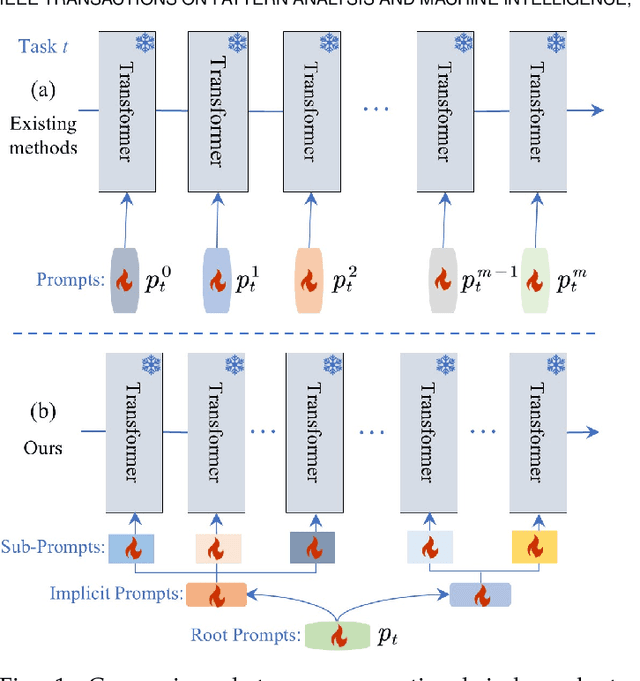
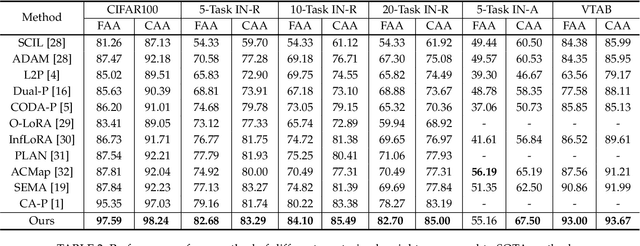
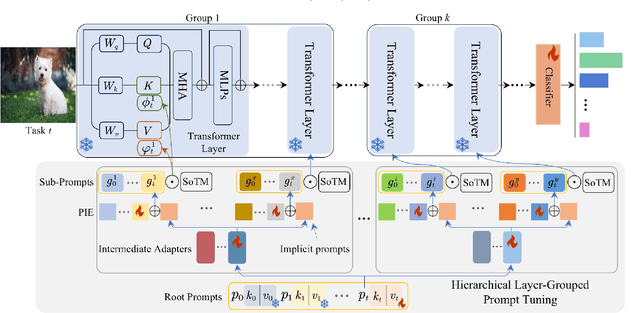
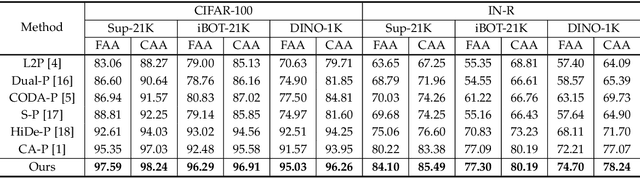
Prompt-based continual learning methods fine-tune only a small set of additional learnable parameters while keeping the pre-trained model's parameters frozen. It enables efficient adaptation to new tasks while mitigating the risk of catastrophic forgetting. These methods typically attach one independent task-specific prompt to each layer of pre-trained models to locally modulate its features, ensuring that the layer's representation aligns with the requirements of the new task. However, although introducing learnable prompts independently at each layer provides high flexibility for adapting to new tasks, this overly flexible tuning could make certain layers susceptible to unnecessary updates. As all prompts till the current task are added together as a final prompt for all seen tasks, the model may easily overwrite feature representations essential to previous tasks, which increases the risk of catastrophic forgetting. To address this issue, we propose a novel hierarchical layer-grouped prompt tuning method for continual learning. It improves model stability in two ways: (i) Layers in the same group share roughly the same prompts, which are adjusted by position encoding. This helps preserve the intrinsic feature relationships and propagation pathways of the pre-trained model within each group. (ii) It utilizes a single task-specific root prompt to learn to generate sub-prompts for each layer group. In this way, all sub-prompts are conditioned on the same root prompt, enhancing their synergy and reducing independence. Extensive experiments across four benchmarks demonstrate that our method achieves favorable performance compared with several state-of-the-art methods.