 Add to Chrome
 Add to Firefox
 Add to Edge
LXD-SLAM: LiDAR+X Dense SLAM with $\sum_{i=0}^{5}C_5^i$ Configurable Sensor Combinations
Jun 26, 2026
Simultaneous Localization and Mapping (SLAM) is essential for autonomous systems, yet achieving reliable, globally consistent pose estimation and dense mapping in complex environments remains challenging due to geometric degeneracy and sensor drift. While multi-sensor fusion addresses these issues, existing systems often lack the modularity to adapt to diverse platforms and rely on mathematically inconsistent fusion or suboptimal map representations. To address these limitations, we propose LXD-SLAM (LiDAR+X Dense SLAM), a highly versatile and unified multi-sensor fusion framework. Centered around 3D LiDAR, our system allows for the plug-and-play integration of LiDAR, Camera, IMU, Wheel Encoder, and GNSS, supporting up to 32 distinct sensor combinations. We employ a mathematically unified Iterative Error-Sate Kalman Filter with an adaptive hierarchical prediction strategy and an update step that minimizes point-to-mesh distances and visual reprojection errors. To support this, the environment is modeled using continuous multi-layered Gaussian Process (GP) sub-meshes, which enables efficient ray-to-mesh depth recovery for visual features. For global consistency, we introduce an Extended Scan Context (ESC) descriptor derived from the GP sub-meshes alongside a Bidirectional PnP optimization for robust multi-modal loop closure within a hybrid pose graph. Extensive evaluations on public datasets and real-world experiments demonstrate that LXD-SLAM matches or exceeds state-of-the-art specialized odometry solutions across various configurations while generating high-fidelity, globally consistent dense meshes in real-time. The relevant codes and data will be made available at https://github.com/peterWon/LXD-SLAM upon publication.

RaysUp: Ultra-light Universal Feature Upsampling via Geometry-Aware Ray Representation
Jun 22, 2026Pre-trained Vision Foundation Models (VFMs) have become central to modern computer vision due to their powerful semantic representations and strong generalization ability. However, their patchified or pooled outputs are inherently low-resolution, limiting their effectiveness in tasks requiring fine-grained, pixel-level reasoning. Existing feature upsampling approaches either degrade semantic fidelity or rely on VFM-specific retraining and heavy architectures, hindering efficiency and scalability. To address these challenges, we propose RaysUp, an ultra-lightweight, task-agnostic, and VFM-agnostic feature upsampling framework that reconstructs high-resolution feature maps at arbitrary resolutions. Unlike conventional 2D interpolation or attention-based schemes, RaysUp lifts feature reconstruction into a geometry-aware ray domain. Specifically, we introduce a Spatially Decoupled Guidance Encoder for direction-aware guidance encoding, an Any-Resolution Cross-Attention mechanism for resolution-flexible reconstruction, and a novel Ray Positional Encoding (RayPE) that injects implicit 3D geometric priors via 6D Plucker ray coordinates. Finally, a Geometry-Aware Neighborhood Attention module further ensures content-adaptive bilateral aggregation while preserving geometric consistency. Extensive experiments across diverse dense prediction tasks demonstrate that RaysUp achieves state-of-the-art performance while using only 16% of the parameters of AnyUp and delivering approximately 7x faster inference. These results highlight a substantially improved accuracy-efficiency trade-off and establish RaysUp as a practical and scalable solution for universal feature upsampling. Code is available at https://github.com/MAP-RaysUp/RaysUp.
GS3LAM: Gaussian Semantic Splatting SLAM
Mar 29, 2026Recently, the multi-modal fusion of RGB, depth, and semantics has shown great potential in dense Simultaneous Localization and Mapping (SLAM). However, a prerequisite for generating consistent semantic maps is the availability of dense, efficient, and scalable scene representations. Existing semantic SLAM systems based on explicit representations are often limited by resolution and an inability to predict unknown areas. Conversely, implicit representations typically rely on time-consuming ray tracing, failing to meet real-time requirements. Fortunately, 3D Gaussian Splatting (3DGS) has emerged as a promising representation that combines the efficiency of point-based methods with the continuity of geometric structures. To this end, we propose GS3LAM, a Gaussian Semantic Splatting SLAM framework that processes multimodal data to render consistent, dense semantic maps in real-time. GS3LAM models the scene as a Semantic Gaussian Field (SG-Field) and jointly optimizes camera poses and the field via multimodal error constraints. Furthermore, a Depth-adaptive Scale Regularization (DSR) scheme is introduced to resolve misalignments between scale-invariant Gaussians and geometric surfaces. To mitigate catastrophic forgetting, we propose a Random Sampling-based Keyframe Mapping (RSKM) strategy, which demonstrates superior performance over common local covisibility optimization methods. Extensive experiments on benchmark datasets show that GS3LAM achieves increased tracking robustness, superior rendering quality, and enhanced semantic precision compared to state-of-the-art methods. Source code is available at https://github.com/lif314/GS3LAM.
RealVLG-R1: A Large-Scale Real-World Visual-Language Grounding Benchmark for Robotic Perception and Manipulation
Mar 16, 2026Visual-language grounding aims to establish semantic correspondences between natural language and visual entities, enabling models to accurately identify and localize target objects based on textual instructions. Existing VLG approaches focus on coarse-grained, object-level localization, while traditional robotic grasping methods rely predominantly on geometric cues and lack language guidance, which limits their applicability in language-driven manipulation scenarios. To address these limitations, we propose the RealVLG framework, which integrates the RealVLG-11B dataset and the RealVLG-R1 model to unify real-world visual-language grounding and grasping tasks. RealVLG-11B dataset provides multi-granularity annotations including bounding boxes, segmentation masks, grasp poses, contact points, and human-verified fine-grained language descriptions, covering approximately 165,000 images, over 800 object instances, 1.3 million segmentation, detection, and language annotations, and roughly 11 billion grasping examples. Building on this dataset, RealVLG-R1 employs Reinforcement Fine-tuning on pretrained large-scale vision-language models to predict bounding boxes, segmentation masks, grasp poses, and contact points in a unified manner given natural language instructions. Experimental results demonstrate that RealVLG supports zero-shot perception and manipulation in real-world unseen environments, establishing a unified semantic-visual multimodal benchmark that provides a comprehensive data and evaluation platform for language-driven robotic perception and grasping policy learning. All data and code are publicly available at https://github.com/lif314/RealVLG-R1.
SmartSplat: Feature-Smart Gaussians for Scalable Compression of Ultra-High-Resolution Images
Dec 23, 2025Recent advances in generative AI have accelerated the production of ultra-high-resolution visual content, posing significant challenges for efficient compression and real-time decoding on end-user devices. Inspired by 3D Gaussian Splatting, recent 2D Gaussian image models improve representation efficiency, yet existing methods struggle to balance compression ratio and reconstruction fidelity in ultra-high-resolution scenarios. To address this issue, we propose SmartSplat, a highly adaptive and feature-aware GS-based image compression framework that supports arbitrary image resolutions and compression ratios. SmartSplat leverages image-aware features such as gradients and color variances, introducing a Gradient-Color Guided Variational Sampling strategy together with an Exclusion-based Uniform Sampling scheme to improve the non-overlapping coverage of Gaussian primitives in pixel space. In addition, we propose a Scale-Adaptive Gaussian Color Sampling method to enhance color initialization across scales. Through joint optimization of spatial layout, scale, and color initialization, SmartSplat efficiently captures both local structures and global textures using a limited number of Gaussians, achieving high reconstruction quality under strong compression. Extensive experiments on DIV8K and a newly constructed 16K dataset demonstrate that SmartSplat consistently outperforms state-of-the-art methods at comparable compression ratios and exceeds their compression limits, showing strong scalability and practical applicability. The code is publicly available at https://github.com/lif314/SmartSplat.
ProgRoCC: A Progressive Approach to Rough Crowd Counting
Apr 18, 2025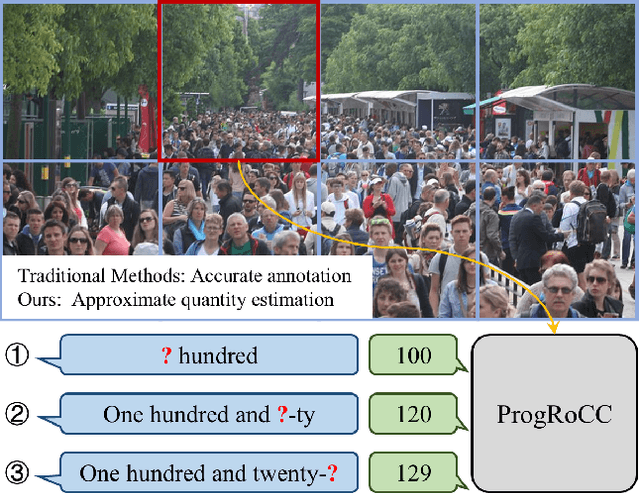
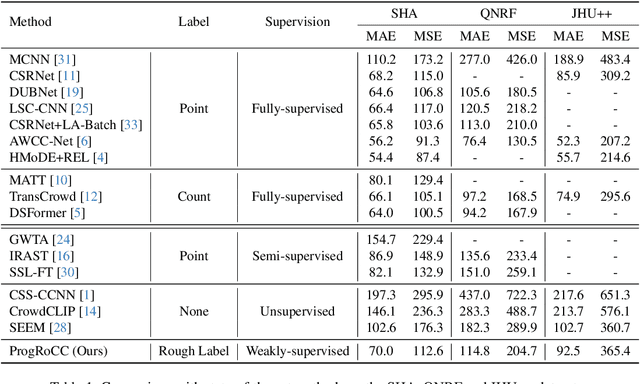
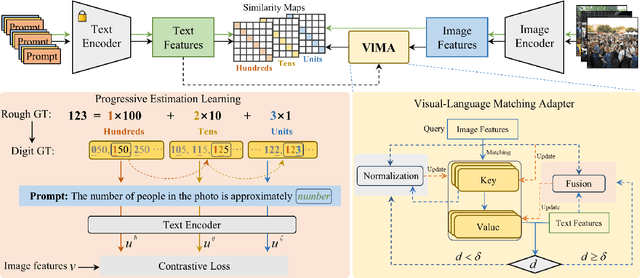
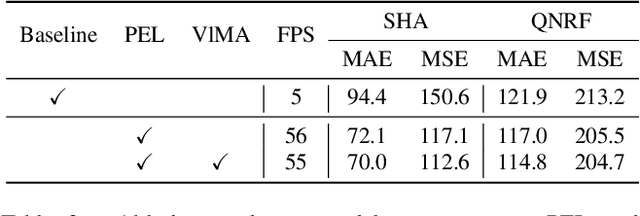
As the number of individuals in a crowd grows, enumeration-based techniques become increasingly infeasible and their estimates increasingly unreliable. We propose instead an estimation-based version of the problem: we label Rough Crowd Counting that delivers better accuracy on the basis of training data that is easier to acquire. Rough crowd counting requires only rough annotations of the number of targets in an image, instead of the more traditional, and far more expensive, per-target annotations. We propose an approach to the rough crowd counting problem based on CLIP, termed ProgRoCC. Specifically, we introduce a progressive estimation learning strategy that determines the object count through a coarse-to-fine approach. This approach delivers answers quickly, outperforms the state-of-the-art in semi- and weakly-supervised crowd counting. In addition, we design a vision-language matching adapter that optimizes key-value pairs by mining effective matches of two modalities to refine the visual features, thereby improving the final performance. Extensive experimental results on three widely adopted crowd counting datasets demonstrate the effectiveness of our method.