 Add to Chrome
 Add to Firefox
 Add to Edge
LimiX-2M: Mitigating Low-Rank Collapse and Attention Bottlenecks in Tabular Foundation Models
Jun 04, 2026
Tabular foundation models (TFMs) increasingly rival tree ensembles, but their performance is often compute-inefficient: with standard affine scalar tokenization, each feature injects value variation through an essentially one-dimensional channel, and feature IDs/positional signals cannot increase within-feature value degrees of freedom, yielding weak early-layer value sensitivity and redundant hidden states. We present a unified tokenize-and-route framework for strong TFMs: RaBEL expands each scalar into compact localized RBF features (optionally exponent-gated) to improve conditioning and shallow-layer effective rank, while a reordered bidirectional block S->N->F aligns computation with the readout by aggregating cross-sample context before feature mixing and using attention pooling. Together, these changes yield LimiX-2M, a 2M-parameter model that outperforms larger TabPFN-v2 and TabICL baselines on widely used tabular benchmarks while reducing training and inference costs. These results highlight value-aware tokenization and readout-aligned routing as key levers for improving the accuracy--efficiency trade-off in TFMs. Model checkpoints and inference code are available at https://github.com/limix-ldm-ai/LimiX.

LimiX: Unleashing Structured-Data Modeling Capability for Generalist Intelligence
Sep 03, 2025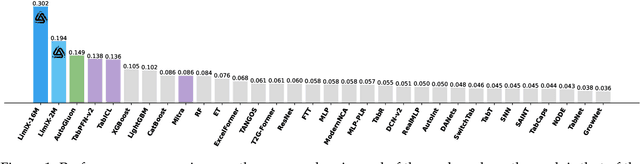
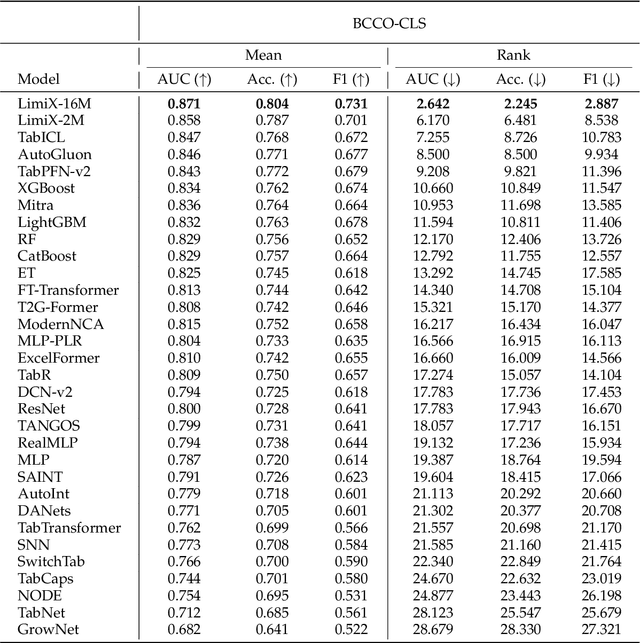
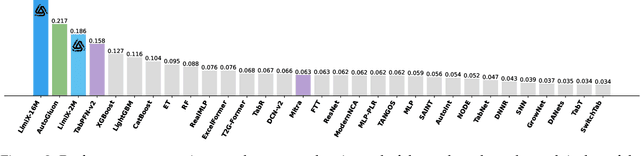
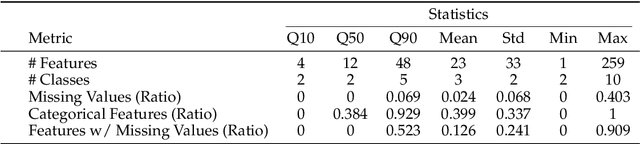
We argue that progress toward general intelligence requires complementary foundation models grounded in language, the physical world, and structured data. This report presents LimiX, the first installment of our large structured-data models (LDMs). LimiX treats structured data as a joint distribution over variables and missingness, thus capable of addressing a wide range of tabular tasks through query-based conditional prediction via a single model. LimiX is pretrained using masked joint-distribution modeling with an episodic, context-conditional objective, where the model predicts for query subsets conditioned on dataset-specific contexts, supporting rapid, training-free adaptation at inference. We evaluate LimiX across 10 large structured-data benchmarks with broad regimes of sample size, feature dimensionality, class number, categorical-to-numerical feature ratio, missingness, and sample-to-feature ratios. With a single model and a unified interface, LimiX consistently surpasses strong baselines including gradient-boosting trees, deep tabular networks, recent tabular foundation models, and automated ensembles, as shown in Figure 1 and Figure 2. The superiority holds across a wide range of tasks, such as classification, regression, missing value imputation, and data generation, often by substantial margins, while avoiding task-specific architectures or bespoke training per task. All LimiX models are publicly accessible under Apache 2.0.