 Add to Chrome
 Add to Firefox
 Add to Edge
PiXTime: A Model for Federated Time Series Forecasting with Heterogeneous Data Structures Across Nodes
Jan 09, 2026
Time series are highly valuable and rarely shareable across nodes, making federated learning a promising paradigm to leverage distributed temporal data. However, different sampling standards lead to diverse time granularities and variable sets across nodes, hindering classical federated learning. We propose PiXTime, a novel time series forecasting model designed for federated learning that enables effective prediction across nodes with multi-granularity and heterogeneous variable sets. PiXTime employs a personalized Patch Embedding to map node-specific granularity time series into token sequences of a unified dimension for processing by a subsequent shared model, and uses a global VE Table to align variable category semantics across nodes, thereby enhancing cross-node transferability. With a transformer-based shared model, PiXTime captures representations of auxiliary series with arbitrary numbers of variables and uses cross-attention to enhance the prediction of the target series. Experiments show PiXTime achieves state-of-the-art performance in federated settings and demonstrates superior performance on eight widely used real-world traditional benchmarks.

TourPlanner: A Competitive Consensus Framework with Constraint-Gated Reinforcement Learning for Travel Planning
Jan 08, 2026Travel planning is a sophisticated decision-making process that requires synthesizing multifaceted information to construct itineraries. However, existing travel planning approaches face several challenges: (1) Pruning candidate points of interest (POIs) while maintaining a high recall rate; (2) A single reasoning path restricts the exploration capability within the feasible solution space for travel planning; (3) Simultaneously optimizing hard constraints and soft constraints remains a significant difficulty. To address these challenges, we propose TourPlanner, a comprehensive framework featuring multi-path reasoning and constraint-gated reinforcement learning. Specifically, we first introduce a Personalized Recall and Spatial Optimization (PReSO) workflow to construct spatially-aware candidate POIs' set. Subsequently, we propose Competitive consensus Chain-of-Thought (CCoT), a multi-path reasoning paradigm that improves the ability of exploring the feasible solution space. To further refine the plan, we integrate a sigmoid-based gating mechanism into the reinforcement learning stage, which dynamically prioritizes soft-constraint satisfaction only after hard constraints are met. Experimental results on travel planning benchmarks demonstrate that TourPlanner achieves state-of-the-art performance, significantly surpassing existing methods in both feasibility and user-preference alignment.
SimRPD: Optimizing Recruitment Proactive Dialogue Agents through Simulator-Based Data Evaluation and Selection
Jan 08, 2026Task-oriented proactive dialogue agents play a pivotal role in recruitment, particularly for steering conversations towards specific business outcomes, such as acquiring social-media contacts for private-channel conversion. Although supervised fine-tuning and reinforcement learning have proven effective for training such agents, their performance is heavily constrained by the scarcity of high-quality, goal-oriented domain-specific training data. To address this challenge, we propose SimRPD, a three-stage framework for training recruitment proactive dialogue agents. First, we develop a high-fidelity user simulator to synthesize large-scale conversational data through multi-turn online dialogue. Then we introduce a multi-dimensional evaluation framework based on Chain-of-Intention (CoI) to comprehensively assess the simulator and effectively select high-quality data, incorporating both global-level and instance-level metrics. Finally, we train the recruitment proactive dialogue agent on the selected dataset. Experiments in a real-world recruitment scenario demonstrate that SimRPD outperforms existing simulator-based data selection strategies, highlighting its practical value for industrial deployment and its potential applicability to other business-oriented dialogue scenarios.
FOREVER: Forgetting Curve-Inspired Memory Replay for Language Model Continual Learning
Jan 07, 2026Continual learning (CL) for large language models (LLMs) aims to enable sequential knowledge acquisition without catastrophic forgetting. Memory replay methods are widely used for their practicality and effectiveness, but most rely on fixed, step-based heuristics that often misalign with the model's actual learning progress, since identical training steps can result in varying degrees of parameter change. Motivated by recent findings that LLM forgetting mirrors the Ebbinghaus human forgetting curve, we propose FOREVER (FORgEtting curVe-inspired mEmory Replay), a novel CL framework that aligns replay schedules with a model-centric notion of time. FOREVER defines model time using the magnitude of optimizer updates, allowing forgetting curve-inspired replay intervals to align with the model's internal evolution rather than raw training steps. Building on this approach, FOREVER incorporates a forgetting curve-based replay scheduler to determine when to replay and an intensity-aware regularization mechanism to adaptively control how to replay. Extensive experiments on three CL benchmarks and models ranging from 0.6B to 13B parameters demonstrate that FOREVER consistently mitigates catastrophic forgetting.
AHA: Aligning Large Audio-Language Models for Reasoning Hallucinations via Counterfactual Hard Negatives
Dec 30, 2025Although Large Audio-Language Models (LALMs) deliver state-of-the-art (SOTA) performance, they frequently suffer from hallucinations, e.g. generating text not grounded in the audio input. We analyze these grounding failures and identify a distinct taxonomy: Event Omission, False Event Identity, Temporal Relation Error, and Quantitative Temporal Error. To address this, we introduce the AHA (Audio Hallucination Alignment) framework. By leveraging counterfactual hard negative mining, our pipeline constructs a high-quality preference dataset that forces models to distinguish strict acoustic evidence from linguistically plausible fabrications. Additionally, we establish AHA-Eval, a diagnostic benchmark designed to rigorously test these fine-grained temporal reasoning capabilities. We apply this data to align Qwen2.5-Omni. The resulting model, Qwen-Audio-AHA, achieves a 13.7% improvement on AHA-Eval. Crucially, this benefit generalizes beyond our diagnostic set. Our model shows substantial gains on public benchmarks, including 1.3% on MMAU-Test and 1.6% on MMAR, outperforming latest SOTA methods.
Learning Coupled System Dynamics under Incomplete Physical Constraints and Missing Data
Dec 28, 2025Advances in data acquisition and computational methods have accelerated the use of differential equation based modelling for complex systems. Such systems are often described by coupled (or more) variables, yet governing equation is typically available for one variable, while the remaining variable can be accessed only through data. This mismatch between known physics and observed data poses a fundamental challenge for existing physics-informed machine learning approaches, which generally assume either complete knowledge of the governing equations or full data availability across all variables. In this paper, we introduce MUSIC (Multitask Learning Under Sparse and Incomplete Constraints), a sparsity induced multitask neural network framework that integrates partial physical constraints with data-driven learning to recover full-dimensional solutions of coupled systems when physics-constrained and data-informed variables are mutually exclusive. MUSIC employs mesh-free (random) sampling of training data and sparsity regularization, yielding highly compressed models with improved training and evaluation efficiency. We demonstrate that MUSIC accurately learns solutions (shock wave solutions, discontinuous solutions, pattern formation solutions) to complex coupled systems under data-scarce and noisy conditions, consistently outperforming non-sparse formulations. These results highlight MUSIC as a flexible and effective approach for modeling partially observed systems with incomplete physical knowledge.
Laser: Governing Long-Horizon Agentic Search via Structured Protocol and Context Register
Dec 23, 2025Recent advances in Large Language Models (LLMs) and Large Reasoning Models (LRMs) have enabled agentic search systems that interleave multi-step reasoning with external tool use. However, existing frameworks largely rely on unstructured natural-language reasoning and accumulate raw intermediate traces in the context, which often leads to unstable reasoning trajectories, context overflow, and degraded performance on complex multi-hop queries. In this study, we introduce Laser, a general framework for stabilizing and scaling agentic search. Laser defines a symbolic action protocol that organizes agent behaviors into three spaces: planning, task-solving, and retrospection. Each action is specified with explicit semantics and a deterministic execution format, enabling structured and logical reasoning processes and reliable action parsing. This design makes intermediate decisions interpretable and traceable, enhancing explicit retrospection and fine-grained control over reasoning trajectories. In coordination with parsable actions, Laser further maintains a compact context register that stores only essential states of the reasoning process, allowing the agent to reason over long horizons without uncontrolled context expansion. Experiments on Qwen2.5/3-series models across challenging multi-hop QA datasets show that Laser consistently outperforms existing agentic search baselines under both prompting-only and fine-tuning settings, demonstrating that Laser provides a principled and effective foundation for robust, scalable agentic search.
The Procrustean Bed of Time Series: The Optimization Bias of Point-wise Loss
Dec 21, 2025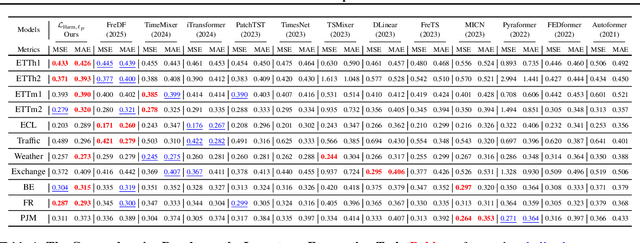
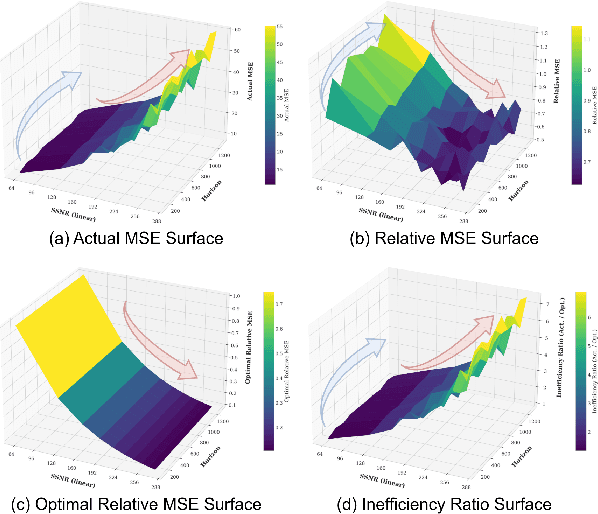
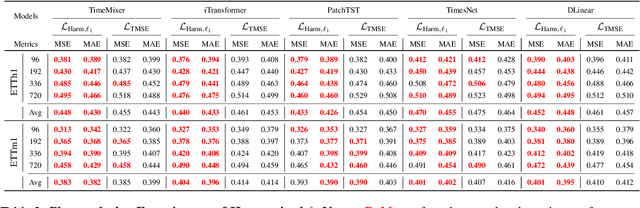
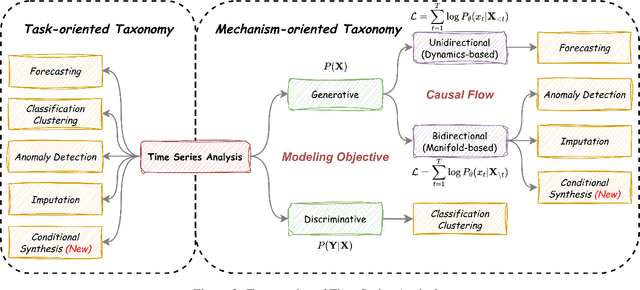
Optimizing time series models via point-wise loss functions (e.g., MSE) relying on a flawed point-wise independent and identically distributed (i.i.d.) assumption that disregards the causal temporal structure, an issue with growing awareness yet lacking formal theoretical grounding. Focusing on the core independence issue under covariance stationarity, this paper aims to provide a first-principles analysis of the Expectation of Optimization Bias (EOB), formalizing it information-theoretically as the discrepancy between the true joint distribution and its flawed i.i.d. counterpart. Our analysis reveals a fundamental paradigm paradox: the more deterministic and structured the time series, the more severe the bias by point-wise loss function. We derive the first closed-form quantification for the non-deterministic EOB across linear and non-linear systems, and prove EOB is an intrinsic data property, governed exclusively by sequence length and our proposed Structural Signal-to-Noise Ratio (SSNR). This theoretical diagnosis motivates our principled debiasing program that eliminates the bias through sequence length reduction and structural orthogonalization. We present a concrete solution that simultaneously achieves both principles via DFT or DWT. Furthermore, a novel harmonized $\ell_p$ norm framework is proposed to rectify gradient pathologies of high-variance series. Extensive experiments validate EOB Theory's generality and the superior performance of debiasing program.
HyperVL: An Efficient and Dynamic Multimodal Large Language Model for Edge Devices
Dec 16, 2025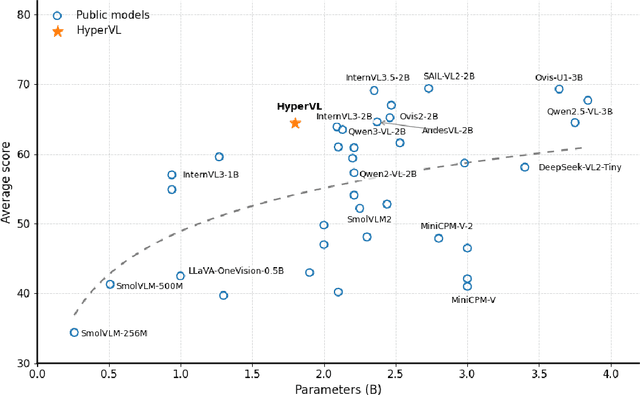

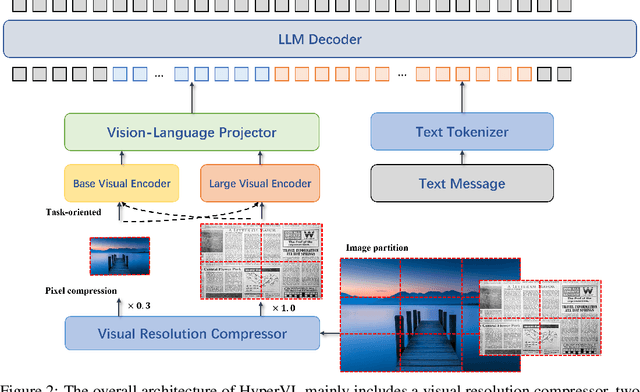
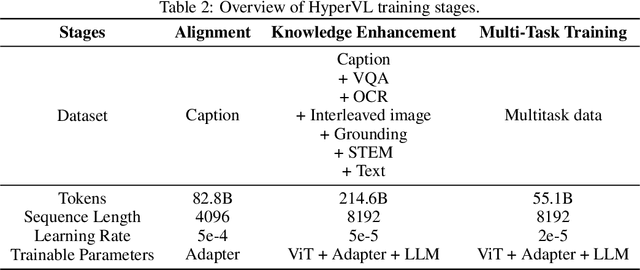
Current multimodal large lanauge models possess strong perceptual and reasoning capabilities, however high computational and memory requirements make them difficult to deploy directly on on-device environments. While small-parameter models are progressively endowed with strong general capabilities, standard Vision Transformer (ViT) encoders remain a critical bottleneck, suffering from excessive latency and memory consumption when processing high-resolution inputs.To address these challenges, we introduce HyperVL, an efficient multimodal large language model tailored for on-device inference. HyperVL adopts an image-tiling strategy to cap peak memory usage and incorporates two novel techniques: (1) a Visual Resolution Compressor (VRC) that adaptively predicts optimal encoding resolutions to eliminate redundant computation, and (2) Dual Consistency Learning (DCL), which aligns multi-scale ViT encoders within a unified framework, enabling dynamic switching between visual branches under a shared LLM. Extensive experiments demonstrate that HyperVL achieves state-of-the-art performance among models of comparable size across multiple benchmarks. Furthermore, it significantly significantly reduces latency and power consumption on real mobile devices, demonstrating its practicality for on-device multimodal inference.
From Feature Interaction to Feature Generation: A Generative Paradigm of CTR Prediction Models
Dec 16, 2025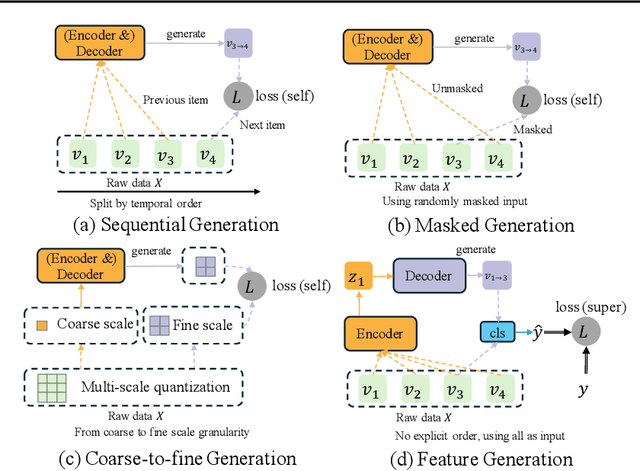
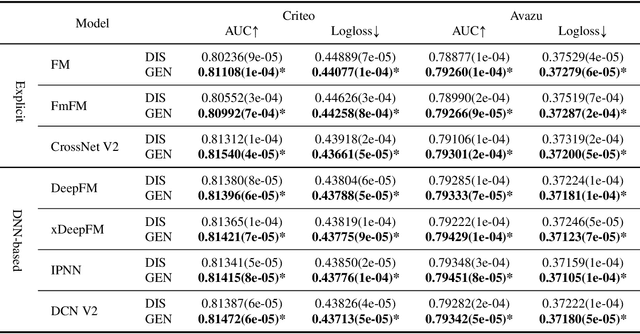
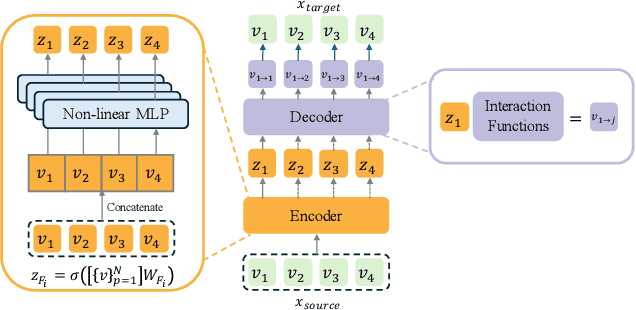
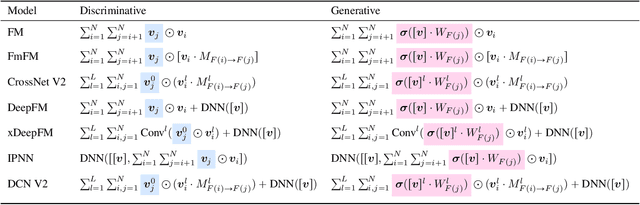
Click-Through Rate (CTR) prediction, a core task in recommendation systems, aims to estimate the probability of users clicking on items. Existing models predominantly follow a discriminative paradigm, which relies heavily on explicit interactions between raw ID embeddings. However, this paradigm inherently renders them susceptible to two critical issues: embedding dimensional collapse and information redundancy, stemming from the over-reliance on feature interactions \emph{over raw ID embeddings}. To address these limitations, we propose a novel \emph{Supervised Feature Generation (SFG)} framework, \emph{shifting the paradigm from discriminative ``feature interaction" to generative ``feature generation"}. Specifically, SFG comprises two key components: an \emph{Encoder} that constructs hidden embeddings for each feature, and a \emph{Decoder} tasked with regenerating the feature embeddings of all features from these hidden representations. Unlike existing generative approaches that adopt self-supervised losses, we introduce a supervised loss to utilize the supervised signal, \ie, click or not, in the CTR prediction task. This framework exhibits strong generalizability: it can be seamlessly integrated with most existing CTR models, reformulating them under the generative paradigm. Extensive experiments demonstrate that SFG consistently mitigates embedding collapse and reduces information redundancy, while yielding substantial performance gains across various datasets and base models. The code is available at https://github.com/USTC-StarTeam/GE4Rec.