 Add to Chrome
 Add to Firefox
 Add to Edge
Expand More, Shrink Less: Shaping Effective-Rank Dynamics for Dense Scaling in Recommendation
May 22, 2026
Scaling recommendation models is a central challenge in recommender systems. Recently, RankMixer has emerged as an effective solution, operating on a unified token representation and alternating between token mixing and per-token feedforward networks (P-FFNs) to achieve scalable performance. However, RankMixer suffers from \textit{embedding collapse}, where learned representations have low effective rank, limiting expressivity and underutilizing the expanded representation space. Through empirical analysis and theoretical insights, we identify rigid token mixing and P-FFN modules as the primary causes of this phenomenon, jointly inducing a \textbf{damped oscillatory trajectory} in effective-rank evolution across layers. To address it, we propose RankElastor, a novel architecture that produces spectrum-robust representations with provable collapse mitigation. RankElastor introduces two components: (i) \textbf{parameterized full mixing}, which enables expressive token mixing with improved spectral robustness; and (ii) \textbf{GLU-improved P-FFNs}, which stabilize representation spectra through GLU-style FFN modules. Extensive experiments on large-scale industrial datasets demonstrate that RankElastor consistently improves recommendation performance, mitigates embedding collapse, and exhibits robust scaling behavior. Code is available at this GitHub repository: https://github.com/vasile-paskardlgm/RankElastor

RankUp: Towards High-rank Representations for Large Scale Advertising Recommender Systems
Apr 21, 2026The scaling laws for recommender systems have been increasingly validated, where MetaFormer-based architectures consistently benefit from increased model depth, hidden dimensionality, and user behavior sequence length. However, whether representation capacity scales proportionally with parameter growth remains largely unexplored. Prior studies on RankMixer reveal that the effective rank of token representations exhibits a damped oscillatory trajectory across layers, failing to increase consistently with depth and even degrading in deeper layers. Motivated by this observation, we propose \textbf{RankUp}, an architecture designed to mitigate representation collapse and enhance expressive capacity through randomized permutation splitting over sparse features, a multi-embedding paradigm, global token integration, crossed pretrained embedding tokens and task-specific token decoupling. RankUp has been fully deployed in large-scale production across Weixin Video Accounts, Official Accounts and Moments, yielding GMV improvements of 3.41\%, 4.81\% and 2.21\%, respectively.
TokenFormer: Unify the Multi-Field and Sequential Recommendation Worlds
Apr 15, 2026Recommender systems have historically developed along two largely independent paradigms: feature interaction models for modeling correlations among multi-field categorical features, and sequential models for capturing user behavior dynamics from historical interaction sequences. Although recent trends attempt to bridge these paradigms within shared backbones, we empirically reveal that naive unifying these two branches may lead to a failure mode of Sequential Collapse Propagation (SCP). That is, the interaction with those dimensionally ill non-sequence fields leads to the dimensional collapse of the sequence features. To overcome this challenge, we propose TokenFormer, a unified recommendation architecture with the following innovations. First, we introduce a Bottom-Full-Top-Sliding (BFTS) attention scheme, which applies full self-attention in the lower layers and shrinking-window sliding attention in the upper layers. Second, we introduce a Non-Linear Interaction Representation (NLIR) that applies one-sided non-linear multiplicative transformations to the hidden states. Extensive experiments on public benchmarks and Tencent's advertising platform demonstrate state-of-the-art performance, while detailed analysis confirm that TokenFormer significantly improves dimensional robustness and representation discriminability under unified modeling.
From Feature Interaction to Feature Generation: A Generative Paradigm of CTR Prediction Models
Dec 16, 2025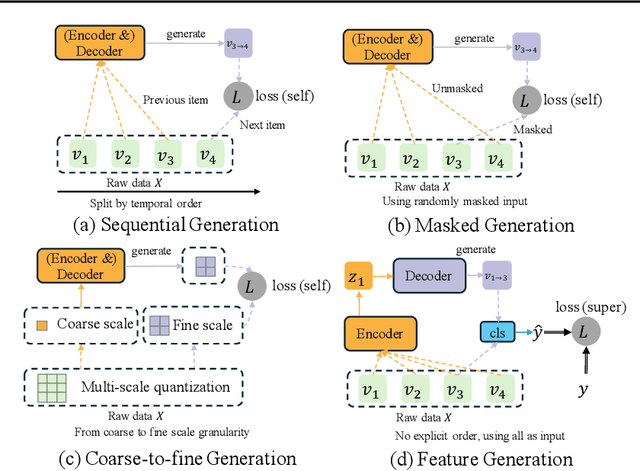
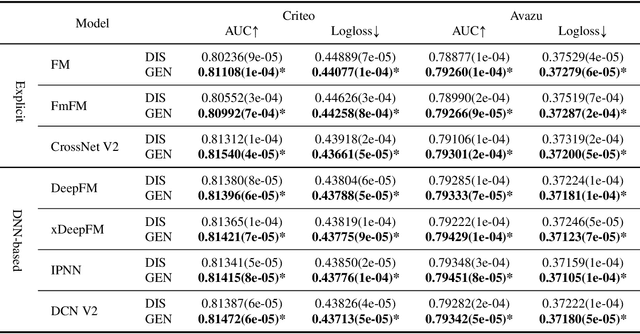
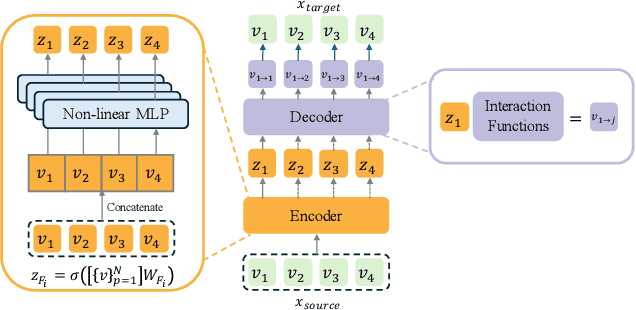
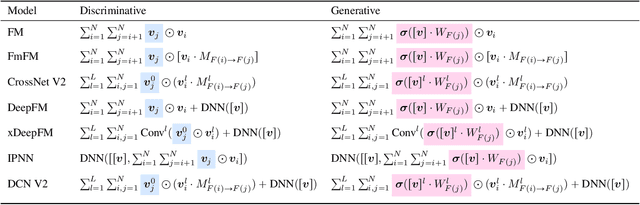
Click-Through Rate (CTR) prediction, a core task in recommendation systems, aims to estimate the probability of users clicking on items. Existing models predominantly follow a discriminative paradigm, which relies heavily on explicit interactions between raw ID embeddings. However, this paradigm inherently renders them susceptible to two critical issues: embedding dimensional collapse and information redundancy, stemming from the over-reliance on feature interactions \emph{over raw ID embeddings}. To address these limitations, we propose a novel \emph{Supervised Feature Generation (SFG)} framework, \emph{shifting the paradigm from discriminative ``feature interaction" to generative ``feature generation"}. Specifically, SFG comprises two key components: an \emph{Encoder} that constructs hidden embeddings for each feature, and a \emph{Decoder} tasked with regenerating the feature embeddings of all features from these hidden representations. Unlike existing generative approaches that adopt self-supervised losses, we introduce a supervised loss to utilize the supervised signal, \ie, click or not, in the CTR prediction task. This framework exhibits strong generalizability: it can be seamlessly integrated with most existing CTR models, reformulating them under the generative paradigm. Extensive experiments demonstrate that SFG consistently mitigates embedding collapse and reduces information redundancy, while yielding substantial performance gains across various datasets and base models. The code is available at https://github.com/USTC-StarTeam/GE4Rec.
Large Foundation Model for Ads Recommendation
Aug 20, 2025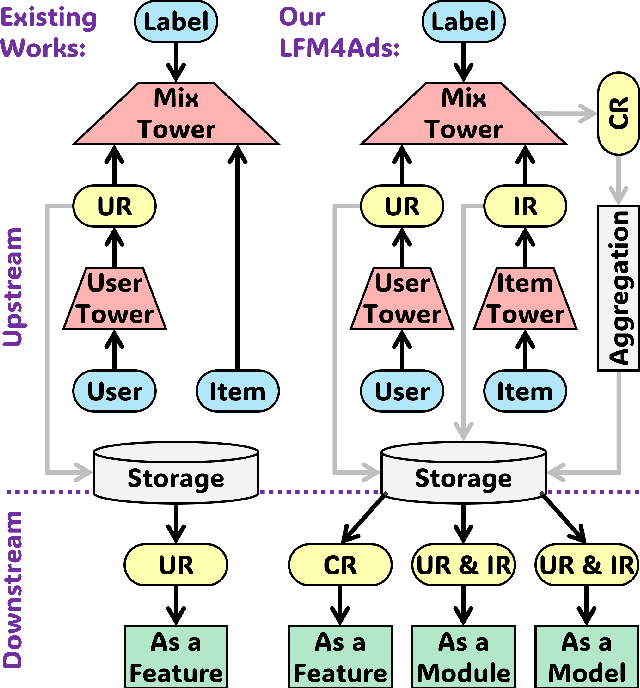
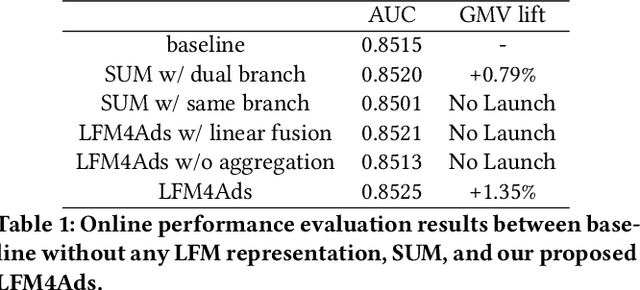
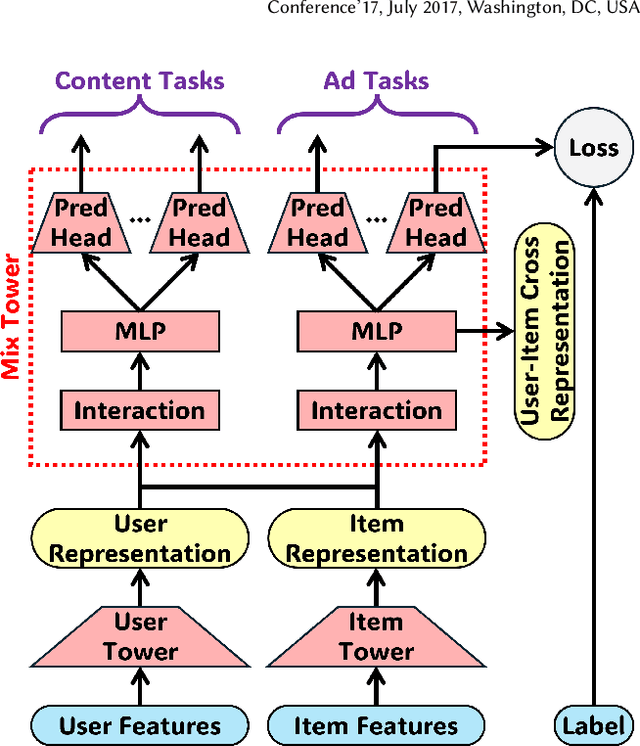
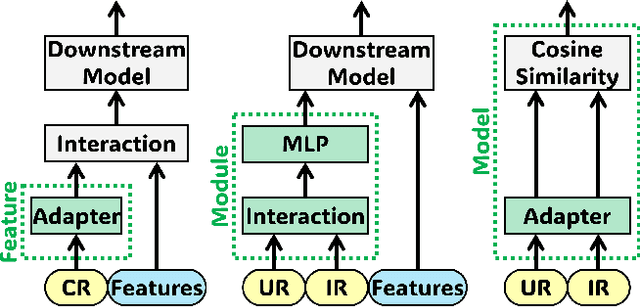
Online advertising relies on accurate recommendation models, with recent advances using pre-trained large-scale foundation models (LFMs) to capture users' general interests across multiple scenarios and tasks. However, existing methods have critical limitations: they extract and transfer only user representations (URs), ignoring valuable item representations (IRs) and user-item cross representations (CRs); and they simply use a UR as a feature in downstream applications, which fails to bridge upstream-downstream gaps and overlooks more transfer granularities. In this paper, we propose LFM4Ads, an All-Representation Multi-Granularity transfer framework for ads recommendation. It first comprehensively transfers URs, IRs, and CRs, i.e., all available representations in the pre-trained foundation model. To effectively utilize the CRs, it identifies the optimal extraction layer and aggregates them into transferable coarse-grained forms. Furthermore, we enhance the transferability via multi-granularity mechanisms: non-linear adapters for feature-level transfer, an Isomorphic Interaction Module for module-level transfer, and Standalone Retrieval for model-level transfer. LFM4Ads has been successfully deployed in Tencent's industrial-scale advertising platform, processing tens of billions of daily samples while maintaining terabyte-scale model parameters with billions of sparse embedding keys across approximately two thousand features. Since its production deployment in Q4 2024, LFM4Ads has achieved 10+ successful production launches across various advertising scenarios, including primary ones like Weixin Moments and Channels. These launches achieve an overall GMV lift of 2.45% across the entire platform, translating to estimated annual revenue increases in the hundreds of millions of dollars.
Understanding the Ranking Loss for Recommendation with Sparse User Feedback
Mar 21, 2024Click-through rate (CTR) prediction holds significant importance in the realm of online advertising. While many existing approaches treat it as a binary classification problem and utilize binary cross entropy (BCE) as the optimization objective, recent advancements have indicated that combining BCE loss with ranking loss yields substantial performance improvements. However, the full efficacy of this combination loss remains incompletely understood. In this paper, we uncover a new challenge associated with BCE loss in scenarios with sparse positive feedback, such as CTR prediction: the gradient vanishing for negative samples. Subsequently, we introduce a novel perspective on the effectiveness of ranking loss in CTR prediction, highlighting its ability to generate larger gradients on negative samples, thereby mitigating their optimization issues and resulting in improved classification ability. Our perspective is supported by extensive theoretical analysis and empirical evaluation conducted on publicly available datasets. Furthermore, we successfully deployed the ranking loss in Tencent's online advertising system, achieving notable lifts of 0.70% and 1.26% in Gross Merchandise Value (GMV) for two main scenarios. The code for our approach is openly accessible at the following GitHub repository: https://github.com/SkylerLinn/Understanding-the-Ranking-Loss.