 Add to Chrome
 Add to Firefox
 Add to Edge
FA-RDP: A Frequency-Adaptive Reactive Diffusion Policy for Contact-Rich Manipulation
Jul 30, 2026
In contact-rich manipulation, action multimodality and reactivity dominate different stages of a single episode. Before contact, multiple trajectories might be equally valid, making it important to preserve diverse action modes. After contact, geometric constraints and force limits narrow the solution space, while successful execution demands rapid responses to force feedback. However, standard diffusion policies use a fixed inference frequency and sampling steps throughout the episode, forcing a fundamental compromise: low-frequency, multi-step sampling better preserves pre-contact multimodality but responds slowly to force feedback, whereas high-frequency sampling improves reactivity but tends to collapse distinct pre-contact modes. To resolve this tradeoff, we present FA-RDP, a frequency-adaptive reactive diffusion policy. A shared multi-frequency visual-force Transformer predicts action chunks at both low and high frequencies, while a learned multimodality indicator dynamically selects multi-step low-frequency sampling before contact and one-step high-frequency sampling as action ambiguity decreases. We further introduce Manifold Consistency Distillation (MCD), which reparameterizes the diffusion network to predict actions on the robot action manifold while retaining DDPM-based residual supervision. Experiments on three contact-rich manipulation tasks show that FA-RDP achieves the highest success rate while preserving diverse pre-contact trajectory modes. Code and videos are available at https://fa-rdp.github.io.

Never Too Late for Force: Accelerating VLA Post-Training with Reactive Force Injection
Jul 15, 2026Pretrained vision-language-action (VLA) policies provide strong language-conditioned manipulation knowledge, but they remain largely vision-driven and can struggle once manipulation enters contact states where the scene is occluded, depth is ambiguous, or small force errors push execution off the offline demonstration distribution. We present LIFT (Late Reactive Injection of Force for VLA Post-Training), a force-aware post-training framework that adds contact reactivity to a pretrained VLA policy while preserving its general manipulation knowledge. LIFT grafts a reactive action expert beside the original action expert, initializes it from pretrained action weights, and injects recent 6D end-effector force through causal force memory and zero-initialized cross attention, enabling actions to be refreshed during execution. To address the policy-dependent distribution shift of contact feedback, LIFT further couples reactive force injection with an online DAgger loop that trains on a mixture of offline task-alignment data and human-corrected online rollouts. Across towel folding, book insertion, and Hanoi ring placement, LIFT learns faster and reaches higher performance than vision-only post-training, while ablations show that reactive force memory and online corrective data are both important for robust contact-rich manipulation. Our code and data will be publicly available.
ActiveGlasses: Learning Manipulation with Active Vision from Ego-centric Human Demonstration
Apr 09, 2026Large-scale real-world robot data collection is a prerequisite for bringing robots into everyday deployment. However, existing pipelines often rely on specialized handheld devices to bridge the embodiment gap, which not only increases operator burden and limits scalability, but also makes it difficult to capture the naturally coordinated perception-manipulation behaviors of human daily interaction. This challenge calls for a more natural system that can faithfully capture human manipulation and perception behaviors while enabling zero-shot transfer to robotic platforms. We introduce ActiveGlasses, a system for learning robot manipulation from ego-centric human demonstrations with active vision. A stereo camera mounted on smart glasses serves as the sole perception device for both data collection and policy inference: the operator wears it during bare-hand demonstrations, and the same camera is mounted on a 6-DoF perception arm during deployment to reproduce human active vision. To enable zero-transfer, we extract object trajectories from demonstrations and use an object-centric point-cloud policy to jointly predict manipulation and head movement. Across several challenging tasks involving occlusion and precise interaction, ActiveGlasses achieves zero-shot transfer with active vision, consistently outperforms strong baselines under the same hardware setup, and generalizes across two robot platforms.
Learning Athletic Humanoid Tennis Skills from Imperfect Human Motion Data
Mar 13, 2026Human athletes demonstrate versatile and highly-dynamic tennis skills to successfully conduct competitive rallies with a high-speed tennis ball. However, reproducing such behaviors on humanoid robots is difficult, partially due to the lack of perfect humanoid action data or human kinematic motion data in tennis scenarios as reference. In this work, we propose LATENT, a system that Learns Athletic humanoid TEnnis skills from imperfect human motioN daTa. The imperfect human motion data consist only of motion fragments that capture the primitive skills used when playing tennis rather than precise and complete human-tennis motion sequences from real-world tennis matches, thereby significantly reducing the difficulty of data collection. Our key insight is that, despite being imperfect, such quasi-realistic data still provide priors about human primitive skills in tennis scenarios. With further correction and composition, we learn a humanoid policy that can consistently strike incoming balls under a wide range of conditions and return them to target locations, while preserving natural motion styles. We also propose a series of designs for robust sim-to-real transfer and deploy our policy on the Unitree G1 humanoid robot. Our method achieves surprising results in the real world and can stably sustain multi-shot rallies with human players. Project page: https://zzk273.github.io/LATENT/
RoboPocket: Improve Robot Policies Instantly with Your Phone
Mar 05, 2026Scaling imitation learning is fundamentally constrained by the efficiency of data collection. While handheld interfaces have emerged as a scalable solution for in-the-wild data acquisition, they predominantly operate in an open-loop manner: operators blindly collect demonstrations without knowing the underlying policy's weaknesses, leading to inefficient coverage of critical state distributions. Conversely, interactive methods like DAgger effectively address covariate shift but rely on physical robot execution, which is costly and difficult to scale. To reconcile this trade-off, we introduce RoboPocket, a portable system that enables Robot-Free Instant Policy Iteration using single consumer smartphones. Its core innovation is a Remote Inference framework that visualizes the policy's predicted trajectory via Augmented Reality (AR) Visual Foresight. This immersive feedback allows collectors to proactively identify potential failures and focus data collection on the policy's weak regions without requiring a physical robot. Furthermore, we implement an asynchronous Online Finetuning pipeline that continuously updates the policy with incoming data, effectively closing the learning loop in minutes. Extensive experiments demonstrate that RoboPocket adheres to data scaling laws and doubles the data efficiency compared to offline scaling strategies, overcoming their long-standing efficiency bottleneck. Moreover, our instant iteration loop also boosts sample efficiency by up to 2$\times$ in distributed environments a small number of interactive corrections per person. Project page and videos: https://robo-pocket.github.io.
Rethinking Camera Choice: An Empirical Study on Fisheye Camera Properties in Robotic Manipulation
Mar 02, 2026The adoption of fisheye cameras in robotic manipulation, driven by their exceptionally wide Field of View (FoV), is rapidly outpacing a systematic understanding of their downstream effects on policy learning. This paper presents the first comprehensive empirical study to bridge this gap, rigorously analyzing the properties of wrist-mounted fisheye cameras for imitation learning. Through extensive experiments in both simulation and the real world, we investigate three critical research questions: spatial localization, scene generalization, and hardware generalization. Our investigation reveals that: (1) The wide FoV significantly enhances spatial localization, but this benefit is critically contingent on the visual complexity of the environment. (2) Fisheye-trained policies, while prone to overfitting in simple scenes, unlock superior scene generalization when trained with sufficient environmental diversity. (3) While naive cross-camera transfer leads to failures, we identify the root cause as scale overfitting and demonstrate that hardware generalization performance can be improved with a simple Random Scale Augmentation (RSA) strategy. Collectively, our findings provide concrete, actionable guidance for the large-scale collection and effective use of fisheye datasets in robotic learning. More results and videos are available on https://robo-fisheye.github.io/
Collision-Free Humanoid Traversal in Cluttered Indoor Scenes
Jan 23, 2026We study the problem of collision-free humanoid traversal in cluttered indoor scenes, such as hurdling over objects scattered on the floor, crouching under low-hanging obstacles, or squeezing through narrow passages. To achieve this goal, the humanoid needs to map its perception of surrounding obstacles with diverse spatial layouts and geometries to the corresponding traversal skills. However, the lack of an effective representation that captures humanoid-obstacle relationships during collision avoidance makes directly learning such mappings difficult. We therefore propose Humanoid Potential Field (HumanoidPF), which encodes these relationships as collision-free motion directions, significantly facilitating RL-based traversal skill learning. We also find that HumanoidPF exhibits a surprisingly negligible sim-to-real gap as a perceptual representation. To further enable generalizable traversal skills through diverse and challenging cluttered indoor scenes, we further propose a hybrid scene generation method, incorporating crops of realistic 3D indoor scenes and procedurally synthesized obstacles. We successfully transfer our policy to the real world and develop a teleoperation system where users could command the humanoid to traverse in cluttered indoor scenes with just a single click. Extensive experiments are conducted in both simulation and the real world to validate the effectiveness of our method. Demos and code can be found in our website: https://axian12138.github.io/CAT/.
ImplicitRDP: An End-to-End Visual-Force Diffusion Policy with Structural Slow-Fast Learning
Dec 11, 2025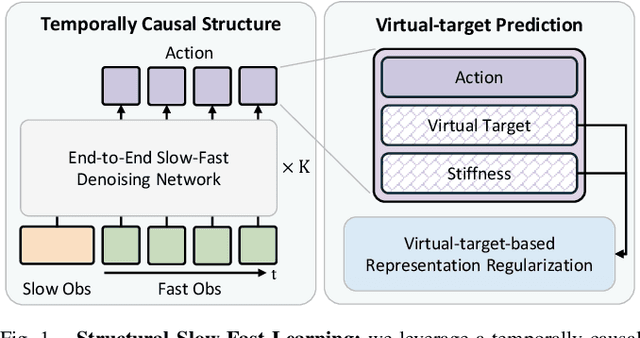
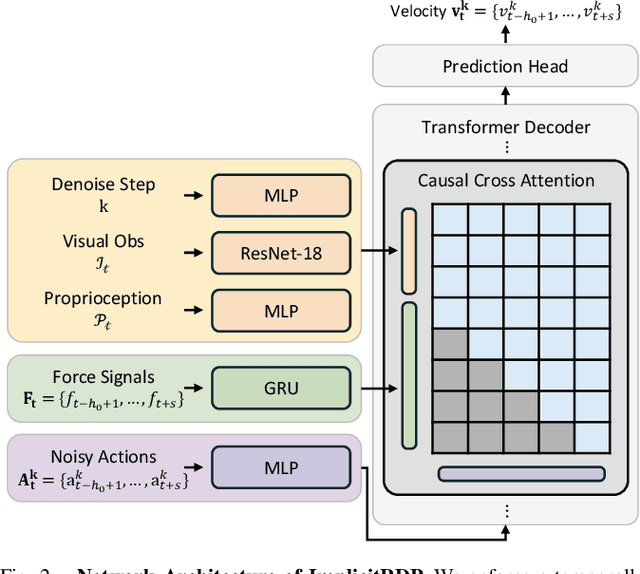
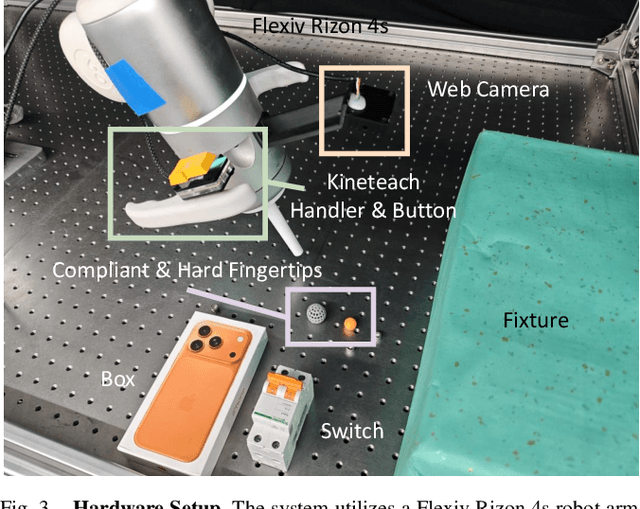

Human-level contact-rich manipulation relies on the distinct roles of two key modalities: vision provides spatially rich but temporally slow global context, while force sensing captures rapid, high-frequency local contact dynamics. Integrating these signals is challenging due to their fundamental frequency and informational disparities. In this work, we propose ImplicitRDP, a unified end-to-end visual-force diffusion policy that integrates visual planning and reactive force control within a single network. We introduce Structural Slow-Fast Learning, a mechanism utilizing causal attention to simultaneously process asynchronous visual and force tokens, allowing the policy to perform closed-loop adjustments at the force frequency while maintaining the temporal coherence of action chunks. Furthermore, to mitigate modality collapse where end-to-end models fail to adjust the weights across different modalities, we propose Virtual-target-based Representation Regularization. This auxiliary objective maps force feedback into the same space as the action, providing a stronger, physics-grounded learning signal than raw force prediction. Extensive experiments on contact-rich tasks demonstrate that ImplicitRDP significantly outperforms both vision-only and hierarchical baselines, achieving superior reactivity and success rates with a streamlined training pipeline. Code and videos will be publicly available at https://implicit-rdp.github.io.
Right-Side-Out: Learning Zero-Shot Sim-to-Real Garment Reversal
Sep 19, 2025Turning garments right-side out is a challenging manipulation task: it is highly dynamic, entails rapid contact changes, and is subject to severe visual occlusion. We introduce Right-Side-Out, a zero-shot sim-to-real framework that effectively solves this challenge by exploiting task structures. We decompose the task into Drag/Fling to create and stabilize an access opening, followed by Insert&Pull to invert the garment. Each step uses a depth-inferred, keypoint-parameterized bimanual primitive that sharply reduces the action space while preserving robustness. Efficient data generation is enabled by our custom-built, high-fidelity, GPU-parallel Material Point Method (MPM) simulator that models thin-shell deformation and provides robust and efficient contact handling for batched rollouts. Built on the simulator, our fully automated pipeline scales data generation by randomizing garment geometry, material parameters, and viewpoints, producing depth, masks, and per-primitive keypoint labels without any human annotations. With a single depth camera, policies trained entirely in simulation deploy zero-shot on real hardware, achieving up to 81.3% success rate. By employing task decomposition and high fidelity simulation, our framework enables tackling highly dynamic, severely occluded tasks without laborious human demonstrations.
Track Any Motions under Any Disturbances
Sep 17, 2025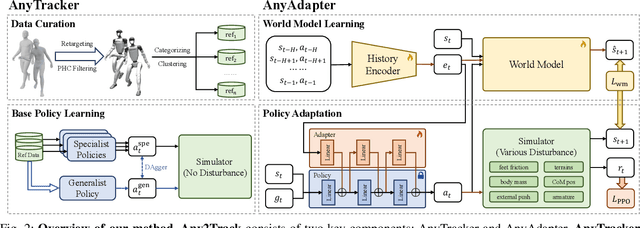

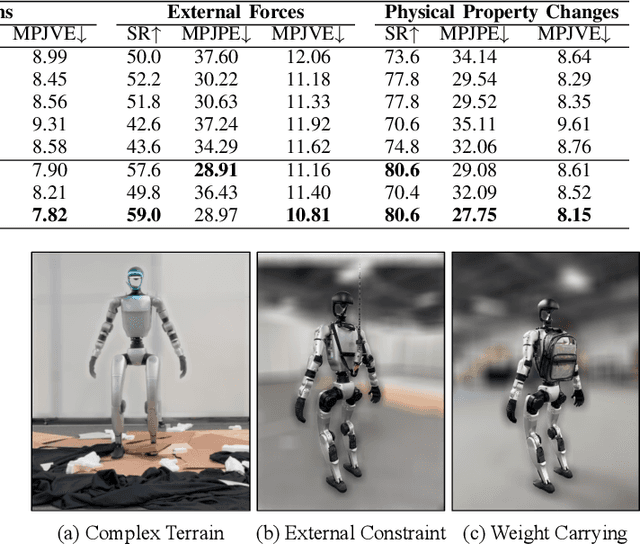

A foundational humanoid motion tracker is expected to be able to track diverse, highly dynamic, and contact-rich motions. More importantly, it needs to operate stably in real-world scenarios against various dynamics disturbances, including terrains, external forces, and physical property changes for general practical use. To achieve this goal, we propose Any2Track (Track Any motions under Any disturbances), a two-stage RL framework to track various motions under multiple disturbances in the real world. Any2Track reformulates dynamics adaptability as an additional capability on top of basic action execution and consists of two key components: AnyTracker and AnyAdapter. AnyTracker is a general motion tracker with a series of careful designs to track various motions within a single policy. AnyAdapter is a history-informed adaptation module that endows the tracker with online dynamics adaptability to overcome the sim2real gap and multiple real-world disturbances. We deploy Any2Track on Unitree G1 hardware and achieve a successful sim2real transfer in a zero-shot manner. Any2Track performs exceptionally well in tracking various motions under multiple real-world disturbances.