 Add to Chrome
 Add to Firefox
 Add to Edge
EgoGuide: Egocentric Guidance for Efficient Robot-Free Demonstration Collection and Learning
Jun 12, 2026
Robot learning from real-world demonstrations is currently constrained by data scaling. Universal Manipulation Interface (UMI) provides an efficient robot-free data collection interface, yet current UMI-style pipelines often collect redundant demonstrations and lack global scene context. To improve data efficiency, we present EgoGuide, a collection interface that records synchronized wrist and head/egocentric observations and couples them with online visual-geometric data quality guidance. We also introduce a Gated Egocentric Residual Policy for robust learning from a viewpoint-varying egocentric camera, allowing head/egocentric context to correct ambiguous local observations while preserving stable wrist-view control. Real-world experiments show that EgoGuide reduces the required number of data episodes and improves data efficiency. The residual policy further improves robustness under visual occlusion. Project Page: https://silicx.github.io/EgoGuide

Tac-DINO: Learning Vision-Tactile Features with Patch Alignment
Jun 10, 2026Touch is the primary medium through which humans interact with the environment. Currently, tactile learning mainly focuses on image-level pretraining or alignment. However, tactile signals correspond to local object contact, while research into scale alignment and holographic matching remains limited and proper datasets and benchmarks also lack. To bridge this gap, we first construct a data collection system to acquire a large-scale tactile dataset, with over 20 K tactile contacts from 505 real-world objects. Building on this dataset, we design a Vis-Tac Holographic Matching Benchmark to evaluate vision-tactile local-to-global alignment ability. Then we propose Vision-Tactile Patch Alignment (VTPA) methods for vision-tactile representation learning. Experiments demonstrate that these exceed the performance of methods without alignment and align with whole-object images.
AetheRock: An Arm-Worn Robot Teaching System for Force-Guided Vision-Tactile Learning
Jun 08, 2026Force and tactile sensing are indispensable in contact-rich manipulation. However, force-aware robot learning faces critical challenges due to the incompatible assembly of tactile and force sensors in handheld or wearable devices. To address these limitations, we first introduce AetheRock for gripper-force, vision, and tactile data collection, which is an arm-worn device featuring a modular and easily manufactured visuo-tactile sensor, GelSlim-MiniFab, at the fingertip, a resistive pressure sensor at the human finger contact region, a customized PCB module, and a wearable kit for comfortable and robust collection. Building on this, we propose ForceVT, a representation learning framework that uses force and vision to guide fidelity-agnostic tactile learning, enabling robust inference in any tactile situation. Real-world experiments show that AetheRock achieves qualified data efficiency and that ForceVT effectively alleviates inefficiencies when visuo-tactile sensors exhibit manufacturing and utilization inconsistencies. Overall, our work mitigates the limitations of gripper-force vision-tactile robot learning through innovative hardware design and algorithms.
Revisiting Articulated Parts Perception in Robot Manipulation
Jun 06, 2026We are surrounded by various objects with movable, articulated parts, e.g., box, handle, door. An accurate and generalizable perception of articulated parts is essential to enhance robotic manipulation capabilities. Building on this need, recent efforts in articulated parts perception have followed two main directions: One line of work uses pose-based representation, which requires high manual cost; in parallel, affordance-based methods extract future object motion from point tracking without additional manual efforts, but suffer from low-quality data. In this paper, we propose a new representation of articulated parts, Geometric Primary Structure (GPS), an abstraction of the part geometry structure to balance scalability and quality. For efficient and scalable data collection, GPS is integrated with a portable Virtual Reality (VR) device and requires only one minute to annotate one object sequence. This direct human annotation provides higher quality than the estimated affordance. With this efficient VR-GPS system, we collect 41K frames for 234 objects across six part classes, and train a generalizable GPS model with a single RGB-D object image as input. For object manipulation, we deploy a heuristic policy based on GPS prediction. Without any in-domain fine-tuning, our method achieves an 73% success rate, covering 270 initial states for 9 objects. Our code, data and reusable tool are available at https://enlighten0707.github.io/gps.
LIDEA: Human-to-Robot Imitation Learning via Implicit Feature Distillation and Explicit Geometry Alignment
Apr 12, 2026Scaling up robot learning is hindered by the scarcity of robotic demonstrations, whereas human videos offer a vast, untapped source of interaction data. However, bridging the embodiment gap between human hands and robot arms remains a critical challenge. Existing cross-embodiment transfer strategies typically rely on visual editing, but they often introduce visual artifacts due to intrinsic discrepancies in visual appearance and 3D geometry. To address these limitations, we introduce LIDEA (Implicit Feature Distillation and Explicit Geometric Alignment), an imitation learning framework in which policy learning benefits from human demonstrations. In the 2D visual domain, LIDEA employs a dual-stage transitive distillation pipeline that aligns human and robot representations in a shared latent space. In the 3D geometric domain, we propose an embodiment-agnostic alignment strategy that explicitly decouples embodiment from interaction geometry, ensuring consistent 3D-aware perception. Extensive experiments empirically validate LIDEA from two perspectives: data efficiency and OOD robustness. Results show that human data substitutes up to 80% of costly robot demonstrations, and the framework successfully transfers unseen patterns from human videos for out-of-distribution generalization.
OmniXtreme: Breaking the Generality Barrier in High-Dynamic Humanoid Control
Feb 27, 2026High-fidelity motion tracking serves as the ultimate litmus test for generalizable, human-level motor skills. However, current policies often hit a "generality barrier": as motion libraries scale in diversity, tracking fidelity inevitably collapses - especially for real-world deployment of high-dynamic motions. We identify this failure as the result of two compounding factors: the learning bottleneck in scaling multi-motion optimization and the physical executability constraints that arise in real-world actuation. To overcome these challenges, we introduce OmniXtreme, a scalable framework that decouples general motor skill learning from sim-to-real physical skill refinement. Our approach uses a flow-matching policy with high-capacity architectures to scale representation capacity without interference-intensive multi-motion RL optimization, followed by an actuation-aware refinement phase that ensures robust performance on physical hardware. Extensive experiments demonstrate that OmniXtreme maintains high-fidelity tracking across diverse, high-difficulty datasets. On real robots, the unified policy successfully executes multiple extreme motions, effectively breaking the long-standing fidelity-scalability trade-off in high-dynamic humanoid control.
A Pragmatic VLA Foundation Model
Jan 26, 2026Offering great potential in robotic manipulation, a capable Vision-Language-Action (VLA) foundation model is expected to faithfully generalize across tasks and platforms while ensuring cost efficiency (e.g., data and GPU hours required for adaptation). To this end, we develop LingBot-VLA with around 20,000 hours of real-world data from 9 popular dual-arm robot configurations. Through a systematic assessment on 3 robotic platforms, each completing 100 tasks with 130 post-training episodes per task, our model achieves clear superiority over competitors, showcasing its strong performance and broad generalizability. We have also built an efficient codebase, which delivers a throughput of 261 samples per second per GPU with an 8-GPU training setup, representing a 1.5~2.8$\times$ (depending on the relied VLM base model) speedup over existing VLA-oriented codebases. The above features ensure that our model is well-suited for real-world deployment. To advance the field of robot learning, we provide open access to the code, base model, and benchmark data, with a focus on enabling more challenging tasks and promoting sound evaluation standards.
The Great March 100: 100 Detail-oriented Tasks for Evaluating Embodied AI Agents
Jan 16, 2026Recently, with the rapid development of robot learning and imitation learning, numerous datasets and methods have emerged. However, these datasets and their task designs often lack systematic consideration and principles. This raises important questions: Do the current datasets and task designs truly advance the capabilities of robotic agents? Do evaluations on a few common tasks accurately reflect the differentiated performance of various methods proposed by different teams and evaluated on different tasks? To address these issues, we introduce the Great March 100 (\textbf{GM-100}) as the first step towards a robot learning Olympics. GM-100 consists of 100 carefully designed tasks that cover a wide range of interactions and long-tail behaviors, aiming to provide a diverse and challenging set of tasks to comprehensively evaluate the capabilities of robotic agents and promote diversity and complexity in robot dataset task designs. These tasks are developed through systematic analysis and expansion of existing task designs, combined with insights from human-object interaction primitives and object affordances. We collect a large amount of trajectory data on different robotic platforms and evaluate several baseline models. Experimental results demonstrate that the GM-100 tasks are 1) feasible to execute and 2) sufficiently challenging to effectively differentiate the performance of current VLA models. Our data and code are available at https://rhos.ai/research/gm-100.
IPR-1: Interactive Physical Reasoner
Nov 19, 2025Humans learn by observing, interacting with environments, and internalizing physics and causality. Here, we aim to ask whether an agent can similarly acquire human-like reasoning from interaction and keep improving with more experience. We study this in a Game-to-Unseen (G2U) setting, curating 1,000+ heterogeneous games with diverse physical and causal mechanisms, and evaluate at three human-like levels: Survival, Curiosity, Utility, from primitive intuition to goal-driven reasoning. Our analysis reveals complementary failures: VLM/VLA agents reason but lack look-ahead in interactive settings, while world models imagine but imitate visual patterns rather than analyze physics and causality. We therefore propose IPR (Interactive Physical Reasoner), using world-model rollouts to score and reinforce a VLM's policy, and introduce PhysCode, a physics-centric action code aligning semantic intent with dynamics to provide a shared action space for prediction and reasoning. Pretrained on 1,000+ games, our IPR performs robustly on three levels, matches GPT-5 overall, and surpasses it on Curiosity. We find that performance improves with more training games and interaction steps, and that the model also zero-shot transfers to unseen games. These results support physics-centric interaction as a path to steadily improving physical reasoning.
exUMI: Extensible Robot Teaching System with Action-aware Task-agnostic Tactile Representation
Sep 18, 2025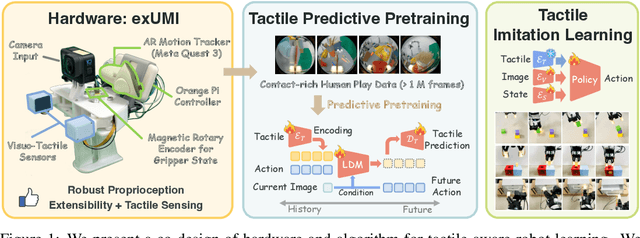
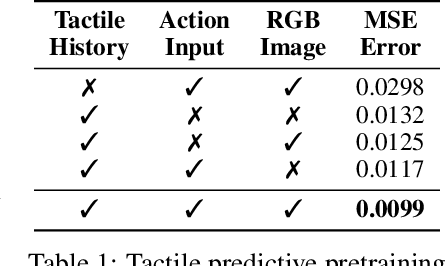
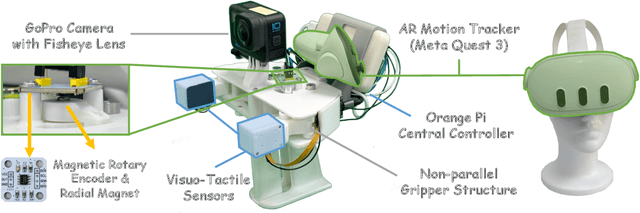
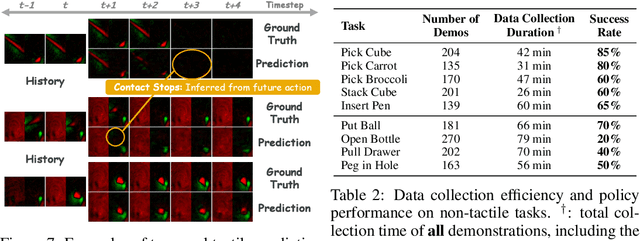
Tactile-aware robot learning faces critical challenges in data collection and representation due to data scarcity and sparsity, and the absence of force feedback in existing systems. To address these limitations, we introduce a tactile robot learning system with both hardware and algorithm innovations. We present exUMI, an extensible data collection device that enhances the vanilla UMI with robust proprioception (via AR MoCap and rotary encoder), modular visuo-tactile sensing, and automated calibration, achieving 100% data usability. Building on an efficient collection of over 1 M tactile frames, we propose Tactile Prediction Pretraining (TPP), a representation learning framework through action-aware temporal tactile prediction, capturing contact dynamics and mitigating tactile sparsity. Real-world experiments show that TPP outperforms traditional tactile imitation learning. Our work bridges the gap between human tactile intuition and robot learning through co-designed hardware and algorithms, offering open-source resources to advance contact-rich manipulation research. Project page: https://silicx.github.io/exUMI.