 Add to Chrome
 Add to Firefox
 Add to Edge
TacCoRL: Integrating Tactile Feedback into VLA via Simulation
Jun 10, 2026
Vision-language-action (VLA) models provide strong visual, language, and action priors for robot manipulation, but visual observations alone often miss the local contact state required for contact-rich tasks. We present TacCoRL, a scalable framework that injects Tactile feedback into VLA policies and improves them through sim-real Co-training and simulation-based reinforcement learning (RL), without requiring large-scale tactile pretraining or extensive real-world contact exploration. The key idea is not only adding touch as an input, but learning how contact readings should modulate action responses in near-failure states that are rare in demonstrations and risky to collect on hardware. We use a real-aligned simulator as a closed-loop training environment for contact interaction. Mixed simulated and real trajectories first warm-start tactile-conditioned actions in the pretrained policy. Reinforcement learning with verifiable task rewards then optimizes the policy using simulated contact rollouts. It reinforces tactile-conditioned actions that lead to task completion, while a supervised objective on real trajectories keeps the refined policy anchored to deployment visual, tactile, and action distributions. The resulting policy transfers directly to the real robot without privileged simulation state or online real-world RL. Across four bimanual contact-rich tasks, the final visuo-tactile policy achieves an average success rate of 72.5%, compared to baseline of 50.0%. Result videos and more details are available at https://tac-corl.github.io/

Sparse2Act: Learning Action-Aligned Sparse 3D Representations for Cross-Domain Robot Manipulation
Jun 10, 2026Explicit 3D representations are attractive for manipulation because they expose object shape, workspace geometry, and robot-object relations in metric coordinates. However, sparse 3D encoders are often learned through downstream task objectives, tying the representation to a particular data distribution, policy architecture, and action parameterization. We introduce Sparse2Act, an observation-action alignment framework for pretraining sparse point-cloud encoders. The key idea is to use task-space end-effector actions as geometric supervision: masked sparse 3D tokens are trained to organize scene features around the workspace motion paired with the observation. After pretraining, only the encoder initialization is reused by downstream policies, allowing them to retain their own architectures and action spaces, including joint-space commands. On the LIBERO-10 benchmark, our method achieves 86.9% average success after 500 fine-tuning steps. The same pretrained encoder supports LIBERO-to-Meta-World cross-domain transfer, achieving 73.4% average success on the Meta-World-5 benchmark. Ablations on the objective and decoder capacity show that the gains come from the masked action-alignment signal and remain useful across downstream action decoders. In real-world experiments, simulation pretraining followed by limited real-data fine-tuning achieves an average success rate of 72.5% across four tasks, demonstrating effective sim-to-real transfer. These results suggest that robot actions can provide compact geometric supervision for reusable sparse 3D representations.
Right-Side-Out: Learning Zero-Shot Sim-to-Real Garment Reversal
Sep 19, 2025Turning garments right-side out is a challenging manipulation task: it is highly dynamic, entails rapid contact changes, and is subject to severe visual occlusion. We introduce Right-Side-Out, a zero-shot sim-to-real framework that effectively solves this challenge by exploiting task structures. We decompose the task into Drag/Fling to create and stabilize an access opening, followed by Insert&Pull to invert the garment. Each step uses a depth-inferred, keypoint-parameterized bimanual primitive that sharply reduces the action space while preserving robustness. Efficient data generation is enabled by our custom-built, high-fidelity, GPU-parallel Material Point Method (MPM) simulator that models thin-shell deformation and provides robust and efficient contact handling for batched rollouts. Built on the simulator, our fully automated pipeline scales data generation by randomizing garment geometry, material parameters, and viewpoints, producing depth, masks, and per-primitive keypoint labels without any human annotations. With a single depth camera, policies trained entirely in simulation deploy zero-shot on real hardware, achieving up to 81.3% success rate. By employing task decomposition and high fidelity simulation, our framework enables tackling highly dynamic, severely occluded tasks without laborious human demonstrations.
GRIP: A General Robotic Incremental Potential Contact Simulation Dataset for Unified Deformable-Rigid Coupled Grasping
Mar 06, 2025Grasping is fundamental to robotic manipulation, and recent advances in large-scale grasping datasets have provided essential training data and evaluation benchmarks, accelerating the development of learning-based methods for robust object grasping. However, most existing datasets exclude deformable bodies due to the lack of scalable, robust simulation pipelines, limiting the development of generalizable models for compliant grippers and soft manipulands. To address these challenges, we present GRIP, a General Robotic Incremental Potential contact simulation dataset for universal grasping. GRIP leverages an optimized Incremental Potential Contact (IPC)-based simulator for multi-environment data generation, achieving up to 48x speedup while ensuring efficient, intersection- and inversion-free simulations for compliant grippers and deformable objects. Our fully automated pipeline generates and evaluates diverse grasp interactions across 1,200 objects and 100,000 grasp poses, incorporating both soft and rigid grippers. The GRIP dataset enables applications such as neural grasp generation and stress field prediction.
Embedded IPC: Fast and Intersection-free Simulation in Reduced Subspace for Robot Manipulation
Sep 24, 2024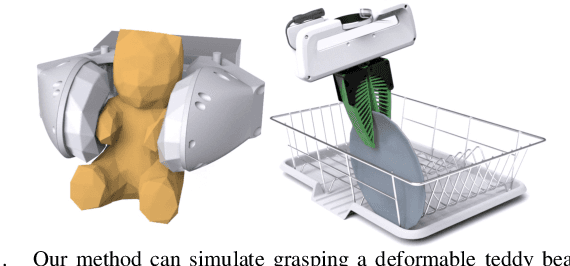
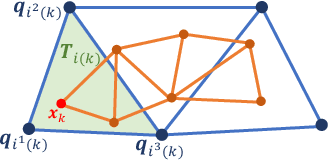

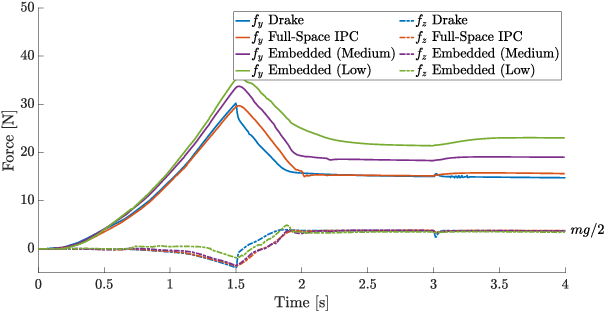
Physics-based simulation is essential for developing and evaluating robot manipulation policies, particularly in scenarios involving deformable objects and complex contact interactions. However, existing simulators often struggle to balance computational efficiency with numerical accuracy, especially when modeling deformable materials with frictional contact constraints. We introduce an efficient subspace representation for the Incremental Potential Contact (IPC) method, leveraging model reduction to decrease the number of degrees of freedom. Our approach decouples simulation complexity from the resolution of the input model by representing elasticity in a low-resolution subspace while maintaining collision constraints on an embedded high-resolution surface. Our barrier formulation ensures intersection-free trajectories and configurations regardless of material stiffness, time step size, or contact severity. We validate our simulator through quantitative experiments with a soft bubble gripper grasping and qualitative demonstrations of placing a plate on a dish rack. The results demonstrate our simulator's efficiency, physical accuracy, computational stability, and robust handling of frictional contact, making it well-suited for generating demonstration data and evaluating downstream robot training applications.