 Add to Chrome
 Add to Firefox
 Add to Edge
RoboPocket: Improve Robot Policies Instantly with Your Phone
Mar 05, 2026
Scaling imitation learning is fundamentally constrained by the efficiency of data collection. While handheld interfaces have emerged as a scalable solution for in-the-wild data acquisition, they predominantly operate in an open-loop manner: operators blindly collect demonstrations without knowing the underlying policy's weaknesses, leading to inefficient coverage of critical state distributions. Conversely, interactive methods like DAgger effectively address covariate shift but rely on physical robot execution, which is costly and difficult to scale. To reconcile this trade-off, we introduce RoboPocket, a portable system that enables Robot-Free Instant Policy Iteration using single consumer smartphones. Its core innovation is a Remote Inference framework that visualizes the policy's predicted trajectory via Augmented Reality (AR) Visual Foresight. This immersive feedback allows collectors to proactively identify potential failures and focus data collection on the policy's weak regions without requiring a physical robot. Furthermore, we implement an asynchronous Online Finetuning pipeline that continuously updates the policy with incoming data, effectively closing the learning loop in minutes. Extensive experiments demonstrate that RoboPocket adheres to data scaling laws and doubles the data efficiency compared to offline scaling strategies, overcoming their long-standing efficiency bottleneck. Moreover, our instant iteration loop also boosts sample efficiency by up to 2$\times$ in distributed environments a small number of interactive corrections per person. Project page and videos: https://robo-pocket.github.io.

ImplicitRDP: An End-to-End Visual-Force Diffusion Policy with Structural Slow-Fast Learning
Dec 11, 2025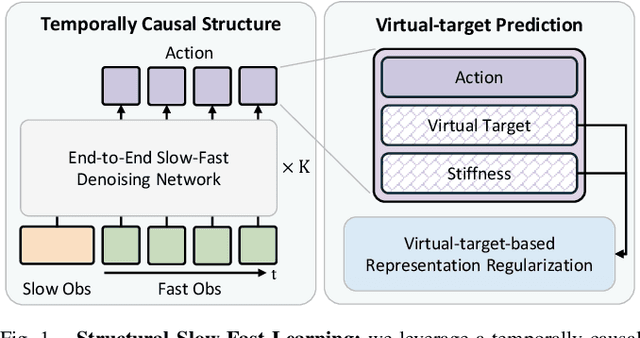
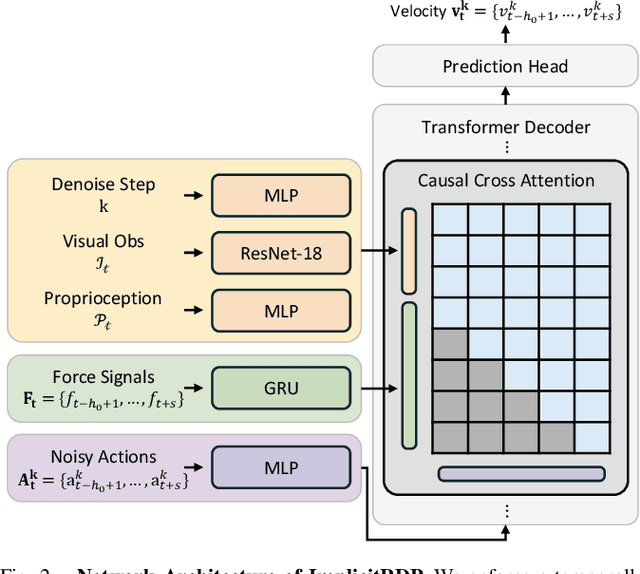
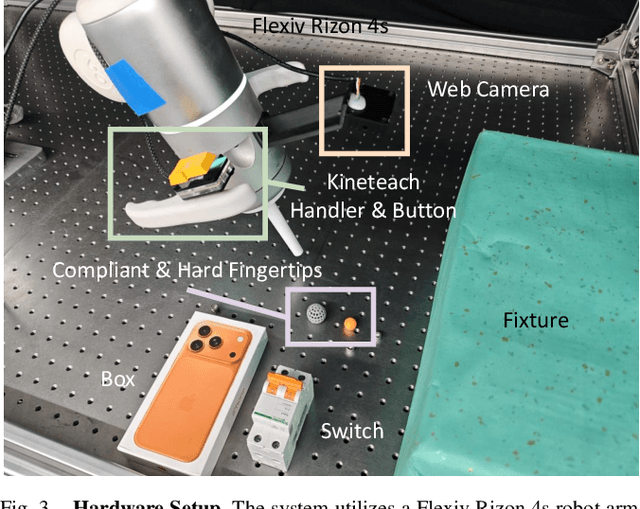

Human-level contact-rich manipulation relies on the distinct roles of two key modalities: vision provides spatially rich but temporally slow global context, while force sensing captures rapid, high-frequency local contact dynamics. Integrating these signals is challenging due to their fundamental frequency and informational disparities. In this work, we propose ImplicitRDP, a unified end-to-end visual-force diffusion policy that integrates visual planning and reactive force control within a single network. We introduce Structural Slow-Fast Learning, a mechanism utilizing causal attention to simultaneously process asynchronous visual and force tokens, allowing the policy to perform closed-loop adjustments at the force frequency while maintaining the temporal coherence of action chunks. Furthermore, to mitigate modality collapse where end-to-end models fail to adjust the weights across different modalities, we propose Virtual-target-based Representation Regularization. This auxiliary objective maps force feedback into the same space as the action, providing a stronger, physics-grounded learning signal than raw force prediction. Extensive experiments on contact-rich tasks demonstrate that ImplicitRDP significantly outperforms both vision-only and hierarchical baselines, achieving superior reactivity and success rates with a streamlined training pipeline. Code and videos will be publicly available at https://implicit-rdp.github.io.
DeformPAM: Data-Efficient Learning for Long-horizon Deformable Object Manipulation via Preference-based Action Alignment
Oct 15, 2024In recent years, imitation learning has made progress in the field of robotic manipulation. However, it still faces challenges when dealing with complex long-horizon deformable object tasks, such as high-dimensional state spaces, complex dynamics, and multimodal action distributions. Traditional imitation learning methods often require a large amount of data and encounter distributional shifts and accumulative errors in these tasks. To address these issues, we propose a data-efficient general learning framework (DeformPAM) based on preference learning and reward-guided action selection. DeformPAM decomposes long-horizon tasks into multiple action primitives, utilizes 3D point cloud inputs and diffusion models to model action distributions, and trains an implicit reward model using human preference data. During the inference phase, the reward model scores multiple candidate actions, selecting the optimal action for execution, thereby reducing the occurrence of anomalous actions and improving task completion quality. Experiments conducted on three challenging real-world long-horizon deformable object manipulation tasks demonstrate the effectiveness of this method. Results show that DeformPAM improves both task completion quality and efficiency compared to baseline methods even with limited data. Code and data will be available at https://deform-pam.robotflow.ai.