 Add to Chrome
 Add to Firefox
 Add to Edge
FA-RDP: A Frequency-Adaptive Reactive Diffusion Policy for Contact-Rich Manipulation
Jul 30, 2026
In contact-rich manipulation, action multimodality and reactivity dominate different stages of a single episode. Before contact, multiple trajectories might be equally valid, making it important to preserve diverse action modes. After contact, geometric constraints and force limits narrow the solution space, while successful execution demands rapid responses to force feedback. However, standard diffusion policies use a fixed inference frequency and sampling steps throughout the episode, forcing a fundamental compromise: low-frequency, multi-step sampling better preserves pre-contact multimodality but responds slowly to force feedback, whereas high-frequency sampling improves reactivity but tends to collapse distinct pre-contact modes. To resolve this tradeoff, we present FA-RDP, a frequency-adaptive reactive diffusion policy. A shared multi-frequency visual-force Transformer predicts action chunks at both low and high frequencies, while a learned multimodality indicator dynamically selects multi-step low-frequency sampling before contact and one-step high-frequency sampling as action ambiguity decreases. We further introduce Manifold Consistency Distillation (MCD), which reparameterizes the diffusion network to predict actions on the robot action manifold while retaining DDPM-based residual supervision. Experiments on three contact-rich manipulation tasks show that FA-RDP achieves the highest success rate while preserving diverse pre-contact trajectory modes. Code and videos are available at https://fa-rdp.github.io.

Asynchronous Multimodal Diffusion Policy Composition via Latency-Aware Guidance Fusion
Jul 19, 2026Diffusion policies have shown strong potential for robotic imitation learning, and recent extensions incorporate additional modalities to improve manipulation performance. However, these modalities often differ not only in information content but also in sensing rates and inference latencies. Existing multimodal diffusion policies typically rely on synchronous fusion or manually designed multi-frequency architectures, which either slow down high-frequency feedback or limit extensibility to new modality combinations. We propose LAG-Fusion, a latency-aware guidance fusion framework for asynchronous multimodal diffusion policy composition. LAG-Fusion allows modality-specific policies to operate at their native inference rates and contribute denoising guidance whenever available. To make asynchronous composition consistent, we derive a reference-frame rebasing rule for diffusion variables under relative action representations, enabling delayed guidance to be aligned before fusion. We instantiate LAG-Fusion in contact-rich manipulation by composing a low-frequency vision policy with a high-frequency force policy. Experiments under heterogeneous modality latencies show that LAG-Fusion improves policy responsiveness and task performance over synchronous fusion and specially designed force-aware baselines.
Force Policy: Learning Hybrid Force-Position Control Policy under Interaction Frame for Contact-Rich Manipulation
Feb 25, 2026Contact-rich manipulation demands human-like integration of perception and force feedback: vision should guide task progress, while high-frequency interaction control must stabilize contact under uncertainty. Existing learning-based policies often entangle these roles in a monolithic network, trading off global generalization against stable local refinement, while control-centric approaches typically assume a known task structure or learn only controller parameters rather than the structure itself. In this paper, we formalize a physically grounded interaction frame, an instantaneous local basis that decouples force regulation from motion execution, and propose a method to recover it from demonstrations. Based on this, we address both issues by proposing Force Policy, a global-local vision-force policy in which a global policy guides free-space actions using vision, and upon contact, a high-frequency local policy with force feedback estimates the interaction frame and executes hybrid force-position control for stable interaction. Real-world experiments across diverse contact-rich tasks show consistent gains over strong baselines, with more robust contact establishment, more accurate force regulation, and reliable generalization to novel objects with varied geometries and physical properties, ultimately improving both contact stability and execution quality. Project page: https://force-policy.github.io/
ImplicitRDP: An End-to-End Visual-Force Diffusion Policy with Structural Slow-Fast Learning
Dec 11, 2025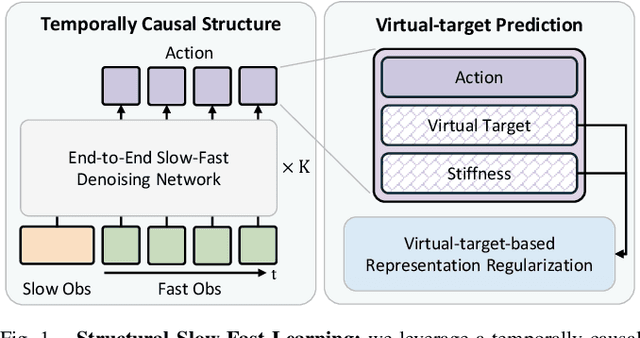
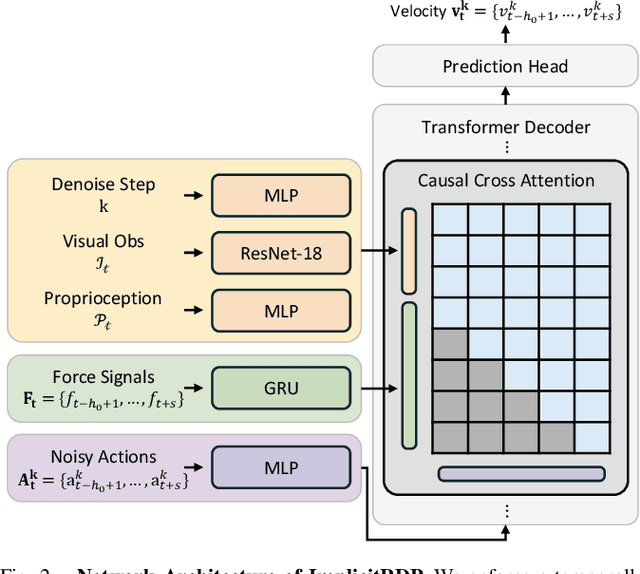
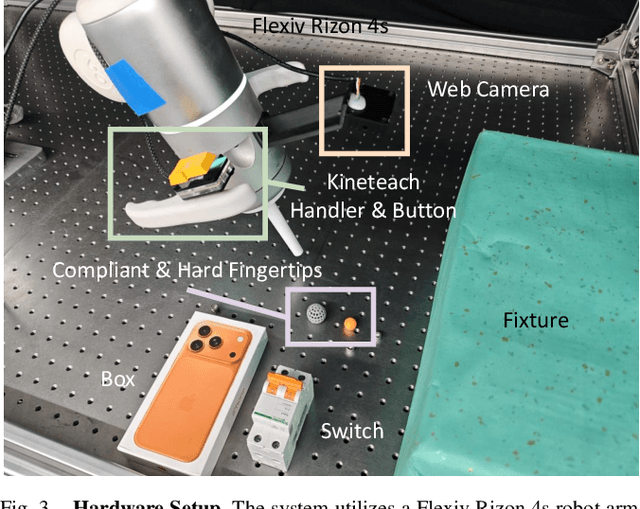

Human-level contact-rich manipulation relies on the distinct roles of two key modalities: vision provides spatially rich but temporally slow global context, while force sensing captures rapid, high-frequency local contact dynamics. Integrating these signals is challenging due to their fundamental frequency and informational disparities. In this work, we propose ImplicitRDP, a unified end-to-end visual-force diffusion policy that integrates visual planning and reactive force control within a single network. We introduce Structural Slow-Fast Learning, a mechanism utilizing causal attention to simultaneously process asynchronous visual and force tokens, allowing the policy to perform closed-loop adjustments at the force frequency while maintaining the temporal coherence of action chunks. Furthermore, to mitigate modality collapse where end-to-end models fail to adjust the weights across different modalities, we propose Virtual-target-based Representation Regularization. This auxiliary objective maps force feedback into the same space as the action, providing a stronger, physics-grounded learning signal than raw force prediction. Extensive experiments on contact-rich tasks demonstrate that ImplicitRDP significantly outperforms both vision-only and hierarchical baselines, achieving superior reactivity and success rates with a streamlined training pipeline. Code and videos will be publicly available at https://implicit-rdp.github.io.