 Add to Chrome
 Add to Firefox
 Add to Edge
ChronoFlow-Policy: Unifying Past-Current-Future Interaction Flow in Visuomotor Policy Learning
Jun 30, 2026
Visual signals play a crucial role in policy learning by enabling models to capture object motion and interaction dynamics. Just as humans reason about actions using both past experience and anticipated outcomes, effective policies should integrate past interactions with future predictions. However, existing visuomotor policies typically model either historical context or future dynamics in isolation, lacking a unified temporal representation of interaction dynamics. In this work, we introduce \textbf{ChronoFlow}, a temporally unified representation that captures \textbf{past, current, and future} interaction dynamics through sparse 3D keypoints of both objects and the gripper. Based on this representation, we propose \textbf{ChronoFlow-Policy}, a diffusion-based visuomotor policy that jointly learns ChronoFlow and action sequences through a co-training objective. Experiments on 14 simulated tasks and 5 real-world manipulation tasks demonstrate that ChronoFlow-Policy consistently outperforms strong diffusion-policy baselines and improves robustness in long-horizon and non-Markovian manipulation scenarios.

LIDEA: Human-to-Robot Imitation Learning via Implicit Feature Distillation and Explicit Geometry Alignment
Apr 12, 2026Scaling up robot learning is hindered by the scarcity of robotic demonstrations, whereas human videos offer a vast, untapped source of interaction data. However, bridging the embodiment gap between human hands and robot arms remains a critical challenge. Existing cross-embodiment transfer strategies typically rely on visual editing, but they often introduce visual artifacts due to intrinsic discrepancies in visual appearance and 3D geometry. To address these limitations, we introduce LIDEA (Implicit Feature Distillation and Explicit Geometric Alignment), an imitation learning framework in which policy learning benefits from human demonstrations. In the 2D visual domain, LIDEA employs a dual-stage transitive distillation pipeline that aligns human and robot representations in a shared latent space. In the 3D geometric domain, we propose an embodiment-agnostic alignment strategy that explicitly decouples embodiment from interaction geometry, ensuring consistent 3D-aware perception. Extensive experiments empirically validate LIDEA from two perspectives: data efficiency and OOD robustness. Results show that human data substitutes up to 80% of costly robot demonstrations, and the framework successfully transfers unseen patterns from human videos for out-of-distribution generalization.
LaMP: Learning Vision-Language-Action Policies with 3D Scene Flow as Latent Motion Prior
Mar 26, 2026We introduce \textbf{LaMP}, a dual-expert Vision-Language-Action framework that embeds dense 3D scene flow as a latent motion prior for robotic manipulation. Existing VLA models regress actions directly from 2D semantic visual features, forcing them to learn complex 3D physical interactions implicitly. This implicit learning strategy degrades under unfamiliar spatial dynamics. LaMP addresses this limitation by aligning a flow-matching \emph{Motion Expert} with a policy-predicting \emph{Action Expert} through gated cross-attention. Specifically, the Motion Expert generates a one-step partially denoised 3D scene flow, and its hidden states condition the Action Expert without full multi-step reconstruction. We evaluate LaMP on the LIBERO, LIBERO-Plus, and SimplerEnv-WidowX simulation benchmarks as well as real-world experiments. LaMP consistently outperforms evaluated VLA baselines across LIBERO, LIBERO-Plus, and SimplerEnv-WidowX benchmarks, achieving the highest reported average success rates under the same training budgets. On LIBERO-Plus OOD perturbations, LaMP shows improved robustness with an average 9.7% gain over the strongest prior baseline. Our project page is available at https://summerwxk.github.io/lamp-project-page/.
OmniCam: Unified Multimodal Video Generation via Camera Control
Apr 03, 2025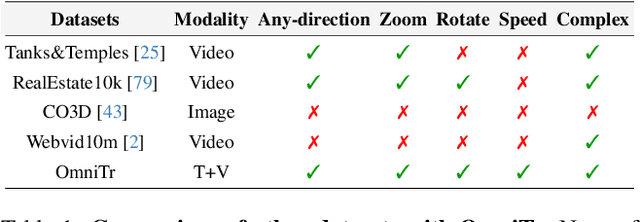
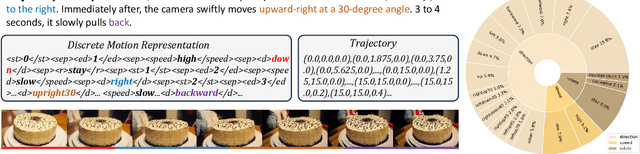
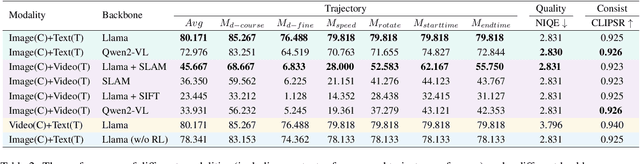
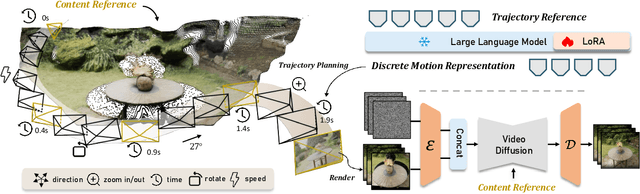
Camera control, which achieves diverse visual effects by changing camera position and pose, has attracted widespread attention. However, existing methods face challenges such as complex interaction and limited control capabilities. To address these issues, we present OmniCam, a unified multimodal camera control framework. Leveraging large language models and video diffusion models, OmniCam generates spatio-temporally consistent videos. It supports various combinations of input modalities: the user can provide text or video with expected trajectory as camera path guidance, and image or video as content reference, enabling precise control over camera motion. To facilitate the training of OmniCam, we introduce the OmniTr dataset, which contains a large collection of high-quality long-sequence trajectories, videos, and corresponding descriptions. Experimental results demonstrate that our model achieves state-of-the-art performance in high-quality camera-controlled video generation across various metrics.
Dense Policy: Bidirectional Autoregressive Learning of Actions
Mar 17, 2025Mainstream visuomotor policies predominantly rely on generative models for holistic action prediction, while current autoregressive policies, predicting the next token or chunk, have shown suboptimal results. This motivates a search for more effective learning methods to unleash the potential of autoregressive policies for robotic manipulation. This paper introduces a bidirectionally expanded learning approach, termed Dense Policy, to establish a new paradigm for autoregressive policies in action prediction. It employs a lightweight encoder-only architecture to iteratively unfold the action sequence from an initial single frame into the target sequence in a coarse-to-fine manner with logarithmic-time inference. Extensive experiments validate that our dense policy has superior autoregressive learning capabilities and can surpass existing holistic generative policies. Our policy, example data, and training code will be publicly available upon publication. Project page: https: //selen-suyue.github.io/DspNet/.
AirExo-2: Scaling up Generalizable Robotic Imitation Learning with Low-Cost Exoskeletons
Mar 05, 2025Scaling up imitation learning for real-world applications requires efficient and cost-effective demonstration collection methods. Current teleoperation approaches, though effective, are expensive and inefficient due to the dependency on physical robot platforms. Alternative data sources like in-the-wild demonstrations can eliminate the need for physical robots and offer more scalable solutions. However, existing in-the-wild data collection devices have limitations: handheld devices offer restricted in-hand camera observation, while whole-body devices often require fine-tuning with robot data due to action inaccuracies. In this paper, we propose AirExo-2, a low-cost exoskeleton system for large-scale in-the-wild demonstration collection. By introducing the demonstration adaptor to transform the collected in-the-wild demonstrations into pseudo-robot demonstrations, our system addresses key challenges in utilizing in-the-wild demonstrations for downstream imitation learning in real-world environments. Additionally, we present RISE-2, a generalizable policy that integrates 2D and 3D perceptions, outperforming previous imitation learning policies in both in-domain and out-of-domain tasks, even with limited demonstrations. By leveraging in-the-wild demonstrations collected and transformed by the AirExo-2 system, without the need for additional robot demonstrations, RISE-2 achieves comparable or superior performance to policies trained with teleoperated data, highlighting the potential of AirExo-2 for scalable and generalizable imitation learning. Project page: https://airexo.tech/airexo2
Motion Before Action: Diffusing Object Motion as Manipulation Condition
Nov 14, 2024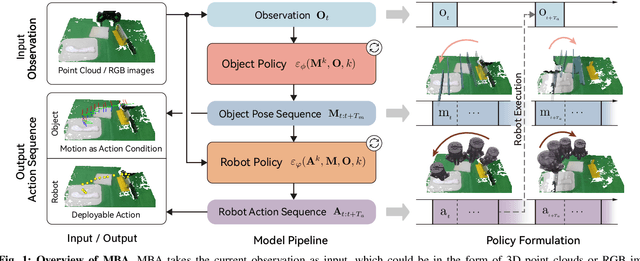

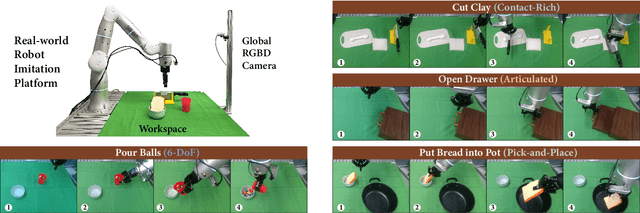
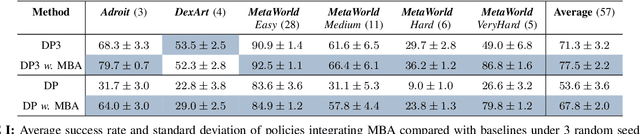
Inferring object motion representations from observations enhances the performance of robotic manipulation tasks. This paper introduces a new paradigm for robot imitation learning that generates action sequences by reasoning about object motion from visual observations. We propose MBA (Motion Before Action), a novel module that employs two cascaded diffusion processes for object motion generation and robot action generation under object motion guidance. MBA first predicts the future pose sequence of the object based on observations, then uses this sequence as a condition to guide robot action generation. Designed as a plug-and-play component, MBA can be flexibly integrated into existing robotic manipulation policies with diffusion action heads. Extensive experiments in both simulated and real-world environments demonstrate that our approach substantially improves the performance of existing policies across a wide range of manipulation tasks.
Multi-view Hand Reconstruction with a Point-Embedded Transformer
Aug 20, 2024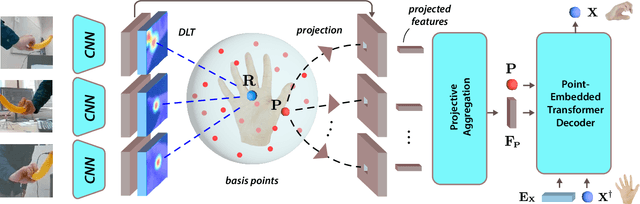
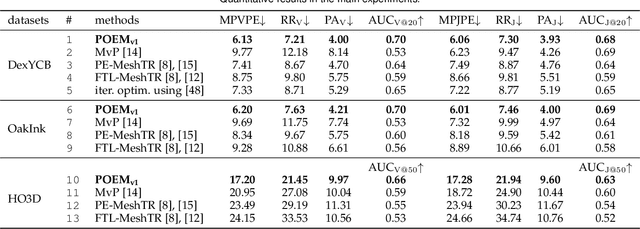
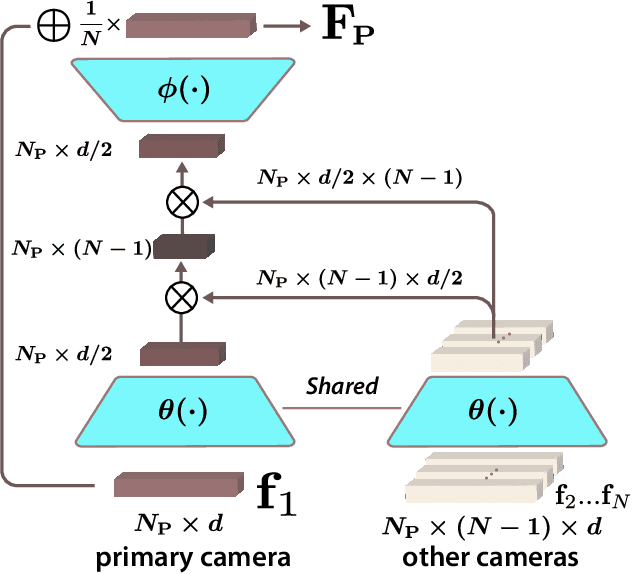
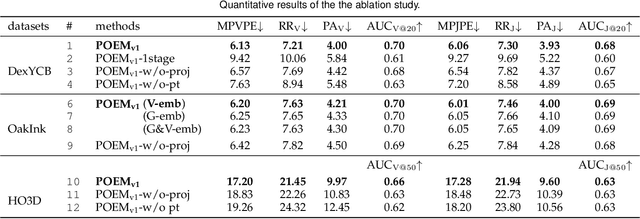
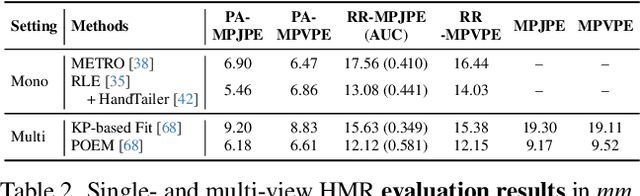
This work introduces a novel and generalizable multi-view Hand Mesh Reconstruction (HMR) model, named POEM, designed for practical use in real-world hand motion capture scenarios. The advances of the POEM model consist of two main aspects. First, concerning the modeling of the problem, we propose embedding a static basis point within the multi-view stereo space. A point represents a natural form of 3D information and serves as an ideal medium for fusing features across different views, given its varied projections across these views. Consequently, our method harnesses a simple yet effective idea: a complex 3D hand mesh can be represented by a set of 3D basis points that 1) are embedded in the multi-view stereo, 2) carry features from the multi-view images, and 3) encompass the hand in it. The second advance lies in the training strategy. We utilize a combination of five large-scale multi-view datasets and employ randomization in the number, order, and poses of the cameras. By processing such a vast amount of data and a diverse array of camera configurations, our model demonstrates notable generalizability in the real-world applications. As a result, POEM presents a highly practical, plug-and-play solution that enables user-friendly, cost-effective multi-view motion capture for both left and right hands. The model and source codes are available at https://github.com/JubSteven/POEM-v2.
OAKINK2: A Dataset of Bimanual Hands-Object Manipulation in Complex Task Completion
Mar 28, 2024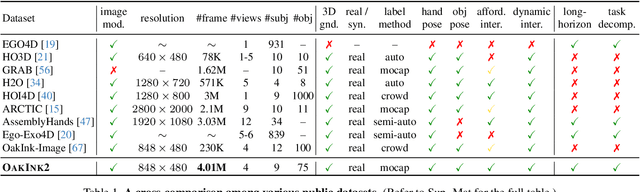
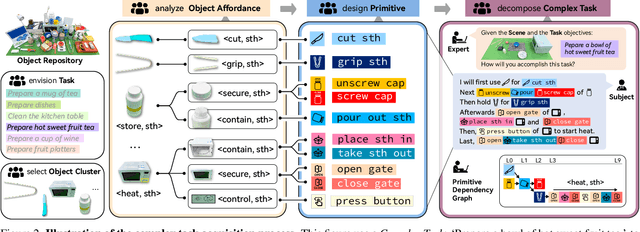
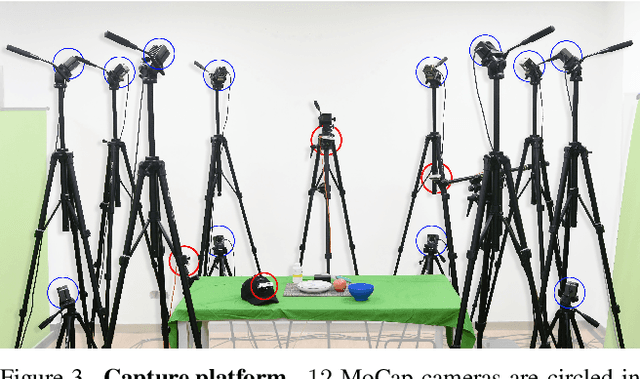
We present OAKINK2, a dataset of bimanual object manipulation tasks for complex daily activities. In pursuit of constructing the complex tasks into a structured representation, OAKINK2 introduces three level of abstraction to organize the manipulation tasks: Affordance, Primitive Task, and Complex Task. OAKINK2 features on an object-centric perspective for decoding the complex tasks, treating them as a sequence of object affordance fulfillment. The first level, Affordance, outlines the functionalities that objects in the scene can afford, the second level, Primitive Task, describes the minimal interaction units that humans interact with the object to achieve its affordance, and the third level, Complex Task, illustrates how Primitive Tasks are composed and interdependent. OAKINK2 dataset provides multi-view image streams and precise pose annotations for the human body, hands and various interacting objects. This extensive collection supports applications such as interaction reconstruction and motion synthesis. Based on the 3-level abstraction of OAKINK2, we explore a task-oriented framework for Complex Task Completion (CTC). CTC aims to generate a sequence of bimanual manipulation to achieve task objectives. Within the CTC framework, we employ Large Language Models (LLMs) to decompose the complex task objectives into sequences of Primitive Tasks and have developed a Motion Fulfillment Model that generates bimanual hand motion for each Primitive Task. OAKINK2 datasets and models are available at https://oakink.net/v2.
CHORD: Category-level Hand-held Object Reconstruction via Shape Deformation
Aug 21, 2023
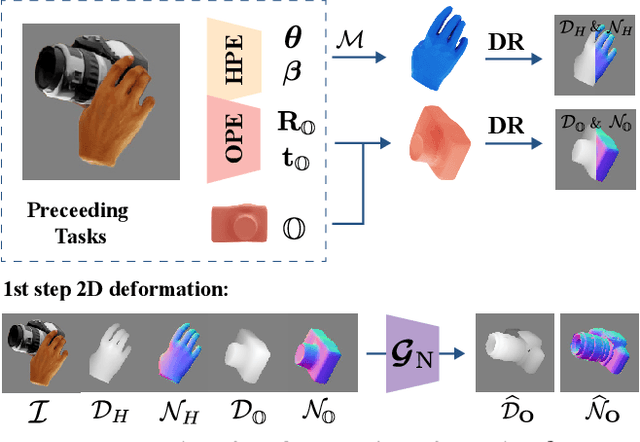
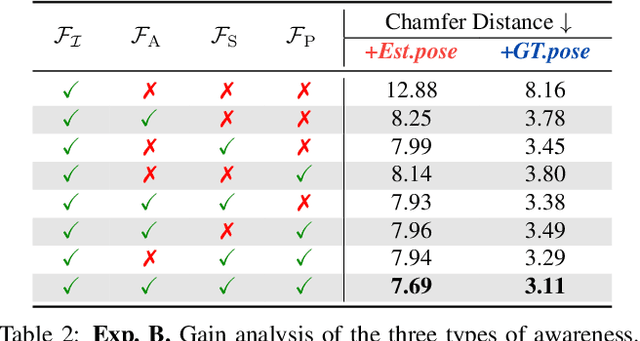

In daily life, humans utilize hands to manipulate objects. Modeling the shape of objects that are manipulated by the hand is essential for AI to comprehend daily tasks and to learn manipulation skills. However, previous approaches have encountered difficulties in reconstructing the precise shapes of hand-held objects, primarily owing to a deficiency in prior shape knowledge and inadequate data for training. As illustrated, given a particular type of tool, such as a mug, despite its infinite variations in shape and appearance, humans have a limited number of 'effective' modes and poses for its manipulation. This can be attributed to the fact that humans have mastered the shape prior of the 'mug' category, and can quickly establish the corresponding relations between different mug instances and the prior, such as where the rim and handle are located. In light of this, we propose a new method, CHORD, for Category-level Hand-held Object Reconstruction via shape Deformation. CHORD deforms a categorical shape prior for reconstructing the intra-class objects. To ensure accurate reconstruction, we empower CHORD with three types of awareness: appearance, shape, and interacting pose. In addition, we have constructed a new dataset, COMIC, of category-level hand-object interaction. COMIC contains a rich array of object instances, materials, hand interactions, and viewing directions. Extensive evaluation shows that CHORD outperforms state-of-the-art approaches in both quantitative and qualitative measures. Code, model, and datasets are available at https://kailinli.github.io/CHORD.