 Add to Chrome
 Add to Firefox
 Add to Edge
HumanTracker: Towards Comprehensive and Human-Aligned Motion Tracking Benchmark
Aug 13, 2026
Humanoid motion tracking is central to teleoperation and whole-body imitation, yet evaluation often disagrees with what people perceive in videos. Kinematic errors average per-frame pose differences but miss the physical artifacts that matter most, particularly unstable support and incorrect contacts such as foot skating and mistimed touch-downs. Meanwhile, widely used test suites are small and lack the diversity needed to stress contact-rich, long-horizon behaviors. We introduce HumanTracker to make humanoid tracking evaluation both perceptually aligned and scalable. The HumanTracker benchmark contains approximately 153 hours of optical motion trajectories from multiple professional performers, organized into four motion families with text labels for fine-grained diagnosis. We further propose HumanScore, a preference-aligned metric trained on 12K motion pairs containing 24K motions. Across representative state-of-the-art trackers, HumanScore better predicts human preferences and reveals contact and stability failures that kinematic metrics often miss.

LIMMT: Less is More for Motion Tracking
Jun 05, 2026We argue that high-quality motion data can steer tracking policies toward better optimization trajectories early in training. In this work, we introduce LIMMT (Less Is More for Motion Tracking). To our knowledge, this is the first data-centric study for physics-based humanoid motion tracking. We go beyond simply removing low-quality and erroneous clips, but define motion data quality through three dimensions: physics feasibility, diversity, and complexity. We show that even training with under 3% of AMASS yields better tracking performance than training with the full dataset. We further conduct data cleaning on the estimated web-sourced mocap data. Extensive experiments and analyses validate the effectiveness of our framework.
Humanoid-GPT: Scaling Data and Structure for Zero-Shot Motion Tracking
Jun 02, 2026We introduce Humanoid-GPT, a GPT-style Transformer with causal attention trained on a billion-scale motion corpus for whole-body control. Unlike prior shallow MLP trackers constrained by scarce data and an agility-generalization trade-off, Humanoid-GPT is pre-trained on a 2B-frame retargeted corpus that unifies all major mocap datasets with large-scale in-house recordings. Scaling both data and model capacity yields a single generative Transformer that tracks highly dynamic behaviors while achieving unprecedented zero-shot generalization to unseen motions and control tasks. Extensive experiments and scaling analyses show that our model establishes a new performance frontier, demonstrating robust zero-shot generalization to unseen tasks while simultaneously tracking highly dynamic and complex motions.
Learning Athletic Humanoid Tennis Skills from Imperfect Human Motion Data
Mar 13, 2026Human athletes demonstrate versatile and highly-dynamic tennis skills to successfully conduct competitive rallies with a high-speed tennis ball. However, reproducing such behaviors on humanoid robots is difficult, partially due to the lack of perfect humanoid action data or human kinematic motion data in tennis scenarios as reference. In this work, we propose LATENT, a system that Learns Athletic humanoid TEnnis skills from imperfect human motioN daTa. The imperfect human motion data consist only of motion fragments that capture the primitive skills used when playing tennis rather than precise and complete human-tennis motion sequences from real-world tennis matches, thereby significantly reducing the difficulty of data collection. Our key insight is that, despite being imperfect, such quasi-realistic data still provide priors about human primitive skills in tennis scenarios. With further correction and composition, we learn a humanoid policy that can consistently strike incoming balls under a wide range of conditions and return them to target locations, while preserving natural motion styles. We also propose a series of designs for robust sim-to-real transfer and deploy our policy on the Unitree G1 humanoid robot. Our method achieves surprising results in the real world and can stably sustain multi-shot rallies with human players. Project page: https://zzk273.github.io/LATENT/
Track Any Motions under Any Disturbances
Sep 17, 2025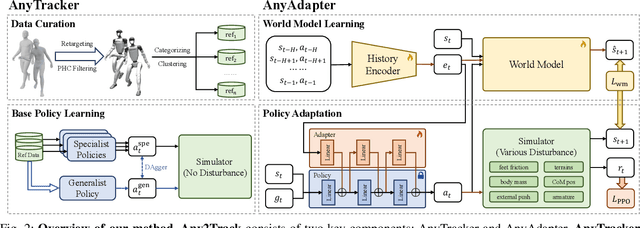

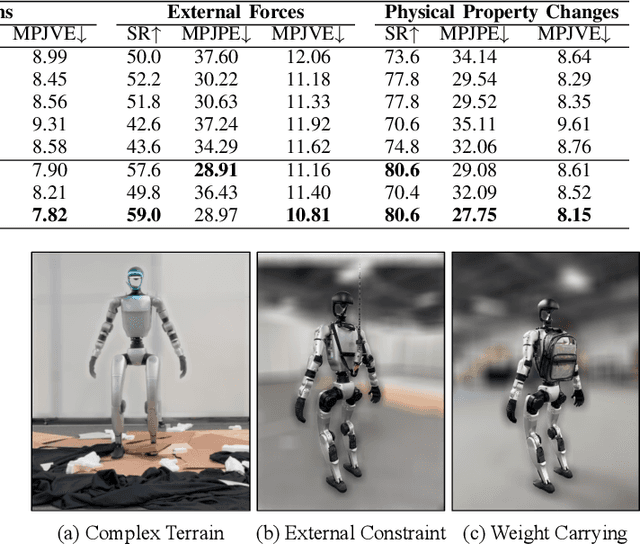

A foundational humanoid motion tracker is expected to be able to track diverse, highly dynamic, and contact-rich motions. More importantly, it needs to operate stably in real-world scenarios against various dynamics disturbances, including terrains, external forces, and physical property changes for general practical use. To achieve this goal, we propose Any2Track (Track Any motions under Any disturbances), a two-stage RL framework to track various motions under multiple disturbances in the real world. Any2Track reformulates dynamics adaptability as an additional capability on top of basic action execution and consists of two key components: AnyTracker and AnyAdapter. AnyTracker is a general motion tracker with a series of careful designs to track various motions within a single policy. AnyAdapter is a history-informed adaptation module that endows the tracker with online dynamics adaptability to overcome the sim2real gap and multiple real-world disturbances. We deploy Any2Track on Unitree G1 hardware and achieve a successful sim2real transfer in a zero-shot manner. Any2Track performs exceptionally well in tracking various motions under multiple real-world disturbances.
Parallel Branch Model Predictive Control on GPUs
Jun 16, 2025We present a parallel GPU-accelerated solver for branch Model Predictive Control problems. Based on iterative LQR methods, our solver exploits the tree-sparse structure and implements temporal parallelism using the parallel scan algorithm. Consequently, the proposed solver enables parallelism across both the prediction horizon and the scenarios. In addition, we utilize an augmented Lagrangian method to handle general inequality constraints. We compare our solver with state-of-the-art numerical solvers in two automated driving applications. The numerical results demonstrate that, compared to CPU-based solvers, our solver achieves competitive performance for problems with short horizons and small-scale trees, while outperforming other solvers on large-scale problems.