 Add to Chrome
 Add to Firefox
 Add to Edge
Beyond Cross-Validation: Adaptive Parameter Selection for Kernel-Based Gradient Descents
Mar 03, 2026
This paper proposes a novel parameter selection strategy for kernel-based gradient descent (KGD) algorithms, integrating bias-variance analysis with the splitting method. We introduce the concept of empirical effective dimension to quantify iteration increments in KGD, deriving an adaptive parameter selection strategy that is implementable. Theoretical verifications are provided within the framework of learning theory. Utilizing the recently developed integral operator approach, we rigorously demonstrate that KGD, equipped with the proposed adaptive parameter selection strategy, achieves the optimal generalization error bound and adapts effectively to different kernels, target functions, and error metrics. Consequently, this strategy showcases significant advantages over existing parameter selection methods for KGD.

Towards Accurate and Interpretable Time-series Forecasting: A Polynomial Learning Approach
Mar 03, 2026Time series forecasting enables early warning and has driven asset performance management from traditional planned maintenance to predictive maintenance. However, the lack of interpretability in forecasting methods undermines users' trust and complicates debugging for developers. Consequently, interpretable time-series forecasting has attracted increasing research attention. Nevertheless, existing methods suffer from several limitations, including insufficient modeling of temporal dependencies, lack of feature-level interpretability to support early warning, and difficulty in simultaneously achieving the accuracy and interpretability. This paper proposes the interpretable polynomial learning (IPL) method, which integrates interpretability into the model structure by explicitly modeling original features and their interactions of arbitrary order through polynomial representations. This design preserves temporal dependencies, provides feature-level interpretability, and offers a flexible trade-off between prediction accuracy and interpretability by adjusting the polynomial degree. We evaluate IPL on simulated and Bitcoin price data, showing that it achieves high prediction accuracy with superior interpretability compared with widely used explainability methods. Experiments on field-collected antenna data further demonstrate that IPL yields simpler and more efficient early warning mechanisms.
Rethinking Camera Choice: An Empirical Study on Fisheye Camera Properties in Robotic Manipulation
Mar 02, 2026The adoption of fisheye cameras in robotic manipulation, driven by their exceptionally wide Field of View (FoV), is rapidly outpacing a systematic understanding of their downstream effects on policy learning. This paper presents the first comprehensive empirical study to bridge this gap, rigorously analyzing the properties of wrist-mounted fisheye cameras for imitation learning. Through extensive experiments in both simulation and the real world, we investigate three critical research questions: spatial localization, scene generalization, and hardware generalization. Our investigation reveals that: (1) The wide FoV significantly enhances spatial localization, but this benefit is critically contingent on the visual complexity of the environment. (2) Fisheye-trained policies, while prone to overfitting in simple scenes, unlock superior scene generalization when trained with sufficient environmental diversity. (3) While naive cross-camera transfer leads to failures, we identify the root cause as scale overfitting and demonstrate that hardware generalization performance can be improved with a simple Random Scale Augmentation (RSA) strategy. Collectively, our findings provide concrete, actionable guidance for the large-scale collection and effective use of fisheye datasets in robotic learning. More results and videos are available on https://robo-fisheye.github.io/
Two-Stage Data Synthesization: A Statistics-Driven Restricted Trade-off between Privacy and Prediction
Feb 09, 2026Synthetic data have gained increasing attention across various domains, with a growing emphasis on their performance in downstream prediction tasks. However, most existing synthesis strategies focus on maintaining statistical information. Although some studies address prediction performance guarantees, their single-stage synthesis designs make it challenging to balance the privacy requirements that necessitate significant perturbations and the prediction performance that is sensitive to such perturbations. We propose a two-stage synthesis strategy. In the first stage, we introduce a synthesis-then-hybrid strategy, which involves a synthesis operation to generate pure synthetic data, followed by a hybrid operation that fuses the synthetic data with the original data. In the second stage, we present a kernel ridge regression (KRR)-based synthesis strategy, where a KRR model is first trained on the original data and then used to generate synthetic outputs based on the synthetic inputs produced in the first stage. By leveraging the theoretical strengths of KRR and the covariant distribution retention achieved in the first stage, our proposed two-stage synthesis strategy enables a statistics-driven restricted privacy--prediction trade-off and guarantee optimal prediction performance. We validate our approach and demonstrate its characteristics of being statistics-driven and restricted in achieving the privacy--prediction trade-off both theoretically and numerically. Additionally, we showcase its generalizability through applications to a marketing problem and five real-world datasets.
Drive-JEPA: Video JEPA Meets Multimodal Trajectory Distillation for End-to-End Driving
Jan 29, 2026End-to-end autonomous driving increasingly leverages self-supervised video pretraining to learn transferable planning representations. However, pretraining video world models for scene understanding has so far brought only limited improvements. This limitation is compounded by the inherent ambiguity of driving: each scene typically provides only a single human trajectory, making it difficult to learn multimodal behaviors. In this work, we propose Drive-JEPA, a framework that integrates Video Joint-Embedding Predictive Architecture (V-JEPA) with multimodal trajectory distillation for end-to-end driving. First, we adapt V-JEPA for end-to-end driving, pretraining a ViT encoder on large-scale driving videos to produce predictive representations aligned with trajectory planning. Second, we introduce a proposal-centric planner that distills diverse simulator-generated trajectories alongside human trajectories, with a momentum-aware selection mechanism to promote stable and safe behavior. When evaluated on NAVSIM, the V-JEPA representation combined with a simple transformer-based decoder outperforms prior methods by 3 PDMS in the perception-free setting. The complete Drive-JEPA framework achieves 93.3 PDMS on v1 and 87.8 EPDMS on v2, setting a new state-of-the-art.
Will It Zero-Shot?: Predicting Zero-Shot Classification Performance For Arbitrary Queries
Jan 27, 2026Vision-Language Models like CLIP create aligned embedding spaces for text and images, making it possible for anyone to build a visual classifier by simply naming the classes they want to distinguish. However, a model that works well in one domain may fail in another, and non-expert users have no straightforward way to assess whether their chosen VLM will work on their problem. We build on prior work using text-only comparisons to evaluate how well a model works for a given natural language task, and explore approaches that also generate synthetic images relevant to that task to evaluate and refine the prediction of zero-shot accuracy. We show that generated imagery to the baseline text-only scores substantially improves the quality of these predictions. Additionally, it gives a user feedback on the kinds of images that were used to make the assessment. Experiments on standard CLIP benchmark datasets demonstrate that the image-based approach helps users predict, without any labeled examples, whether a VLM will be effective for their application.
Will It Zero-Shot?: Will It Zero-Shot?: Predicting Zero-Shot Classification Performance For Arbitrary Queries
Jan 24, 2026Vision-Language Models like CLIP create aligned embedding spaces for text and images, making it possible for anyone to build a visual classifier by simply naming the classes they want to distinguish. However, a model that works well in one domain may fail in another, and non-expert users have no straightforward way to assess whether their chosen VLM will work on their problem. We build on prior work using text-only comparisons to evaluate how well a model works for a given natural language task, and explore approaches that also generate synthetic images relevant to that task to evaluate and refine the prediction of zero-shot accuracy. We show that generated imagery to the baseline text-only scores substantially improves the quality of these predictions. Additionally, it gives a user feedback on the kinds of images that were used to make the assessment. Experiments on standard CLIP benchmark datasets demonstrate that the image-based approach helps users predict, without any labeled examples, whether a VLM will be effective for their application.
Vision-based Wearable Steering Assistance for People with Impaired Vision in Jogging
Aug 01, 2024


Outdoor sports pose a challenge for people with impaired vision. The demand for higher-speed mobility inspired us to develop a vision-based wearable steering assistance. To ensure broad applicability, we focused on a representative sports environment, the athletics track. Our efforts centered on improving the speed and accuracy of perception, enhancing planning adaptability for the real world, and providing swift and safe assistance for people with impaired vision. In perception, we engineered a lightweight multitask network capable of simultaneously detecting track lines and obstacles. Additionally, due to the limitations of existing datasets for supporting multi-task detection in athletics tracks, we diligently collected and annotated a new dataset (MAT) containing 1000 images. In planning, we integrated the methods of sampling and spline curves, addressing the planning challenges of curves. Meanwhile, we utilized the positions of the track lines and obstacles as constraints to guide people with impaired vision safely along the current track. Our system is deployed on an embedded device, Jetson Orin NX. Through outdoor experiments, it demonstrated adaptability in different sports scenarios, assisting users in achieving free movement of 400-meter at an average speed of 1.34 m/s, meeting the level of normal people in jogging. Our MAT dataset is publicly available from https://github.com/snoopy-l/MAT
Weighted Spectral Filters for Kernel Interpolation on Spheres: Estimates of Prediction Accuracy for Noisy Data
Jan 16, 2024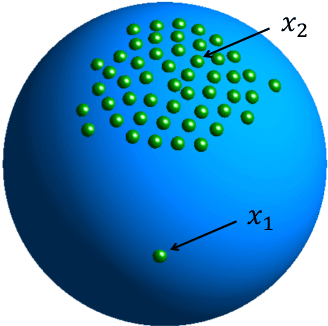
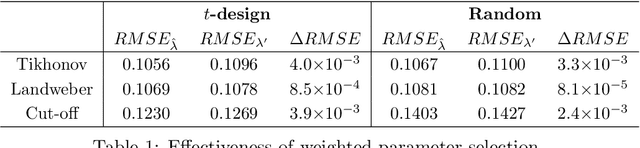
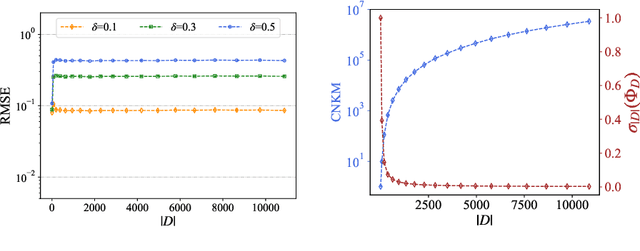
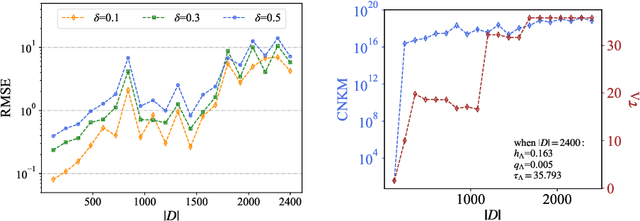
Spherical radial-basis-based kernel interpolation abounds in image sciences including geophysical image reconstruction, climate trends description and image rendering due to its excellent spatial localization property and perfect approximation performance. However, in dealing with noisy data, kernel interpolation frequently behaves not so well due to the large condition number of the kernel matrix and instability of the interpolation process. In this paper, we introduce a weighted spectral filter approach to reduce the condition number of the kernel matrix and then stabilize kernel interpolation. The main building blocks of the proposed method are the well developed spherical positive quadrature rules and high-pass spectral filters. Using a recently developed integral operator approach for spherical data analysis, we theoretically demonstrate that the proposed weighted spectral filter approach succeeds in breaking through the bottleneck of kernel interpolation, especially in fitting noisy data. We provide optimal approximation rates of the new method to show that our approach does not compromise the predicting accuracy. Furthermore, we conduct both toy simulations and two real-world data experiments with synthetically added noise in geophysical image reconstruction and climate image processing to verify our theoretical assertions and show the feasibility of the weighted spectral filter approach.
Data Drift Monitoring for Log Anomaly Detection Pipelines
Oct 17, 2023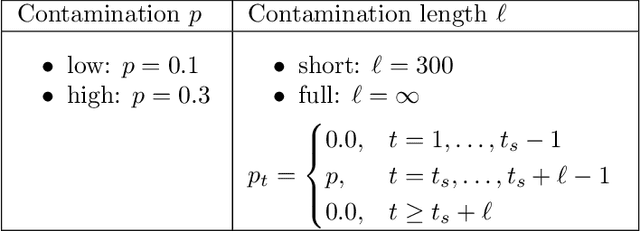
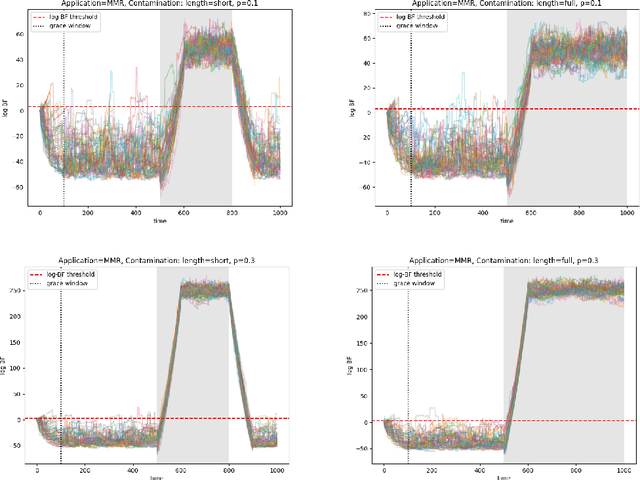
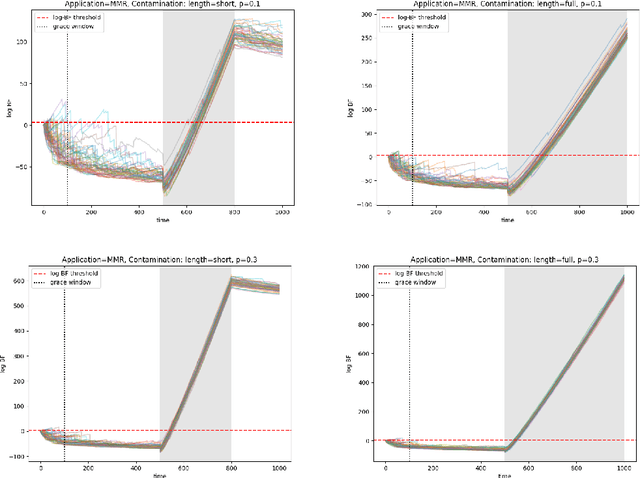
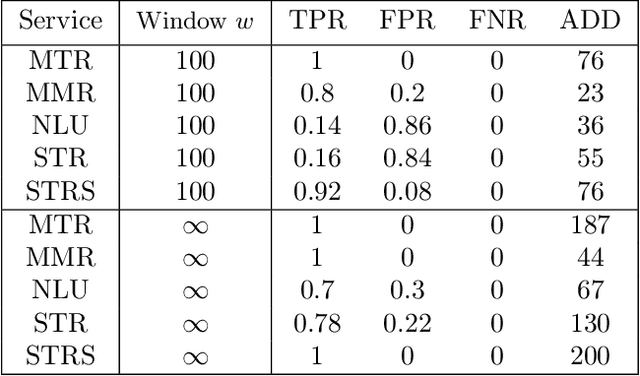
Logs enable the monitoring of infrastructure status and the performance of associated applications. Logs are also invaluable for diagnosing the root causes of any problems that may arise. Log Anomaly Detection (LAD) pipelines automate the detection of anomalies in logs, providing assistance to site reliability engineers (SREs) in system diagnosis. Log patterns change over time, necessitating updates to the LAD model defining the `normal' log activity profile. In this paper, we introduce a Bayes Factor-based drift detection method that identifies when intervention, retraining, and updating of the LAD model are required with human involvement. We illustrate our method using sequences of log activity, both from unaltered data, and simulated activity with controlled levels of anomaly contamination, based on real collected log data.