 Add to Chrome
 Add to Firefox
 Add to Edge
Intern-S2-Preview: Scientific Agentic Foundation Model
Aug 13, 2026
Scientific discovery increasingly requires AI systems that can reason over scientific evidence of heterogeneous modalities, interact with scientific tools and environments, and sustain progress across long task horizons. We present Intern-S2-Preview, a series of scientific agentic foundation models designed to support multimodal scientific understanding, reasoning, generation, and long-horizon tasks. The training pipeline begins with scientific multimodal pre-training over rendered scientific documents, interleaved image-text data, and diverse scientific corpora. Starting from the pretrained checkpoint, we apply a unified post-training pipeline consisting of supervised fine-tuning, scalable multi-task reinforcement learning (RL), black- and white-box agentic RL, and on-policy distillation. This pipeline is supported by practical techniques that improve rollout and training stability and efficiency, including partial rollout with off-policy correction, adaptive length regularization, online speculative decoding, robust multi-task optimization, and trace-aware experience assembly for agentic tasks. At the architecture level, Intern-S2-Preview-397B extends time series modelling from efficient long-sequence understanding to numerical forecasting, while Memory Decoder is studied as a separate memory-augmented path for rapid scientific specialization without modifying the frozen 397B backbone. Evaluations across scientific, multimodal, agentic, and general-purpose benchmarks show that Intern-S2-Preview-397B achieves competitive or leading results in multiple settings. The time series modules improve scientific signal understanding and forecasting on SciTS, while the separate Intern-MemDec-4B extension improves the Biology-Instructions average score from 56.92 to 60.32 without modifying the frozen 397B backbone.

Scalable Visual Pretraining for Language Intelligence
Jul 10, 2026The rapid progress of large foundation models has been driven predominantly by pretraining on large-scale text corpora. However, many forms of knowledge are conveyed through visual representations, where figures, typeset equations, and page layouts carry rich information that cannot be faithfully or completely captured by text alone. Yet current pretraining approaches discard these visual cues by converting visually rich sources, such as documents and web pages, into plain text for learning language intelligence. This paper challenges the default assumption that language models must be trained on text-only representations and shows that Visual Pretraining is a scalable learner for foundation model intelligence. To this end, we conduct a systematic study of unsupervised visual pretraining paradigms that directly leverage visual documents without text extraction. Across multiple backbones and benchmarks, visual pretraining on the same underlying corpora consistently outperforms text-only pretraining, offering an efficient pathway to scalable language intelligence.
DynaHOI: Benchmarking Hand-Object Interaction for Dynamic Target
Feb 12, 2026Most existing hand motion generation benchmarks for hand-object interaction (HOI) focus on static objects, leaving dynamic scenarios with moving targets and time-critical coordination largely untested. To address this gap, we introduce the DynaHOI-Gym, a unified online closed-loop platform with parameterized motion generators and rollout-based metrics for dynamic capture evaluation. Built on DynaHOI-Gym, we release DynaHOI-10M, a large-scale benchmark with 10M frames and 180K hand capture trajectories, whose target motions are organized into 8 major categories and 22 fine-grained subcategories. We also provide a simple observe-before-act baseline (ObAct) that integrates short-term observations with the current frame via spatiotemporal attention to predict actions, achieving an 8.1% improvement in location success rate.
$M^3-Verse$: A "Spot the Difference" Challenge for Large Multimodal Models
Dec 21, 2025Modern Large Multimodal Models (LMMs) have demonstrated extraordinary ability in static image and single-state spatial-temporal understanding. However, their capacity to comprehend the dynamic changes of objects within a shared spatial context between two distinct video observations, remains largely unexplored. This ability to reason about transformations within a consistent environment is particularly crucial for advancements in the field of spatial intelligence. In this paper, we introduce $M^3-Verse$, a Multi-Modal, Multi-State, Multi-Dimensional benchmark, to formally evaluate this capability. It is built upon paired videos that provide multi-perspective observations of an indoor scene before and after a state change. The benchmark contains a total of 270 scenes and 2,932 questions, which are categorized into over 50 subtasks that probe 4 core capabilities. We evaluate 16 state-of-the-art LMMs and observe their limitations in tracking state transitions. To address these challenges, we further propose a simple yet effective baseline that achieves significant performance improvements in multi-state perception. $M^3-Verse$ thus provides a challenging new testbed to catalyze the development of next-generation models with a more holistic understanding of our dynamic visual world. You can get the construction pipeline from https://github.com/Wal-K-aWay/M3-Verse_pipeline and full benchmark data from https://www.modelscope.cn/datasets/WalKaWay/M3-Verse.
RIG: Synergizing Reasoning and Imagination in End-to-End Generalist Policy
Mar 31, 2025Reasoning before action and imagining potential outcomes (i.e., world models) are essential for embodied agents operating in complex open-world environments. Yet, prior work either incorporates only one of these abilities in an end-to-end agent or integrates multiple specialized models into an agent system, limiting the learning efficiency and generalization of the policy. Thus, this paper makes the first attempt to synergize Reasoning and Imagination in an end-to-end Generalist policy, termed RIG. To train RIG in an end-to-end manner, we construct a data pipeline that progressively integrates and enriches the content of imagination and reasoning in the trajectories collected from existing agents. The joint learning of reasoning and next image generation explicitly models the inherent correlation between reasoning, action, and dynamics of environments, and thus exhibits more than $17\times$ sample efficiency improvements and generalization in comparison with previous works. During inference, RIG first reasons about the next action, produces potential action, and then predicts the action outcomes, which offers the agent a chance to review and self-correct based on the imagination before taking real actions. Experimental results show that the synergy of reasoning and imagination not only improves the robustness, generalization, and interoperability of generalist policy but also enables test-time scaling to enhance overall performance.
Ego3DT: Tracking Every 3D Object in Ego-centric Videos
Oct 11, 2024
The growing interest in embodied intelligence has brought ego-centric perspectives to contemporary research. One significant challenge within this realm is the accurate localization and tracking of objects in ego-centric videos, primarily due to the substantial variability in viewing angles. Addressing this issue, this paper introduces a novel zero-shot approach for the 3D reconstruction and tracking of all objects from the ego-centric video. We present Ego3DT, a novel framework that initially identifies and extracts detection and segmentation information of objects within the ego environment. Utilizing information from adjacent video frames, Ego3DT dynamically constructs a 3D scene of the ego view using a pre-trained 3D scene reconstruction model. Additionally, we have innovated a dynamic hierarchical association mechanism for creating stable 3D tracking trajectories of objects in ego-centric videos. Moreover, the efficacy of our approach is corroborated by extensive experiments on two newly compiled datasets, with 1.04x - 2.90x in HOTA, showcasing the robustness and accuracy of our method in diverse ego-centric scenarios.
STEVE Series: Step-by-Step Construction of Agent Systems in Minecraft
Jun 17, 2024Building an embodied agent system with a large language model (LLM) as its core is a promising direction. Due to the significant costs and uncontrollable factors associated with deploying and training such agents in the real world, we have decided to begin our exploration within the Minecraft environment. Our STEVE Series agents can complete basic tasks in a virtual environment and more challenging tasks such as navigation and even creative tasks, with an efficiency far exceeding previous state-of-the-art methods by a factor of $2.5\times$ to $7.3\times$. We begin our exploration with a vanilla large language model, augmenting it with a vision encoder and an action codebase trained on our collected high-quality dataset STEVE-21K. Subsequently, we enhanced it with a Critic and memory to transform it into a complex system. Finally, we constructed a hierarchical multi-agent system. Our recent work explored how to prune the agent system through knowledge distillation. In the future, we will explore more potential applications of STEVE agents in the real world.
CityCraft: A Real Crafter for 3D City Generation
Jun 07, 2024


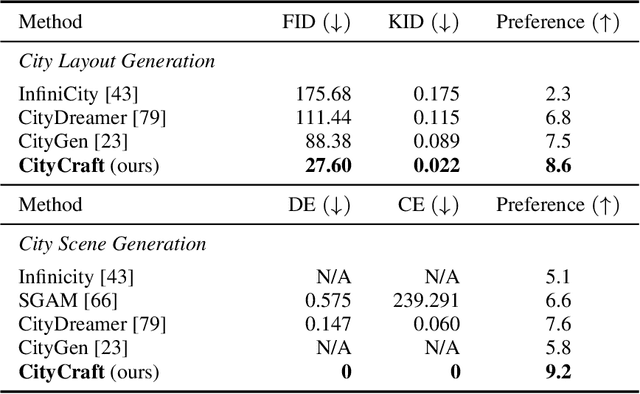
City scene generation has gained significant attention in autonomous driving, smart city development, and traffic simulation. It helps enhance infrastructure planning and monitoring solutions. Existing methods have employed a two-stage process involving city layout generation, typically using Variational Autoencoders (VAEs), Generative Adversarial Networks (GANs), or Transformers, followed by neural rendering. These techniques often exhibit limited diversity and noticeable artifacts in the rendered city scenes. The rendered scenes lack variety, resembling the training images, resulting in monotonous styles. Additionally, these methods lack planning capabilities, leading to less realistic generated scenes. In this paper, we introduce CityCraft, an innovative framework designed to enhance both the diversity and quality of urban scene generation. Our approach integrates three key stages: initially, a diffusion transformer (DiT) model is deployed to generate diverse and controllable 2D city layouts. Subsequently, a Large Language Model(LLM) is utilized to strategically make land-use plans within these layouts based on user prompts and language guidelines. Based on the generated layout and city plan, we utilize the asset retrieval module and Blender for precise asset placement and scene construction. Furthermore, we contribute two new datasets to the field: 1)CityCraft-OSM dataset including 2D semantic layouts of urban areas, corresponding satellite images, and detailed annotations. 2) CityCraft-Buildings dataset, featuring thousands of diverse, high-quality 3D building assets. CityCraft achieves state-of-the-art performance in generating realistic 3D cities.
Do We Really Need a Complex Agent System? Distill Embodied Agent into a Single Model
Apr 06, 2024With the power of large language models (LLMs), open-ended embodied agents can flexibly understand human instructions, generate interpretable guidance strategies, and output executable actions. Nowadays, Multi-modal Language Models~(MLMs) integrate multi-modal signals into LLMs, further bringing richer perception to entity agents and allowing embodied agents to perceive world-understanding tasks more delicately. However, existing works: 1) operate independently by agents, each containing multiple LLMs, from perception to action, resulting in gaps between complex tasks and execution; 2) train MLMs on static data, struggling with dynamics in open-ended scenarios; 3) input prior knowledge directly as prompts, suppressing application flexibility. We propose STEVE-2, a hierarchical knowledge distillation framework for open-ended embodied tasks, characterized by 1) a hierarchical system for multi-granular task division, 2) a mirrored distillation method for parallel simulation data, and 3) an extra expert model for bringing additional knowledge into parallel simulation. After distillation, embodied agents can complete complex, open-ended tasks without additional expert guidance, utilizing the performance and knowledge of a versatile MLM. Extensive evaluations on navigation and creation tasks highlight the superior performance of STEVE-2 in open-ended tasks, with $1.4 \times$ - $7.3 \times$ in performance.
Hierarchical Auto-Organizing System for Open-Ended Multi-Agent Navigation
Mar 18, 2024Due to the dynamic and unpredictable open-world setting, navigating complex environments in Minecraft poses significant challenges for multi-agent systems. Agents must interact with the environment and coordinate their actions with other agents to achieve common objectives. However, traditional approaches often struggle to efficiently manage inter-agent communication and task distribution, crucial for effective multi-agent navigation. Furthermore, processing and integrating multi-modal information (such as visual, textual, and auditory data) is essential for agents to comprehend their goals and navigate the environment successfully and fully. To address this issue, we design the HAS framework to auto-organize groups of LLM-based agents to complete navigation tasks. In our approach, we devise a hierarchical auto-organizing navigation system, which is characterized by 1) a hierarchical system for multi-agent organization, ensuring centralized planning and decentralized execution; 2) an auto-organizing and intra-communication mechanism, enabling dynamic group adjustment under subtasks; 3) a multi-modal information platform, facilitating multi-modal perception to perform the three navigation tasks with one system. To assess organizational behavior, we design a series of navigation tasks in the Minecraft environment, which includes searching and exploring. We aim to develop embodied organizations that push the boundaries of embodied AI, moving it towards a more human-like organizational structure.