 Add to Chrome
 Add to Firefox
 Add to Edge
MESA:Task-Adaptive Multi-Structure Evidence Selection for Long-Horizon Agent Memory
Aug 10, 2026
Long-horizon agents accumulate trajectories spanning hundreds of interleaved reasoning, action, and observation steps, where answering a query may depend on evidence buried far back in the history. External memory stores such trajectories as structured representations, yet each structure provides a distinct and incomplete view. Existing multi-memory systems either read a fixed set of structures for every query, inflating context and introducing noise, or route each query to a single structure, preventing the composition of complementary evidence. A controlled analysis on AMA-Bench shows that the optimal memory configuration is typically neither a single structure nor the full union, but a tailored composition of multiple structural memories that varies with query and task demands. Motivated by these findings, we formulate structure-level dynamic selection: selecting and fusing a query-adaptive subset from a library of specialized memory structures. We propose MESA (a Multi-structure Evidence Selection framework for long-horizon Agent), which builds five complementary structure views of each trajectory and learns from end-to-end answer-level feedback to select and fuse a query-specific subset for a frozen answer model. To learn under this weak supervision, MESA employs harness optimization with prior-guided search and UCB-guided scheduling to balance exploration and exploitation. On AMA-Bench, MESA outperforms the strongest baseline by 8.5% while using 41% fewer evidence tokens than the all-structure alternative.

SkillHEX: Improving Agent Skills via Hypothesis-Driven Autonomous Exploration and Exploitation
Aug 06, 2026Although agent skills equip LLMs with reusable procedural knowledge, manual maintenance suffers from high costs, unscalability, and misalignment. Real-world deployments thus require autonomous, on-demand skill evolution at test time, constrained by limited interaction budgets and a lack of training or validation sets. This setting introduces a severe sparse reward challenge, where outcomes conflate multiple latent failure causes. Under such ambiguity, existing methods that greedily refine a single incumbent skill are particularly vulnerable to an exploitation trap, allowing early misdiagnoses to exhaust limited trials along unproductive trajectories. To address this, we introduce SkillHEX, a closed-loop framework coupling hypothesis-driven self-verification with evidence-guided tree search. SkillHEX translates falsifiable failure hypotheses into executable tests, producing diagnostic evidence as dense reward without additional environment attempts. This evidence guides a search over persistent skill-revision branches, dynamically balancing the exploitation of supported edits with the exploration of plausible alternatives. Evaluated on 87 tasks from SkillsBench, SkillHEX outperforms existing self-evolving methods and achieves an average pass rate of 55.9% and 57.9% using GPT-5.3-Codex and Claude Opus 4.7 under a five-iteration budget, respectively.
AeroAct: Action-Centered World-Action Models for Language-Conditioned Quadrotor Flight
Jul 16, 2026Language-conditioned quadrotor flight requires a policy to ground semantic goals, anticipate the visual consequences of ego-motion, and output control references that remain smooth and dynamically executable under rapidly changing first-person views. Existing aerial vision-language navigation and vision-language-action methods commonly use discrete actions, high-level waypoints, or instantaneous velocity commands, which provide limited supervision about how flight actions change future observations. We present AeroAct, an action-centered world-action model (WAM) for quadrotor navigation. To the best of our knowledge, AeroAct is the first WAM instantiated and demonstrated for real-world aerial flight. The model adapts a pretrained video diffusion Transformer to predict local trajectory-action chunks from egocentric visual history, proprioception, and language. Future first-person frames are used during training as dense consequence supervision, while deployment directly decodes actions without generating future video. To obtain aligned visual, state, language, and dynamically feasible action data, we build a DiffAero-based pipeline with complementary Isaac Lab and 3D Gaussian splatting renderers. We further introduce a low-cost handheld collection device that couples camera observations with motion estimates to recreate flight-like egocentric trajectories, and a self-guidance procedure that improves temporal consistency across overlapping trajectory chunks. Closed-loop simulation and real-world experiments show that temporal visual context improves target tracking and object-search performance, and that WAM-based policies can be executed on a physical quadrotor.
TriggerBench: Investigating Prospective Memory for Large Language Models
Jun 22, 2026While Large Language Models (LLMs) are increasingly deployed in long interactions, existing evaluations focus predominantly on retrospective memory (RM) via explicit queries. Prospective memory (PM), the critical ability to spontaneously recall and act on latent constraints without direct prompts, remains largely unevaluated. We introduce TriggerBench, a comprehensive PM benchmark spanning five dimensions across both daily assistants and professional workflows. TriggerBench pairs scenarios with matched RM controls, contrastive positive/negative variants, and overloaded triggers, enabling fine-grained measurement of proactive recall, false-alarm rate, and attentional robustness under a single protocol. Our evaluation yields three key findings. (i) PM shows a precision-recall trade-off and attentional fragility. Though enhanced reasoning significantly improves proactive recall, models may overfit to an "always-remind" heuristic. Furthermore, PM accuracy degrades substantially under implicit constraints or triggers overloaded by concurrent user requests, indicating that robust PM remains an open challenge. (ii) PM is notably harder than RM: on identical contexts, RM near-saturates up to 100K tokens, while PM decays sharply as context length scales. (iii) PM may serve as a behavioral probe of spare reasoning capacity. Pairing PM scenarios with AIME-2025 math problems reveals that successful trajectories yield higher PM accuracy than failed ones at the same context length, showing PM tracks spare reasoning budget that token count obscures. Project page: https://github.com/KristenZHANG/TriggerBench-Official.
Beyond Semantic Organization: Memory as Execution State Management for Long-Horizon Agents
Jun 04, 2026LLM-based agents increasingly tackle long-horizon tasks with interdependent decisions, where each action reshapes future constraints and intermediate errors can cascade. Existing RAG and agent memory systems organize histories by semantic similarity, retrieving content-relevant entries at decision time. We argue that this design mismatches execution-state dependencies: it fragments decision trajectories and mixes valid and erroneous traces, hindering coherent state reconstruction and error isolation. We propose MAGE (Memory as Agent-Guided Exploration), an active execution-state manager that stores interactions in a hierarchical state tree. The agent derives its state from the active root-to-current path, combining subgoal summaries, recent traces, and hints from prior branches. Four coupled operations maintain the tree: Grow records new traces, Compress summarizes completed subgoals, Maintain validates summaries, and Revise restores a target boundary and resumes on a new branch. This design bounds context growth while preserving state integrity and isolating flawed segments from the active path. Experiments on MemoryArena show that MAGE improves the average task success rate by 7.8--20.4 pp over baselines, while reducing token consumption by 55.1%.
Revisiting the Integration of Convolution and Attention for Vision Backbone
Nov 21, 2024Convolutions (Convs) and multi-head self-attentions (MHSAs) are typically considered alternatives to each other for building vision backbones. Although some works try to integrate both, they apply the two operators simultaneously at the finest pixel granularity. With Convs responsible for per-pixel feature extraction already, the question is whether we still need to include the heavy MHSAs at such a fine-grained level. In fact, this is the root cause of the scalability issue w.r.t. the input resolution for vision transformers. To address this important problem, we propose in this work to use MSHAs and Convs in parallel \textbf{at different granularity levels} instead. Specifically, in each layer, we use two different ways to represent an image: a fine-grained regular grid and a coarse-grained set of semantic slots. We apply different operations to these two representations: Convs to the grid for local features, and MHSAs to the slots for global features. A pair of fully differentiable soft clustering and dispatching modules is introduced to bridge the grid and set representations, thus enabling local-global fusion. Through extensive experiments on various vision tasks, we empirically verify the potential of the proposed integration scheme, named \textit{GLMix}: by offloading the burden of fine-grained features to light-weight Convs, it is sufficient to use MHSAs in a few (e.g., 64) semantic slots to match the performance of recent state-of-the-art backbones, while being more efficient. Our visualization results also demonstrate that the soft clustering module produces a meaningful semantic grouping effect with only IN1k classification supervision, which may induce better interpretability and inspire new weakly-supervised semantic segmentation approaches. Code will be available at \url{https://github.com/rayleizhu/GLMix}.
Text4Seg: Reimagining Image Segmentation as Text Generation
Oct 13, 2024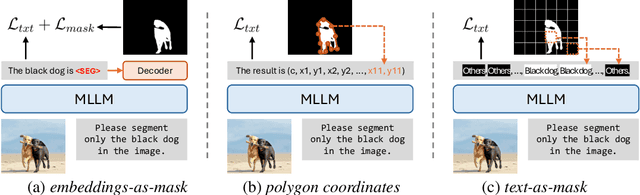
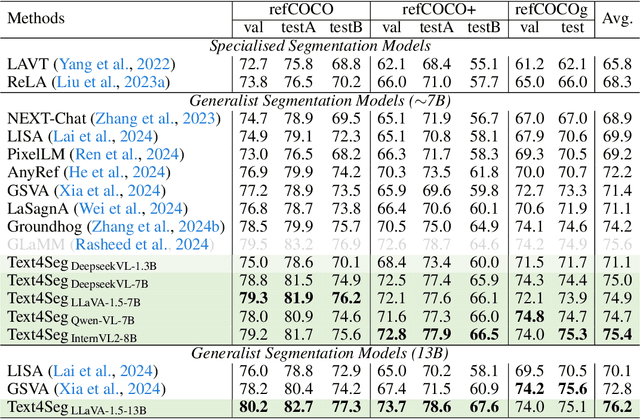
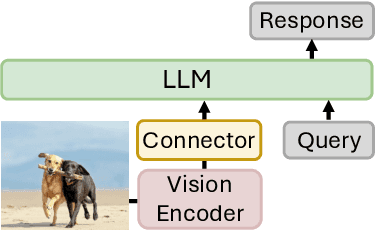
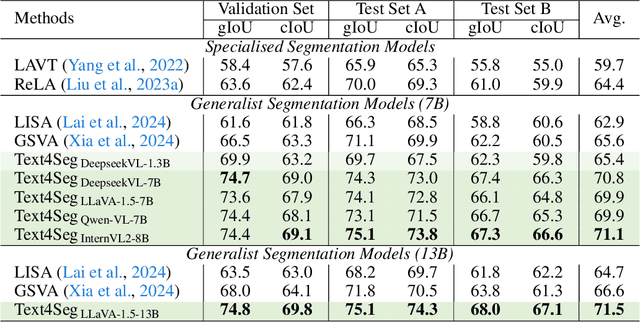
Multimodal Large Language Models (MLLMs) have shown exceptional capabilities in vision-language tasks; however, effectively integrating image segmentation into these models remains a significant challenge. In this paper, we introduce Text4Seg, a novel text-as-mask paradigm that casts image segmentation as a text generation problem, eliminating the need for additional decoders and significantly simplifying the segmentation process. Our key innovation is semantic descriptors, a new textual representation of segmentation masks where each image patch is mapped to its corresponding text label. This unified representation allows seamless integration into the auto-regressive training pipeline of MLLMs for easier optimization. We demonstrate that representing an image with $16\times16$ semantic descriptors yields competitive segmentation performance. To enhance efficiency, we introduce the Row-wise Run-Length Encoding (R-RLE), which compresses redundant text sequences, reducing the length of semantic descriptors by 74% and accelerating inference by $3\times$, without compromising performance. Extensive experiments across various vision tasks, such as referring expression segmentation and comprehension, show that Text4Seg achieves state-of-the-art performance on multiple datasets by fine-tuning different MLLM backbones. Our approach provides an efficient, scalable solution for vision-centric tasks within the MLLM framework.
ProxyCLIP: Proxy Attention Improves CLIP for Open-Vocabulary Segmentation
Aug 09, 2024Open-vocabulary semantic segmentation requires models to effectively integrate visual representations with open-vocabulary semantic labels. While Contrastive Language-Image Pre-training (CLIP) models shine in recognizing visual concepts from text, they often struggle with segment coherence due to their limited localization ability. In contrast, Vision Foundation Models (VFMs) excel at acquiring spatially consistent local visual representations, yet they fall short in semantic understanding. This paper introduces ProxyCLIP, an innovative framework designed to harmonize the strengths of both CLIP and VFMs, facilitating enhanced open-vocabulary semantic segmentation. ProxyCLIP leverages the spatial feature correspondence from VFMs as a form of proxy attention to augment CLIP, thereby inheriting the VFMs' robust local consistency and maintaining CLIP's exceptional zero-shot transfer capacity. We propose an adaptive normalization and masking strategy to get the proxy attention from VFMs, allowing for adaptation across different VFMs. Remarkably, as a training-free approach, ProxyCLIP significantly improves the average mean Intersection over Union (mIoU) across eight benchmarks from 40.3 to 44.4, showcasing its exceptional efficacy in bridging the gap between spatial precision and semantic richness for the open-vocabulary segmentation task.
ClearCLIP: Decomposing CLIP Representations for Dense Vision-Language Inference
Jul 17, 2024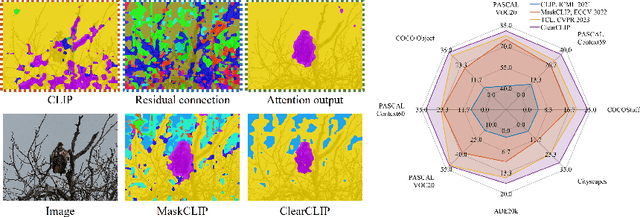
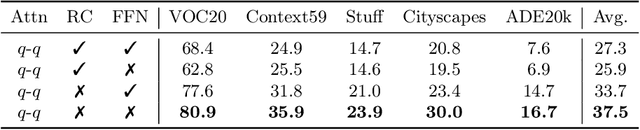
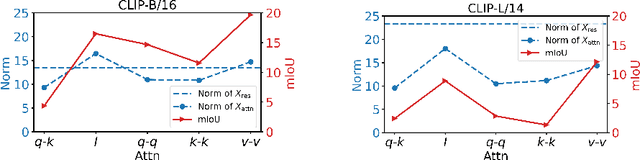
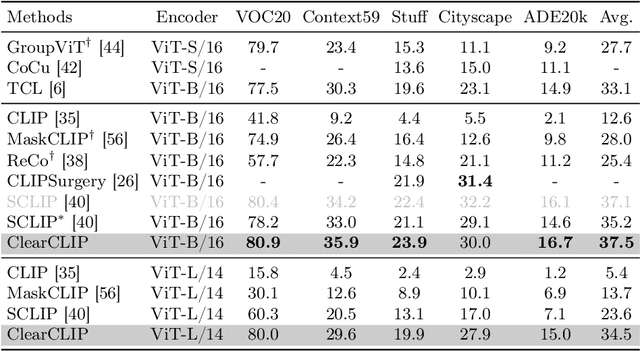
Despite the success of large-scale pretrained Vision-Language Models (VLMs) especially CLIP in various open-vocabulary tasks, their application to semantic segmentation remains challenging, producing noisy segmentation maps with mis-segmented regions. In this paper, we carefully re-investigate the architecture of CLIP, and identify residual connections as the primary source of noise that degrades segmentation quality. With a comparative analysis of statistical properties in the residual connection and the attention output across different pretrained models, we discover that CLIP's image-text contrastive training paradigm emphasizes global features at the expense of local discriminability, leading to noisy segmentation results. In response, we propose ClearCLIP, a novel approach that decomposes CLIP's representations to enhance open-vocabulary semantic segmentation. We introduce three simple modifications to the final layer: removing the residual connection, implementing the self-self attention, and discarding the feed-forward network. ClearCLIP consistently generates clearer and more accurate segmentation maps and outperforms existing approaches across multiple benchmarks, affirming the significance of our discoveries.
RelayAttention for Efficient Large Language Model Serving with Long System Prompts
Feb 29, 2024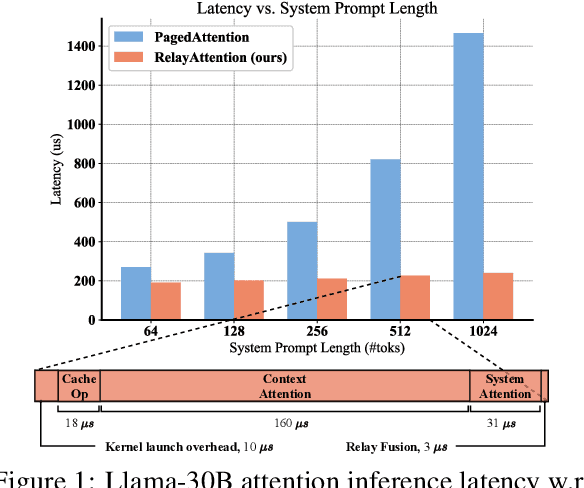


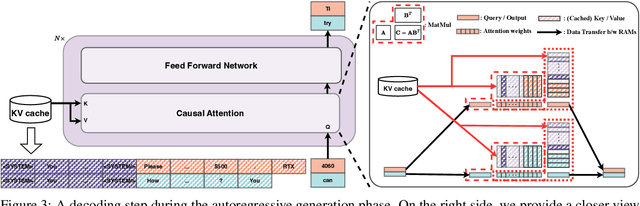
Practical large language model (LLM) services may involve a long system prompt, which specifies the instructions, examples, and knowledge documents of the task and is reused across numerous requests. However, the long system prompt causes throughput/latency bottlenecks as the cost of generating the next token grows w.r.t. the sequence length. This paper aims to improve the efficiency of LLM services that involve long system prompts. Our key observation is that handling these system prompts requires heavily redundant memory accesses in existing causal attention computation algorithms. Specifically, for batched requests, the cached hidden states (i.e., key-value pairs) of system prompts are transferred from off-chip DRAM to on-chip SRAM multiple times, each corresponding to an individual request. To eliminate such a redundancy, we propose RelayAttention, an attention algorithm that allows reading these hidden states from DRAM exactly once for a batch of input tokens. RelayAttention is a free lunch: it maintains the generation quality while requiring no model retraining, as it is based on a mathematical reformulation of causal attention. Code is available at \url{https://github.com/rayleizhu/vllm-ra}.