 Add to Chrome
 Add to Firefox
 Add to Edge
Differential Transformer
Oct 07, 2024
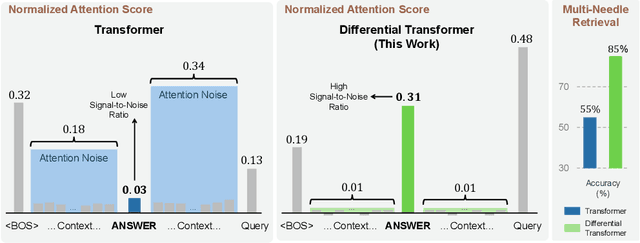

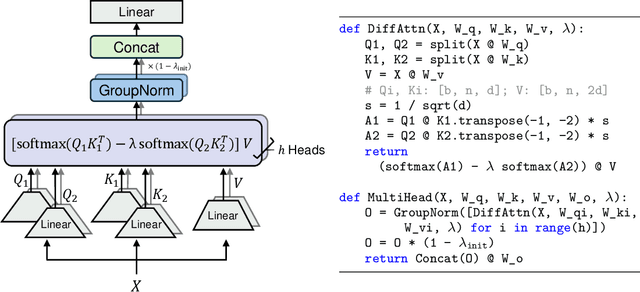
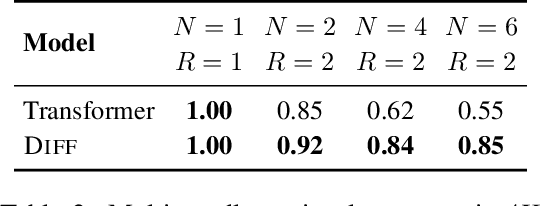
Transformer tends to overallocate attention to irrelevant context. In this work, we introduce Diff Transformer, which amplifies attention to the relevant context while canceling noise. Specifically, the differential attention mechanism calculates attention scores as the difference between two separate softmax attention maps. The subtraction cancels noise, promoting the emergence of sparse attention patterns. Experimental results on language modeling show that Diff Transformer outperforms Transformer in various settings of scaling up model size and training tokens. More intriguingly, it offers notable advantages in practical applications, such as long-context modeling, key information retrieval, hallucination mitigation, in-context learning, and reduction of activation outliers. By being less distracted by irrelevant context, Diff Transformer can mitigate hallucination in question answering and text summarization. For in-context learning, Diff Transformer not only enhances accuracy but is also more robust to order permutation, which was considered as a chronic robustness issue. The results position Diff Transformer as a highly effective and promising architecture to advance large language models.

Dynamic Diffusion Transformer
Oct 04, 2024Diffusion Transformer (DiT), an emerging diffusion model for image generation, has demonstrated superior performance but suffers from substantial computational costs. Our investigations reveal that these costs stem from the static inference paradigm, which inevitably introduces redundant computation in certain diffusion timesteps and spatial regions. To address this inefficiency, we propose Dynamic Diffusion Transformer (DyDiT), an architecture that dynamically adjusts its computation along both timestep and spatial dimensions during generation. Specifically, we introduce a Timestep-wise Dynamic Width (TDW) approach that adapts model width conditioned on the generation timesteps. In addition, we design a Spatial-wise Dynamic Token (SDT) strategy to avoid redundant computation at unnecessary spatial locations. Extensive experiments on various datasets and different-sized models verify the superiority of DyDiT. Notably, with <3% additional fine-tuning iterations, our method reduces the FLOPs of DiT-XL by 51%, accelerates generation by 1.73, and achieves a competitive FID score of 2.07 on ImageNet. The code is publicly available at https://github.com/NUS-HPC-AI-Lab/ Dynamic-Diffusion-Transformer.
Semantic Refocused Tuning for Open-Vocabulary Panoptic Segmentation
Sep 24, 2024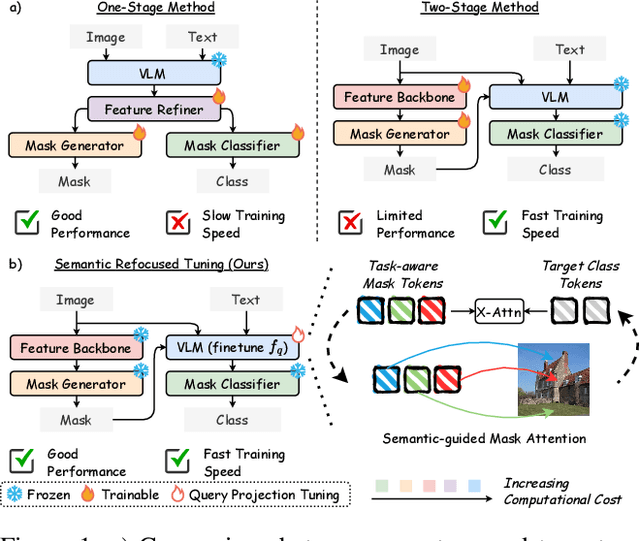

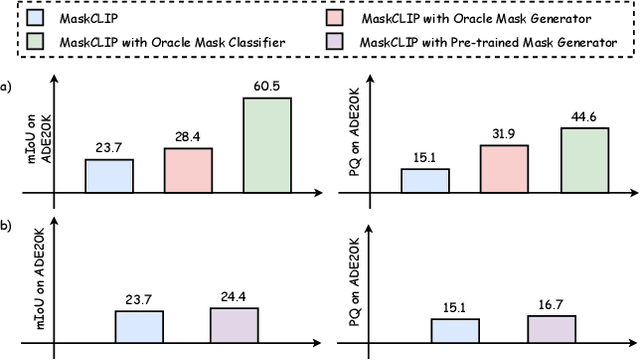

Open-vocabulary panoptic segmentation is an emerging task aiming to accurately segment the image into semantically meaningful masks based on a set of texts. Despite existing efforts, it remains challenging to develop a high-performing method that generalizes effectively across new domains and requires minimal training resources. Our in-depth analysis of current methods reveals a crucial insight: mask classification is the main performance bottleneck for open-vocab. panoptic segmentation. Based on this, we propose Semantic Refocused Tuning (SMART), a novel framework that greatly enhances open-vocab. panoptic segmentation by improving mask classification through two key innovations. First, SMART adopts a multimodal Semantic-guided Mask Attention mechanism that injects task-awareness into the regional information extraction process. This enables the model to capture task-specific and contextually relevant information for more effective mask classification. Second, it incorporates Query Projection Tuning, which strategically fine-tunes the query projection layers within the Vision Language Model (VLM) used for mask classification. This adjustment allows the model to adapt the image focus of mask tokens to new distributions with minimal training resources, while preserving the VLM's pre-trained knowledge. Extensive ablation studies confirm the superiority of our approach. Notably, SMART sets new state-of-the-art results, demonstrating improvements of up to +1.3 PQ and +5.4 mIoU across representative benchmarks, while reducing training costs by nearly 10x compared to the previous best method. Our code and data will be released.
OStr-DARTS: Differentiable Neural Architecture Search based on Operation Strength
Sep 22, 2024


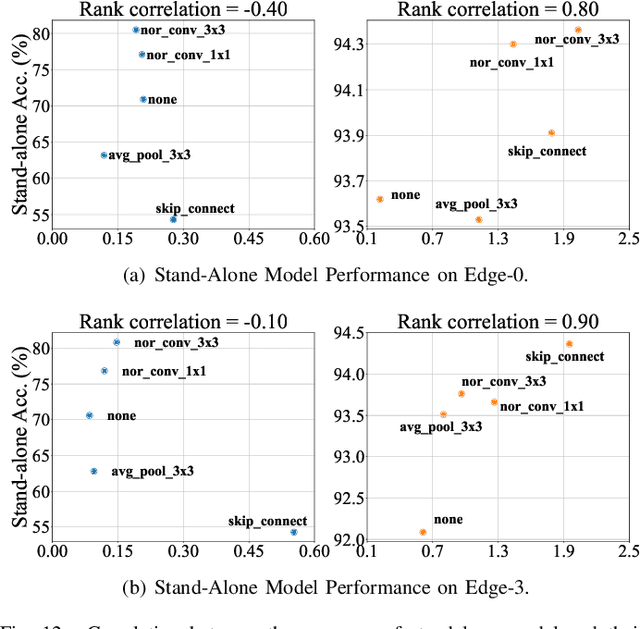
Differentiable architecture search (DARTS) has emerged as a promising technique for effective neural architecture search, and it mainly contains two steps to find the high-performance architecture: First, the DARTS supernet that consists of mixed operations will be optimized via gradient descent. Second, the final architecture will be built by the selected operations that contribute the most to the supernet. Although DARTS improves the efficiency of NAS, it suffers from the well-known degeneration issue which can lead to deteriorating architectures. Existing works mainly attribute the degeneration issue to the failure of its supernet optimization, while little attention has been paid to the selection method. In this paper, we cease to apply the widely-used magnitude-based selection method and propose a novel criterion based on operation strength that estimates the importance of an operation by its effect on the final loss. We show that the degeneration issue can be effectively addressed by using the proposed criterion without any modification of supernet optimization, indicating that the magnitude-based selection method can be a critical reason for the instability of DARTS. The experiments on NAS-Bench-201 and DARTS search spaces show the effectiveness of our method.
Multiple-Exit Tuning: Towards Inference-Efficient Adaptation for Vision Transformer
Sep 21, 2024Parameter-efficient transfer learning (PETL) has shown great potential in adapting a vision transformer (ViT) pre-trained on large-scale datasets to various downstream tasks. Existing studies primarily focus on minimizing the number of learnable parameters. Although these methods are storage-efficient, they allocate excessive computational resources to easy samples, leading to inefficient inference. To address this issue, we introduce an inference-efficient tuning method termed multiple-exit tuning (MET). MET integrates multiple exits into the pre-trained ViT backbone. Since the predictions in ViT are made by a linear classifier, each exit is equipped with a linear prediction head. In inference stage, easy samples will exit at early exits and only hard enough samples will flow to the last exit, thus saving the computational cost for easy samples. MET consists of exit-specific adapters (E-adapters) and graph regularization. E-adapters are designed to extract suitable representations for different exits. To ensure parameter efficiency, all E-adapters share the same down-projection and up-projection matrices. As the performances of linear classifiers are influenced by the relationship among samples, we employ graph regularization to improve the representations fed into the classifiers at early exits. Finally, we conduct extensive experiments to verify the performance of MET. Experimental results show that MET has an obvious advantage over the state-of-the-art methods in terms of both accuracy and inference efficiency.
AdaNAT: Exploring Adaptive Policy for Token-Based Image Generation
Aug 31, 2024
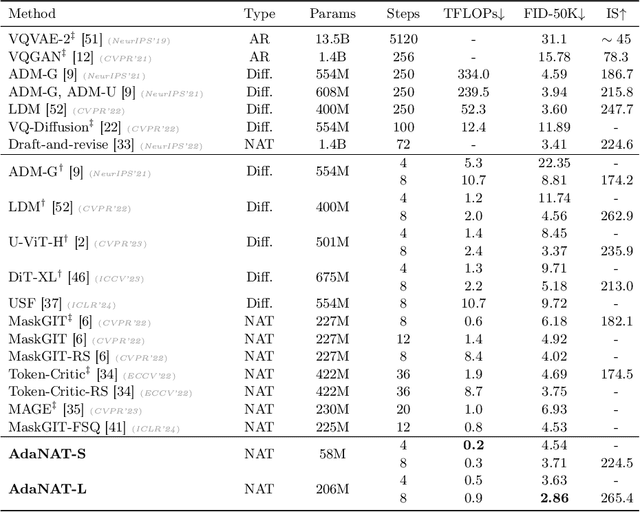


Recent studies have demonstrated the effectiveness of token-based methods for visual content generation. As a representative work, non-autoregressive Transformers (NATs) are able to synthesize images with decent quality in a small number of steps. However, NATs usually necessitate configuring a complicated generation policy comprising multiple manually-designed scheduling rules. These heuristic-driven rules are prone to sub-optimality and come with the requirements of expert knowledge and labor-intensive efforts. Moreover, their one-size-fits-all nature cannot flexibly adapt to the diverse characteristics of each individual sample. To address these issues, we propose AdaNAT, a learnable approach that automatically configures a suitable policy tailored for every sample to be generated. In specific, we formulate the determination of generation policies as a Markov decision process. Under this framework, a lightweight policy network for generation can be learned via reinforcement learning. Importantly, we demonstrate that simple reward designs such as FID or pre-trained reward models, may not reliably guarantee the desired quality or diversity of generated samples. Therefore, we propose an adversarial reward design to guide the training of policy networks effectively. Comprehensive experiments on four benchmark datasets, i.e., ImageNet-256 & 512, MS-COCO, and CC3M, validate the effectiveness of AdaNAT. Code and pre-trained models will be released at https://github.com/LeapLabTHU/AdaNAT.
Sequence-aware Pre-training for Echocardiography Probe Guidance
Aug 27, 2024Cardiac ultrasound probe guidance aims to help novices adjust the 6-DOF probe pose to obtain high-quality sectional images. Cardiac ultrasound faces two major challenges: (1) the inherently complex structure of the heart, and (2) significant individual variations. Previous works have only learned the population-averaged 2D and 3D structures of the heart rather than personalized cardiac structural features, leading to a performance bottleneck. Clinically, we observed that sonographers adjust their understanding of a patient's cardiac structure based on prior scanning sequences, thereby modifying their scanning strategies. Inspired by this, we propose a sequence-aware self-supervised pre-training method. Specifically, our approach learns personalized 2D and 3D cardiac structural features by predicting the masked-out images and actions in a scanning sequence. We hypothesize that if the model can predict the missing content it has acquired a good understanding of the personalized cardiac structure. In the downstream probe guidance task, we also introduced a sequence modeling approach that models individual cardiac structural information based on the images and actions from historical scan data, enabling more accurate navigation decisions. Experiments on a large-scale dataset with 1.36 million samples demonstrated that our proposed sequence-aware paradigm can significantly reduce navigation errors, with translation errors decreasing by 15.90% to 36.87% and rotation errors decreasing by 11.13% to 20.77%, compared to state-of-the-art methods.
Frequency-aware Feature Fusion for Dense Image Prediction
Aug 23, 2024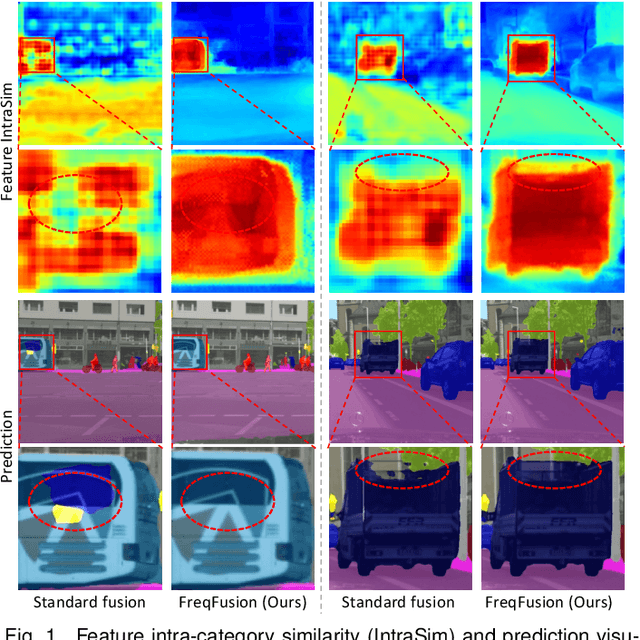
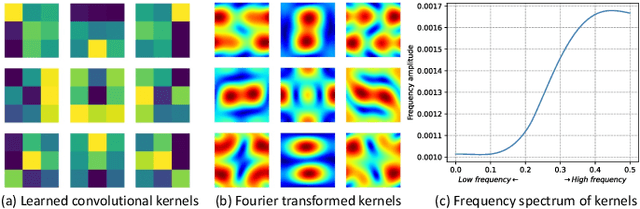

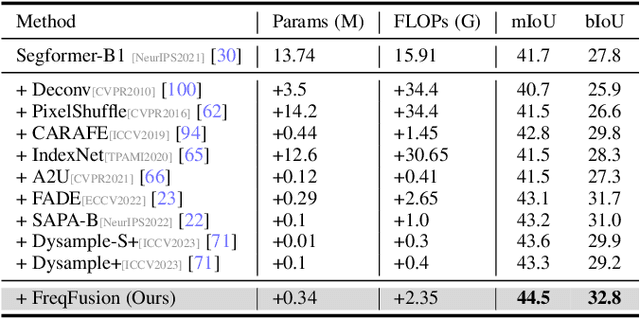
Dense image prediction tasks demand features with strong category information and precise spatial boundary details at high resolution. To achieve this, modern hierarchical models often utilize feature fusion, directly adding upsampled coarse features from deep layers and high-resolution features from lower levels. In this paper, we observe rapid variations in fused feature values within objects, resulting in intra-category inconsistency due to disturbed high-frequency features. Additionally, blurred boundaries in fused features lack accurate high frequency, leading to boundary displacement. Building upon these observations, we propose Frequency-Aware Feature Fusion (FreqFusion), integrating an Adaptive Low-Pass Filter (ALPF) generator, an offset generator, and an Adaptive High-Pass Filter (AHPF) generator. The ALPF generator predicts spatially-variant low-pass filters to attenuate high-frequency components within objects, reducing intra-class inconsistency during upsampling. The offset generator refines large inconsistent features and thin boundaries by replacing inconsistent features with more consistent ones through resampling, while the AHPF generator enhances high-frequency detailed boundary information lost during downsampling. Comprehensive visualization and quantitative analysis demonstrate that FreqFusion effectively improves feature consistency and sharpens object boundaries. Extensive experiments across various dense prediction tasks confirm its effectiveness. The code is made publicly available at https://github.com/Linwei-Chen/FreqFusion.
Toward Pedestrian Head Tracking: A Benchmark Dataset and an Information Fusion Network
Aug 12, 2024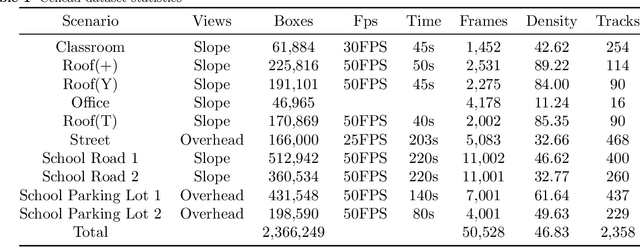
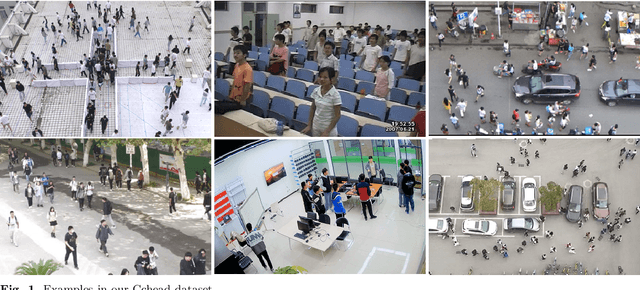
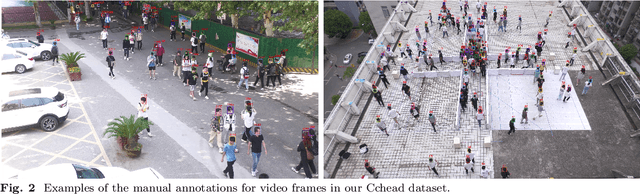

Pedestrian detection and tracking in crowded video sequences have a wide range of applications, including autonomous driving, robot navigation and pedestrian flow surveillance. However, detecting and tracking pedestrians in high-density crowds face many challenges, including intra-class occlusions, complex motions, and diverse poses. Although deep learning models have achieved remarkable progress in head detection, head tracking datasets and methods are extremely lacking. Existing head datasets have limited coverage of complex pedestrian flows and scenes (e.g., pedestrian interactions, occlusions, and object interference). It is of great importance to develop new head tracking datasets and methods. To address these challenges, we present a Chinese Large-scale Cross-scene Pedestrian Head Tracking dataset (Cchead) and a Multi-Source Information Fusion Network (MIFN). Our dataset has features that are of considerable interest, including 10 diverse scenes of 50,528 frames with over 2,366,249 heads and 2,358 tracks annotated. Our dataset contains diverse human moving speeds, directions, and complex crowd pedestrian flows with collision avoidance behaviors. We provide a comprehensive analysis and comparison with existing state-of-the-art (SOTA) algorithms. Moreover, our MIFN is the first end-to-end CNN-based head detection and tracking network that jointly trains RGB frames, pixel-level motion information (optical flow and frame difference maps), depth maps, and density maps in videos. Compared with SOTA pedestrian detection and tracking methods, MIFN achieves superior performance on our Cchead dataset. We believe our datasets and baseline will become valuable resources towards developing pedestrian tracking in dense crowds.
Efficient Diffusion Transformer with Step-wise Dynamic Attention Mediators
Aug 11, 2024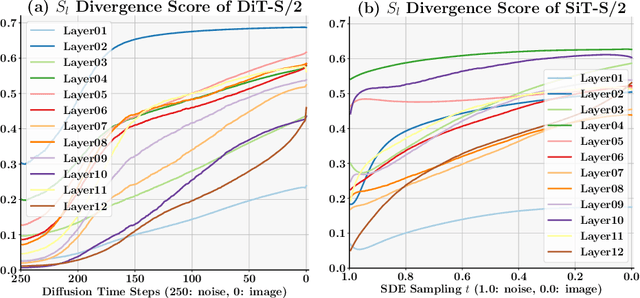
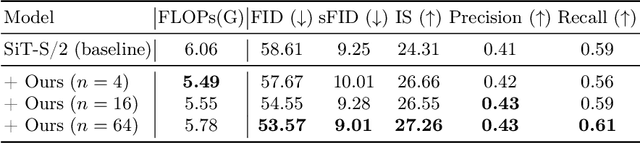
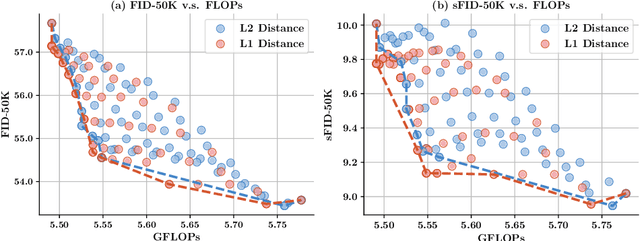
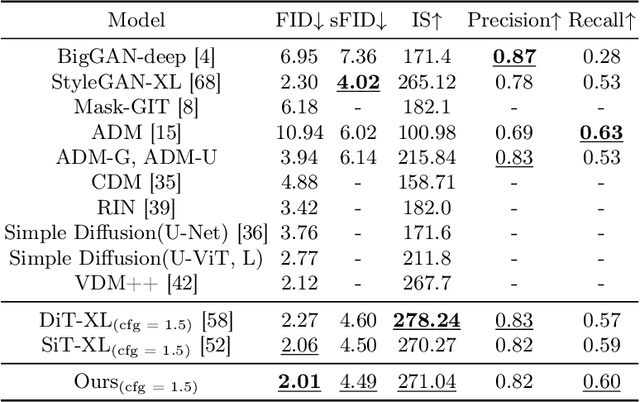
This paper identifies significant redundancy in the query-key interactions within self-attention mechanisms of diffusion transformer models, particularly during the early stages of denoising diffusion steps. In response to this observation, we present a novel diffusion transformer framework incorporating an additional set of mediator tokens to engage with queries and keys separately. By modulating the number of mediator tokens during the denoising generation phases, our model initiates the denoising process with a precise, non-ambiguous stage and gradually transitions to a phase enriched with detail. Concurrently, integrating mediator tokens simplifies the attention module's complexity to a linear scale, enhancing the efficiency of global attention processes. Additionally, we propose a time-step dynamic mediator token adjustment mechanism that further decreases the required computational FLOPs for generation, simultaneously facilitating the generation of high-quality images within the constraints of varied inference budgets. Extensive experiments demonstrate that the proposed method can improve the generated image quality while also reducing the inference cost of diffusion transformers. When integrated with the recent work SiT, our method achieves a state-of-the-art FID score of 2.01. The source code is available at https://github.com/LeapLabTHU/Attention-Mediators.