 Add to Chrome
 Add to Firefox
 Add to Edge
Diagram-MMU: A Multi-Modal Benchmark for Scientific Diagrams
Aug 12, 2026
Multimodal Large Language Models (MLLMs) have been growing the capability for scientific writing and collaboration. For example, OpenAI Prism is a free workspace for scientific writing and collaboration. One important feature in Prism is turning scientific diagrams directly into LaTeX TikZ code. In this paper, we build a benchmark, Diagram-MMU, a multi-modal benchmark designed to assess MLLMs' ability for scientific diagram parsing and understanding. Diagram-MMU features 3.7k curated diagrams and 18.3k human-validated questions across six domains. It evaluates MLLMs on three tasks common in vibe writing workspaces: diagram-to-code parsing, diagram-to-code editing, and diagram question answering, alongside agentic settings per task. The evaluation of 12 MLLMs reveals that diagram-to-code tasks are more challenging than diagram question answering: models can reason well over diagrams but struggle to parse and edit them, underscoring the need for methods to enhance MLLMs' capability in diagram-to-code generation. Under agentic settings, most models improve parsing and editing performance but degrade on question answering, while Claude-4.6 Opus consistently improves across all three tasks. Project Page: https://vi-ocean.github.io/projects/diagram-mmu.

V-FIND: Revealing the Intrinsic Forgery Knowledge Encoded in Video Forgery Detectors
Aug 04, 2026As generated videos become increasingly realistic, reliable video forgery detection is increasingly important. Existing studies typically optimize and use video forgery detectors as black boxes, while the latent forgery-discriminative knowledge inside them remains largely unexplored. Instead of continuing to rely on resource-intensive full-model retraining to steadily improve detection performance, we ask whether video forgery detection can also be achieved by uncovering and activating sparse forensic knowledge within the detector. We find that forgery-discriminative knowledge is not uniformly distributed across the full representation space, but is concentrated in a sparse set of functionally specialized neurons. Based on this insight, we propose a video forgery-intrinsic neuron discovery (V-FIND) framework. V-FIND first localizes critical layers that exhibit pronounced discrepancies between real and forged videos, and then identifies latent anchor neurons that consistently carry forgery-discriminative signals, organizing them into a compact forensic subspace. With the original backbone frozen and only a lightweight linear classifier trained, this subspace still delivers strong detection performance across multiple external benchmarks for generated videos. Further neuron intervention experiments provide direct evidence for the functional specificity of the discovered neurons. Overall, these results suggest that video forgery detectors contain sparse, extractable, and reusable forgery-discriminative knowledge, offering a new perspective on understanding and exploiting their intrinsic forensic capability.
SSP-SAM: SAM with Semantic-Spatial Prompt for Referring Expression Segmentation
Mar 18, 2026The Segment Anything Model (SAM) excels at general image segmentation but has limited ability to understand natural language, which restricts its direct application in Referring Expression Segmentation (RES). Toward this end, we propose SSP-SAM, a framework that fully utilizes SAM's segmentation capabilities by integrating a Semantic-Spatial Prompt (SSP) encoder. Specifically, we incorporate both visual and linguistic attention adapters into the SSP encoder, which highlight salient objects within the visual features and discriminative phrases within the linguistic features. This design enhances the referent representation for the prompt generator, resulting in high-quality SSPs that enable SAM to generate precise masks guided by language. Although not specifically designed for Generalized RES (GRES), where the referent may correspond to zero, one, or multiple objects, SSP-SAM naturally supports this more flexible setting without additional modifications. Extensive experiments on widely used RES and GRES benchmarks confirm the superiority of our method. Notably, our approach generates segmentation masks of high quality, achieving strong precision even at strict thresholds such as Pr@0.9. Further evaluation on the PhraseCut dataset demonstrates improved performance in open-vocabulary scenarios compared to existing state-of-the-art RES methods. The code and checkpoints are available at: https://github.com/WayneTomas/SSP-SAM.
Towards Better Dental AI: A Multimodal Benchmark and Instruction Dataset for Panoramic X-ray Analysis
Sep 11, 2025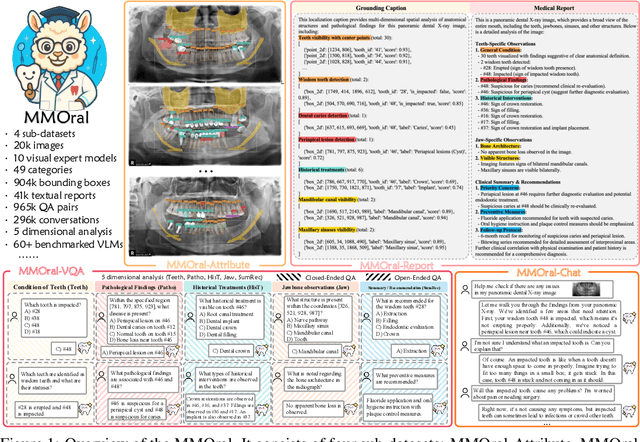
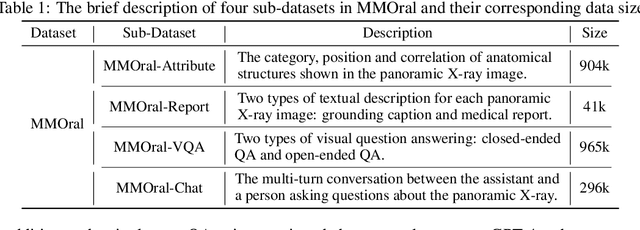
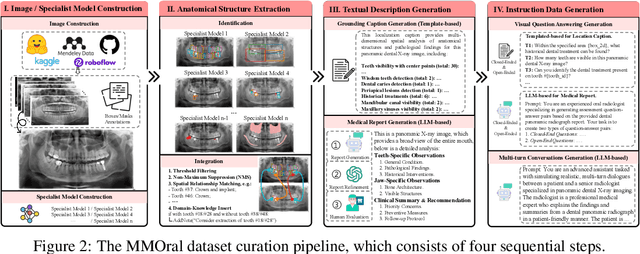
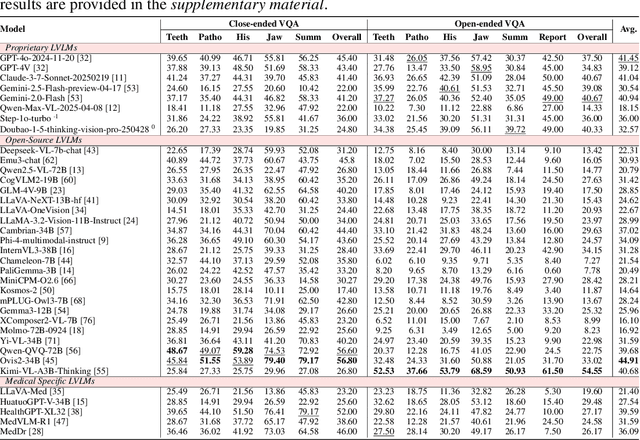
Recent advances in large vision-language models (LVLMs) have demonstrated strong performance on general-purpose medical tasks. However, their effectiveness in specialized domains such as dentistry remains underexplored. In particular, panoramic X-rays, a widely used imaging modality in oral radiology, pose interpretative challenges due to dense anatomical structures and subtle pathological cues, which are not captured by existing medical benchmarks or instruction datasets. To this end, we introduce MMOral, the first large-scale multimodal instruction dataset and benchmark tailored for panoramic X-ray interpretation. MMOral consists of 20,563 annotated images paired with 1.3 million instruction-following instances across diverse task types, including attribute extraction, report generation, visual question answering, and image-grounded dialogue. In addition, we present MMOral-Bench, a comprehensive evaluation suite covering five key diagnostic dimensions in dentistry. We evaluate 64 LVLMs on MMOral-Bench and find that even the best-performing model, i.e., GPT-4o, only achieves 41.45% accuracy, revealing significant limitations of current models in this domain. To promote the progress of this specific domain, we also propose OralGPT, which conducts supervised fine-tuning (SFT) upon Qwen2.5-VL-7B with our meticulously curated MMOral instruction dataset. Remarkably, a single epoch of SFT yields substantial performance enhancements for LVLMs, e.g., OralGPT demonstrates a 24.73% improvement. Both MMOral and OralGPT hold significant potential as a critical foundation for intelligent dentistry and enable more clinically impactful multimodal AI systems in the dental field. The dataset, model, benchmark, and evaluation suite are available at https://github.com/isbrycee/OralGPT.
DeRIS: Decoupling Perception and Cognition for Enhanced Referring Image Segmentation through Loopback Synergy
Jul 02, 2025Referring Image Segmentation (RIS) is a challenging task that aims to segment objects in an image based on natural language expressions. While prior studies have predominantly concentrated on improving vision-language interactions and achieving fine-grained localization, a systematic analysis of the fundamental bottlenecks in existing RIS frameworks remains underexplored. To bridge this gap, we propose DeRIS, a novel framework that decomposes RIS into two key components: perception and cognition. This modular decomposition facilitates a systematic analysis of the primary bottlenecks impeding RIS performance. Our findings reveal that the predominant limitation lies not in perceptual deficiencies, but in the insufficient multi-modal cognitive capacity of current models. To mitigate this, we propose a Loopback Synergy mechanism, which enhances the synergy between the perception and cognition modules, thereby enabling precise segmentation while simultaneously improving robust image-text comprehension. Additionally, we analyze and introduce a simple non-referent sample conversion data augmentation to address the long-tail distribution issue related to target existence judgement in general scenarios. Notably, DeRIS demonstrates inherent adaptability to both non- and multi-referents scenarios without requiring specialized architectural modifications, enhancing its general applicability. The codes and models are available at https://github.com/Dmmm1997/DeRIS.
MATHGLANCE: Multimodal Large Language Models Do Not Know Where to Look in Mathematical Diagrams
Mar 26, 2025Diagrams serve as a fundamental form of visual language, representing complex concepts and their inter-relationships through structured symbols, shapes, and spatial arrangements. Unlike natural images, their inherently symbolic and abstract nature poses significant challenges for Multimodal Large Language Models (MLLMs). However, current benchmarks conflate perceptual and reasoning tasks, making it difficult to assess whether MLLMs genuinely understand mathematical diagrams beyond superficial pattern recognition. To address this gap, we introduce MATHGLANCE, a benchmark specifically designed to isolate and evaluate mathematical perception in MLLMs. MATHGLANCE comprises 1.2K images and 1.6K carefully curated questions spanning four perception tasks: shape classification, object counting, relationship identification, and object grounding, covering diverse domains including plane geometry, solid geometry, and graphical representations. Our evaluation of MLLMs reveals that their ability to understand diagrams is notably limited, particularly in fine-grained grounding tasks. In response, we construct GeoPeP, a perception-oriented dataset of 200K structured geometry image-text pairs explicitly annotated with geometric primitives and precise spatial relationships. Training MLLM on GeoPeP leads to significant gains in perceptual accuracy, which in turn substantially improves mathematical reasoning. Our benchmark and dataset establish critical standards for evaluating and advancing multimodal mathematical understanding, providing valuable resources and insights to foster future MLLM research.
Visual Position Prompt for MLLM based Visual Grounding
Mar 19, 2025
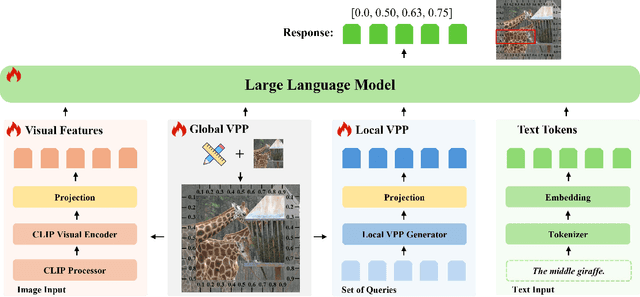
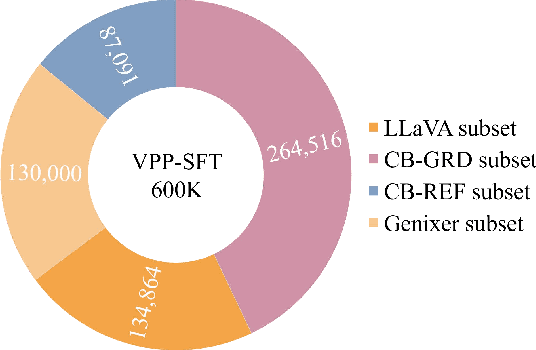
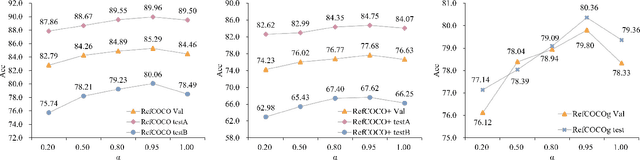
Although Multimodal Large Language Models (MLLMs) excel at various image-related tasks, they encounter challenges in precisely aligning coordinates with spatial information within images, particularly in position-aware tasks such as visual grounding. This limitation arises from two key factors. First, MLLMs lack explicit spatial references, making it difficult to associate textual descriptions with precise image locations. Second, their feature extraction processes prioritize global context over fine-grained spatial details, leading to weak localization capability. To address this issue, we introduce VPP-LLaVA, an MLLM equipped with Visual Position Prompt (VPP) to improve its grounding capability. VPP-LLaVA integrates two complementary mechanisms. The global VPP overlays learnable, axis-like embeddings onto the input image to provide structured spatial cues. The local VPP focuses on fine-grained localization by incorporating position-aware queries, which suggests probable object locations. We also introduce a VPP-SFT dataset with 0.6M samples, consolidating high-quality visual grounding data into a compact format for efficient model training. Training on this dataset with VPP enhances the model's performance, achieving state-of-the-art results on standard grounding benchmarks despite using fewer training samples compared to other MLLMs like MiniGPT-v2, which rely on much larger datasets ($\sim$21M samples). The code and VPP-SFT dataset will be available at https://github.com/WayneTomas/VPP-LLaVA upon acceptance.
Open Eyes, Then Reason: Fine-grained Visual Mathematical Understanding in MLLMs
Jan 11, 2025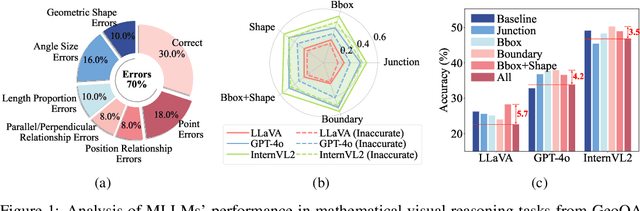
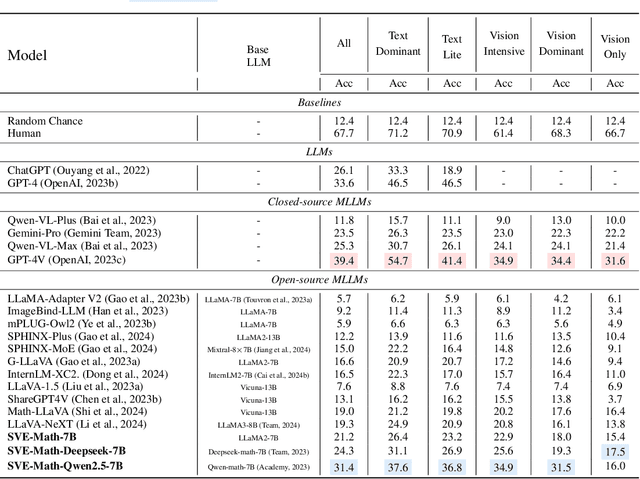
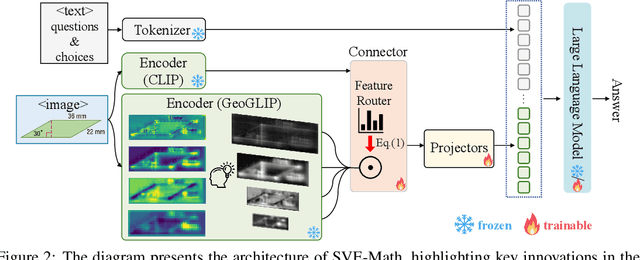
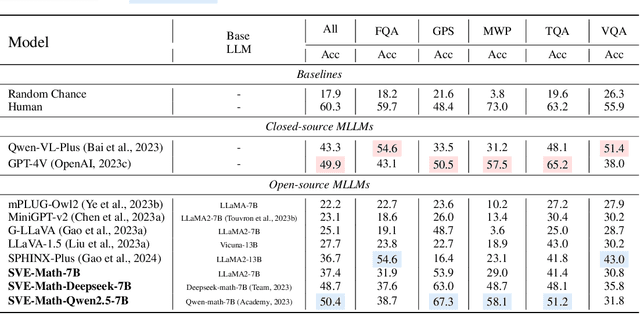
Current multimodal large language models (MLLMs) often underperform on mathematical problem-solving tasks that require fine-grained visual understanding. The limitation is largely attributable to inadequate perception of geometric primitives during image-level contrastive pre-training (e.g., CLIP). While recent efforts to improve math MLLMs have focused on scaling up mathematical visual instruction datasets and employing stronger LLM backbones, they often overlook persistent errors in visual recognition. In this paper, we systematically evaluate the visual grounding capabilities of state-of-the-art MLLMs and reveal a significant negative correlation between visual grounding accuracy and problem-solving performance, underscoring the critical role of fine-grained visual understanding. Notably, advanced models like GPT-4o exhibit a 70% error rate when identifying geometric entities, highlighting that this remains a key bottleneck in visual mathematical reasoning. To address this, we propose a novel approach, SVE-Math (Selective Vision-Enhanced Mathematical MLLM), featuring a geometric-grounded vision encoder and a feature router that dynamically adjusts the contribution of hierarchical visual feature maps. Our model recognizes accurate visual primitives and generates precise visual prompts tailored to the language model's reasoning needs. In experiments, SVE-Math-Qwen2.5-7B outperforms other 7B models by 15% on MathVerse and is compatible with GPT-4V on MathVista. Despite being trained on smaller datasets, SVE-Math-7B achieves competitive performance on GeoQA, rivaling models trained on significantly larger datasets. Our findings emphasize the importance of incorporating fine-grained visual understanding into MLLMs and provide a promising direction for future research.
Descriptive Caption Enhancement with Visual Specialists for Multimodal Perception
Dec 18, 2024


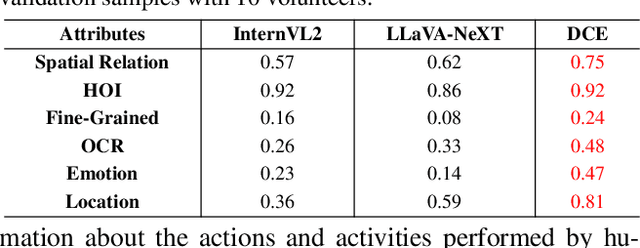
Training Large Multimodality Models (LMMs) relies on descriptive image caption that connects image and language. Existing methods either distill the caption from the LMM models or construct the captions from the internet images or by human. We propose to leverage off-the-shelf visual specialists, which were trained from annotated images initially not for image captioning, for enhancing the image caption. Our approach, named DCE, explores object low-level and fine-grained attributes (e.g., depth, emotion and fine-grained categories) and object relations (e.g., relative location and human-object-interaction (HOI)), and combine the attributes into the descriptive caption. Experiments demonstrate that such visual specialists are able to improve the performance for visual understanding tasks as well as reasoning that benefits from more accurate visual understanding. We will release the source code and the pipeline so that other visual specialists are easily combined into the pipeline. The complete source code of DCE pipeline and datasets will be available at \url{https://github.com/syp2ysy/DCE}.
Continual SFT Matches Multimodal RLHF with Negative Supervision
Nov 22, 2024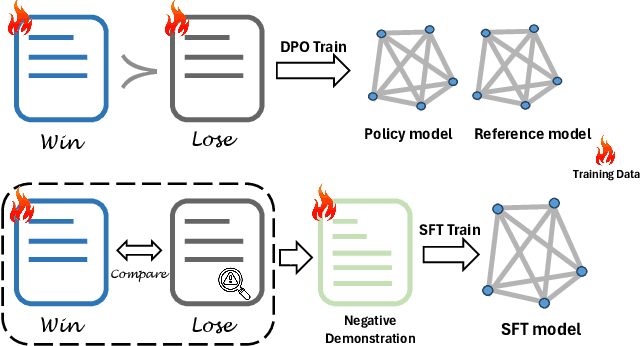

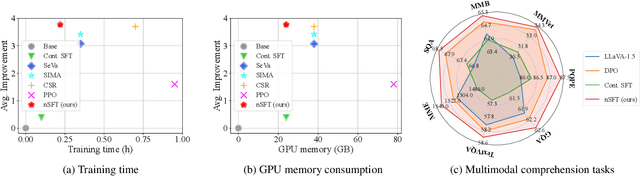

Multimodal RLHF usually happens after supervised finetuning (SFT) stage to continually improve vision-language models' (VLMs) comprehension. Conventional wisdom holds its superiority over continual SFT during this preference alignment stage. In this paper, we observe that the inherent value of multimodal RLHF lies in its negative supervision, the logit of the rejected responses. We thus propose a novel negative supervised finetuning (nSFT) approach that fully excavates these information resided. Our nSFT disentangles this negative supervision in RLHF paradigm, and continually aligns VLMs with a simple SFT loss. This is more memory efficient than multimodal RLHF where 2 (e.g., DPO) or 4 (e.g., PPO) large VLMs are strictly required. The effectiveness of nSFT is rigorously proved by comparing it with various multimodal RLHF approaches, across different dataset sources, base VLMs and evaluation metrics. Besides, fruitful of ablations are provided to support our hypothesis. We hope this paper will stimulate further research to properly align large vision language models.